



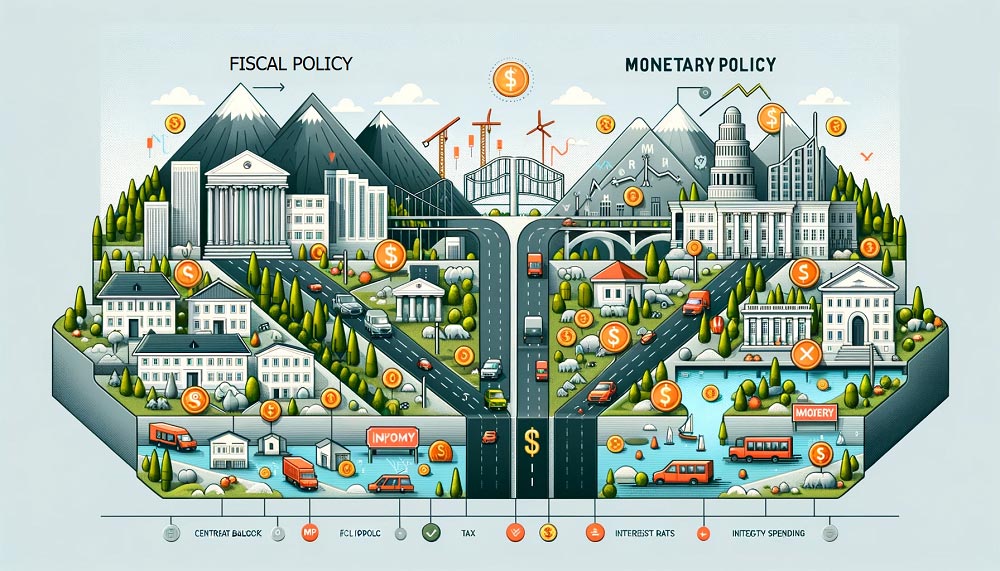
Fiscal policy and monetary policy are the two main levers used to stabilize an economy and influence growth, inflation, and employment. They often work toward similar macro goals, but they operate through different institutions, tools, and transmission channels. Understanding the difference matters because the “right” policy response depends on whether a problem is demand-driven, supply-driven, financial, or structural.
What is fiscal policy?
Fiscal policy refers to how a government uses:
-
public spending (government consumption and investment)
-
taxation (rates, bases, exemptions)
-
public borrowing and debt management
The purpose is to influence overall demand, support public services and investment, and manage distributional outcomes. Fiscal policy decisions are typically made through political and legislative processes, and they can directly target sectors (infrastructure, health, education, social protection) or groups (households, businesses, regions).
What is monetary policy?
Monetary policy is conducted by the central bank to influence financial conditions—primarily inflation and overall economic stability—by managing interest rates, liquidity, and credit conditions. In most modern frameworks, central banks aim to keep inflation stable over time while smoothing the business cycle.
For the institutional role and transmission mechanism, see the explainer on the central bank’s impact on national economies.
Core objectives: where they overlap and where they differ
Both policies can influence growth and employment, but their primary focus is often different.
Fiscal policy objectives
-
support economic activity during downturns (stimulus)
-
cool excess demand during overheating (contraction)
-
finance public goods and long-term development (infrastructure, human capital)
-
reduce inequality through taxes and transfers
-
respond to shocks (disasters, pandemics, war-related disruptions)
Monetary policy objectives
-
maintain price stability (inflation control)
-
stabilize output around potential over the business cycle
-
support financial stability through liquidity management
-
influence exchange rate pressures indirectly (especially in open economies)
Inflation is the most common trigger for tight monetary policy. If you need the background, see inflation: causes and economic impact.
Main tools used by each policy
Fiscal policy tools
-
government spending changes
capital spending (infrastructure) and current spending (operations, wages, transfers) -
tax changes
personal income tax, corporate tax, VAT/sales tax, excise, customs duties -
transfers and subsidies
social assistance, unemployment benefits, targeted support -
borrowing and debt strategy
issuance of bonds, maturity structure, refinancing plans
Monetary policy tools
-
policy interest rate
the benchmark short-term rate that guides broader market rates -
open market operations
buying/selling securities to manage liquidity and keep short-term rates near target -
reserve requirements and liquidity facilities
rules and lending windows that influence bank credit creation and funding stress
Money supply is often discussed as a channel or indicator rather than a single “control knob.” For a clearer explanation, see can money supply affect interest rate policy?.
How each policy affects the economy
Fiscal policy transmission
Fiscal policy acts directly through demand:
-
spending increases raise aggregate demand immediately (especially transfers and consumption spending)
-
tax cuts increase disposable income and may raise private spending
-
public investment can lift demand now and productivity later, depending on project quality
Fiscal policy can also reshape the economy structurally by changing incentives, access to services, and public infrastructure.
Monetary policy transmission
Monetary policy works mainly through financial conditions:
-
interest rate changes affect borrowing costs, saving incentives, and investment viability
-
tighter policy can slow credit and reduce inflation pressures
-
easier policy can support spending and investment when inflation is under control
The growth channel is often discussed through interest-rate effects on investment and consumption. For more detail, see how interest rates impact economic growth.
Timing and effectiveness
Policy effectiveness depends heavily on timing lags and real-world constraints.
Fiscal policy timing
-
decision and implementation can be slow due to legislative processes
-
targeted programs may take time to reach households or start projects
-
multipliers vary depending on leakages (imports), capacity constraints, and how funds are spent
Monetary policy timing
-
central banks can act quickly (rate decisions and liquidity operations)
-
effects on inflation and real activity often arrive with a lag
-
transmission can weaken if banks are risk-averse or credit channels are impaired
Advantages and limitations
Fiscal policy: strengths and limits
Strengths:
-
can be targeted (sectors, regions, vulnerable groups)
-
can directly address distribution and welfare outcomes
-
public investment can support long-term capacity
Limitations:
-
may increase deficits and debt if poorly designed or sustained too long
-
political cycles can distort priorities
-
inflation risk rises if demand is boosted beyond supply capacity
Monetary policy: strengths and limits
Strengths:
-
faster to adjust than fiscal policy
-
strong tool for stabilizing inflation expectations in many systems
-
can help stabilize financial markets via liquidity support
Limitations:
-
impacts are indirect and depend on banking/financial transmission
-
less precise targeting (can’t easily direct benefits to specific sectors or groups)
-
may face constraints at very low interest rates or in weak credit environments
How fiscal and monetary policy work together
In practice, outcomes depend on coordination (or conflict) between the two:
-
expansionary fiscal policy combined with tight monetary policy can reduce its growth impact and raise borrowing costs
-
tight fiscal policy combined with easy monetary policy may stabilize inflation but can still leave demand weak
-
in crises, both may be expansionary initially, followed by normalization when inflation or debt risks rise
The key is diagnosis: whether the dominant problem is weak demand, supply constraints, inflation expectations, financial instability, or long-term productivity.
Conclusion
Fiscal policy and monetary policy are different tools with different operators:
-
fiscal policy is run by government using spending, taxes, and borrowing
-
monetary policy is run by the central bank using interest rates and liquidity tools
Both can influence growth, employment, and inflation, but they do so through distinct channels, with different time lags and constraints. Understanding those differences is essential for evaluating policy debates and interpreting economic conditions.
Disclaimer: This article is for general information only. It is not financial, legal, or investment advice.





Comments 0
No comments yet. Be the first to start the conversation.