



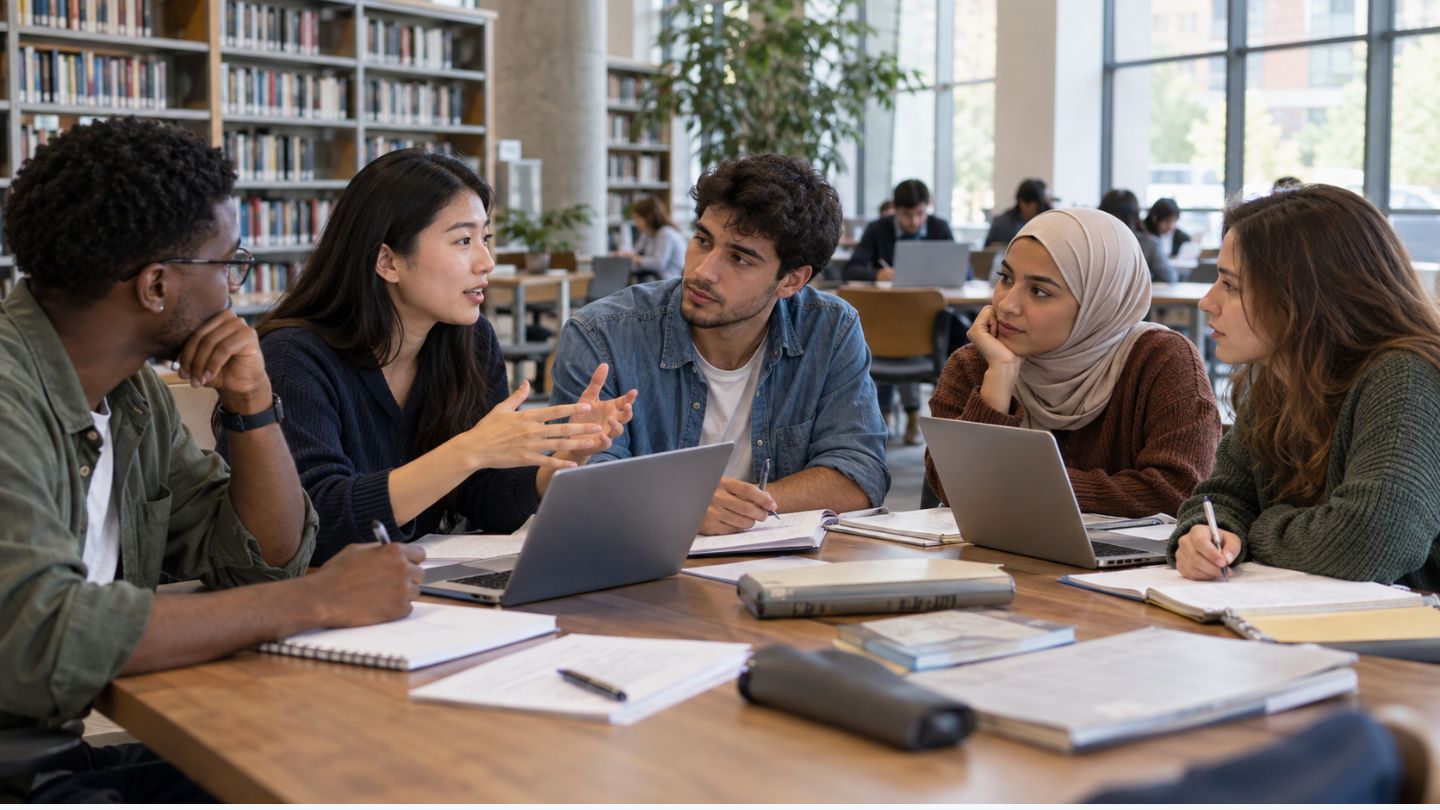
College can support personal growth by giving students repeated opportunities to make decisions, take responsibility, work with different people, respond to feedback, test ideas, and reflect on their values and goals. These experiences may strengthen independence, self-awareness, critical thinking, communication, resilience, confidence, empathy, time management, and self-advocacy.
For global readers, “college” is used here as a broad term for postsecondary or higher education. Personal development does not depend on living on a residential campus. Commuter students, online learners, adult students, international students, and students living with family may develop through different forms of study, work, relationships, and responsibility. This inclusive framing reflects the scope of the research used for this article.
Personal growth should not be treated as an automatic effect of enrollment. Students differ in their responsibilities, support systems, cultures, finances, previous experiences, learning environments, and access to activities. What matters is not simply attending college but how students engage with coursework, relationships, responsibilities, feedback, and opportunities.
Answer Summary: College can help with personal growth by creating repeated chances to practise independence, decision-making, communication, critical thinking, responsibility, self-advocacy, and resilience. Growth is more likely when students take part in meaningful learning, build supportive relationships, seek feedback, reflect on experience, and use available opportunities. The form of growth differs across residential, commuter, online, adult, and international student settings.
Key Takeaways:
- College can create conditions for personal development, but enrollment alone does not produce it.
- Independence can grow through responsibility even when a student lives at home.
- Academic work can strengthen reasoning, judgment, and decision-making.
- Group work, mentoring, and shared projects can develop communication and collaboration.
- Feedback and manageable difficulty may support resilience when suitable help is available.
- Online, commuter, adult, and international students may grow through different experiences.
- Reflection helps turn experience into learning.
How Can College Support Personal Growth?
College can support personal growth through a cycle of experience, practice, feedback, and reflection. Academic demands, social situations, responsibilities, and decisions give students opportunities to develop abilities that extend beyond subject knowledge.
The National Survey of Student Engagement (NSSE) examines how undergraduate students participate in activities connected with learning and personal development. Its research synthesis covers classroom engagement, collaborative learning, interaction, internships, research with faculty, service-learning, learning communities, study abroad, and senior projects. NSSE reports associations between such educational experiences and stronger engagement, deeper learning, and greater perceived gains in learning and personal development. Its evidence base is concentrated in the United States and Canada, with participation from institutions elsewhere, so these findings should not be presented as one universal global pattern.
The short answer
The growth mechanism is less about the label “college” and more about what students repeatedly practise.
| College experience | What the student practises | Possible area of growth |
|---|---|---|
| Managing classes and responsibilities | Planning, prioritising, seeking help | Independence and responsibility |
| Working with evidence and competing views | Analysis, judgment, explanation | Critical thinking |
| Group projects and discussions | Listening, communication, conflict handling | Relationship skills |
| Feedback and unfamiliar tasks | Adjustment, persistence, reflection | Resilience and confidence |
| Projects, research, service, or internships | Initiative, coordination, accountability | Leadership and self-advocacy |
| Contact with different ideas and experiences | Curiosity, perspective-taking, reflection | Self-awareness and empathy |
Why personal growth is not automatic
Personal development depends on engagement and context. Students at the same institution may have different experiences because they take different courses, build different relationships, participate in different activities, or balance college with work and family responsibilities.
NSSE also notes substantial variation in engagement among students within the same institution. This supports an important distinction: the educational environment matters, but what a student experiences and does within that environment matters too.
Growth can also be uneven. A student may become more confident academically while still finding group communication difficult. Another may build strong self-management through employment and commuting while having limited time for student organizations.
1. College Can Strengthen Independence and Responsibility
College can strengthen independence by placing more decisions and responsibilities in the student's hands. These may include managing deadlines, setting priorities, contacting instructors, handling administrative tasks, and deciding when support is needed.
Independence does not mean solving every problem alone. It includes recognizing when a task can be handled personally and when information, feedback, or assistance is needed.
Living arrangements do not define independence either. A student living away from home may manage meals, transport, schedules, and household tasks. A commuter living with family may develop similar capacities through travel planning, coursework, employment, family responsibilities, and decisions about limited time.
Academic responsibility also provides practice. Students may need to interpret assignment requirements, prepare over longer periods, track several deadlines, and communicate when expectations are unclear.
For broader context on academic, social, and practical student experiences, see College Life.
2. College Can Deepen Self-Awareness and Identity
College can deepen self-awareness by exposing students to subjects, communities, feedback, responsibilities, and possible roles that challenge earlier assumptions about themselves.
A student may begin with one academic interest and discover another through coursework. Someone who rarely speaks in groups may learn that preparation helps them communicate effectively. Another student may discover strengths in research, writing, organization, creative work, or coordination after taking responsibility for a project.
Self-awareness also comes from noticing patterns. Which tasks hold your attention? What feedback appears repeatedly? Which values guide difficult decisions? What environments help you work effectively? Which responsibilities feel meaningful?
UC Davis New Student Programs describes first-year development across academic, identity, social, resilience, and confidence domains. This offers a current institutional example of how personal development may appear during college, without implying that each student follows the same path.
Identity development may also come through employment, friendship groups, research, volunteering, cultural communities, mentoring, or family responsibilities. College provides contexts for reflection; students interpret those experiences in different ways.
3. College Can Improve Critical Thinking and Decision-Making
College can improve critical thinking when students compare evidence, examine assumptions, evaluate sources, explain reasoning, and work with competing interpretations.
Critical thinking is not the same as disagreeing. It requires asking whether a claim is supported, whether a source is suitable, what information is missing, whether another explanation fits the evidence, and how strongly a conclusion can be stated.
Essays, laboratory work, research assignments, case analysis, presentations, design work, problem sets, and academic discussions can provide repeated practice. The format differs across disciplines.
These habits may also help with personal decisions. A student considering another commitment, a change in academic direction, a work opportunity, or a revised schedule can identify the goal, gather relevant information, compare trade-offs, make a decision, and later review the outcome.
4. College Can Build Communication and Relationship Skills
College can build communication skills because students often need to explain ideas, listen carefully, coordinate work, give and receive feedback, and handle disagreement.
Group projects provide a clear example. Students may need to divide tasks, agree on deadlines, clarify expectations, respond when work is incomplete, combine different contributions, and present a shared product.
Class discussions, presentations, peer review, mentoring, and meetings with instructors offer other forms of practice. Students can learn to ask clearer questions, explain disagreement respectfully, adapt language for different audiences, and respond to criticism without treating it as a personal attack.
Relationships also influence student development. An American Psychological Association research summary defines school belonging around feeling accepted, respected, included, and supported. The study summarized by the APA found an association between belonging and socioemotional flourishing among college and university students, while the strength of that relationship differed across identity groups. This variation cautions against assuming that all students experience educational environments in the same way.
For related practical guidance, see Communication in Real Life: Boundaries, Conflict, and Collaboration.
5. College Can Develop Resilience and Confidence
College can support resilience and confidence when students face manageable difficulty, receive useful feedback, adjust their approach, and learn from the experience.
Examples include revising work after critical feedback, preparing differently after a weak assessment, applying again after being turned down for an activity, or learning how to contribute to a demanding group project.
Difficulty by itself is not a developmental benefit. Excessive pressure, persistent isolation, unsafe circumstances, or repeated difficulty without appropriate support should not be treated as useful simply because they are hard.
A more constructive pattern is challenge followed by support, reflection, and adjustment. The student identifies what did not work, seeks information where needed, changes the approach, and applies that change later.
Confidence developed this way is tied to experience. The student has evidence that they can learn a task, revise their work, ask for help, or handle a responsibility that once felt unfamiliar.
6. College Can Broaden Perspective and Empathy
College can broaden perspective when students encounter ideas, disciplines, cultures, and life experiences outside their previous frame of reference.
That contact may happen through classmates, readings, academic discussions, community projects, international study, interdisciplinary courses, online collaboration, or conversations with people of different ages and backgrounds.
Exposure alone does not create empathy. Students still need to listen carefully, ask respectful questions, examine assumptions, and avoid treating one person's experience as representative of an entire group.
Perspective-taking can also strengthen reasoning. Social, economic, scientific, or ethical questions may appear different when culture, geography, language, disability, family responsibility, income, or access to education are taken into account.
The practical skill is not agreement on every issue. It is the ability to recognize the limits of one's own experience and consider evidence from more than one viewpoint.
7. College Can Strengthen Time Management and Self-Advocacy
College can strengthen time management and self-advocacy because students often have to coordinate competing demands while deciding when clarification or support is needed.
Time management includes estimating how long work may take, setting priorities, leaving enough time for preparation, and revising plans when circumstances change. It also involves setting realistic limits.
Different students practise these abilities in different settings. A commuter may coordinate travel and classes. An adult student may combine coursework with employment and family duties. An online learner may need to create a study routine without a fixed daily classroom schedule.
Self-advocacy develops when students learn to communicate needs and questions clearly. This may involve asking an instructor to clarify an assignment, contacting an adviser, discussing a group-work problem, or using an academic support service.
See Time Management Skills Every Student Needs for related study-planning guidance.
8. College Can Create Leadership and Purposeful Engagement
College can create opportunities to practise leadership through projects, student organizations, service, research, peer support, internships, and other co-curricular activities.
Leadership does not require a formal title. A student practises it when they coordinate a shared task, communicate responsibilities, help resolve confusion, mentor another student, or take responsibility for part of a project.
NSSE identifies internships, research with faculty, community-based learning, learning communities, study abroad, and senior projects among the educational experiences it studies as high-impact practices. Its synthesis links participation with stronger engagement and greater perceived learning and personal-development gains, while also recognizing questions about access, equity, and quality.
Students interested in activities outside class can also read about college co-curricular programs.
Does Personal Growth Look Different Across Study Modes?
Yes. Personal growth may take different forms for residential, commuter, online, adult, international, and working students because their responsibilities and learning environments differ.
An online student may build self-management through independent scheduling, written communication, virtual teamwork, and contacting instructors without regular face-to-face meetings.
A commuter student may develop planning skills through transport, classes, work, family commitments, and scheduled campus activities. An adult learner may connect academic ideas with employment, parenting, community roles, or previous education.
An international student may encounter unfamiliar academic conventions, languages, communication styles, or social expectations. Experiences vary by country, institution, language, and personal circumstances.
Students living with family may also become more independent by taking greater responsibility for study, transport, communication, household commitments, or personal decisions. Independence is better assessed through responsibility and decision-making than housing status.
How Can Students Make Personal Growth More Likely?
Students can make personal growth more likely by turning experience into deliberate practice. Participation has greater developmental value when students reflect on what happened, seek useful feedback, and decide what to change.
Useful habits include:
- Ask for specific feedback rather than a general judgment.
- Choose meaningful involvement that carries real responsibility.
- Build relationships with peers, instructors, mentors, or supervisors who offer different perspectives.
- Review difficult projects, disagreements, and decisions after they end.
- Use academic and student-support resources before a manageable problem becomes harder to address.
- Take on unfamiliar responsibilities at a sustainable pace.
- Compare current habits with earlier habits rather than another student's development.
Reflection matters because experience alone does not teach the same lesson to everyone. A student who reviews a disagreement, asks for feedback, changes their communication, and applies that change later has turned an event into active learning.
How Can You Tell Whether College Is Helping You Grow?
Personal growth is easier to assess through changes in behavior than through a vague sense of becoming more mature.
Ask yourself:
- Do I manage responsibilities with less outside prompting?
- Can I explain the reasoning behind an important decision?
- Am I better at asking specific questions when I need help?
- Can I receive feedback without tying it to my personal worth?
- Am I better at working with people whose habits or views differ from mine?
- After an ordinary setback, can I identify what to change?
- Can I describe my strengths and limitations more accurately?
- Do I plan my time more realistically?
- Can I communicate concerns or boundaries more clearly?
- Can I identify an experience that changed how I understand an issue or another person's viewpoint?
- Am I willing to revise an opinion when the evidence changes?
Mixed answers are expected. The purpose is to identify where development is occurring and where additional practice, feedback, or support may help.
What College Cannot Guarantee
College cannot guarantee maturity, confidence, strong relationships, or a particular direction in life. It can provide opportunities to practise these capacities, but access and outcomes differ.
Some students have limited time for clubs or unpaid activities because of employment or family duties. Online students may have fewer informal social interactions. Some courses include extensive teamwork, while others rely more on independent study.
Support also affects the experience. Feedback is more useful when it is specific. Challenge is more constructive when expectations are clear and suitable help is available. Contact with different people is more educational when interaction is meaningful rather than based on simple proximity.
College is also not the sole setting for personal development. Employment, vocational education, community service, family responsibilities, creative work, and other adult experiences can also build independence, judgment, communication, and resilience.
The relevant issue is whether a student's educational experience provides meaningful opportunities to practise, reflect, receive feedback, and take responsibility.
Conclusion
College can contribute to personal growth through responsibility, academic challenge, relationships, feedback, reflection, and purposeful participation. These experiences may strengthen independence, self-awareness, critical thinking, communication, resilience, empathy, time management, self-advocacy, and leadership.
Personal development is easier to judge by what a student is learning to do: make decisions with clearer reasoning, manage responsibilities, communicate across differences, ask for help when needed, respond to feedback, and learn from experience.
For prospective students, personal growth can be one part of assessing higher education alongside academic goals, cost, time, access, support, and personal circumstances. For current students, a useful focus is whether everyday college experiences are creating meaningful opportunities for practice and reflection.





Comments 0
No comments yet. Be the first to start the conversation.