




Two students can spend the same amount of time studying and remember very different amounts a week later. One may repeatedly read notes until the material feels familiar. Another may close the book, try to recall the main ideas, check mistakes, and return to the material after a delay.
The second approach often feels harder. That does not mean it is less effective.
Some study methods work better for durable learning because they require learners to retrieve, reconstruct, distinguish, explain, and apply knowledge rather than simply see it again. Research on retrieval practice and distributed practice provides particularly strong evidence for improving long-term retention. Interleaving can help learners distinguish between related problem types, while self-explanation can support deeper understanding.
The important question is therefore not simply, “Which study method is best?” A more useful question is: “What kind of thinking will I need to perform later, and does my study method make me practice that thinking now?”
What Makes a Study Method Effective?
A study method should be judged by what it helps you do after the study session is over.
If the goal is to remember concepts next week, the method should strengthen access to those concepts after a delay. If the goal is to solve unfamiliar problems, practice should require more than repeating a procedure while an example remains visible. If the goal is to explain an idea, studying should involve organizing relationships and reasoning about why the idea works.
This distinction matters because performance during practice is not always the same as lasting learning.
Material can feel easy immediately after reading because it is still familiar. A student may answer several similar problems correctly because the worksheet has already indicated which method to use. Someone may recognize every highlighted sentence in a chapter but struggle to explain the same ideas without the book.
These experiences can create an illusion of mastery.
A useful way to evaluate a study method is to ask:
-
Does it require me to retrieve information without seeing the answer?
-
Does it bring me back to the material after a delay?
-
Does it make me distinguish between similar concepts or procedures?
-
Does it require me to explain relationships rather than repeat wording?
-
Can I check mistakes and receive accurate feedback?
-
Does the practice resemble what I will eventually need to do?
Different methods answer these questions differently, which helps explain why they produce different learning outcomes.
Retrieval Practice Strengthens Access to Knowledge
Retrieval practice means trying to bring information to mind without first looking at the answer.
Examples include answering a question from memory, writing everything you remember about a topic after closing your notes, solving a problem without viewing the worked solution, or using flashcards that require genuine recall before the answer is revealed.
The key difference is between retrieving information and merely seeing it again.
Research on the testing effect shows that testing can function as a learning activity, not only as a way to measure what someone already knows.
In a study by Roediger and Karpicke, students either repeatedly studied material or practiced retrieving it. Repeated studying supported stronger performance on an immediate test, but retrieval practice produced better retention when testing occurred after longer delays.
This finding illustrates an important principle: the study method that produces the smoothest immediate performance is not necessarily the method that produces the strongest later memory.
Research by Karpicke and Blunt also found that retrieval practice supported meaningful learning and inference in a comparison involving concept mapping. Retrieval therefore should not be understood only as memorizing isolated facts. Well-designed retrieval questions can require explanation, connection, comparison, and application.
For example, instead of asking only:
“What is photosynthesis?”
a learner could also retrieve answers to:
“Why is light necessary in photosynthesis?”
“How is photosynthesis related to cellular respiration?”
“What would happen if one part of the process were disrupted?”
The quality of the retrieval prompt matters because learners become better at what they practice doing.
For a focused comparison, see Collegenp’s guide to active recall vs re-reading. The guide to retrieval practice in daily lessons provides additional examples of applying retrieval in study and teaching.
Retrieval Works Better When Answers Are Checked
Retrieval practice does not mean repeatedly guessing without correction.
A learner can confidently retrieve the wrong answer. Repeating that error without feedback can strengthen a misunderstanding rather than repair it.
A practical retrieval sequence is:
-
Attempt the answer without looking.
-
Compare the response with a reliable source.
-
Identify missing or incorrect parts.
-
Correct the answer.
-
Attempt retrieval again later.
Feedback therefore plays an important supporting role.
For a mathematics problem, checking only the final answer may not be enough. The learner should also check the reasoning and identify where an incorrect step occurred. For a conceptual question, correction may involve comparing an explanation with a textbook, teacher-provided answer, lecture material, or another reliable source.
Retrieval exposes what you know. Feedback helps determine whether what you retrieved was accurate.
Spacing Makes Learning More Durable
The timing of study sessions also matters.
Cramming, or massed practice, places a large amount of study into one concentrated period. Spaced or distributed practice separates learning across multiple sessions.
Research reviewed by Cepeda and colleagues found substantial evidence for the spacing effect across studies of verbal learning. Their analysis also showed that the relationship between spacing and retention is not governed by one universal interval. Appropriate spacing depends partly on how long the information needs to be retained.
The practical principle is simpler than finding a perfect schedule: important material should usually be revisited after meaningful delays rather than reviewed only in one long block.
Suppose two students each spend three hours reviewing the same material.
One studies for three continuous hours the night before an assessment.
Another studies for shorter sessions spread across several days.
The total time may be similar, but the learning conditions are different. In the spaced schedule, the student repeatedly has to regain access to information after some forgetting has occurred.
That repeated reconstruction can strengthen later retrieval.
Cramming often feels effective because recently studied information is highly accessible. Immediately after a long study session, definitions, formulas, and examples may come to mind quickly. That short-term accessibility can be mistaken for durable learning.
Spacing gives a more demanding test: can the information still be retrieved when it is no longer fresh?
For practical scheduling ideas, see spaced repetition for long-term memory.
Spacing and Retrieval Work Well Together
Spacing and retrieval are related but distinct.
Spacing concerns when you return to information. Retrieval concerns what you do when you return.
Simply rereading the same paragraph every few days creates spacing, but it does not necessarily create retrieval practice. Similarly, answering a question repeatedly within a few minutes involves retrieval but provides little spacing.
They can be combined.
A learner might study a concept today, retrieve it tomorrow without notes, check the answer, retrieve it several days later, and return to it again during a later cumulative review.
This sequence repeatedly requires the learner to regain access to information after time has passed.
The result is a study routine built around both retrieval and distributed practice rather than repeated exposure alone.
Interleaving Trains Strategy Selection
Blocked practice groups similar problems or examples together.
A mathematics worksheet, for example, might contain ten consecutive problems that all require the same procedure. Once the student recognizes the pattern, each problem provides another opportunity to repeat that procedure.
Interleaved practice mixes related problem types.
Instead of receiving ten problems that require one method, a student may receive problems requiring several previously learned methods in mixed order. The learner must first identify what kind of problem is being presented and then choose an appropriate strategy.
That adds another layer of thinking.
The learner is no longer practicing only:
“Can I perform this procedure?”
The learner is also practicing:
“Can I recognize when this procedure should be used?”
A randomized controlled trial by Rohrer and colleagues found that interleaved mathematics practice improved later test performance compared with blocked practice under the conditions studied.
The finding helps explain why interleaving can be valuable when learners must discriminate among similar strategies, categories, or problem types.
However, interleaving should not be interpreted as a rule that all practice must always be mixed.
When students first encounter a difficult procedure, some blocked practice can make sense. They may need to understand the steps and practice executing them before being asked to choose among several competing procedures.
Interleaving becomes especially useful once learners have enough knowledge to benefit from comparing and selecting among related options.
Self-Explanation Builds Connections Between Ideas
Remembering information is not the same as understanding it.
Students also need to understand relationships, causes, mechanisms, principles, and reasoning. Self-explanation can support this kind of learning.
Self-explanation means explaining material or problem-solving steps in your own words.
A student looking at a worked mathematics example could ask:
“Why is this step valid?”
“Why was this formula selected?”
“What would change if the values were different?”
A student reading history could ask:
“How did this event contribute to the next development?”
“What evidence supports this interpretation?”
A science student could ask:
“What causes this process?”
“How is this concept connected to the previous chapter?”
These questions require the learner to construct relationships instead of merely repeat sentences.
Research reviews of learning techniques, including work by Dunlosky and colleagues and the later meta-analysis by Donoghue and Hattie, have examined self-explanation and related strategies as part of the broader evidence base on learning methods.
Self-explanation does have an important limitation: learners can generate incorrect explanations.
Producing an explanation from memory does not guarantee that the explanation is accurate. Students with weak prior knowledge may unintentionally construct explanations around misunderstandings.
For that reason, self-explanation should be followed by checking against reliable material or feedback when accuracy matters.
Why Rereading Can Feel More Effective Than It Is
Rereading is one of the easiest study activities to perform.
The text is already available. There is no blank page to face and no unanswered question exposing what you have forgotten. With each reading, the material usually becomes easier to process.
That increasing ease can feel like learning.
The problem is that familiarity and recall are different.
Recognition asks whether something looks familiar when it is in front of you.
Recall asks whether you can produce the information when it is absent.
Many academic and real-world tasks depend heavily on the second ability. During an exam, presentation, interview, written response, or problem-solving task, the original textbook paragraph usually is not available.
This is why rereading can give an incomplete picture of learning. A paragraph may look obvious while it is open, but become difficult to explain when the book closes.
That does not make rereading useless.
Rereading can be helpful when:
-
a topic is being encountered for the first time;
-
the original explanation was difficult to understand;
-
the learner needs to verify exact details;
-
an incorrect retrieval attempt has revealed a gap;
-
the learner needs to compare several parts of a text.
The problem occurs when rereading becomes the primary evidence that learning has occurred.
A useful test is simple: after reading, close the source and try to produce the important ideas without it.
Highlighting Has Similar Limitations
Highlighting can help organize a text, identify important passages, or mark material that requires later review.
However, highlighting by itself does not require retrieval.
A page covered in carefully selected colors may show that the learner identified important information, but it does not show that the information can later be recalled or applied.
Highlighting becomes more useful when it supports another activity.
For example, a student could highlight a small number of essential ideas during an initial reading, later convert those ideas into retrieval questions, and then answer the questions without reopening the page.
In that routine, highlighting serves as an organizational step rather than the entire study method.
Productive Difficulty Is Not the Same as Making Study Hard
Some effective learning methods feel more difficult during practice.
Retrieving information after a delay is harder than reading it again immediately. Mixed problems are often harder than a worksheet containing the same problem type repeatedly. Explaining why an answer is correct requires more work than recognizing the correct answer on the page.
This idea is sometimes discussed through the concept of desirable difficulties: learning conditions that make practice more challenging in ways that can support later learning.
The word “desirable” is essential.
Difficulty alone does not improve learning.
A beginner who is asked to solve a complex problem without enough instruction may simply become confused. A learner who cannot retrieve anything from a topic may need another explanation before attempting independent recall. Interleaving material that has not yet been learned may create unnecessary difficulty rather than useful discrimination.
A productive challenge should require useful mental work while remaining achievable with appropriate knowledge, guidance, and feedback.
The goal is not to make studying uncomfortable. The goal is to make practice require the mental operations needed later.
Match the Study Method to the Learning Goal
No study technique performs exactly the same function in every situation.
A student learning a completely new procedure may need explanation and guided examples first. Someone who needs to remember terminology for several months may benefit from repeated spaced retrieval. A learner who already knows several mathematics procedures may need mixed practice to learn when each procedure applies.
The method should match the task.
| Learning goal | Useful approach | Why it fits |
|---|---|---|
| Remember facts and concepts over time | Retrieval practice with spacing | Requires recall and repeated access after delays |
| Understand relationships and reasoning | Self-explanation with feedback | Requires learners to organize and explain connections |
| Choose between related methods or problem types | Interleaving after initial learning | Practices discrimination and strategy selection |
| Learn a new procedure | Explanation, worked examples, then independent practice | Provides initial support before requiring independent performance |
| Prepare for a cumulative assessment | Spaced retrieval with mixed review | Combines delayed recall with practice across multiple topics |
These methods do not need to compete with one another. A well-designed study routine can use several methods at different stages.
A Practical Evidence-Informed Study Cycle
Research-supported principles can be applied without building a complicated study system.
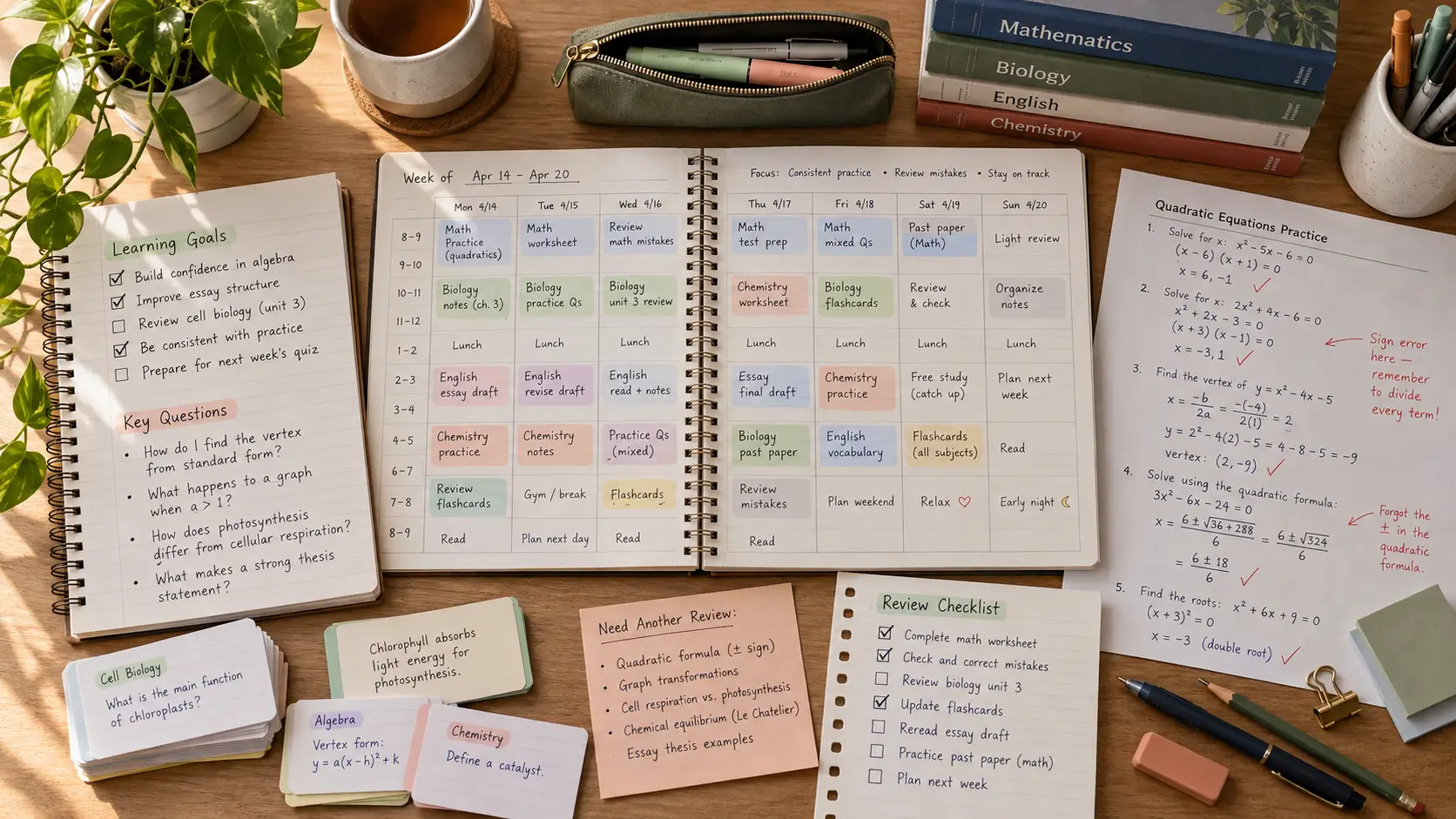
1. Understand the material first
Begin with the information needed to make sense of the topic.
Read the section, follow the lesson, examine a diagram, review a worked example, or clarify unfamiliar terminology.
Retrieval cannot replace initial learning when the learner has nothing meaningful to retrieve.
2. Close the source and retrieve
After understanding a manageable section, stop looking at the material.
Try to explain the main ideas, answer questions, solve a problem, draw a diagram, reconstruct a process, or write a short summary from memory.
The purpose is to discover what is accessible without support.
3. Check the answer
Compare what you produced with a reliable source.
Identify:
-
missing information;
-
incorrect details;
-
confused concepts;
-
incomplete reasoning;
-
unnecessary information.
Correct the errors while the comparison is clear.
4. Return after a delay
Do not complete every review immediately.
Come back later and attempt retrieval again before opening the source.
The delay makes the next attempt a more meaningful test of retention.
5. Mix related material when appropriate
Once several concepts or procedures are understood individually, practice them together.
For example, mix several kinds of mathematics problems instead of completing a full page of one type before moving to another.
This creates practice in identifying which knowledge or strategy is relevant.
6. Explain important relationships
Ask “why,” “how,” “compare,” and “what would happen if” questions.
This helps move practice beyond isolated recall toward structured understanding.
7. Use mistakes to guide the next session
The most useful study plan is not necessarily the one with the most notes, flashcards, or hours recorded.
It is the one that identifies weak knowledge and brings the learner back to it appropriately.
Mistakes from retrieval practice can help determine what needs another explanation, another example, or another spaced review.
What About Learning Styles?
Students can have genuine preferences about how they like to study.
One student may enjoy diagrams. Another may prefer listening to an explanation. Someone else may like writing detailed notes.
Preferences, however, should not be confused with the stronger claim that learners achieve better outcomes when instruction is matched to a fixed category such as “visual,” “auditory,” or “kinesthetic.”
Pashler and colleagues reviewed evidence for this learning-styles matching hypothesis and concluded that the evidence available did not provide an adequate basis for incorporating learning-style assessments into general educational practice.
This does not mean format is irrelevant.
The appropriate format often depends on what is being learned.
Geometry may require diagrams because spatial relationships are important. Pronunciation requires attention to sound. Physical skills require physical practice. Understanding a historical argument may require reading and comparing sources.
A more useful principle is therefore to match the representation and study activity to the content and task rather than assuming every learner needs instruction designed around one fixed style.
For more detail, see Collegenp’s article on the learning styles myth.
Why Effective Studying Can Feel Less Successful
One reason students continue using weak study strategies is that immediate experience can be misleading.
Rereading feels smooth because the answer is visible.
Blocked practice feels successful because the same method is repeatedly used.
Studying the same material several times in one session feels productive because the information remains fresh.
Retrieval, spacing, and mixed practice remove some of those supports.
They reveal forgetting.
They expose confusion.
They require decisions.
That can make practice feel less successful even when it is producing information the learner needs.
The difficulty itself should not be treated as proof that learning is occurring. Instead, ask what the difficulty represents.
If it comes from attempting to recall information after a reasonable delay, distinguish similar concepts, explain a relationship, or independently choose a strategy, it may be useful.
If it comes from missing prerequisite knowledge, unclear instruction, or a task far beyond the learner’s current understanding, more guidance may be needed first.
How to Judge Whether Your Study Method Is Working
Do not judge learning only by how familiar the material looks at the end of a session.
Test it under conditions that are closer to the eventual goal.
After some time has passed, ask:
-
Can I explain the main idea without my notes?
-
Can I answer a question without seeing the definition?
-
Can I solve the problem without copying the example?
-
Can I distinguish this concept from a similar one?
-
Can I identify which strategy a new problem requires?
-
Can I explain why my answer is correct?
-
Can I detect and correct my own mistakes?
These questions provide better evidence of usable learning than the number of pages reread or sentences highlighted.
Key Takeaways
Some study methods work better than others because they require different kinds of mental activity.
Retrieval practice requires learners to produce knowledge instead of merely recognizing it. Spacing requires learners to regain access to knowledge after time has passed. Interleaving can help learners distinguish among related categories or strategies. Self-explanation requires learners to organize relationships and reasoning. Feedback helps correct inaccurate retrieval and explanations.
Rereading, highlighting, blocked practice, explanations, and worked examples still have useful roles. Their value depends on the learner’s current knowledge and the task they are trying to master.
Effective studying is therefore not about using one technique for everything.
A stronger approach is to understand new material, retrieve it without support, check accuracy, return after delays, mix related material when appropriate, and practice the same kinds of thinking that will eventually be required.
The most useful question is not, “Did studying feel easy?”
It is, “What can I still retrieve, explain, distinguish, and apply when the support is gone?”





Comments 0
No comments yet. Be the first to start the conversation.