




You finish a project, submit a report, or hand over a task. Everything makes sense to you because you remember the decisions, conversations, problems, and changes that shaped the work.
Then someone else opens the files and starts asking questions. Which document is the current version? Where did these figures come from? Why was this method chosen? Has the work been checked? What still needs attention?
The answers may exist in scattered messages, personal notes, or your memory. They are not necessarily available to the person who needs them.
This is the problem work documentation should solve.
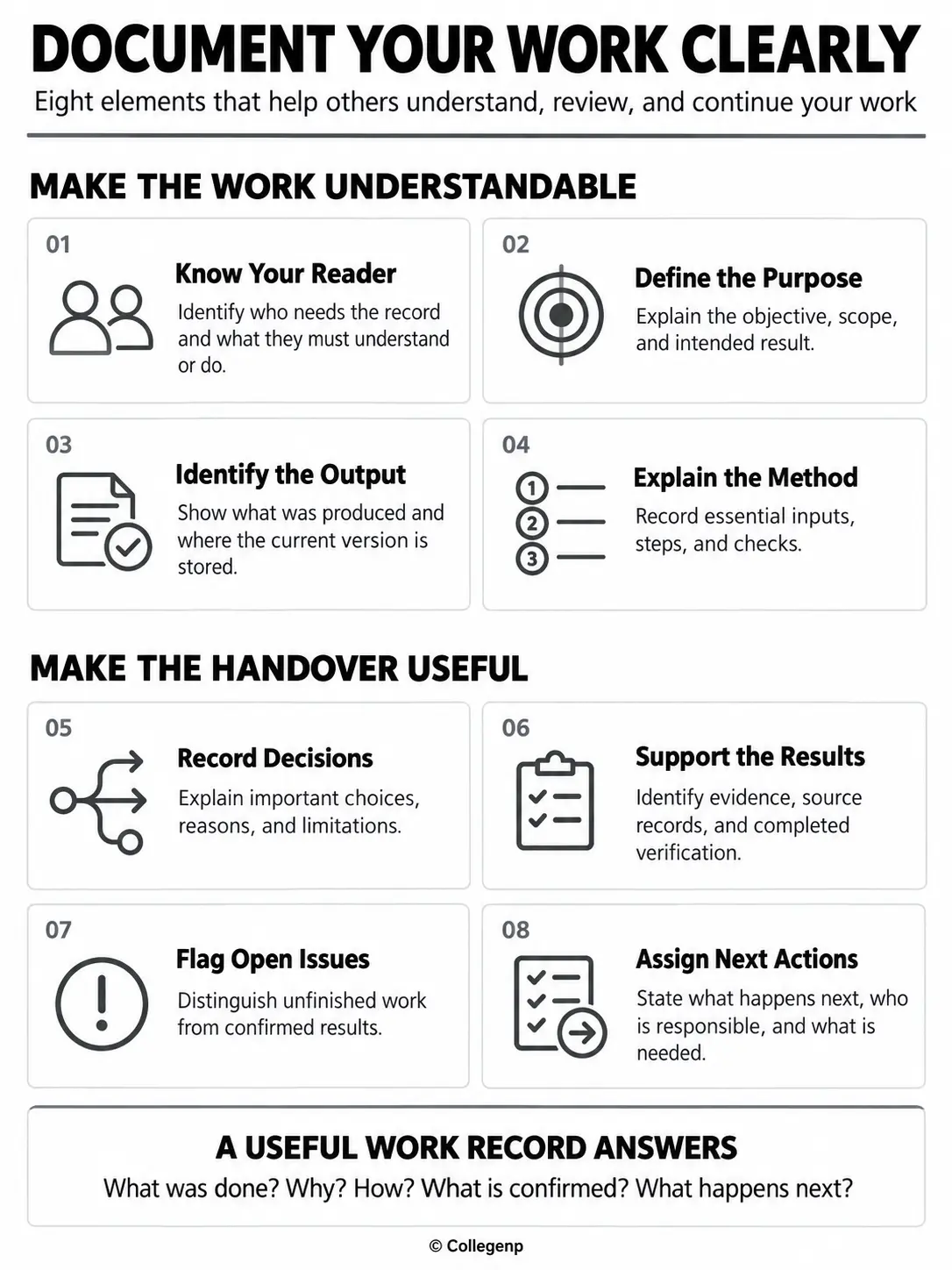
Documenting your work means creating a clear, accessible record of what you worked on, why it mattered, how you approached it, what you produced, and what someone else needs to know about the result.
It is different from recording every activity. Useful documentation preserves the context needed to understand, review, repeat, or continue the work without reconstructing its history from unrelated files and conversations.
The amount of detail depends on the task. A completed school assignment, a recurring workplace procedure, and an unfinished project handover need different explanations.
Answer Summary: To document your work effectively, identify who will read the record and what they need to accomplish. Explain the purpose, scope, output, method, and important decisions. Distinguish completed work from unverified or outstanding items. Provide supporting evidence, accessible file locations, and specific next actions where needed. Keep the record current and check whether someone unfamiliar with the work can use it.
Start With What the Next Person Needs to Know
The starting point is not deciding how many pages to write. It is understanding what another person needs to do with your work.
Someone reviewing a completed assignment wants to understand whether the work meets its requirements. A colleague continuing an unfinished project needs to know what has been completed, what is blocking further work, and what responsibilities remain.
A person repeating a routine procedure needs different information: the necessary inputs, sequence of actions, possible exceptions, and method for checking the result.
Google's Technical Writing guidance on audience recommends considering readers' existing knowledge, roles, and familiarity with the subject. Its central principle is that documentation should provide the information readers need but do not already possess.
A practical way to apply this is to complete one sentence before writing:
"After reading this document, the intended reader should be able to..."
The answer might be to find the completed output, evaluate the work, understand a decision, repeat a process, or continue an unfinished task.
That answer helps determine what information belongs in the record.
Match the documentation to its purpose
Not every task needs the same document.
| Reader's purpose | Information needed | Suitable record |
|---|---|---|
| Review completed work | Objective, scope, outputs, supporting evidence, limitations | Work or project summary |
| Repeat a task | Prerequisites, instructions, exceptions, verification checks | Procedure or work instructions |
| Understand a decision | Context, alternatives, reasoning, consequences | Decision record |
| Continue unfinished work | Current status, completed tasks, unresolved issues, responsibilities | Handover note |
| Find project information | Overview, file locations, relevant references, ownership | Project index or README |
These formats can overlap.
For a small project, one document may contain everything necessary. For a larger project, a short overview can direct readers to separate procedures, supporting evidence, and decision records.
The important consideration is whether the structure helps readers find the information they need without sorting through unnecessary detail.
Explain What the Work Was Supposed to Achieve
A reader cannot judge the meaning of your work without understanding its purpose.
Descriptions such as "Prepared the report" or "Completed the research" identify an activity but provide little context. They do not explain what question the work addressed, which requirements mattered, or what the output was intended to establish.
Begin with the reason the work was undertaken.
For a research assignment, that may be a question you were asked to investigate. For an administrative task, it may be a recurring reporting requirement. For a project, it may be a defined deliverable or an agreed problem requiring attention.
Define the scope clearly
Explain what the work covered and, when relevant, what it did not cover.
Suppose someone is documenting an analysis of responses collected through a student survey. The record should identify which responses were included and what analysis was performed. If the work did not investigate certain questions, those exclusions matter when readers interpret the findings.
Without a clear scope, someone reviewing the results may assume that the analysis addresses questions it was not designed to answer.
Google's Technical Writing guidance on documents recommends stating scope and relevant exclusions so readers understand what the document is intended to cover.
The same principle applies to ordinary work records.
Scope does not require a lengthy explanation. A few precise sentences can establish the boundaries of the work.
Identify the actual output
Readers also need to know what exists because of the work.
The output may be a completed report, revised document, presentation, dataset, design, approved procedure, or unfinished draft.
Identify its location and current status.
Do not assume that a file named "Final Report" is necessarily approved or that a document marked "Updated" is the most recent authoritative version.
If approval is still pending, say so. If the output requires further checking, distinguish that from completed verification.
A record should establish what has been produced without overstating what has been confirmed.
Explain How the Work Was Done
When another person needs to review or repeat your work, the method matters as much as the output.
But explaining a method is not the same as keeping a diary.
A diary describes activities as they happened. A useful method record explains the actions and conditions that matter for understanding or reproducing the result.
For instance, recording that you worked on a spreadsheet for several hours does not help someone understand how the figures were prepared.
The reader needs to know which source material was used, how the information was processed, what checks were performed, and whether any issues remain unresolved.
Identify the necessary inputs
Before explaining the actions, establish what the reader needs.
Depending on the work, relevant inputs may include an approved source document, a dataset, earlier project requirements, background knowledge, a specific file format, or authorized access to a system.
If the work depends on information from another person, identify that dependency.
This prevents an otherwise clear procedure from becoming unusable because the reader lacks information that the original writer took for granted.
Describe the essential actions in sequence
For repeatable tasks, explain the steps in the order they should be performed.
Use instructions that identify observable actions rather than relying on vague descriptions.
Compare these two statements:
"Check the spreadsheet carefully."
"Compare the figures in the summary worksheet with the source records and identify any unmatched entries for review."
The second statement clarifies what should be compared and what the reader should do when a discrepancy appears.
It does not claim that the task is accurate simply because someone has inspected it.
Google's documentation style guidance on procedures recommends clear, action-focused steps, with relevant explanations and results where necessary.
For a complicated task, divide the procedure into meaningful stages. For a simple task, avoid creating multiple sections merely to make the record appear detailed.
Explain how the result was checked
Completing an action and confirming its correctness are different activities.
Your documentation should identify the relevant checks when the reader needs to assess reliability.
For example, a report may have been compared against its source records, reviewed for required sections, or checked against an agreed set of criteria.
Record what was checked, not a broader assurance that cannot be supported.
"References checked against the listed sources" describes a specific activity.
"All information is accurate" makes a much wider claim and requires stronger evidence.
If no formal verification took place, do not suggest otherwise.
Record meaningful exceptions
Routine instructions may fail when something unexpected happens.
If a procedure changes when information is missing, a required approval is unavailable, or a source document contains conflicting details, explain the relevant response.
A useful exception note identifies the condition and the authorized action or decision required.
When the appropriate response is unknown, record the issue as unresolved instead of inventing a solution.
You do not need to describe every minor difficulty. Focus on exceptions that affect the result, the reader's decision, or the ability to continue the work correctly.
Document Important Decisions and Their Reasons
A record that explains only what was done can leave another person unable to understand why the work took a particular direction.
This matters when several approaches were reasonable and the choice affects future work.
For example, someone preparing a research report may decide to exclude incomplete responses from a particular analysis. If that decision influences the findings, a later reviewer needs to understand the criteria used.
Recording the choice without its reasoning is insufficient.
A useful decision note addresses the situation requiring a decision, the relevant alternatives, the reasons for the selected approach, and its limitations or consequences.
Microsoft's guidance on architecture decision records provides a formal approach for documenting consequential technical decisions. It emphasizes context, alternatives, reasoning, consequences, and decision status.
Although the guidance concerns software architecture, these questions are useful for other projects where choices need to be understood or revisited.
Which decisions deserve an explanation?
Not every preference requires a written justification.
A minor formatting choice generally needs less attention than a decision affecting the project's scope, interpretation of evidence, use of resources, or future responsibilities.
Use the likely consequences to judge how much detail is necessary.
If another person might reasonably question or need to revisit a decision, preserving its rationale is useful.
Explain changes without rewriting history
A decision can be reasonable when made and later require revision.
When that happens, preserve enough information to explain the original choice and why it changed.
Distinguish what was known at the time from information discovered afterward.
If a previous decision is no longer valid, identify the replacement. Otherwise, someone reading different project documents may encounter conflicting instructions without knowing which applies.
For consequential decisions, a linked replacement record can preserve this distinction more clearly than silently changing an earlier explanation.
Separate Completed Work From Unresolved Questions
One of the most important responsibilities in documenting work is representing its current condition accurately.
A file may exist without being complete. A draft may be complete without being approved. An analysis may have produced findings while important questions remain unanswered.
These distinctions affect what someone else can safely do with the material.
Use status descriptions that correspond to actual work.
For example:
-
"Draft completed" means the draft exists.
-
"Source references checked" describes a verification activity.
-
"Awaiting review" means the required review has not been completed.
-
"Approved for submission" should be used only when that approval has occurred.
Avoid treating the existence of an output as evidence that it satisfies every requirement.
Distinguish evidence from interpretation
When reporting findings, make it clear which statements come directly from available evidence and which are interpretations.
For research or analysis, identify the source material supporting the result. Explain any relevant limitations in the information or method.
If the available evidence supports a narrow conclusion, do not broaden it merely to make the result appear more substantial.
If conflicting information remains, preserve that uncertainty in the record.
The purpose is not to make the work appear flawless. It is to give readers an accurate basis for assessing what the work establishes.
What should be recorded when work is unfinished?
An unfinished task can still have useful documentation.
Identify the completed portion, the material available for review, the unresolved issues, and the conditions preventing further work.
For example, an illustrative group-project handover could state:
"The report draft is in the shared project folder. Reference checking remains incomplete. The assigned reviewer needs to verify the citations before the document is submitted."
This gives the next person a clear description of the situation without implying that the report is ready for submission.
It also makes the remaining responsibility visible.
Make Handover Instructions Specific Enough to Act On
A handover should allow the next person to identify what requires attention and how to continue.
Statements such as "Follow up later" or "Complete the remaining work" do not establish a usable responsibility.
A practical handover identifies the next action, its owner, relevant dependencies, and the expected result.
Consider an unfinished report awaiting review. The next reader needs more than an instruction to "finish the report."
They need to know which sections require review, where the latest draft is stored, what information is outstanding, and whether further action depends on another person's approval.
This prevents the next person from confusing a pending decision with a task they are authorized to complete independently.
Clarify responsibility without overcomplicating the record
For collaborative work, identify the person or role responsible for the next action.
A student group may need to record who is checking references, who is combining contributions, and who is responsible for submitting the final document.
A workplace handover may require a designated reviewer, document owner, or approving authority.
The level of detail should fit the arrangement. A small informal project does not need an elaborate responsibility system.
What matters is that someone reading the record can identify what they are expected to do and where their responsibility begins or ends.
Include dependencies and relevant deadlines
If an action depends on receiving information, access, or approval, identify that dependency.
Record deadlines when they have been established by the relevant project, institution, or organization. Do not invent dates to make an incomplete handover appear organized.
When a task has no confirmed deadline, that absence should remain clear.
For a handover, an unresolved dependency can be more important than a long description of earlier activity.
Keep the Documentation Findable, Accessible, and Current
A carefully written document is of limited use if people cannot locate it or identify the current version.
Store the documentation in an agreed location that the intended reader can access.
If it relates to a larger collection of files, provide a clear entry point explaining where the main output, supporting evidence, instructions, and related records are located.
GitHub's guidance on README files illustrates this approach for software repositories. A README introduces a project, helps readers understand its purpose, and directs them toward information about using or contributing to it.
For non-software work, a project overview or index can serve a similar purpose.
Make the authoritative version identifiable
Multiple files with names such as "final," "final revised," and "latest copy" can leave readers uncertain about which document to use.
Identify the approved or current authoritative version and the location where it is maintained.
If earlier versions must be retained, distinguish them from current material.
Where the work changes over time, record meaningful updates and identify who maintains the documentation.
A useful record should not continue presenting an outdated procedure as current after the process has changed.
Use headings, links, and visuals carefully
Readers should be able to locate the relevant information without examining the entire document.
Use descriptive headings and link text. Explain abbreviations that the intended audience may not recognize.
Where screenshots or diagrams are necessary, accompany them with enough text to communicate their meaning.
The World Wide Web Consortium's Writing for Web Accessibility guidance recommends meaningful headings, descriptive links, text alternatives for images, and clear instructions.
These principles support readers who use assistive technology and anyone trying to find specific information efficiently.
Respect information access and confidentiality
Documentation should preserve necessary knowledge without distributing information beyond its intended audience.
Before sharing, check whether the record contains personal information, confidential project material, restricted records, or sensitive access details.
Avoid placing passwords or confidential information in broadly accessible documents.
Where supporting material must remain restricted, provide an appropriate reference for authorized readers rather than copying sensitive content into an unrestricted record.
Some fields, including healthcare, finance, safety-related operations, and regulated professional work, have documentation obligations beyond general writing guidance. Follow the applicable approved procedures for those records.
A Practical Template for Documenting Your Work
A reusable structure helps when you need to document an assignment, completed task, project, or handover but are uncertain what information belongs in the record.
The following template can be adapted to the work rather than completed mechanically.
Work or Project Title:
Name the task or project clearly.
Purpose:
What question, requirement, or problem was the work intended to address?
Scope:
What activities or materials were included? What relevant areas were excluded?
Current Status:
What is completed, under review, blocked, or unfinished?
Output or Deliverable:
What was produced, and where is the current authoritative version stored?
Inputs and Sources:
What information, documents, materials, or prerequisites were required?
Method:
What essential actions were performed? Which instructions matter if the work must be repeated?
Important Decisions:
What consequential choices were made, and why?
Evidence and Checks:
What supports the result? What verification was performed?
Limitations or Outstanding Issues:
What remains uncertain, incomplete, or dependent on further review?
Next Actions:
What needs to happen next, who is responsible, and what dependencies or confirmed deadlines apply?
Document Owner and Review Status:
Who maintains the record, and when was its content last meaningfully reviewed?
Related Material:
Where can readers find supporting documents, detailed procedures, or relevant earlier decisions?
A brief completed assignment may require only some of these fields. A complicated handover may require separate supporting documents.
Do not fill unused sections with vague statements. If a field does not help the intended reader, omit it.
Check the Documentation From the Reader's Perspective
The final review should test whether the record serves its purpose.
Read it as someone who was not present when the work was performed.
Can that person identify the objective and find the correct output? Can they distinguish confirmed results from work still awaiting review? Do they have the information needed to understand important decisions?
If the document contains a repeatable procedure, are the prerequisites, actions, exceptions, and checks clear?
If it is a handover, can the next person identify their responsibilities without depending on an explanation from the original writer?
Where practical, ask an authorized person unfamiliar with the details to use the record for its intended purpose.
Pay attention to questions they cannot answer from the document.
A missing source reference, unexplained abbreviation, unclear decision, or inaccessible file may reveal a more meaningful problem than a minor wording issue.
Correct those problems before treating the record as ready for use.
The test does not guarantee that every future reader will understand the work. It provides a practical way to identify gaps that were less obvious to the person who created the documentation.
Conclusion
Documenting your work is about preserving the information another person needs to understand what happened and act appropriately afterward.
A useful record establishes the purpose and scope, identifies the actual output, explains essential methods and decisions, and distinguishes completed work from unresolved issues.
When the work must continue, it also clarifies responsibilities, dependencies, and next actions.
The appropriate amount of documentation depends on the work and its intended reader. A short record with precise information can be more useful than an extensive collection of unexplained notes.
Before closing a project or transferring responsibility, examine the record from the next reader's position. If that person can understand the work, locate the evidence, recognize its limitations, and determine what to do next, the documentation is serving its purpose.
References
-
Google for Developers. Technical Writing One: Audience. Guidance on identifying readers, understanding their knowledge, and matching documentation to their needs.
-
Google for Developers. Technical Writing One: Documents. Guidance on document scope, intended audience, summaries, and logical organization.
-
Google for Developers. Google Developer Documentation Style Guide: Procedures. Guidance on writing clear procedural instructions.
-
GitHub Docs. About the Repository README File. Guidance on introducing a project and helping readers locate relevant project information.
-
Microsoft Learn. Maintain an Architecture Decision Record. Azure Well-Architected Framework guidance on recording consequential technical decisions, alternatives, reasoning, and consequences.
-
World Wide Web Consortium (W3C), Web Accessibility Initiative. Writing for Web Accessibility: Tips for Getting Started. Guidance on meaningful headings, descriptive links, text alternatives, and clear instructions.






Comments 0
No comments yet. Be the first to start the conversation.