



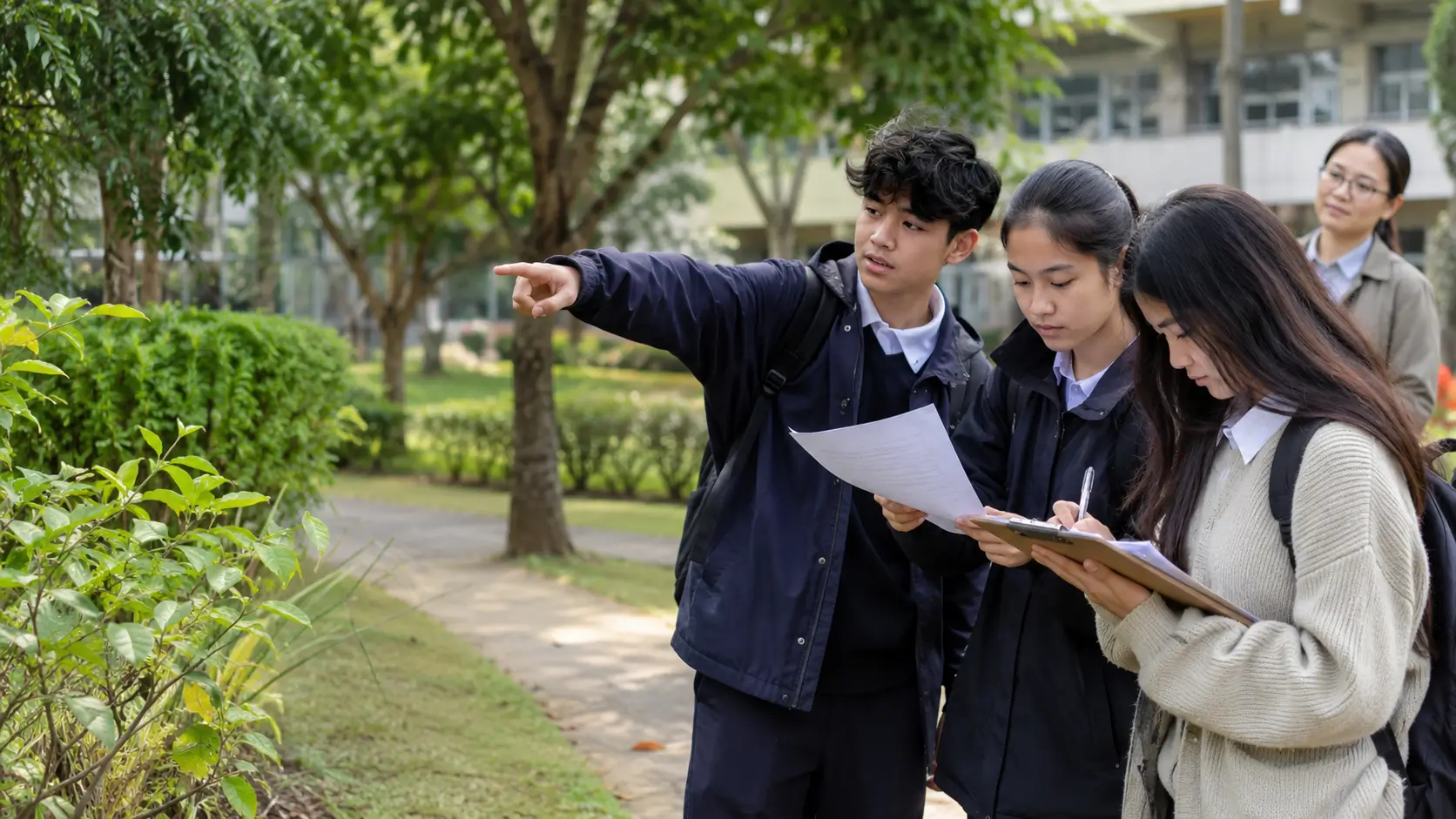
A school fieldwork project is a structured investigation in which students collect evidence from a real setting, analyse their findings, and answer a specific research question. The process connects classroom learning with direct observation, measurement, or other approved research activities.
Completing fieldwork involves more than visiting a location or preparing a report. Students must understand the assignment, select an achievable question, choose suitable methods, record observations accurately, and explain what their evidence shows.
One common difficulty is collecting information without knowing how it will answer the research question. Another is presenting graphs or photographs without interpreting their meaning. These problems can often be avoided by planning the investigation around the evidence needed from the beginning.
The Field Studies Council identifies questioning, evidence collection, analysis, conclusions, and evaluation as connected stages of geographical enquiry. The same underlying approach can inform appropriate school science, environmental studies, and social-studies investigations.
Answer Summary: To complete a school fieldwork project, first understand the assignment and develop a clear research question. Identify the evidence required, select appropriate methods, and arrange a safe, teacher-approved investigation. Record observations systematically, organise and analyse the findings, and prepare a report that answers the original question. Evaluate the reliability of the evidence, acknowledge limitations, and follow the school's specific assessment and submission requirements.
What Is a School Fieldwork Project?
A school fieldwork project investigates a real place, environment, event, or activity through systematic evidence collection and interpretation.
The exact approach depends on the subject. Geography fieldwork may examine differences between locations, environmental conditions, or human activities. School science can involve observations or measurements of natural phenomena, while social studies may use structured observations or approved questionnaires.
A field trip and a fieldwork project are related but different. A field trip is an educational visit. A fieldwork project requires a defined investigation, relevant evidence, and conclusions based on that evidence.
Fieldwork does not necessarily involve travelling far from school. Where the assignment permits, an approved investigation within school grounds or another nearby accessible location may be appropriate.
The essential requirement is that the chosen setting provides evidence capable of addressing the research question.
Step 1: Understand the Assignment and Choose a Research Question
A fieldwork project should begin with the teacher's instructions, not with a preferred location or equipment list.
Check the assignment's subject, objectives, expected evidence, assessment criteria, submission deadline, and report format. Determine whether primary data, a hypothesis, maps, photographs, graphs, or references are compulsory.
These requirements vary between schools, subjects, and education systems. No single fieldwork report structure, sample size, or word count applies internationally.
Develop an achievable research question
A suitable research question identifies what will be investigated and can be answered using evidence available within the project's practical limits.
For example, "Environmental pollution" is too broad for a short school investigation.
A more focused question is:
How does the amount of visible litter differ between two approved areas of the school grounds?
This is a hypothetical research question, not a completed investigation. It identifies a measurable subject and two locations for comparison.
The student would still need to decide how to define visible litter, select comparable observation areas, and record the findings consistently.
Before finalising the question, consider whether the evidence can be collected safely, whether the locations are accessible, and whether sufficient time and resources are available.
A useful planning statement is:
To answer my research question, I need to record [specific evidence] at [approved locations] using [appropriate methods].
If this statement cannot be completed clearly, the research question or method needs further refinement.
Distinguish between an aim and a hypothesis
The aim explains what the investigation intends to find out.
A hypothesis is a prediction or proposed explanation that can be tested against collected evidence.
For a comparison between two locations, students may predict that the recorded conditions will differ. The observations can then be used to assess whether that prediction is supported.
A formal hypothesis is not necessary for every project. Descriptive investigations can use an open research question when permitted by the assignment.
For additional guidance on research planning, students can consult Collegenp's article on preparing a research project.
Step 2: Choose Appropriate Fieldwork Methods
Fieldwork methods should be selected according to the evidence needed to answer the research question.
Observation, measurement, mapping, questionnaires, and secondary-source research serve different purposes. Using several methods is not automatically better than using one carefully designed method.
Understand primary and secondary data
Primary data is information collected directly for the investigation. It may include field measurements, observation records, sketches, or responses obtained through an approved questionnaire.
Secondary data comes from existing materials, including published maps, official datasets, research publications, and relevant institutional reports.
Primary and secondary data can complement one another. Direct observations establish what was recorded during the investigation, while reliable secondary sources can provide background or context.
Evidence can also be quantitative or qualitative.
Quantitative evidence consists of numerical information, such as counts, measurements, or frequencies. Qualitative evidence describes characteristics, conditions, observations, or views.
Primary data does not have to be numerical, and secondary data is not automatically less useful.
Match methods to the research question
|
Evidence needed |
Possible method |
Main consideration |
|---|---|---|
|
Physical or environmental conditions |
Structured observation, field sketch, or suitable measurement |
Consistent categories and units |
|
Differences between locations |
Counts or measurements at selected sites |
Comparable observation procedures |
|
People's views or experiences |
Teacher-approved questionnaire or interview |
Consent and neutral questions |
|
Background information |
Published maps, reports, or datasets |
Source reliability and relevance |
For example, comparing visible litter between school areas would require a clear definition of what is being counted and a consistent way to select observation spaces.
A questionnaire about attitudes toward litter would answer a different question. Neither method should substitute for the other without considering the investigation's aim.
Select sites and consider sampling
Sampling means examining a selected portion of the locations, events, observations, or people relevant to a study.
The Field Studies Council identifies systematic, random, and stratified sampling as different approaches to geographical fieldwork.
Systematic sampling follows predetermined intervals. Random sampling uses a process that gives eligible units a defined chance of selection. Stratified sampling selects observations from identified groups or categories.
The method should fit the investigation rather than being chosen merely because it sounds technical.
A small sample from easily accessible locations may support a limited comparison, but it cannot automatically represent an entire school, community, or environment.
Observation time, weather, location selection, and inconsistent procedures can also influence the results.
Before beginning fieldwork, test the recording sheet and methods through an approved trial. This helps identify unclear instructions or categories before they affect the main observations.
Step 3: Prepare a Safe and Practical Fieldwork Plan
Fieldwork preparation involves confirming the approved location, methods, schedule, equipment, supervision, and responsibilities.
The Royal Geographical Society's school fieldwork guidance covers learning objectives, access arrangements, equipment, supervision, accessibility, and risk assessment. It is primarily written for school staff responsible for organising educational activities.
Students should understand what they are permitted to do, where they can work, and who is supervising the investigation.
Teachers and schools are responsible for the formal safety, safeguarding, access, and emergency arrangements. Permission and supervision requirements depend on local rules, school policies, and the nature of the activity.
An investigation should not proceed at an unsuitable or unapproved location simply because it was included in the original plan.
Access requirements also matter. A suitable project should account for students' mobility, participation needs, available equipment, and practical constraints.
Protect participants and the environment
Fieldwork involving people requires additional care.
Interviews, questionnaires, photographs, or recordings should be undertaken only with the necessary school approval and appropriate participant permissions.
Participation should be voluntary. Questions should be understandable and non-leading, and participants should be able to decline involvement.
Avoid collecting unnecessary identifying information or publishing identifiable images without appropriate authorisation.
The Royal Geographical Society's ethical fieldwork guidance emphasises informed participation, privacy, confidentiality, and responsible handling of information.
Students should also respect site rules, avoid disturbing wildlife or habitats, and follow instructions concerning equipment and environmental protection.
Organise responsibilities in group projects
Groups should agree on who will collect observations, maintain records, check information, and prepare different report sections.
Members collecting comparable evidence should use the same definitions, recording categories, units, and procedures.
This helps prevent incompatible records when group members combine their findings.
Step 4: Collect and Record Fieldwork Evidence
Accurate field records are essential because later analysis depends on what was collected during the investigation.
Prepare a structured recording sheet before the field visit. Include enough information for another reader to understand what was observed, where it was recorded, and how the evidence was obtained.
A blank record can contain the following fields:
|
Recording field |
Information required |
|---|---|
|
Site identification |
Approved location or site code |
|
Date and time |
Actual observation date and period |
|
Observation |
What was directly recorded |
|
Measurement |
Actual value and unit, when relevant |
|
Conditions |
Relevant site or environmental conditions |
|
Notes |
Unusual observations or collection difficulties |
Record information consistently. If observations are being compared, use the same definitions and appropriate procedures at each location.
Separate direct observations from interpretations. A field note should describe what was recorded rather than immediately assert an unsupported explanation.
Photographs and sketches should have clear labels and identifiable links to the relevant observations. Follow school rules before photographing people or sensitive locations.
Check records before leaving
Review completed sheets for missing units, unclear entries, inconsistent categories, duplicated observations, or unidentified locations.
Correct recording errors only when the original information is available and the correction is justified.
Missing observations should remain identified as missing. They must not be changed to zero unless zero was the actual recorded result.
If essential information cannot be collected, document the limitation and consult the supervising teacher about an approved alternative.
Step 5: Organise, Present, and Analyse the Data
Data presentation arranges evidence so that it can be understood. Analysis examines that evidence to identify patterns, differences, relationships, or possible explanations.
These are related but distinct activities.
Begin by checking the records and organising observations into meaningful categories or tables.
The Field Studies Council recommends choosing presentation methods that suit the type of information collected rather than using a particular graph without justification.
For example, bar charts can compare counts across categories. Line graphs may show changes across an appropriate ordered sequence, while scatterplots can examine relationships between paired numerical variables.
Maps and annotated field sketches are useful where spatial information matters. Qualitative observations may be organised into carefully defined themes.
Connect findings to the research question
A graph showing differences between two sites presents information, but the analysis should explain what those differences mean.
Return to the research question and identify which observations directly address it.
A useful evidence-to-explanation sequence is:
-
Observation: What pattern, difference, or relationship appears in the actual records?
-
Evidence: Which measurements, notes, or documented observations support that description?
-
Interpretation: What explanation is consistent with the evidence and relevant subject knowledge?
-
Qualification: What alternative explanations or limitations prevent a stronger conclusion?
These questions guide interpretation without requiring students to manufacture results.
For the hypothetical litter investigation, the analysis would compare the actual counts from the selected areas, provided they were collected using comparable procedures.
Even if the counts differed, the observations alone would not establish why the difference occurred. Explanations involving human activity, waste disposal arrangements, or environmental conditions would require relevant supporting evidence.
Similarly, a relationship between two recorded variables does not establish that one caused the other.
Unexpected findings should be included rather than excluded because they differ from the original prediction.
Step 6: Write the School Fieldwork Report
A fieldwork report should enable the reader to follow the investigation from its original question to the conclusions drawn from the collected evidence.
The University of Southern California Libraries' field-report guidance emphasises systematic observation, accurate records, interpretation, and transparent reporting. Its guidance is primarily for social-science research, so school assignments may require simpler structures.
The following report structure can be adapted to the teacher's instructions.
|
Report section |
What to include |
|---|---|
|
Title and introduction |
Research question, aim, and relevant background |
|
Methodology |
Study locations, observation period, methods, tools, and sampling |
|
Results |
Recorded findings, labelled tables, graphs, maps, or images |
|
Analysis |
Patterns, comparisons, explanations, and unexpected findings |
|
Conclusion |
Direct answer supported by the evidence |
|
Evaluation |
Limitations, effects on findings, and possible improvements |
|
References and appendices |
Cited secondary sources and required supporting records |
Write the introduction and methodology
The introduction should establish the investigation's focus and explain why the question is relevant to the subject.
The methodology should describe what was collected, where and when collection occurred, and which procedures were followed.
Include enough detail for another reader to understand how the observations were produced. Explain significant methodological choices, such as why particular sites or samples were selected.
Present results separately from interpretation
The results section should report the evidence without adding unsupported explanations.
Use accurately labelled graphs, tables, photographs, or sketches where they improve understanding.
The analysis section should then explain what the evidence indicates, including meaningful similarities, differences, and unusual observations.
Write a conclusion supported by findings
The conclusion returns directly to the original research question.
Summarise the answer supported by the collected evidence and identify the observations that justify it.
If a hypothesis was included, explain whether the results support it, contradict it, or remain insufficient for a clear assessment.
Avoid introducing new findings or claiming certainty beyond what the investigation establishes.
Reference information correctly
Cite secondary sources used for background information, explanations, maps, or comparisons.
Follow the school's required citation style. When evaluating published information, consider its author, publication date, evidence, and relevance.
Collegenp's guide to finding reliable online sources provides further guidance on evaluating research material.
Step 7: Evaluate Limitations and Finalise the Project
Evaluation explains how the investigation's methods and conditions affect the reliability and interpretation of its findings.
It should go beyond listing difficulties encountered during fieldwork.
The Field Studies Council distinguishes measurement errors, differences arising from observers or procedures, sampling problems, and questions about whether a method adequately addresses its intended purpose.
For each important limitation, explain what occurred, how it affected the evidence, and what improvement would be appropriate.
For example, observations collected during a single period may describe conditions at that time but may not establish what happens throughout the day.
Likewise, using different observation categories at separate sites can weaken a comparison because the recorded information is not directly equivalent.
Understand reliability and validity
Reliability concerns the consistency of observations or measurements when suitable procedures are repeated.
Validity concerns whether the chosen method actually measures or investigates what the research question requires.
A method may produce consistent results while failing to address the intended question. Collecting additional information using that unsuitable method does not resolve the problem.
The Geographical Association also cautions against confirmation bias, where students focus on evidence that agrees with their expectations and neglect contradictory findings.
Results that contradict a hypothesis do not automatically indicate unsuccessful fieldwork. What matters is whether the evidence was collected responsibly, interpreted accurately, and evaluated with appropriate caution.
If data is incomplete, state what was obtained and what remains unknown. Narrow the conclusion where necessary rather than filling gaps with invented observations.
School Fieldwork Project Planning Sheet
Before collecting evidence, complete the following details using the assignment instructions.
-
Assignment: Subject, required work, assessment criteria, and deadline.
-
Research question: The specific issue or comparison being investigated.
-
Aim or hypothesis: Intended purpose and optional testable prediction.
-
Evidence required: Observations, measurements, categories, or secondary information.
-
Methods: Approved collection techniques and sampling approach.
-
Locations: Accessible, teacher-approved study sites.
-
Recording plan: Units, categories, observation period, and field sheets.
-
Responsibilities: Supervision, permissions, equipment, and group tasks.
-
Analysis plan: How evidence will be compared, presented, and interpreted.
-
Submission: Required report sections, references, and supporting materials.
The planning sheet is adaptable rather than a compulsory school form.
Final School Fieldwork Project Checklist
Before submitting the project, confirm that:
Conclusion
A school fieldwork project is completed through a connected process of questioning, collecting evidence, analysing observations, and presenting supported conclusions.
The strength of the project depends on how well the research question, methods, records, analysis, and report fit together.
A small, carefully planned investigation can answer a focused question without requiring extensive travel or elaborate equipment. However, conclusions must remain within the limits of the evidence collected.
Before submission, students should check that their findings address the original question, their interpretations are justified, and their evaluation explains any important uncertainty.
References
1. Field Studies Council — Planning: Geographical Enquiry. Guidance on aims, hypotheses, evidence collection, analysis, conclusions, and evaluation.
2. Geographical Association — Fieldwork Through Enquiry. Guidance on enquiry design, fieldwork decisions, data interpretation, and critical evaluation.
3. Field Studies Council — Fieldwork Methods. Guidance on sampling methods, representative evidence, and bias.
4. Field Studies Council — Data Presentation. Guidance on presenting quantitative and qualitative evidence appropriately.
5. Field Studies Council — Evaluation. Guidance on measurement errors, sampling limitations, and validity.
6. Royal Geographical Society — School Fieldwork Preparation Checklist. School-focused planning guidance covering supervision, access, equipment, and safety arrangements.
7. Royal Geographical Society — Responsible and Ethical Fieldwork: Working With People. Guidance on voluntary participation, permissions, confidentiality, and responsible data handling.
8. University of Southern California Libraries — Writing a Field Report. Academic guidance on systematic field observation, analysis, report structure, and research limitations.



Comments 0
No comments yet. Be the first to start the conversation.