



Table of Content
- Has Nepal Failed to Develop Despite Abundant Physical Resources Because of Too Much Unskilled Workforce?
- Physical and Natural Resources: A Mountain of Potential but Low Returns
- Current State of the Workforce: Demographic Dividend and Dominance of Unskilled Workers
- Is Unskilled Workforce the Only Problem, or Is It Also a Structural Failure?
- Shortage of Middle-Level Technicians Who Connect Resources With the Economy
- Way Forward: Human Capital Formation and Industrial Alignment
- Conclusion
Has Nepal Failed to Develop Despite Abundant Physical Resources Because of Too Much Unskilled Workforce?
For any nation’s sustainable economic development and prosperity, a balanced combination of three forms of capital is fundamentally necessary: natural capital, physical and financial capital, and human capital. In Nepal’s context, we have repeatedly heard: “Nepal is a country rich in natural and physical resources.”
Its water resources, geographical diversity, arable land, medicinal herbs, and vast tourism potential have always been considered foundations for development. Yet, despite all this, Nepal still struggles on the world economic map as an underdeveloped country.
Against this background, a serious question arises: Is the main reason Nepal has failed to use its physical resources the dominance of an unskilled labor force? Despite having resources, is the lack of people with the knowledge, skills, and technical capacity to create value addition the root of poverty?
This article objectively and factually analyzes these questions and examines the relationship between Nepal’s resources, the state of its workforce, and policy challenges.
Physical and Natural Resources: A Mountain of Potential but Low Returns
Nepal’s natural wealth can be a matter of envy for the world. Mountain ranges, biodiversity in the hills, the fertile Terai, valuable medicinal herbs, mineral prospects, and thousands of rivers and streams are our assets.
Water resources and energy: Nepal has immense potential for hydropower production. However, while major rivers continue to flow unused for years and billions of rupees are spent importing mineral fuels, the country has not been able to manage its water resources properly. From constructing hydropower projects to managing grids in the international market and conducting energy diplomacy, Nepal has consistently faced a shortage of high-level technical and managerial human resources.
Agriculture and forest products: A large part of the economy is still based on agriculture, but it remains largely subsistence-oriented. Valuable medicinal herbs found in forests, such as yarsagumba and chiraito, are exported cheaply as raw materials. Expensive medicines and beauty products made from those same herbs are then imported from abroad.
Tourism: Nepal should have become a tourism hub because of the scenic landscapes and cultural heritage provided freely by nature. However, tourism returns have not met expectations due to the lack of hospitality workers capable of delivering high-quality services and the shortage of marketing and IT experts who can promote tourism in the global market.
A clear point emerges here: development does not happen merely because raw materials exist. The skills and technology required to process raw materials and convert them into finished products are primary conditions for development.
Current State of the Workforce: Demographic Dividend and Dominance of Unskilled Workers
Nepal is currently in the era of the demographic dividend. According to the National Census 2078, about 61.96 percent of Nepal’s total population falls within the 15 to 59 age group. This means the number of young and working-age people in Nepal is currently at the highest level in the country’s history.
Unfortunately, a large share of these working-age people do not have the technical skills demanded by the market.
The Picture of Foreign Employment
Foreign employment data clearly shows the condition of Nepal’s workforce. Among the hundreds of thousands of youths who obtain labor permits through the Department of Foreign Employment and go to Gulf countries and Malaysia, a very large percentage are unskilled or semi-skilled workers. Nepali youths are working in highly risky and physically demanding sectors abroad, including construction, cleaning, and general security guard work.
If they had internationally recognized vocational skills such as plumbing, advanced wiring, heavy machinery operation, software development, or nursing, they could earn double or triple with less labor. Due to the lack of skills, Nepali workers are forced to work at low wages. At the same time, in Nepal’s own large infrastructure projects, such as tunnels, airports, and hydropower projects, contractors import skilled workers from India, China, or other countries, saying they cannot find technical workers.
Is Unskilled Workforce the Only Problem, or Is It Also a Structural Failure?
The dominance of an unskilled workforce is certainly a major obstacle to Nepal’s development, but it is not the only reason. It is the result of broad failure in the state’s educational, policy, and administrative structures.
a. Mismatch Between Education and the Market
Schools and universities distribute certificates to hundreds of thousands of students every year. However, this education is more focused on generalist education and less focused on market-driven vocational skills. History and literature have their own importance, but in the modern economy, they do not directly create jobs in the same way technical and market-oriented skills do. When the market needs data analysts, agronomists, or mechanical engineers, it finds crowds of youths carrying certificates in humanities or general management.
Because educational institutions have not produced the human resources the market needs, a serious gap has emerged between skills and employment.
b. The Irony of Brain Drain
Even youths who have skills, competence, and knowledge are unwilling to stay in the country. Well-educated doctors, engineers, scientists, and IT professionals are migrating to developed countries such as Europe, the United States, and Australia in search of proper opportunities, research budgets, transparent evaluation, and secure living standards.
On the one hand, those who remain in the country lack skill-based training. On the other hand, the outflow of already skilled people has repeatedly pushed the country into a technical skill vacuum. This reflects the serious challenge of brain drain in Nepal.
c. Lack of Capital, Technology, and Good Governance
A skilled person alone cannot change everything. Skilled people need capital, investment, and tools to work. The government’s development budget expenditure rate is extremely slow, political policies are unstable, and red tape discourages entrepreneurs from establishing industries.
Therefore, having an unskilled workforce is one weakness. Failing to mobilize the available skilled workforce with capital and supportive policy is another serious problem.
Shortage of Middle-Level Technicians Who Connect Resources With the Economy
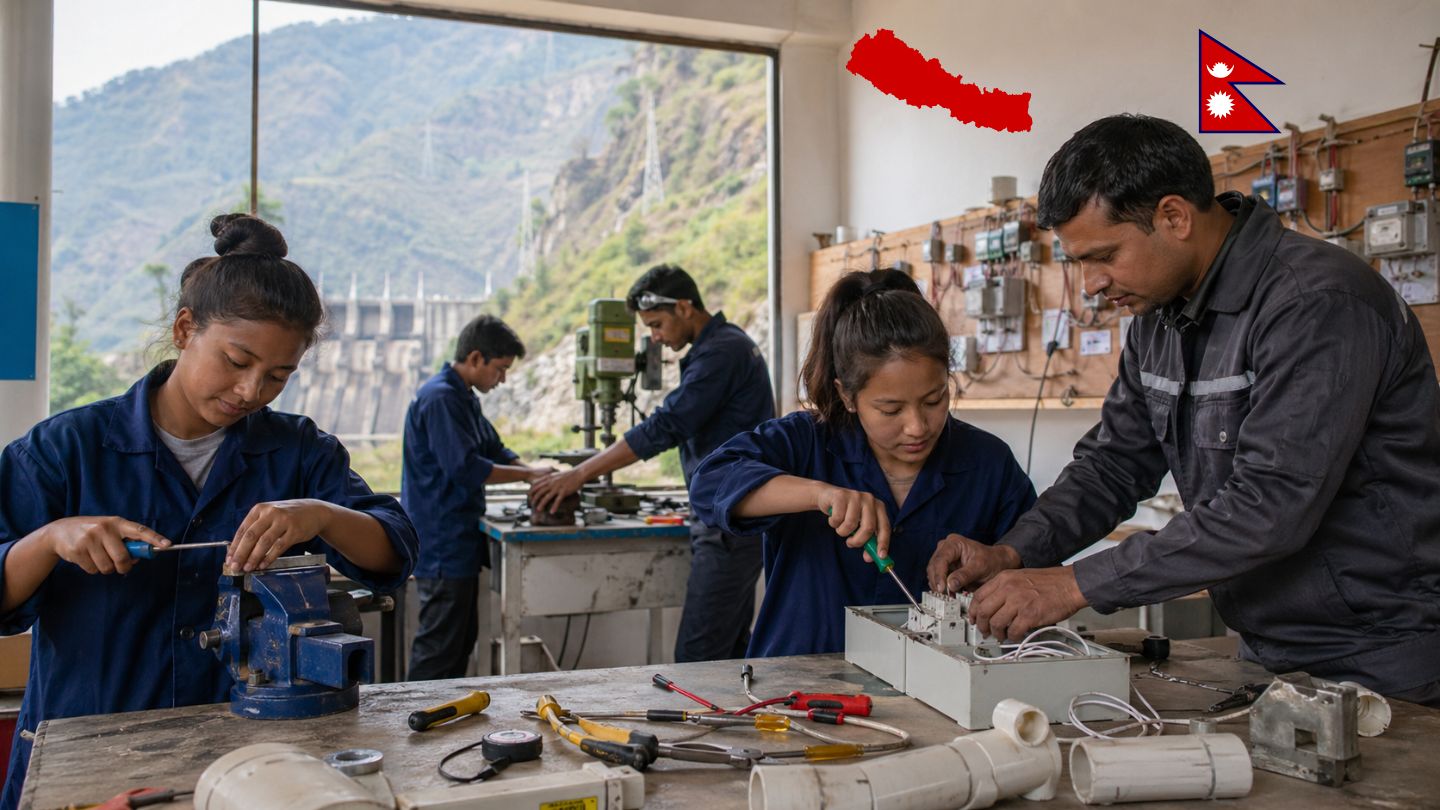
Nepal today needs managers who can organize agricultural supply chains, tunneling foremen, civil draftsmen, and biomedical technicians who can repair hospital equipment more than it needs aerospace scientists. This group is called the middle-level technical workforce.
Countries such as Japan, South Korea, and Germany, despite having almost no natural resources, became some of the world’s major economies through the strength of middle-level artisans and technicians. Switzerland, a landlocked and mountainous country like Nepal, built its identity more through banking services, tourism, and skills such as watchmaking and chocolate production than through natural resources.
These countries are strong examples showing that human resources can build a nation even without natural resources. However, in Nepal, where natural resources are also abundant, institutions that prepare technical human resources, such as CTEVT and other technical institutions, have been able to provide quality training only in very limited numbers compared with national demand.
Way Forward: Human Capital Formation and Industrial Alignment
When a country has physical resources but lacks the human capacity to convert them into wealth, it remains trapped in the vicious cycle of selling raw materials and buying finished goods. To overcome this, the following strategic reforms are urgently needed.
Increase investment in technical education: Skill-based subjects such as basic IT, automobiles, modern agricultural technology, tailoring, and hospitality should be included as compulsory subjects from Grade 8. University curricula should be updated every three years according to market demand.
Strengthen industry-academia linkage: Industries or companies should work with technical colleges to determine the skills students need, based on the type of workers they require. Internships and on-the-job training should be expanded widely.
Verify the skills of returnee youths: Thousands of youths who return after operating machines or learning construction work for 5 to 10 years in Gulf countries or Malaysia have practical skills. The government should provide national certification for their skills and offer grants and startup loans without hassle so they can start small enterprises within the country.
Create merit-based opportunities: Whether in government or private institutions, opportunities should be provided on the basis of purely competitive competence, not favoritism or access. This can help reduce talent migration.
Develop domestic value chains in minerals and medicinal herbs: At the policy level, taxes on raw material exports should be increased, while incentives such as tax holidays should be provided to establish processing industries within the country. This would directly give domestic unskilled and semi-skilled workers the opportunity to learn work-based skills inside Nepal.
Conclusion
The core reason Nepal has not developed is not the lack of resources, but the severe shortage of skilled human resources with a scientific approach to identify, extract, and use those resources. It is foolish to sit atop a gold mine and say, “I am poor,” because until people have the goldsmith’s skills and tools to extract and refine that gold, the mine remains only stone. Natural resources are static assets. Prosperity emerges from them only when human skill, technology, and innovation are applied.
If Nepal can invest this short and historic period of demographic dividend in skill-based education and entrepreneurship, its rivers can turn into energy, its medicinal herbs into exports worth billions of dollars, and its hills into world-class hospitality destinations. Having a large unskilled workforce is certainly a problem. But if investment begins today to make that workforce skilled, Nepal will not have to wait many decades to find a faster path to economic development.







Comments 0
No comments yet. Be the first to start the conversation.