



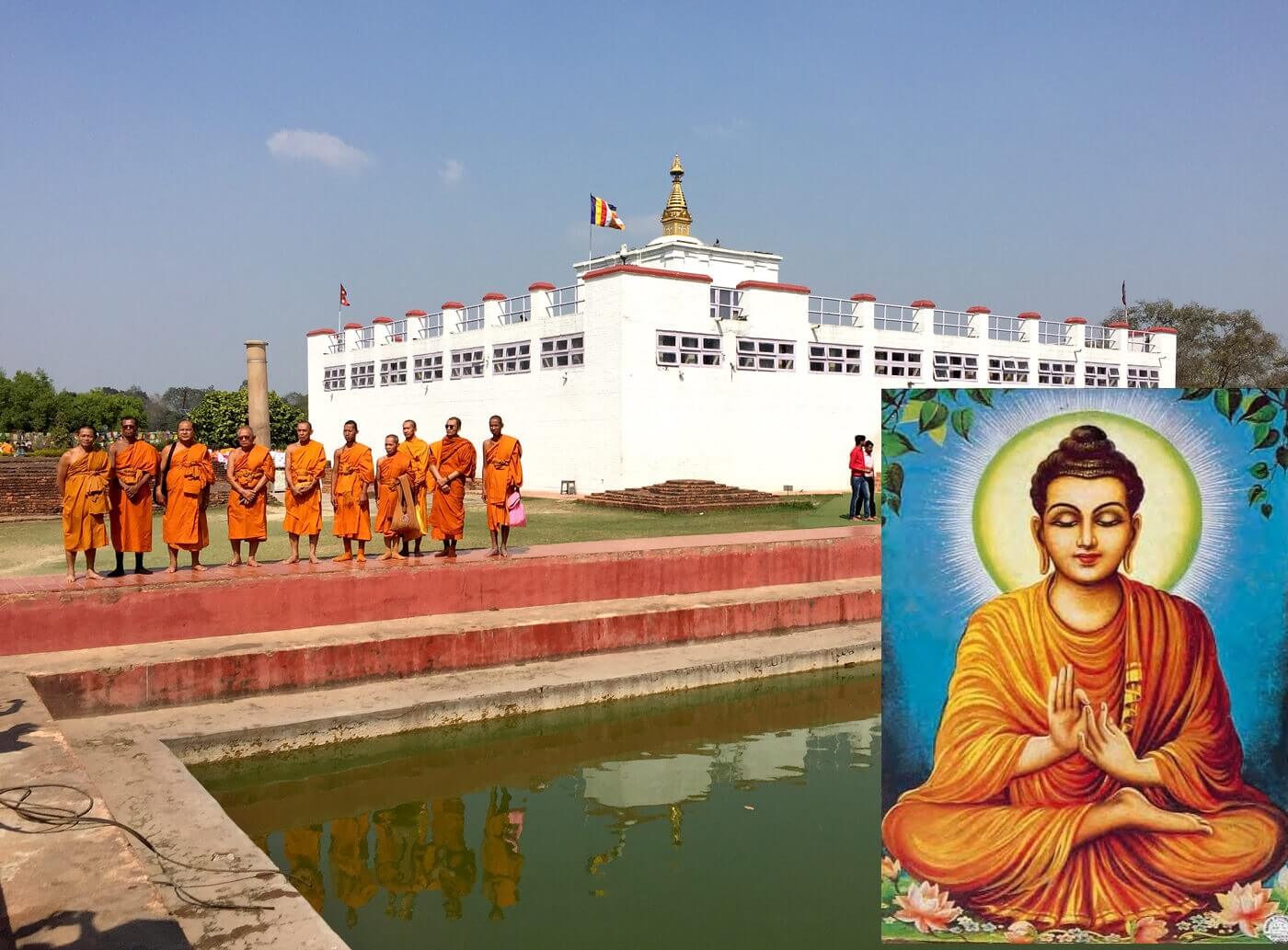
Historical Development of Buddhist Philosophy and the Relevance of the Noble Eightfold Path in Modern Good Governance
When discussing Buddhist religion and philosophy, the historical figure Siddhartha Gautama often comes first to many people’s minds. However, according to followers of Buddhism and scholars of this philosophy, many Buddhas had already appeared on this earth before Siddhartha Gautama.
Based on mythological belief and the current time cycle of Kali Yuga, it is believed that seven Buddhas have already been born and that another Buddha, known as Maitreya Buddha, will arrive in the future. In various Buddhist sects, the continuity of Buddhas before Gautama Buddha is acknowledged, and they are also revered with equal devotion.
The names of those earlier Buddhas and information about them are clearly mentioned in Buddhist texts. Historical and archaeological interest exists not only in relation to Nepal’s Lumbini and Kapilvastu regions, but also regarding other Buddhas described as having been born outside the broader land of Nepal.
Even today, authentic records can be seen in different forms regarding Buddhas such as Vipassi, Shikhi, Vishvabhu, Kakuchchhanda, Kanakamuni, and Kashyapa, who are said to have been born before Siddhartha Gautama.
In the context of the Kathmandu Valley, based on important texts including the Swayambhu Purana, it becomes clear that the development and continuity of the Buddhist tradition here were shaped by Buddhas who preceded Gautama Buddha. In the Mahayana and Vajrayana traditions, earlier Buddhas and Bodhisattvas before Gautama Buddha are worshipped and honored with even greater significance.
When exploring Buddhist history before Gautama Buddha, the mythological account of Swayambhu becomes a major basis. According to some Buddhist traditions, genealogies, and the Swayambhu Purana, human Buddhas before Gautama Buddha, including Vipassi, Shikhi, Vishvabhu, Kakuchchhanda, Kanakamuni, and Kashyapa, are said to have come to the valley.
Along with this, Bodhisattvas such as Manjushri, Padmasambhava, and Nagarjuna are also said to have come to the Kathmandu Valley. The accounts that link them to the origin story of Swayambhu and to the draining of water from the Kathmandu Valley to make human settlement possible are viewed in connection with the Swayambhu Purana.
The Swayambhu Purana also mentions that Gautama Buddha himself came to the valley to visit Swayambhu, although this has not been fully historically verified. Nevertheless, even when earlier Buddhas and Bodhisattvas are named in the Buddhist tradition, the core basis and accepted foundation of Buddhist teachings have, in later practice, been centered on Gautama Buddha.
Therefore, Gautama Buddha is regarded as the historical and authentic Buddha, and Buddhist education to this day is guided by his teachings and knowledge.
After Gautama Buddha’s Mahaparinirvana, Buddhist followers were divided into many branches and sects, but the main path of their teaching remained the Buddha’s own instruction. The essence of the Buddha’s teaching is the Four Noble Truths, which include birth, suffering, the cause of suffering, and the path to the cessation of suffering, namely the Eightfold Path.
In addition, the Three Jewels—Buddha, Dharma, and Sangha—are also major foundations of Buddhist philosophy. All the Buddha’s sermons and teachings are collected in the Tripitaka.
The Tripitaka includes the Sutta Pitaka, Vinaya Pitaka, and Abhidhamma Pitaka. The Sutta Pitaka contains the Buddha’s sermons and teachings, while the Vinaya Pitaka contains the rules to be followed by Buddhist monks and nuns.
Similarly, the Abhidhamma Pitaka includes profound subjects related to philosophy and psychology. These Tripitaka texts are the words of the Buddha, and their main purpose is to make human life useful and peaceful by encouraging the observance of conduct such as sila, the Five Precepts, and the Eight Precepts.
After attaining enlightenment, Shakyamuni Gautama Buddha traveled on foot for about 45 years, spreading his Dharma and teachings. He used the Pali language, which was commonly understood by the people of that time, as the main medium of his religious discourse.
However, soon after the Buddha’s Mahaparinirvana, some disputes began to emerge within the Buddhist Sangha. As long as the Buddha was alive, no factions, sub-factions, or sects had developed.
After the Buddha’s passing, monks began interpreting the Buddha’s rules according to their own preferences. Some monks, feeling independent, attempted to bring deviations into the Buddha’s rules. In this process, around one hundred years later, some monks created new rules and began following them according to their own convenience.
Those who advocated that the Buddha’s original teachings and rules should be followed exactly as they were expelled those who sought to introduce distortions from the Buddhist Sangha. Those who continued the Buddha’s original path and tradition came to be known as Sthaviravada or Theravada. Some also called them Hinayana.
They accepted the Tripitaka in the Pali language as their core scripture. However, the monks who believed that rules should be changed according to time and who applied modified rules came to be known as Mahasanghika. Over time, this Mahasanghika tradition developed and moved forward as the Mahayana sect. The Mahayana sect made Sanskrit the main language of its texts.
Over time, mantra and tantra entered Buddhist philosophy. Around the eighth or ninth century, the Vajrayana sect, based on tantra and mantra, developed widely through Nepal, Tibet, and China.
In Nepal’s context, the Buddhism that developed in the Himalayan region is mainly based on the Mahayana tradition, while the tradition that developed in the valley appears closer to Vajrayana.
The Vajrayana tradition holds the belief that Buddhahood can be attained through a shorter path by realizing bodhicitta through mantra, tantra, meditation, and spiritual practice.
The Newar Buddhist tradition of Nepal, which allows the practice of religion while remaining in household life instead of becoming a monk or nun, is a distinctive form of Vajrayana. In the Vajrayana tradition, kulaputras have played tantric and ritual roles as Bajracharya or Gubhaju. This has given Nepal’s Buddhism a distinct and original identity.
Nepal has a long and glorious history of Buddhism. Although Nepal has an ancient history of the Theravada tradition dating back to the time of Gautama Buddha, this tradition appears to have become somewhat overshadowed during the medieval period.
An inscription of Licchavi-period King Amshuverma, believed to be from around BS 750, and records mentioning donations made to monasteries by some medieval kings as well as references to monks and nuns confirm the historicity of the Theravada tradition in Nepal.
However, later developments such as the division of caste and varna, the growing influence of Hinduism, and especially policies from the time of Jayasthiti Malla that discouraged the monastic tradition of becoming monks and nuns in the monasteries of the Kathmandu Valley gradually caused Theravada practices to disappear.
For a long time, Theravada practice could not continue. However, in the modern period, after the establishment of Anandakuti Vihar in Kathmandu in 1943, the practice of the Theravada tradition resumed in Nepal. Today, the importance and development of this tradition appear to be increasing.
Buddhist philosophy is not limited to religious worship. It is also believed to have a deep influence on the development of moral conduct, good governance, the rule of law, and transparent leadership in human life.
The main essence of the Buddha’s teachings within the Tripitaka, the Noble Eightfold Path, has been interpreted as an important instrument for policy reform, legal compliance, and social transformation in the present day.
The summarized essence of the 52 texts related to the Noble Eightfold Path can be viewed in connection with today’s good governance, social psychology, and the promotion of public welfare.
The Noble Eightfold Path and Its Modern Relevance
The eight components of the Noble Eightfold Path and their modern relevance are as follows:
1. Right View
Right View refers to realistic knowledge related to the Four Noble Truths. It accepts the reality that suffering exists, that suffering has a cause, that suffering can be ended, and that there is also a method for ending it.
In the context of modern policymaking and governance, this means first identifying problems realistically and objectively before formulating any policy or plan.
Policymakers should not be guided by emotion, impulse, or pressure from personal or political interests. Right View means evaluating, on the basis of facts and data, the real problems of the country and society, where their roots or causes lie, and how they can be solved.
2. Right Intention
Right Intention inspires people to abandon hatred, impulses, unrest, and confusion within themselves and to develop positive thinking.
In the context of good governance and leadership, Right Intention means that leaders should abandon personal interests, attachments, and prejudices and make a firm commitment to work for public welfare.
It teaches leadership to become people-oriented, honest, and results-oriented. A commitment to work selflessly while remaining accountable to the people, rather than acting only for elections or publicity, falls under this principle.
3. Right Speech
Right Speech means not lying, not tale-bearing or backbiting, not using abusive language, and staying away from meaningless chatter. Its relevance has increased even more in the present age of digital communication.
Today, there is a growing tendency in the communication sector to deliberately cultivate falsehoods, or fake news, spread ethnic, communal, and regional hatred on social media, assassinate character, and use unwanted abusive language in the name of freedom of expression.
Right Speech helps prevent such distortions and promotes civilized, decent, and dignified communication in society. It is indispensable for the development of a transparent and responsible communication culture.
4. Right Action
Right Action teaches people to avoid unethical and undesirable acts such as killing, violence, theft, and sexual misconduct. In the modern state system, this points to compliance with the law, the end of impunity, and the rule of law.
Acts such as corruption, bribery, commission-based systems, middleman practices, smuggling, and fraud, which are major obstacles to good governance, are contrary to Right Action.
To build a clean and corruption-free society, every citizen and every person holding public office is considered required to observe Right Action.
5. Right Livelihood
Right Livelihood means earning one’s living through honest and ethical means. According to Buddhist philosophy, trade or business that harms society is prohibited.
This includes the complete prohibition of activities such as the trade of lethal weapons, trade of poisonous substances, trade of narcotic drugs, trade of meat or living beings, and human trafficking, including the slave trade or prostitution.
In today’s context, this principle teaches the promotion of clean market management, the end of black marketing, and ethical business practices.
6. Right Effort
Right Effort means preventing bad thoughts from arising in the mind and continuously practicing good thoughts. In any organization or state mechanism, it is a process of continuous improvement.
Identifying negative tendencies that arise within the human mind, discouraging them, planting the seeds of good culture, and continuing them is Right Effort. It expects continuous positive change at both personal and organizational levels.
7. Right Mindfulness
Right Mindfulness means remaining always aware and alert about all one’s actions, thoughts, and deeds. At the level of policy formulation and implementation, it demands continuous monitoring, evaluation, and awareness.
Policymakers and administrators must always remain alert about whether the policies and programs introduced by the state are moving in the right direction and what results they are producing.
Being physically, mentally, and emotionally aware of one’s responsibilities is Right Mindfulness.
8. Right Concentration
Right Concentration means a state of mental focus and peace. As long as a person’s mind remains disturbed, that person cannot make the right decision.
People who lead the state, administration, or any institution may be distracted by external pressure, the influence of interest groups, and constant noise.
In such a situation, the mental stability required to remain free from external influence, set aside stress and provocation, and make correct and just decisions with full concentration is Right Concentration.
Conclusion
In conclusion, the Noble Eightfold Path propounded by the Buddha 2,500 years ago is not only a means of individual liberation. It is also a powerful means to prevent political instability, economic corruption, social distortion, and moral decline in present society.
Scholars of Buddhist philosophy emphasize that if state leaders, policymakers, communication professionals, and ordinary citizens apply these eight paths in their professions and conduct, a civilized, transparent, and well-governed society can be built in Nepal and across the world.







Comments 0
No comments yet. Be the first to start the conversation.