



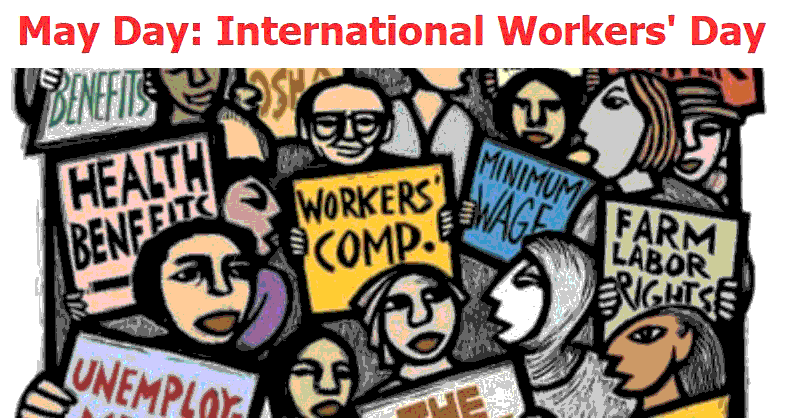
International Labour Day: History, Significance, Current Situation, and the Future of Work
Every year on May 1, International Labour Day, also known as May Day, is observed around the world. This day is not merely a public holiday marked on the calendar. It is a global symbol of the historic struggle, sacrifice, and achievements of the working class in its fight for rights, dignity, and justice.
Understanding the meaning of Labour Day is especially important for today’s young generation, which is either entering the labour market or planning its future career. The basic rights we enjoy today, such as the eight-hour workday, meaning eight hours of work, eight hours of rest, and eight hours of recreation, minimum wage, leave facilities, and workplace safety, were not gifts granted out of goodwill. They are the result of the long struggle of earlier generations of workers.
This article presents a factual and detailed analysis of the historical background of International Labour Day, the development of Nepal’s labour movement, the challenges workers face today, the new dimensions brought by changing technology and the gig economy, and the future of work.
Historical Background: How Did May 1 Begin?
The roots of International Labour Day are connected to the Industrial Revolution of the 19th century. During the Industrial Revolution, factories expanded rapidly across Europe and the United States, but the condition of the workers employed in them was extremely poor.
Workers were forced to work 12 to 16 hours a day in unhealthy and unsafe environments. There was no legal provision for leave, medical treatment, or fair wages. Child labour was common.
Gradually, voices began to rise against such extreme exploitation. The main demand of workers was the “eight-hour workday.” In 1884, the Federation of Organized Trades and Labor Unions in the United States passed a resolution demanding that the eight-hour workday be implemented by May 1, 1886.
The Haymarket Affair
On the scheduled date, May 1, 1886, millions of workers across the United States went on strike demanding an eight-hour workday. The center of this movement was Chicago.
On May 3, a clash between police and striking workers resulted in the deaths of several workers. In protest, a peaceful gathering was organized at Haymarket Square in Chicago on May 4. Toward the end of the gathering, someone whose identity has still not been established threw a bomb into the police crowd. Dozens of police officers and workers died in the bomb explosion and the shooting that followed.
After this incident, labour leaders faced severe repression. Many were arrested, and some labour leaders were sentenced to death without sufficient evidence.
In memory of these martyrs and to continue the campaign for the eight-hour workday, the Second International, held in Paris in 1889, made the historic declaration that May 1 would be observed every year as International Labour Day from 1890 onward. Since then, this day has been established worldwide as a day of workers’ unity and rights.
Current Relevance and Significance of May Day
In today’s era, when many people work in air-conditioned offices in front of computers, a question may arise: what does Labour Day mean? However, the term worker or labourer does not refer only to someone who carries heavy loads or sweats in a factory.
Every person who earns a living by selling physical or mental labour, whether a software engineer, bank employee, teacher, doctor, or construction worker, is a worker.
The relevance of May 1 becomes clear through the following points:
Reminder of rights: This day reminds us that labour rights, such as maternity leave, sick leave, pension, and overtime allowance, were not obtained automatically.
Platform for policy debate: It pressures governments and employers to formulate policies and regulations in the interest of the working class and to implement them effectively.
Equality and justice: This day is important for advocating equal pay for equal work, especially ending wage discrimination between women and men, ending workplace harassment, and ensuring a safe working environment.
Global solidarity: Workers’ problems are global. In the present era of capitalism and globalization, May Day provides a platform to review the working practices of multinational companies and their impact on workers.
Labour Movement in Nepal: History and Development
The history of the labour movement in Nepal is inseparably connected with the country’s democratic movement. The beginning of industrial development in Nepal is considered to have started with the establishment of Biratnagar Jute Mills in B.S. 1993.
Biratnagar Jute Mill Strike, B.S. 2004
Nepal’s first organized labour movement began on Falgun 20, B.S. 2004, in 1947, from Biratnagar Jute Mills. Led by Girija Prasad Koirala, Manmohan Adhikari, Tarini Prasad Koirala, and other leaders, the strike was initially purely related to workers’ demands for wage increases, leave, and ration facilities.
However, after the then Rana regime tried to suppress the movement brutally, it turned into an anti-Rana political movement. In this way, the labour movement in Nepal laid the foundation for the achievement of democracy.
After the restoration of democracy in B.S. 2007, various trade unions began to open. In B.S. 2016, the Nepal Factories and Factory Workers Act was issued, which was Nepal’s first labour law. However, after the Panchayat system was introduced in B.S. 2017, trade union rights were restricted.
The working class also played a decisive role in the People’s Movement of B.S. 2046 and the Second People’s Movement of B.S. 2062/63.
In Nepal, May 1 began to be observed openly from 1989, around B.S. 2046. Since B.S. 2064, the government has started giving a national holiday on the occasion of May Day.
Legal Framework and Labour Rights in Nepal’s Constitution
At present, Nepal’s laws give high importance to workers. Legally, workers in Nepal have obtained comparatively progressive rights in South Asia.
Nepal’s Constitution, 2072: Article 34 of the Constitution has established the right to labour as a fundamental right. It ensures every worker’s right to fair wages, facilities, and contribution-based social security. It also guarantees the right to form trade unions and engage in collective bargaining.
Labour Act, 2074: This Act has made important provisions related to employment security, workplace health and safety, and maternity leave of 98 days, moving beyond the old “no work, no pay” notion mentioned in the source.
Contribution-based Social Security Act, 2074: This is considered the biggest transformation in Nepal’s labour sector. Under this system, 11 percent of a worker’s basic salary and 20 percent from the employer, making a total of 31 percent, is deposited in the Social Security Fund. It provides workers with medical treatment, health and maternity protection, accident and disability protection, dependent family protection, and old-age pension security.
5. Current Condition and Challenges of Workers in Nepal
Although progressive provisions exist in law, the reality of Nepal’s labour market is complex and challenging.
a. Dominance of the Informal Sector
A large share of Nepal’s labour force, about more than 60 percent, works in the informal sector. Workers involved in agriculture, construction, transport, small shops, and domestic work have not been brought under the scope of the Labour Act and the Social Security Fund.
They have neither employment contracts nor any guarantee of minimum wage.
b. Problems in Implementing Minimum Wage
Although the government fixes the minimum wage for workers, currently set at Rs. 17,300 per month, it has not been fully implemented. Especially in small industries, private schools, and service-based organizations, the practice of not paying the prescribed minimum wage remains widespread.
c. Pain of Foreign Employment
Remittance is the backbone of Nepal’s economy. Millions of Nepali youths are compelled to sell their labour in Gulf countries such as Qatar, Saudi Arabia, and the UAE, as well as Malaysia.
In those countries, Nepali workers face severe exploitation, harsh weather, low wages, and unsafe workplaces. Due to systems such as the Kafala System, the situation in which workers in foreign lands become almost bound to their employers has not yet been fully eliminated.
Even within Nepal, the lack of skill-based employment has forced young people into risky migration.
d. Politicized Trade Unions
Most trade unions in Nepal are affiliated with one political party or another. Because of this, allegations are sometimes made that party interests dominate over the real rights and interests of workers and collective bargaining.
Independent and purely professional trade unions have still not developed sufficiently.
6. Global Labour Issues and the Future of Work
In the 21st century, both the nature and definition of labour are changing rapidly. The young generation is facing labour models different from the traditional 9-to-5 job.
a. Gig Economy and New Challenges
Ride-sharing and delivery platforms such as Pathao, inDrive, and Foodmandu, and online freelancing platforms such as Upwork and Fiverr, have created new employment opportunities. This is called the gig economy.
However, people working on these platforms are legally considered “independent contractors” rather than “workers.” As a result, they are deprived of basic labour rights such as sick leave, accident insurance, pension, and the guarantee of minimum wage.
Because algorithms themselves evaluate their work and determine wages, the risk of this becoming a new form of exploitation is increasing.
b. Artificial Intelligence and Automation
Artificial intelligence, robotics, and machine learning are creating major upheaval in the labour market. Machines are replacing repetitive tasks. AI has begun to perform jobs such as data entry, basic coding, and customer care.
On one hand, this creates the risk of millions of jobs being lost. On the other hand, new types of jobs requiring advanced technical skills are being created. Therefore, the labour movement of the future must place strong emphasis on workers’ upskilling and reskilling.
c. Climate Change and Labour
Climate change is directly affecting workers around the world. Extreme heat is having a serious impact on the health of construction workers, agricultural workers, and those who work under the open sky.
According to the International Labour Organization, the reduction in working hours due to rising temperatures is causing losses worth billions of dollars to the global economy. This points to the need to redefine the meaning of a safe working environment.
d. Remote Work and Work-Life Balance
After the COVID-19 pandemic, work from home and hybrid work models became popular worldwide. These models provided flexibility, but they also blurred the line between work and personal life.
The obligation to respond to emails or messages even after office hours has increased burnout among workers. In some European countries, the “right to disconnect,” meaning the right to disconnect from office communication after working hours, has already become law. This is now becoming a global demand.
Role of the International Labour Organization
The International Labour Organization, established in 1919 under the Treaty of Versailles, is the only tripartite organization of the United Nations, consisting of representatives of governments, employers, and workers. Its main objective is to promote decent work.
Nepal became a member of the ILO in 1966. Nepal has ratified 11 ILO conventions, including 7 fundamental conventions. These include conventions related to the elimination of child labour, equal pay, and non-discrimination.
These international standards have served as guidelines for formulating Nepal’s domestic labour laws and policies.
Myths and Realities
Some myths about Labour Day and labour rights are still common in society.
Myth: Labour Day is only for wage labourers or people who do physical work.
Reality: Every person who earns wages or salary by performing any kind of physical or mental labour is legally a worker. Therefore, this day belongs to everyone, from managers in corporate offices to farmers working in fields.
Myth: Trade unions always go on strike and shut down industries.
Reality: The main role of trade unions is to conduct peaceful collective bargaining with employers. A strike is only the final option. In countries with good labour relations, unions have played a supportive role in increasing industrial productivity.
Myth: The Social Security Fund deducts workers’ salaries.
Reality: When workers contribute 11 percent of their basic salary to the fund, employers add an additional 20 percent from their side. This money is not a deduction, but savings secured for future protection, pension, and medical treatment.
Conclusion
International Labour Day, observed on May 1, reminds us of the rights gained by past generations through their blood and sweat. From the Haymarket Affair to the Biratnagar Jute Mill strike, the working class has overcome many challenges.
Although labour rights appear strong in our legal documents today, their practical implementation remains weak.
In Nepal’s context, the major needs of the present are to bring the large number of informal-sector workers under the umbrella of social security, make foreign employment safe and dignified, and ensure the rights of young people involved in the gig economy.
As artificial intelligence and automation change the nature of work, the government, employers, and workers’ organizations must work together and invest in producing skilled human resources capable of dealing with new technologies.
Labour Day is not only a celebration. It is a day of commitment to move forward toward building a discrimination-free, safe, and just society by respecting every form of work and every drop of sweat.





Comments 0
No comments yet. Be the first to start the conversation.