



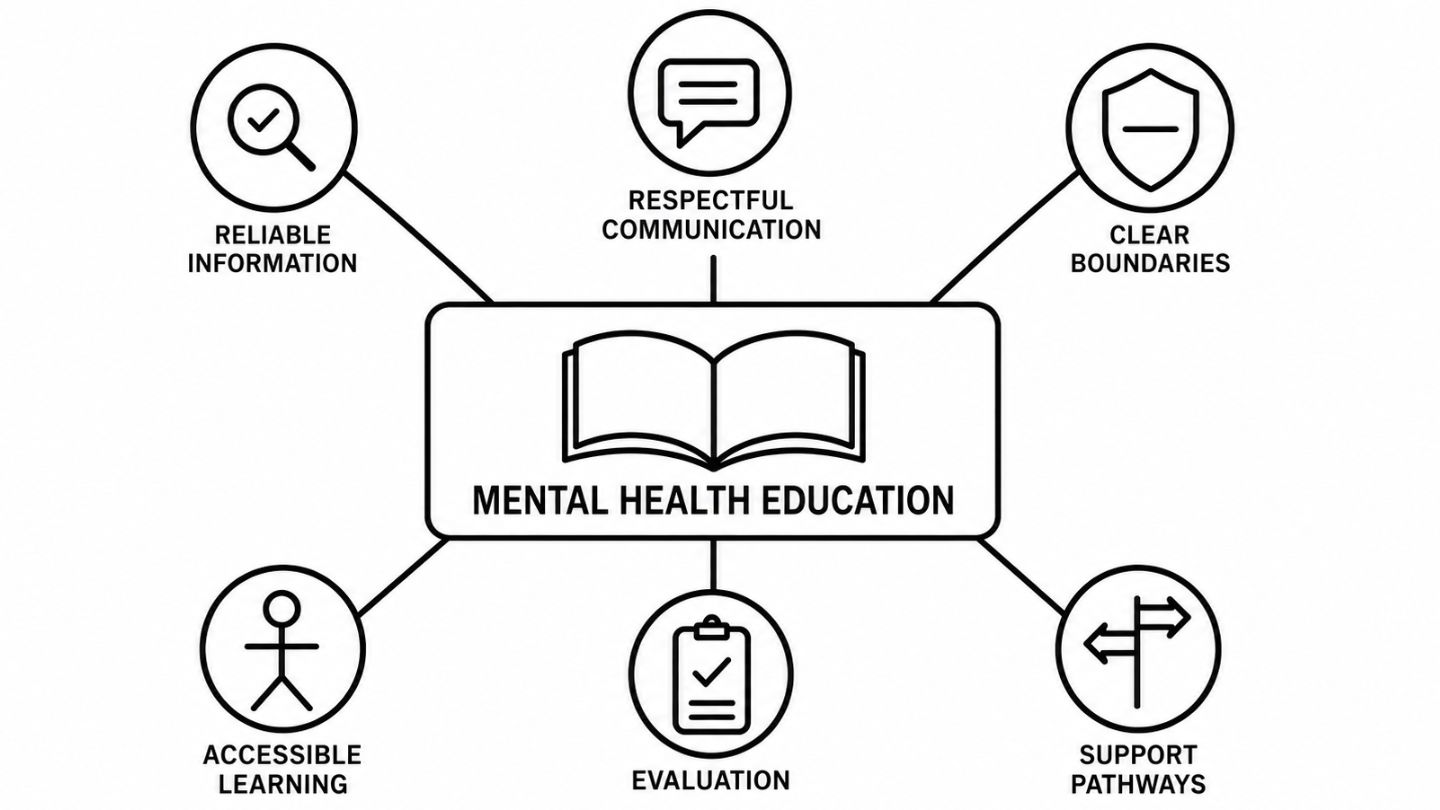
Mental health education gives people accurate language, reliable information, critical evaluation skills, and a clearer understanding of where support fits. In schools and colleges, it can help learners understand mental health concepts, question misinformation, communicate respectfully, and recognize the roles of teachers, counselors, families, peers, and qualified professionals.
Research most consistently supports improvements in knowledge and mental health literacy. Some programs also report changes in attitudes, stigma, or short-term help-seeking measures, but results vary across populations, settings, program designs, and follow-up periods. Mental health education is therefore most useful when it is part of a wider system that includes trained staff, supportive policies, clear role boundaries, privacy protections, and realistic support pathways.
This article provides general educational information. It does not offer diagnosis, treatment, or individualized mental health guidance.
Answer Summary: Mental health education matters because it helps people understand mental health, evaluate information, communicate without reinforcing stigma, and identify appropriate sources of support. Its clearest evidence concerns knowledge and literacy. Quality programs use accurate, age-appropriate content, trained delivery, clear professional boundaries, local adaptation, privacy protections, referral pathways, and evaluation that matches claims to measured outcomes.
Table of Content
- What Is Mental Health Education?
- How Is Mental Health Education Different From Awareness and Care?
- Why Does Mental Health Education Matter?
- What Does Research Show?
- Why Are Schools and Colleges Important?
- What Should Quality Mental Health Education Include?
- What Should Mental Health Education Avoid?
- What Can Mental Health Education Not Do Alone?
- What Roles Do Teachers, Families, Peers, and Professionals Have?
- Why Does Local Adaptation Matter?
- How Can a Mental Health Education Program Be Evaluated?
- Why Mental Health Education Matters in Practice
Key Takeaways:
-
Mental health education is different from diagnosis and treatment.
-
Knowledge gains are more consistently supported than lasting behavior change.
-
Help-seeking intentions and actual service use are different outcomes.
-
Teachers and peers can support learners but should not act as clinicians.
-
Learners should not be pressured to disclose personal experiences.
-
Programs need accurate content, trained delivery, privacy protections, and support pathways.
-
Global principles should be adapted to local languages, cultures, institutions, and services.
What Is Mental Health Education?
Mental health education is planned or informal learning that develops accurate knowledge, respectful attitudes, communication skills, information-evaluation abilities, and awareness of appropriate support pathways.
The World Health Organization’s mental health guidance describes mental health as a state of mental well-being that supports coping, learning, working, relationships, and participation in community life. It also explains that mental health exists on a continuum and is shaped by individual, family, community, and structural conditions.
This definition matters because mental health should not be reduced to a diagnosis, a temporary emotion, or a question of personal willpower.
Mental health literacy is a central part of mental health education. The WHO health-literacy framework focuses on people’s ability to access, understand, appraise, and use health information and services. It also recognizes that institutions share responsibility for making reliable information understandable and usable.
How Is Mental Health Education Different From Awareness and Care?
Awareness, literacy, education, and professional care are related, but they serve different purposes.
| Term | Main purpose | Important boundary |
|---|---|---|
| Mental health awareness | Recognize that mental health matters | Awareness alone may not develop practical skills |
| Mental health literacy | Understand concepts and evaluate information | Literacy does not provide individual assessment |
| Mental health education | Develop knowledge, communication, and support-navigation skills | Quality depends on content, delivery, and safeguards |
| Counseling or clinical care | Respond to individual needs through qualified practice | Care requires appropriate qualifications, consent, and privacy |
Awareness can begin a conversation. Literacy helps people interpret information and assess its reliability. Education develops these abilities through structured learning. Counseling and clinical care address individual needs through appropriately qualified professional practice.
Education Is Not Diagnosis
Mental health education should not encourage learners to diagnose themselves or other people.
It should avoid:
-
simplified diagnostic checklists;
-
activities that ask students to label classmates;
-
claims that ordinary emotional experiences confirm a condition;
-
public discussion of private experiences;
-
medication or treatment instructions;
-
promises that a lesson will prevent or resolve a condition.
Education can explain concepts, communication skills, and support pathways. Individual assessment and treatment belong to appropriately qualified professionals working within applicable professional standards.
Why Does Mental Health Education Matter?
Mental health education matters because learners encounter mental health claims through classrooms, social media, news, advertising, online videos, and personal conversations. The accuracy, context, and purpose of this information vary.
It Strengthens Information-Evaluation Skills
Education can teach learners to ask:
-
Who created this information?
-
What evidence supports the claim?
-
Which population or setting was studied?
-
Is the information current?
-
Does it distinguish education from diagnosis?
-
Is it educational, promotional, or commercial?
-
Does it explain its limitations?
These questions help learners avoid relying on confident but unsupported claims. A personal story may describe one person’s experience, but it does not prove that the same conclusion applies to everyone.
It Corrects Misinformation
Mental health education can explain that mental health is influenced by several interacting personal and social conditions rather than one characteristic or cause.
It can also correct assumptions that:
-
mental health difficulties reflect weakness;
-
a person can be diagnosed from a brief observation;
-
all distress has the same meaning;
-
one strategy works for everyone;
-
awareness automatically changes behavior;
-
teachers or peers should act as clinicians.
Accurate education uses calm, person-respecting language. It does not define people by a condition or use fear to gain attention.
It Can Address Stigma
Stigma may affect how people speak about mental health, respond to others, and approach available support. Education can introduce accurate terminology, challenge stereotypes, and encourage respectful communication.
However, outcomes differ across programs. Education may improve some attitude or stigma measures, but it should not be presented as a guaranteed or permanent solution.
It Clarifies Support Pathways
Mental health education can explain the difference between:
-
speaking with a trusted adult;
-
approaching a teacher or designated staff member;
-
contacting a school or college support service;
-
consulting a counselor;
-
seeking assessment from a qualified professional.
It can also explain what each role can provide and where its responsibilities end.
Readers seeking more information about institutional support roles can review Collegenp’s guide to the school counselors’ role in student success.
Knowledge of services, stated intentions to seek help, and recorded service use are separate outcomes. Actual use may also depend on service availability, trust, cost, distance, privacy, culture, family attitudes, and institutional procedures.
It Supports Responsible Communication
Shared terminology can help students, educators, and families discuss mental health without expecting untrained people to provide clinical answers.
Responsible communication includes:
-
respecting privacy;
-
avoiding pressure to disclose;
-
not discussing another person’s private situation publicly;
-
explaining the limits of confidentiality;
-
avoiding diagnosis by teachers or peers;
-
using approved institutional procedures when support is requested.
What Does Research Show?
Research supports a measured conclusion: mental health literacy programs often improve knowledge, while findings for stigma, help-seeking, sustained behavior, and clinical outcomes are less consistent.
| Outcome | Evidence pattern | Necessary qualification |
|---|---|---|
| Knowledge and mental health literacy | More consistent improvement | Results depend on the program, population, and measurement method |
| Attitudes and stigma | Improvement in some programs | Effects are not universal or necessarily lasting |
| Help-seeking measures | Some short-term improvement | Intentions are not the same as service use |
| Clinical outcomes | Not established as a general literacy-program result | Separate clinical evidence is required |
A 2025 systematic review and meta-analysis of adolescent mental health literacy interventions reported immediate improvements across several measures. Results varied by region and intervention type, and help-seeking effects were not maintained at the two-month follow-up. The review also identified limitations in the available evidence.
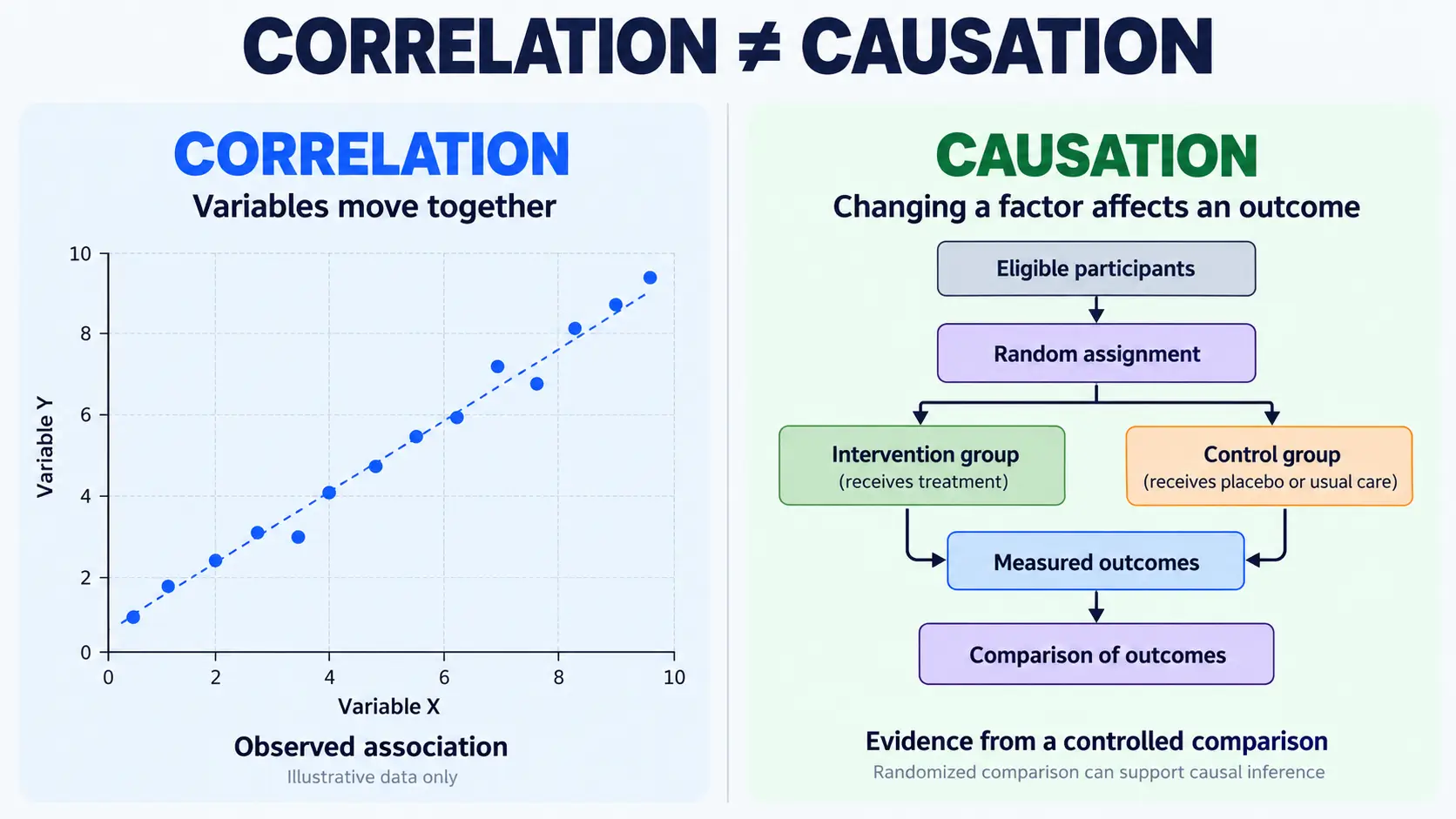
These findings do not mean mental health education is ineffective. They show why claims must identify the specific outcome that was measured.
Measured Outcomes Must Remain Separate
A higher knowledge score does not establish:
-
increased service use;
-
improved symptoms;
-
prevention of a condition;
-
safer institutional practice;
-
lasting behavior change.
A program claim should match its evidence:
-
A knowledge assessment supports a knowledge claim.
-
An attitude questionnaire supports an attitude claim.
-
A stated intention supports an intention claim.
-
Service records are needed for a service-use claim.
-
Clinical claims require suitable clinical measures.
These outcomes should not be combined into a broad claim that one program improves every aspect of mental health.
Follow-Up Periods Matter
An immediate result does not establish that a change will continue.
Program reports should state:
-
when outcomes were measured;
-
whether follow-up occurred;
-
who participated;
-
which measures were used;
-
whether results differed between groups;
-
which limitations were identified.
Short-term findings can be useful, but they should be described as short-term.
Why Are Schools and Colleges Important?
Schools and colleges can connect education with policies, trained staff, student-support roles, and established institutional procedures.
Their value does not come simply from reaching many learners. It depends on how the program is designed, delivered, supported, and evaluated.
A Whole-School and Systems Approach
The WHO, UNICEF, and UNESCO school-systems brief explains that mental health and well-being initiatives can be strengthened through a whole-school and systems approach. The brief supports cooperation between education, health, and related sectors rather than prescribing one curriculum for every country.
UNESCO’s guidance on mental health in education identifies five connected areas:
-
supportive policies and leadership;
-
safe and inclusive learning environments;
-
mental health and life skills within curricula;
-
teacher training and well-being;
-
links with health and protection services.
UNESCO also explains that teachers are important allies but are not mental health professionals. They need suitable training, support networks, and clear referral pathways.
School-Based Delivery Requires Preparation
A school program is less reliable when:
-
its content is inaccurate or excessively clinical;
-
staff have not received suitable preparation;
-
learners are expected to disclose personal experiences;
-
privacy boundaries are unclear;
-
support pathways are unavailable or outdated;
-
examples do not fit the learners’ language or context;
-
a single awareness event is presented as a complete strategy.
The education setting provides an opportunity for structured learning, but it does not guarantee a particular outcome.
For related classroom guidance, readers may review how teachers can support students’ mental health.
Considerations for Colleges
Higher-education institutions may need to consider:
-
adult learners;
-
international students;
-
disability access;
-
residential arrangements;
-
campus and off-campus services;
-
privacy and consent procedures;
-
differences between academic advice, counseling, and clinical care.
Institutions should define their own responsibilities and procedures rather than copying another institution’s model without local review.
Students balancing academic responsibilities and personal well-being may also find Collegenp’s guide on how to prioritize mental health in an academic schedule useful.
What Should Quality Mental Health Education Include?
Quality mental health education combines accurate content, suitable teaching, clear boundaries, privacy protection, accessibility, and realistic support pathways.
| Quality element | Why it matters | Question to verify |
|---|---|---|
| Accurate content | Reduces misinformation | Who wrote and reviewed it? |
| Age-appropriate design | Prevents unsuitable detail | Which learners was it designed for? |
| Trained delivery | Supports appropriate responses | What preparation is provided? |
| Clear role boundaries | Prevents informal diagnosis | What can each role do? |
| Privacy and choice | Protects learners | Is personal disclosure voluntary? |
| Accessible delivery | Supports participation | Are formats and activities inclusive? |
| Local support pathways | Connects education to real options | Have the services been checked? |
| Outcome-specific evaluation | Prevents exaggerated claims | What was actually measured? |
Accurate and Age-Appropriate Content
Content should:
-
use understandable terminology;
-
distinguish education from clinical assessment;
-
avoid self-diagnosis prompts;
-
use examples suitable for the age group;
-
explain privacy boundaries;
-
exclude treatment instructions.
Age suitability involves more than vocabulary. It also includes the activity format, examples, level of detail, discussion method, and expected personal participation.
Information-Evaluation Skills
Learners should know how to examine:
-
the author or organization;
-
the publication date;
-
the evidence source;
-
the population studied;
-
the purpose of the content;
-
acknowledged limitations.
Popularity, repetition, or emotional impact does not establish reliability.
Trained Delivery
Facilitators should understand:
-
the learning objectives;
-
their responsibilities and limits;
-
how to answer questions without diagnosing;
-
how to respond when a learner requests private support;
-
when institutional safeguarding procedures apply;
-
whom to contact under local procedures.
Privacy, Consent, and Choice
Programs should not require learners to share personal experiences.
Before using surveys, personal reflection exercises, or group discussions, institutions should determine:
-
whether participation is voluntary;
-
how information will be handled;
-
who may access it;
-
whether consent is required;
-
how learners can choose an alternative activity;
-
what happens when private support is requested.
Accessibility
Accessible delivery may require:
-
plain language;
-
captions or transcripts;
-
readable layouts;
-
compatible digital formats;
-
alternatives to group discussion;
-
translation or language support;
-
adjustments for disabled learners.
Honest Evaluation
Evaluation should state what changed, what did not, and what remains uncertain.
Relevant limitations may include:
-
a small participant group;
-
a short follow-up period;
-
no comparison group;
-
incomplete data;
-
differences among participant groups;
-
measures that do not capture real-world behavior.
What Should Mental Health Education Avoid?
Mental health education should avoid methods that confuse learning with assessment or place inappropriate responsibility on students and staff.
Simplified Self-Assessment
Brief symptom lists can encourage learners to label themselves or others without appropriate assessment. Educational content should explain concepts without turning a lesson into a diagnostic exercise.
Required Personal Disclosure
Activities that request personal stories may expose private information or create social pressure. Participation should not depend on sharing personal experiences.
Unclear Role Boundaries
Programs should not imply that teachers, parents, or peers should diagnose or treat learners. Supportive roles and professional care should remain distinct.
Support Information That Has Not Been Checked
Programs should not list services or referral routes without confirming that the information is current and relevant to the intended location.
One-Size-Fits-All Content
Language, examples, and institutional procedures created for one setting may not be suitable elsewhere. Programs need local adaptation.
Claims That Exceed the Evaluation
A knowledge gain should not be presented as proof of clinical improvement, prevention, or lasting behavior change.
What Can Mental Health Education Not Do Alone?
Mental health education cannot:
-
diagnose an individual;
-
provide clinical treatment;
-
guarantee service use;
-
remove financial or geographic barriers;
-
create services where none exist;
-
resolve unsuitable institutional conditions;
-
replace qualified professional care;
-
guarantee prevention or clinical improvement.
It also cannot remove every barrier affecting access to support, including cost, distance, language, privacy concerns, discrimination, and service shortages.
Education is one part of a broader support system. Its purpose is to improve knowledge, communication, and navigation rather than replace other services.
What Roles Do Teachers, Families, Peers, and Professionals Have?
Clear roles prevent responsibility from being placed on people without appropriate qualifications, authority, or institutional support.
| Role | Appropriate contribution | Boundary |
|---|---|---|
| Teachers and education staff | Teach approved content and follow institutional procedures | Do not diagnose or treat |
| Parents and caregivers | Communicate respectfully and help evaluate options | Do not replace qualified assessment |
| Peers | Listen respectfully and encourage appropriate support | Do not assess or carry responsibility alone |
| Counselors and support staff | Work within qualifications and institutional roles | Do not work outside their competence |
| Qualified professionals | Provide assessment or care within professional scope | Roles vary by jurisdiction |
Teachers and Education Staff
Teachers can provide accurate educational information, maintain respectful classroom conditions, and follow approved procedures when a learner requests support.
They should not diagnose, provide treatment, or promise confidentiality beyond institutional and professional requirements.
Parents and Caregivers
Parents and caregivers can:
-
listen calmly;
-
avoid blame;
-
help evaluate information;
-
discuss suitable local options;
-
respect privacy within applicable responsibilities.
They should not be presented as substitutes for qualified assessment or care.
Peers
Peers can listen respectfully and encourage contact with an appropriate trusted person.
They should not be expected to:
-
evaluate another person’s condition;
-
provide treatment;
-
make institutional decisions;
-
manage a difficult situation alone.
Counselors and Qualified Professionals
Professional titles, qualifications, licensing rules, and scopes of practice differ between locations.
Institutions should verify these details before publishing referral information or assigning responsibilities.
Why Does Local Adaptation Matter?
Global principles need local adaptation because language, culture, educational systems, professional roles, and access to services vary.
Local adaptation may include:
-
checking translations and terminology;
-
reviewing examples for cultural relevance;
-
consulting intended learners;
-
involving families and educators;
-
checking disability access;
-
mapping available services;
-
reviewing consent and privacy procedures;
-
updating referral information;
-
testing facilitator understanding.
Adaptation should preserve factual accuracy and evidence qualifications while making the program understandable and relevant to its intended setting.
How Can a Mental Health Education Program Be Evaluated?
A credible program should clearly state what it teaches, who developed it, which population it serves, how it is delivered, and what evidence supports its claims.
1. Who Developed and Reviewed It?
Look for named authors or responsible organizations, qualifications, source lists, review procedures, and update dates.
Labels such as “expert-approved” or “evidence-based” need supporting information.
2. Who Was It Designed For?
Check:
-
age;
-
education level;
-
language;
-
cultural setting;
-
accessibility needs;
-
institutional environment.
A resource created for adults or one national system should not automatically be used with school students elsewhere.
3. What Does It Claim to Change?
Identify the exact outcome:
-
knowledge;
-
mental health literacy;
-
attitudes;
-
stigma;
-
intentions;
-
service use;
-
clinical measures.
The evidence should assess the same outcome.
4. How Was It Evaluated?
Check whether the evaluation reports:
-
participant characteristics;
-
study design;
-
outcome measures;
-
comparison conditions;
-
follow-up period;
-
incomplete data;
-
study limitations.
5. Are Facilitators Prepared?
The program should describe training, supervision, boundaries, referral procedures, and privacy responsibilities.
6. Are Privacy and Consent Addressed?
Check whether the program collects personal or health-related information and how it is stored, accessed, and used.
7. Are Support Pathways Realistic?
Confirm that named services or referral routes are current and available in the relevant setting.
8. Is the Program Accessible?
Review language, disability access, activity design, digital compatibility, and alternatives to public participation.
9. Can Learners Give Feedback?
Learners should have an accessible way to report confusing, unsuitable, or inaccessible content.
10. Is There an Update Process?
Programs should periodically review terminology, evidence, links, referral information, and outcome claims.
For related student guidance, Collegenp provides articles on how to prepare for exams without stress and how to manage stress during exams. These are general student resources rather than treatment guidance.
Why Mental Health Education Matters in Practice
Mental health education matters because awareness alone does not teach people how to assess information, communicate responsibly, or understand support pathways.
Its clearest role is educational. It can build knowledge, improve the quality of discussion, challenge misinformation, and explain where different support roles begin and end.
Quality programs use accurate content, trained delivery, clear role boundaries, privacy protections, local adaptation, realistic support pathways, and evaluation that matches claims to measured outcomes.
Mental health education is most useful when it helps people understand the subject without asking students, teachers, parents, peers, or online resources to perform roles that belong to appropriately qualified professionals.





Comments 0
No comments yet. Be the first to start the conversation.