




A sentence can sound factual and still carry more certainty than its evidence allows.
This happens easily during ordinary writing. You read a report, an interview, a university page, a research paper, or an institutional statement. You understand what it says. Then you begin writing from memory. Somewhere between the source and the finished paragraph, a statement made by the source becomes a confirmed fact. An interpretation becomes part of the evidence. A personal experience becomes a claim about other people. An expert's assessment appears without attribution and begins to sound like an established conclusion.
The problem is not that writers have opinions. Analysis, interpretation, professional judgment, and experience all have legitimate places in useful writing. The problem starts when readers cannot tell which sentences are supported facts, which are interpretations, which come from direct experience, and which express judgment.
Established writing and journalism standards place strong emphasis on this distinction. Purdue OWL advises writers to evaluate authorship, evidence, timeliness, and cross-checking. The Society of Professional Journalists calls for verification before publication and use of original sources where possible. Reuters separates fact-based reporting from unattributed opinion, while the Associated Press requires disputed information to be attributed and internet material to be traced and vetted.
The practical goal is simple: write each statement with no more certainty than its evidence supports.
Answer Summary: To separate evidence from personal opinion, identify the exact claim first. Ask whether it can be checked, where the information came from, and what the source directly supports. Keep first-hand experience within the boundaries of what was experienced. Separate interpretation from the underlying evidence, attribute expert judgments and source claims, and leave uncertainty visible. When an important claim lacks adequate support, verify it, narrow it, attribute it accurately, or remove it.
Table of Content
- Why Fact Versus Opinion Is Only the Beginning
- Seven Statement Types Writers Need to Recognize
- Start With the Exact Claim
- Match the Evidence to the Claim
- Keep Personal Experience Within Its Proper Scope
- Separate Interpretation From Evidence
- Treat Expert Judgment as Judgment
- Understand What a Source-Stated Claim Proves
- A Real Classroom Example of the Difference
- How to Verify a Claim Before Publication
- What to Do When Reliable Sources Disagree
- Use a Claim–Evidence Audit Before Publishing
- The Final Editorial Test
- Conclusion
Key Takeaways:
-
A checkable statement still needs adequate evidence.
-
A source making a claim does not automatically confirm that claim.
-
First-hand experience supports what was directly experienced, not a universal conclusion.
-
Interpretation explains evidence but is not identical to the evidence.
-
Expert knowledge can strengthen a judgment without turning the judgment into a fact.
-
Attribution tells readers who is responsible for a statement.
-
Unresolved uncertainty should remain visible rather than being replaced with confident wording.
Why Fact Versus Opinion Is Only the Beginning
Fact versus opinion is useful for basic critical reading, but professional writing requires finer distinctions.
OpenStax teaches readers to distinguish facts, opinions, inferences, and bias. It also warns against opinions presented as facts and inferences based on insufficient factual support. Purdue OWL distinguishes first-hand research, including interviews, experiments, surveys, personal experience, and anecdotes, from information obtained through other texts and sources.
These distinctions matter because one paragraph can contain several different kinds of statements.
A report may provide data. An organization may explain those data. An expert may interpret their significance. A writer may compare the finding with other evidence and reach another conclusion. Each step can be useful, but they do not carry the same evidentiary status.
The Open University also teaches critical readers to distinguish fact from opinion and to examine whether opinions are supported by evidence. Its broader critical-reading course emphasizes reliable evidence, context, author perspective, and the use of qualified language to avoid unsupported generalizations.
For publication work, a simple two-category system leaves too much hidden.
Seven Statement Types Writers Need to Recognize
A writer who can classify a statement before publishing it is less likely to give it more certainty than it deserves.
| Statement type | What it means | Appropriate treatment |
|---|---|---|
| Verified factual claim | A checkable statement supported by adequate evidence | State accurately and cite or identify the source when needed |
| Source-stated claim | A person, organization, document, or institution states something | Attribute it to the source unless independently confirmed |
| First-hand experience | Something someone directly saw, used, did, measured, or experienced | Keep the wording within the genuine scope of that experience |
| Interpretation or inference | A conclusion drawn from evidence | Show that a reasoning step has occurred |
| Expert judgment | An assessment made using relevant expertise | Attribute it and distinguish the judgment from the supporting evidence |
| Personal opinion | A preference, evaluation, recommendation, or value judgment | Present it as judgment rather than objective fact |
| Unverified or conflicting claim | Evidence is absent, inadequate, outdated, or inconsistent | Verify further, disclose the uncertainty, narrow the wording, or remove it |
This classification solves a common editorial problem. It forces the writer to ask not only, “Is this sentence true?” but also, “What kind of sentence is this, and what gives me grounds to write it?”
Those are different questions.
Start With the Exact Claim
Fact-checking becomes easier when a paragraph is broken into individual claims.
A single sentence may contain a date, a comparison, a reason, an evaluation, and a prediction. One citation placed at the end does not prove that the source supports every part.
Start by asking: What am I asking the reader to accept?
If a statement can be checked against a document, dataset, record, observation, or other source, it is making a factual claim. Calling something a factual claim does not mean it has already been proven. It means the statement is capable of being checked.
If the sentence says that something is suitable, weak, unfair, effective, difficult, valuable, harmful, or preferable, evaluation has entered the sentence. Evidence may support the evaluation, but the evaluation remains a judgment.
If the sentence explains what evidence means, it contains interpretation.
If the sentence reports what another person or organization believes, concludes, predicts, alleges, or recommends, attribution matters.
This claim-by-claim approach is more reliable than asking whether an entire article is “factual” or “opinion-based.” Most substantial writing contains both evidence and interpretation.
Match the Evidence to the Claim
A credible source is useful only when it is suitable for the specific claim being made.
Purdue OWL recommends checking the author, the evidence provided, the timeliness of the material, references, intended audience, broad generalizations, and whether key information can be cross-checked. It also notes that the value of recency depends on the subject. Current scientific questions may require recent evidence, while historical research may legitimately depend on much older primary material.
Source selection should follow the claim.
An official rule is most securely checked against the current official rule or record.
A quotation should be traced as close as practical to the original interview, speech, document, recording, or publication.
A statistical statement should be checked against the report, dataset, research paper, or organization responsible for the figure.
A claim about someone's direct experience can be supported by that person's genuine account of the experience.
A conclusion about a larger group needs evidence capable of supporting a conclusion about that group.
The name or reputation of the publisher does not remove the need for this match. A reliable organization can be an authoritative source for one question and an indirect source for another.
Writers should ask two separate questions:
Does this source deserve consideration?
Does this source support this exact claim?
The second question is the one that protects the sentence.
Keep Personal Experience Within Its Proper Scope
First-hand experience can be valid evidence, but it has boundaries.
Purdue OWL recognizes personal experience and anecdotes as forms of first-hand research alongside interviews, experiments, and surveys. Google Search Central also discusses genuine first-hand experience as one way content can demonstrate useful knowledge, while emphasizing that trust is the most important aspect within its E-E-A-T framework.
The crucial issue is scope.
A genuine account of using a service can support a statement about that person's experience with the service.
It does not by itself establish how every user experiences the service.
A teacher's classroom observation can document what occurred in that classroom.
It does not automatically establish how all students respond under similar circumstances.
A worker can accurately describe a procedure used in one workplace without proving that the same procedure is standard across an entire profession.
Experience becomes misleading when the writing silently moves from “this happened here” to “this is what happens.”
The correction is not to remove experience. It is to state its boundary.
This distinction also protects writers from another problem: fabricated authenticity. A publication should not invent first-person use, interviews, observations, case studies, screenshots, or personal stories to make an article sound experienced. The supplied editorial research brief specifically treats genuine first-hand experience as different from research evidence and warns against overgeneralizing from it.
A reader gains more from an honest limitation than from a personal story that did not happen.
Separate Interpretation From Evidence
Evidence and interpretation work together, but they should remain distinguishable.
Evidence concerns what a source records, measures, documents, observes, or states. Interpretation concerns what someone concludes from that material.
OpenStax describes facts, inferences, and opinions as different elements of argumentative writing. Its guidance warns readers to look for inferences based on insufficient facts and for opinions presented as facts.
This distinction matters because two careful people can agree about the evidence and disagree about its meaning.
Clear writing gives readers access to both layers.
A report may show a change in a measured outcome.
A researcher may propose an explanation for the change.
Another researcher may accept the measurement but challenge the proposed explanation.
If an article writes the explanation as though it were part of the measurement itself, the reader loses the ability to see where evidence ends and reasoning begins.
Useful attribution signals include phrases such as “the report states,” “the authors conclude,” “the organization attributes the change to,” or “the available evidence supports a narrower conclusion.”
Qualification also matters. An inference supported by limited evidence should not be written with the same certainty as a directly documented fact.
Careful qualification is not weak writing. It is accurate writing.
Treat Expert Judgment as Judgment
Expertise can improve the quality of an opinion without changing the statement into a raw fact.
An expert may understand evidence, methods, limitations, and context better than a non-specialist. That makes the expert's assessment valuable. It does not mean every expert statement should appear without attribution.
The Associated Press says information that can reasonably be disputed should be attributed. Reuters says opinions from other people have a place in reporting when relevant, but quoted opinion should be authoritative and attributed.
For a reader, the distinction is meaningful.
“The study recorded X” describes evidence.
“The researchers interpret X as evidence of Y” reports interpretation.
“An expert considers Y the more plausible explanation” reports expert judgment.
These statements may appear together. They should not be collapsed into one stronger statement unless the evidence itself supports that stronger wording.
Authority deserves respect. It does not replace evidence.
Understand What a Source-Stated Claim Proves
One of the easiest mistakes in publishing is confusing evidence that a claim was made with evidence that the claim is true.
An institution may say that a program has a certain benefit. A company may describe its own service in favorable terms. An advocacy group may publish a policy claim. A press release may describe an event, result, or product from the issuing organization's perspective.
The source is direct evidence that the organization made the statement.
It is not necessarily independent confirmation of the underlying statement.
The Associated Press provides a useful real newsroom standard here. AP's published guidance says news releases are not published in their original form. Reporters are expected to judge their credibility, supplement release material with information from other sources, write independently, and credit material taken from the release. AP also says internet information must be vetted and attributed to its original source.
That principle applies far beyond newsrooms.
An official statement may be the correct primary source for what an organization says.
A separate source may be needed to confirm a disputed factual claim inside that statement.
The writer's task is to know which of those two jobs the source is performing.
A Real Classroom Example of the Difference
A documented classroom experience shows why quotation and evidence are easy to confuse.
In a KQED article first published in 2017 and updated in 2024, educator Alice Chen described hearing a student argue that a quotation was factual because it appeared in an article. The teaching problem was not whether the quotation had been copied correctly. The issue was that the existence of a quotation had been treated as proof that the statement inside it was a fact.
The distinction is important for writers of any age.
A quotation can prove that a person said something.
It does not, by itself, prove the truth of everything the person said.
If an official says a project is successful, the quotation can establish the official's stated view. Independent evidence is needed if the article also wants to establish the success claim as a fact.
If an expert predicts a future result, the quotation documents the prediction. It does not transform the prediction into a known outcome.
If a source makes an accusation, accurate quotation documents the accusation. It does not independently verify the accusation.
This is where attribution protects the reader. It preserves the difference between “this happened” and “this person says this happened.”
How to Verify a Claim Before Publication
A practical verification process starts with the strongest source available and works outward only as needed.
Find the original source
SPJ advises journalists to verify information before publication and use original sources where possible. AP likewise requires material obtained online to be vetted and attributed to its original source.
Information often passes through several layers.
A social post may quote an article.
The article may summarize a report.
The report may draw from a dataset.
If the claim depends on what the dataset found, reading only the social post or secondary article leaves the most important evidence unchecked.
Tracing information back does not mean every article needs primary research. It means the writer should know how far the claim has travelled from its evidentiary source.
Read what the source says, not what you expected it to say
Finding the source is only half of verification.
Check the section that supports the sentence.
Does it cover the same population?
The same date?
The same geographic area?
The same definition?
The same measurement?
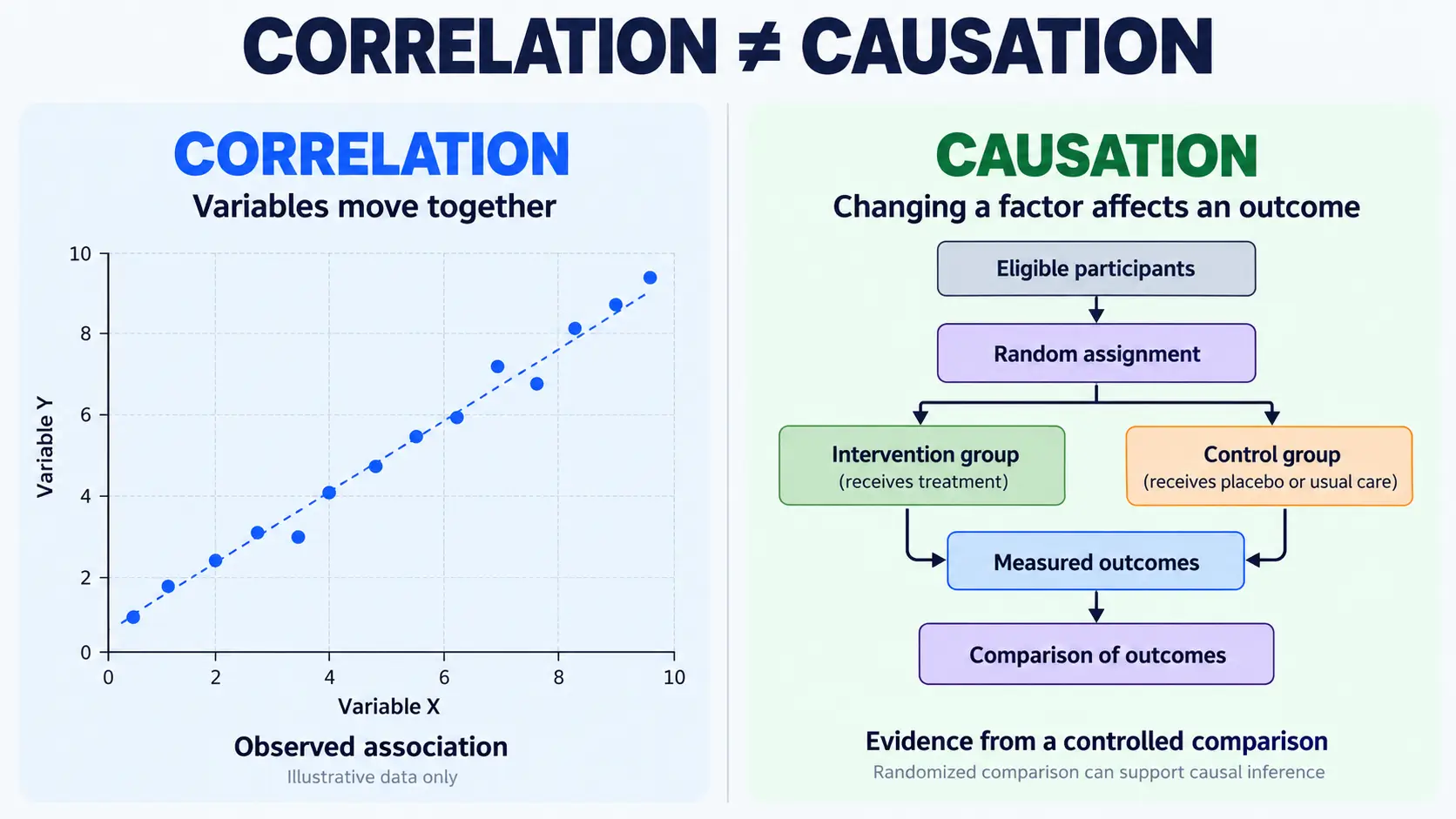
Does the source report correlation while the article claims causation?
Does the source describe an estimate while the article writes an exact figure?
Does it state a limitation that changes the meaning of the result?
A citation is not proof of accuracy when the cited material does not support the wording.
Cross-check where the risk warrants it
Purdue OWL describes cross-checking as comparing information from one source with information found elsewhere. Reuters also instructs journalists to cross-check information where possible and to be explicit about what remains unknown.
The amount of checking should reflect the claim.
A stable definition taken from an authoritative source may require little additional work.
A disputed, consequential, surprising, changing, or second-hand claim deserves stronger scrutiny.
Claims affecting admission, eligibility, deadlines, fees, health, safety, employment, legal rights, or other important decisions require more care because an error can carry a direct cost for the reader.
Check the date
Old information is not automatically bad information.
Outdated information presented as current is the problem.
Purdue OWL notes that some subjects need current sources, while historical research may rely appropriately on older material.
Writers should distinguish four dates when they matter: when the page was published, when it was updated, when the underlying event occurred, and what period the evidence covers.
Those dates are not interchangeable.
Check context
AP's standards state that quotations should not be taken out of context. SPJ likewise calls for sufficient context and warns against oversimplifying information when summarizing it.
A technically accurate fragment can still mislead if the surrounding material changes its meaning.
Verification includes the sentence before and after the quotation, the methodology behind a figure, the conditions attached to a rule, and the limitations attached to a finding.
What to Do When Reliable Sources Disagree
Conflicting sources do not give the writer permission to choose whichever statement produces a cleaner article.
Start by checking whether the sources are answering the same question.
Differences can come from publication date, geographic scope, population, methodology, terminology, document version, or institutional responsibility.
Next, examine source proximity.
For an official rule, the body responsible for that rule usually deserves more weight than a secondary summary.
For a research finding, the original study provides information that a later commentary may omit.
For a quotation, the original recording or transcript can resolve wording that has changed through repeated citation.
For a current requirement, a newer official document may replace an older document.
If the disagreement remains unresolved, preserve it.
A defensible sentence may state that the available sources give different information and that the discrepancy could not be resolved from the material reviewed.
That sentence tells the reader something important.
False certainty would hide it.
Use a Claim–Evidence Audit Before Publishing
A small audit table can expose problems that remain invisible during ordinary proofreading.
| Claim | Evidence Check | Publication Decision |
|---|---|---|
| Write the exact statement being made and classify it as fact, source-stated claim, experience, interpretation, expert judgment, opinion, or unresolved claim. | Identify the source, check the original where practical, confirm what it directly supports, and note any uncertainty, limitation, or conflicting evidence. | Publish as written, revise the wording, add attribution, verify further, disclose uncertainty, or remove the claim. |
The most useful question is not simply, “Do I have a source?”
It is: “What does this source actually support?”
That question helps catch citations that support only part of a sentence, opinions written as facts, institutional claims treated as independent confirmation, outdated information, overgeneralized personal experience, and interpretations presented without attribution.
The most useful question in the table is not “Do I have a source?”
It is “What does this source prove?”
That one question catches several common errors at once: citations that support only part of a sentence, opinions treated as facts, organization claims presented as independent confirmation, outdated information, overgeneralized experiences, and interpretations that have lost their attribution.
The audit also improves editing efficiency. A writer does not need to distrust every sentence equally. Attention can be directed toward claims that are consequential, disputed, unfamiliar, changing, numerical, causal, or broader than the evidence supporting them.
The Final Editorial Test
Before publication, read the article once more without asking whether it sounds polished.
Ask whether every material statement is carrying the correct label in the reader's mind.
Can the evidence be traced?
Is direct experience presented only as direct experience?
Can the reader distinguish what a source said from what the writer independently confirmed?
Is an interpretation visible as interpretation?
Is an expert judgment attributed?
Is a personal evaluation written as evaluation?
Is uncertainty still visible where verification stopped?
Would the wording change if the supporting source disappeared?
That last question is useful. If removing the source would make the sentence impossible to defend, the source relationship needs to be clear enough for the reader to understand.
Responsible publishing also continues after publication. Reuters, AP, and SPJ all include correction or accountability principles in their published standards. Reuters says errors should be corrected transparently; AP calls for corrections to be made fully and transparently; SPJ says journalists should acknowledge mistakes and correct them promptly and prominently.
Evidence-based writing is not a performance of certainty. It is a record of what the writer can support, what the sources say, what remains interpretive, and what is still unknown.
Conclusion
Separating evidence from personal opinion does not require removing personality, judgment, or analysis from writing.
It requires keeping their boundaries visible.
Evidence should be traceable to a source appropriate for the claim. First-hand experience should remain within the limits of what was genuinely experienced. Interpretation should show where reasoning has moved beyond the raw evidence. Expert judgment should be attributed. Personal opinion should be recognizable as judgment. Source-stated claims should not quietly become independently confirmed facts.
When evidence is weak, the answer is not stronger wording.
The answer is better verification, narrower wording, clearer attribution, an honest statement of uncertainty, or removal of the unsupported claim.
Readers do not need a writer who sounds certain about everything. They need a writer who shows them why each important statement deserves the confidence placed in it.





Comments 0
No comments yet. Be the first to start the conversation.