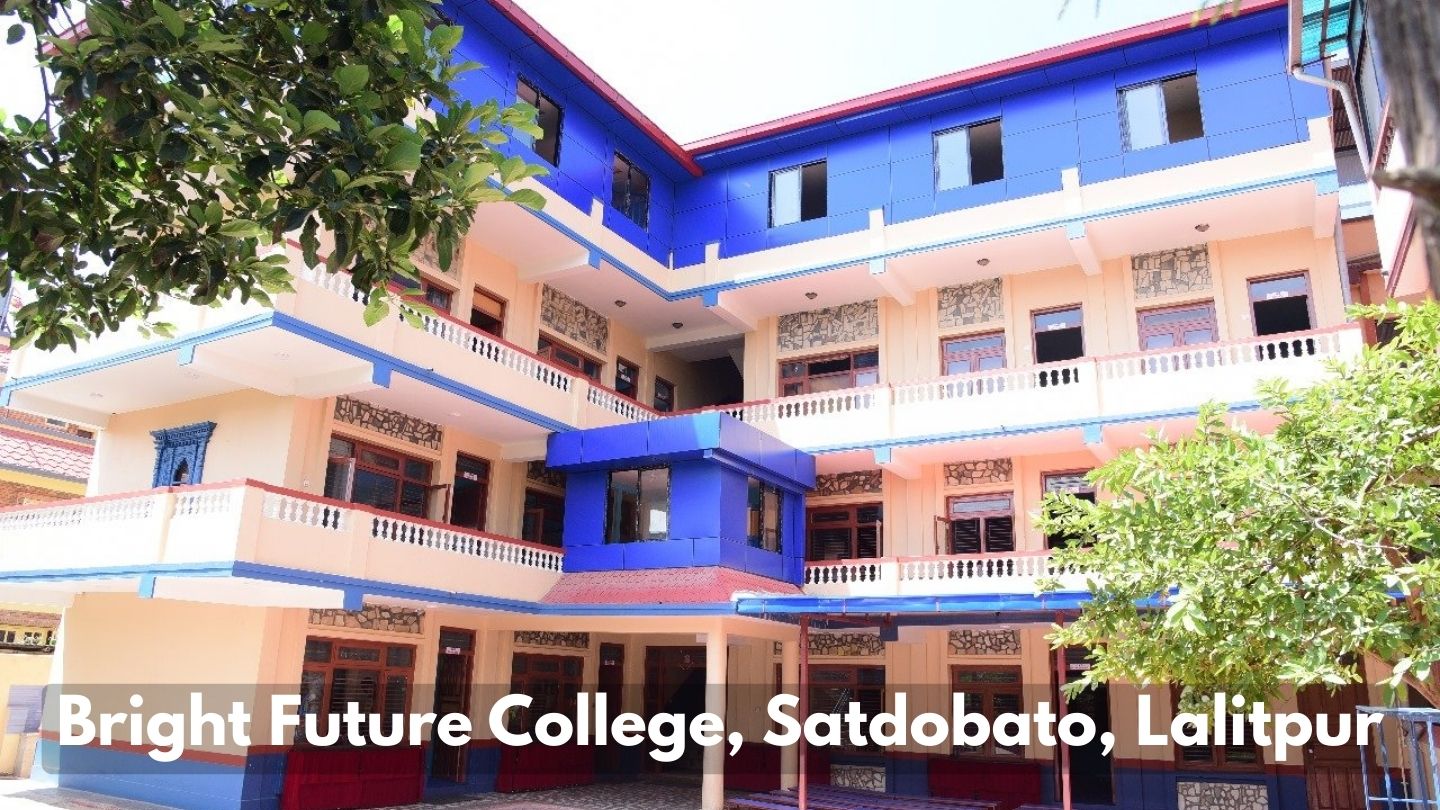
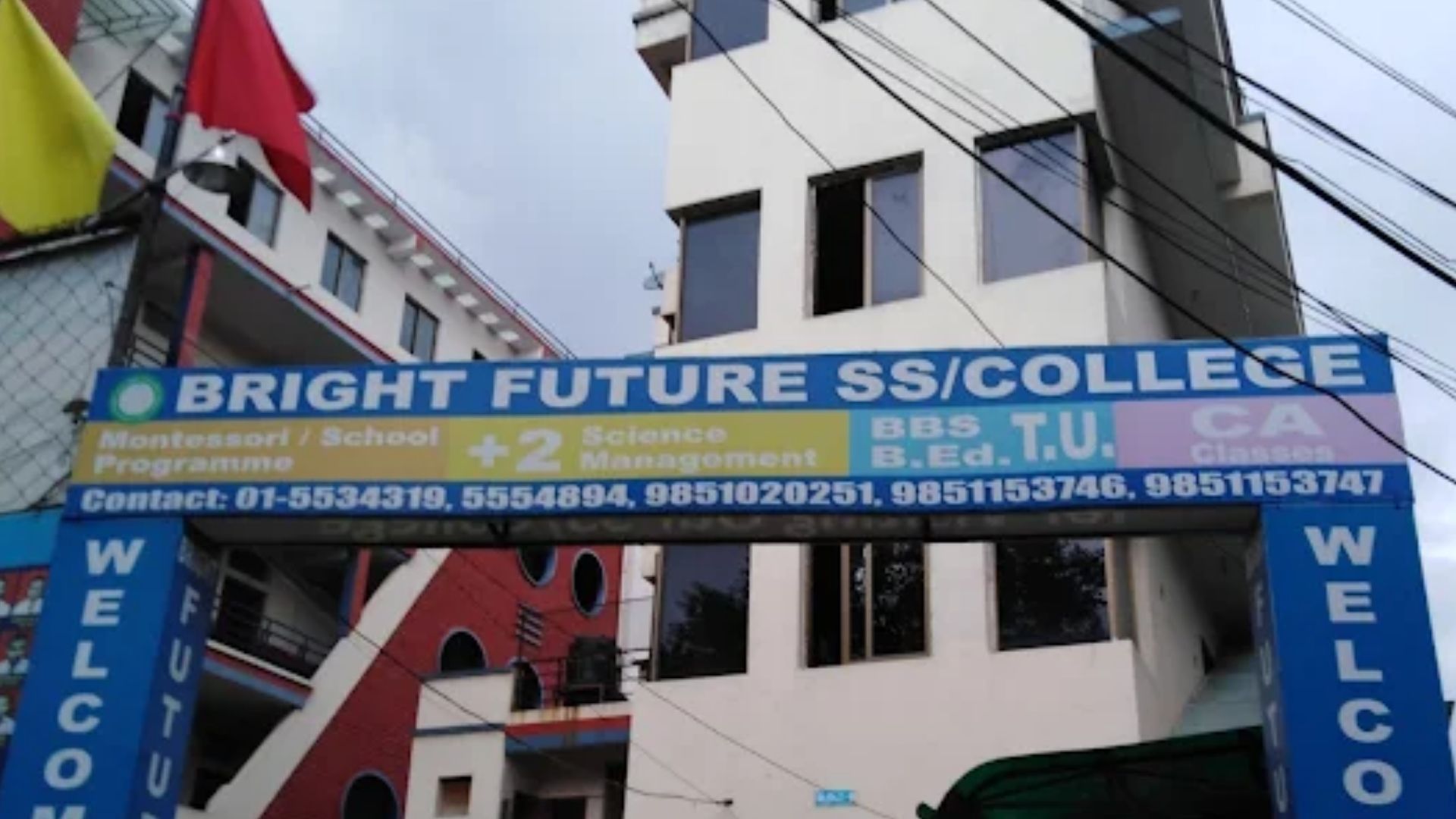
Bright Future College is a private educational institution located in Satdobato, Lalitpur, Nepal. The institution records its establishment year as 2009 AD and presents itself as approved by the Ministry of Education.
It offers Ten Plus Two (+2) programs under the National Examination Board (NEB) and bachelor-level programs under Tribhuvan University (TU), which means academic rules, examinations, and certification follow the relevant affiliating body.
Type: Private educational institution
Location: Satdobato, Lalitpur, Nepal
Established: 2009 AD
Status: Approved by the Ministry of Education
Affiliated bodies: NEB for +2; TU for bachelor programs
Programs listed: +2 Science, +2 Management, +2 Humanities, +2 Law, +2 Education; BBS; B.Ed
Class time noted: 6:00 am to 10:30 am
Campus leadership named: Kishor Adhikari (Campus Chief)
Bright Future College lists programs at two levels: Ten Plus Two (+2) under NEB and bachelor programs under TU. The affiliation matters because curriculum, examination forms, result publication, and certification are handled through the official system of the affiliating body.
The following +2 programs are listed:
Ten Plus Two (10+2) Science
Ten Plus Two (10+2) Management
Ten Plus Two (10+2) Humanities
Ten Plus Two (10+2) Law
Ten Plus Two (10+2) Education
At +2 level, validity has a practical meaning: the stream is open for the year, subject combinations are available, students can be registered under NEB processes, and they can sit for board examinations under NEB rules.
Applicants should confirm stream-wise subject groups, lab requirements, and seat availability according to the latest admission notice.
The bachelor programs listed are:
Bachelor of Business Studies (BBS)
Bachelor of Education (B.Ed)
For TU programs, validity relates to TU affiliation and the campus meeting requirements for student registration, internal assessment, exam form submission, and participation in TU examinations.
Students should confirm how the campus handles registration timelines, internal evaluation records, and exam-related communication according to the intake notice.
Eligibility is the first checkpoint. Admission requirements describe what documents are needed, how selection is done, the fee schedule, and the deadlines. Since eligibility rules can change, applicants should treat all criteria as “according to notice” for the intake year.
A policy reference indicates a minimum average GPA of 1.6 for students moving from Grade 10 (SEE) to Grade 11. Students should confirm the current requirement from the latest admission notice and the official guidance used for that year, especially when rules differ by stream or subject group.
For bachelor admissions, applicants generally need completion of 10+2 (or equivalent). The intake notice should state:
minimum academic requirement accepted for the year
required documents (transcripts, character certificate, photos, and other items listed)
selection method (merit list, entrance assessment, interview/counseling, or a combination)
deadlines and fee-payment schedule
If the notice includes any additional conditions, those conditions become the official reference for that intake.
A clear admission pathway reduces confusion and protects students from unofficial information. The steps below are written as a practical checklist. Each step should match the current notice.
Read the admission notice and confirm validity dates, eligibility, and stream availability.
Submit the application form through the method stated by the college.
Prepare documents required for the intake (SEE-related documents and other items listed in the notice).
Attend the selection step if it is part of that intake (assessment, interview, or counseling).
Pay the required fees within the deadline and keep receipts safely.
Complete original-document verification if requested before final enrollment.
Attend orientation, which usually covers rules, routine, and communication practice.
Check eligibility and match your documents with the intake requirement.
Submit the application and required documents within the stated period.
Follow the selection method stated in the notice and track the published result or call notice.
Complete enrollment and confirm TU-related processes (registration, exam forms, and internal assessment rules).
The institution identifies a Campus Chief and also lists an academic contact role for program communication. For students, the best way to judge teaching and learning practice is to look for predictable routines and clear academic rules.
class routine and attendance rules
How internal assessment is recorded and communicated
access to labs for science and computer-related learning
counseling availability for stream selection and academic planning
how official notices are shared (notice board, website, SMS, or other channels)
The class time noted is 6:00 am to 10:30 am. Students should confirm whether the same timing applies to every program and every level, since routines can change by intake and by academic level.
A student-friendly campus profile should name facilities without exaggeration and explain how they support learning and daily routine.
Library and e-library for reading, reference, and quiet study
Science lab for practical learning in science subjects
Computer lab for digital learning, assignments, and subject support
Cafeteria for daily student needs during class hours
Parking for students and staff who commute
Playground and sports space for physical activity
Entertainment hall used for cultural and group activities
Campus experience is shaped by routine, learning support, and access to facilities. Morning class timing can suit students who prefer early study hours and want the remaining day for family responsibilities, travel, or additional learning activities.
The institution also lists items connected with student participation and support such as sports, classroom learning aids, conference or meeting spaces, tours, and ECA. Students should confirm what is active for the year through the activity calendar or notices, since activities depend on the academic calendar and scheduled events.
ECA supports communication, teamwork, discipline, and participation in campus life. A reliable ECA section is notice-based, not assumption-based.
the activity calendar for the year and participation rules
safety rules and consent process for tours and off-campus activities
any costs, deadlines, and refund rules (if applicable)
whether participation records are maintained for institutional reporting
Bright Future College indicates scholarship support for deserving students and describes fees for bachelor programs as moderate. For publication accuracy, scholarship details should be treated as notice-based.
scholarship category (merit-based, need-based, or category-based) and eligibility
documents required and submission deadline
selection method and result publication date
continuation rules (attendance, internal performance, and renewal period)
validity period and the number of terms covered
The recorded milestones include establishment in 2009 AD and the operation of +2 programs under NEB alongside TU bachelor programs (BBS and B.Ed). Beyond those items, public-facing milestones should be added only when they are supported by dated records such as official notices, audited summaries, or verifiable institutional reports.
Keep a copy of the admission notice for the intake year
Keep fee receipts and enrollment confirmation
Confirm the stream, subject group, and exam participation rules under NEB or TU
Confirm scholarship decisions in writing and keep a dated copy
Confirm any rules on attendance, internal assessment, and exam form submission
This section is written as a neutral tool for decision-making.
Confirm the program level and affiliating body (NEB or TU)
Confirm the program is open for the intake year and note the validity dates
Confirm eligibility and admission requirements according to notice
confirm the fee schedule and refund rules (if stated) before payment
Choose a +2 stream based on interest, academic background, and next-step study plans
for BBS and B.Ed., confirm routine, internal evaluation practice, and exam communication
commuting time and the feasibility of morning classes
access to labs and study spaces
counseling and guidance availability
Scholarship criteria and decision timeline
The Campus Chief is named as Kishor Adhikari. The leadership message focuses on student learning, critical thinking, and co-curricular participation as part of campus life. For an informational profile, the key point is that leadership frames the institution’s role as academic support within NEB and TU structures.
Bright Future College, Satdobato, Lalitpur is a private institution established in 2009 AD. It presents itself as approved by the Ministry of Education, affiliated with NEB for Ten Plus Two (+2) programs, and affiliated with TU for bachelor programs, including BBS and B.Ed. For reliable decisions, applicants should confirm eligibility, deadlines, and program validity according to the latest notice for the intended intake year and keep written records for transparency.
The institution lists NEB affiliation for +2 programs and TU affiliation for BBS and B.Ed. Applicants should confirm current validity through the latest notices and the intake-year process used by the campus.
Science, Management, Humanities, Law, and Education are listed. Subject combinations and seats should be confirmed according to notice.
BBS and B.Ed are listed under TU affiliation. Eligibility and the selection method should be confirmed according to notice.
A minimum average GPA of 1.6 for Grade 11 entry is referenced. Confirm the current requirement through the latest notice used for the intake year.
The listed facilities include library, e-library, science lab, computer lab, cafeteria, a parking, a playground, and an entertainment hall.
A morning class time of 6:00 am to 10:30 am is noted. Confirm the current routine for your chosen level and program.
Scholarship details should be verified through a dated scholarship notice or written criteria that states eligibility, selection method, renewal rules, and validity period.
Contact Bright Future College's administrative office for detailed information on the course, admissions, location, fees, scholarships, facilities, counseling or eligibility.
Bright Future College
Email Address: schoolcollegebrightfuture@gmail.com
Phone Number: +977-1-5434319, +977-1-5454894, +977-1-5444807, +977-9851153747, +977-9851153746, +977-9851020251, +977-9843042785
Website: http://bfc.edu.np
Location: Lagankhel to Satdobato Road, Satdobato, Lalitpur, Nepal


.png)