Overview
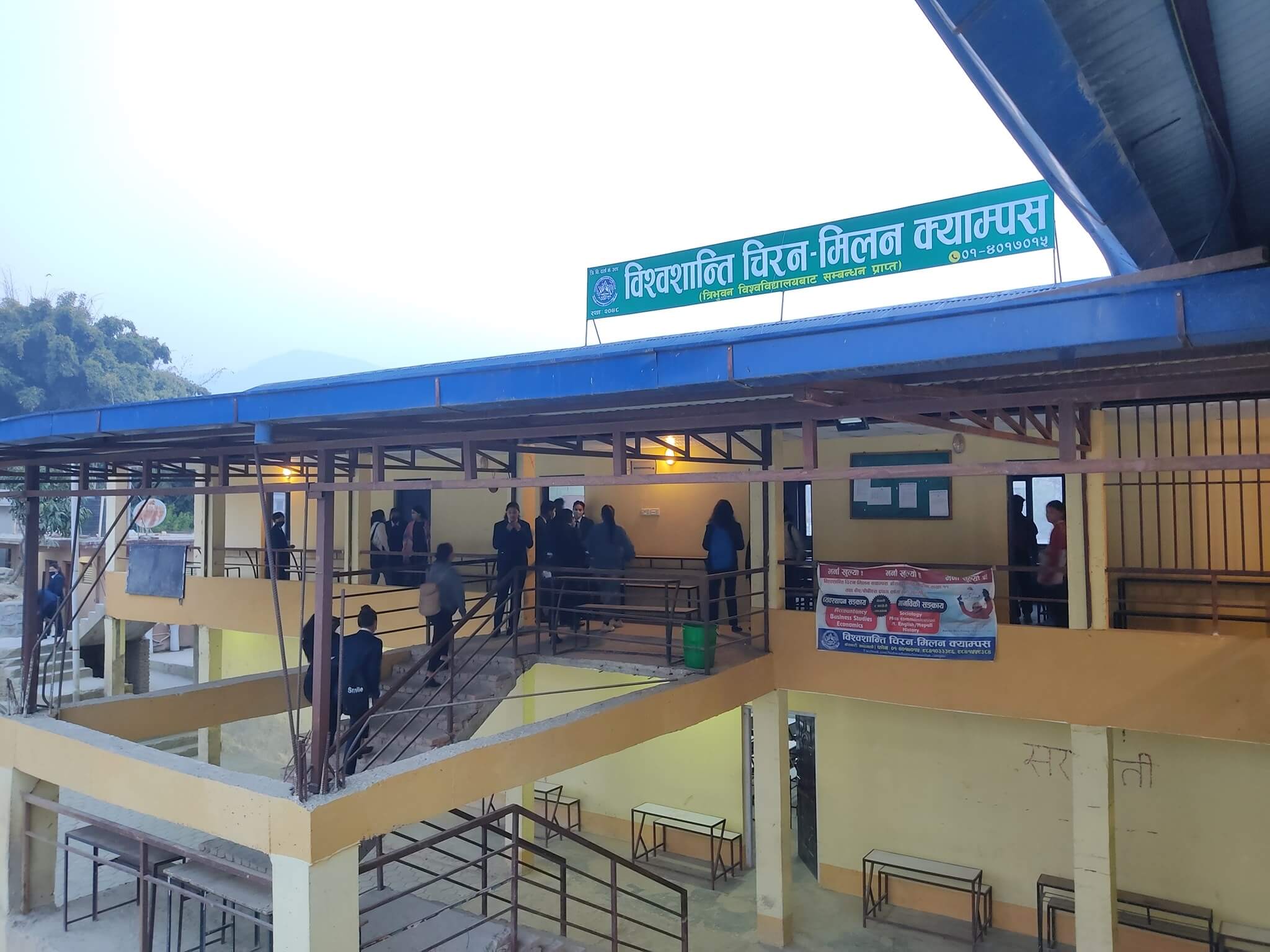
Bishwa Shanti Chiran-Milan Campus (BSCMC) is a community-run, non-profit institution in Bansbari, Kathmandu. It was established in 2048 BS (1992 AD) with the aim of widening access to higher secondary and undergraduate study. The campus runs +2 programs under the National Examination Board (NEB) in Management and Humanities, and bachelor’s programs under Tribhuvan University (TU) in Bachelor of Business Studies (BBS) and Bachelor of Arts (BA).
Morning classes help students manage study alongside family and work. Over the years, the campus has strengthened its internal examination system, expanded facilities, and maintained a steady, community-supported learning environment.
Quick Highlights
-
Type: Community, non-profit campus
-
Location: Bansbari (Maharajgunj area), Kathmandu Metropolitan City, Ward 3
-
Established: 2048 BS (1992 AD)
-
Affiliations: NEB (+2 level) and Tribhuvan University (BBS, BA)
-
Streams: +2 Management, +2 Humanities, BBS, BA
-
Class Timing: Morning shift
-
Student Base: Learners from 60+ districts, including remote areas
-
Assessment: Examination Committee with published calendar and regular internal tests
-
Facilities: Permanent buildings, library, computer access, safe drinking water, campus garden
-
Support: Need-based and merit scholarships, fee concessions as per rules
Academic Programs Offered
Ten Plus Two (Class 11–12), NEB: Management
The Management stream builds the basics for business study. Students learn accounting, economics, and business foundations with regular class tests and assignments. The course suits those planning to continue into TU’s BBS and other management degrees.
Ten Plus Two (Class 11–12), NEB: Humanities
The Humanities stream focuses on languages and social sciences. Students study Nepali, English, Sociology, Psychology, Economics, and other NEB-approved subjects. It supports pathways to BA and roles that value reading, writing, and social analysis.
Bachelor of Business Studies (BBS), Tribhuvan University
BBS is a four-year program covering areas such as accounting, finance, marketing, business law, and organizational behavior. Teaching follows TU syllabi with steady pacing, unit tests, and internal evaluation. The morning schedule is practical for working learners.
Bachelor of Arts (BA), Tribhuvan University
The BA program runs within TU’s Faculty of Humanities and Social Sciences. Offered subjects include Compulsory English, Major Nepali, Optional English, Sociology, and Mass Communication and Journalism. Students develop writing, analysis, and media awareness for varied roles in education, media, and the social sector.
Admission Process
Eligibility
-
BBS and BA: Completion of 10+2/PCL/Intermediate or an equivalent qualification from a recognized board.
-
+2 Management and +2 Humanities: Completion of SEE or an equivalent qualification.
Steps
-
Collect the enrollment form from the campus account section.
-
Fill in accurate personal and academic details.
-
Attach required documents (recent photographs, marksheets/transcripts, character certificates, and identity copies).
-
Submit the form within the deadline announced by the campus.
After Application
-
Selection follows campus rules for each intake.
-
Orientation explains class schedules, internal tests, library use, and student support processes.
Teaching Faculty and Learning Methodology
Teachers at BSCMC have long experience with NEB and TU curricula. Classes move through unit plans and past-paper patterns. Short quizzes, mid-term tests, and assignments form part of internal evaluation. Faculty coordinate with the Examination Committee to keep the academic calendar on track and to reduce schedule clashes.
In BBS, learners practice accounting entries, ledgers, and basic analysis. In BA and +2 Humanities, they work on reading responses, short essays, and group discussion. In +2 Management, they build study habits for business courses through regular tasks in accounting and economics.
Infrastructure and Learning Facilities
Land and Buildings
The campus operates on public land provided with local government support in the Bansbari area. Over time, BSCMC constructed permanent academic buildings with help from the University Grants Commission (UGC), the District Development Committee, local authorities, and community donors. A two-storey academic block supports daily teaching and administration. At present, there are three permanent buildings with classroom and office spaces.
ICT, Library, and Study Spaces
Classrooms use basic ICT tools when needed. During the pandemic period, the campus conducted virtual classes to maintain learning continuity. The library holds core NEB and TU texts, references, newspapers, and selected journals. UGC support has contributed to library resources, computers, and furniture. A reading room supports quiet study before or after morning classes.
Water, Hygiene, and Upkeep
A deep borewell and water purification system are in place with local government support. Building painting and upkeep have improved the study setting. Each building has toilets, and the garden area offers a calm space for short breaks.
Student Life and Campus Experience
BSCMC has a close-knit feel. Students from more than 60 districts share notes, discuss exam strategies, and form small study groups. Informal counselling by teachers helps with subject choices, time management, and examination planning. The culture encourages punctuality, steady attendance, and respectful conduct.
Extracurricular Activities (ECA)
Activities vary by year and interest, and may include:
-
Literary circles, creative writing, and debates
-
Quiz and speech events
-
Social outreach with local bodies
-
Sports and games at available facilities or partner venues
-
Media-related workshops for BA groups
-
Study and career skills sessions for +2 and BBS learners
ECA schedules avoid clashes with internal tests and the academic calendar.
Scholarships and Financial Support
The campus provides support to students from low-income and marginalized backgrounds. Merit-based recognition is also available. Awards follow campus rules, available funds, and committee decisions.
Illustrative Fee Structure (Bachelor’s Level)
The figures below reflect the provided data. Applicants should verify current amounts at the account section.
| Level / Year | Components | BBS Total (NPR) | BA Total (NPR) |
|---|---|---|---|
| 1st Year | Admission 5000; Library Deposit 1000; TU Registration 1000; First 5000; Second 5000; Third 5000; Internal/Project 1000 (BA only) | 22,000 | 23,000 |
| 2nd Year | Admission 6000; First 5000; Second 5000; Third 5000; Internal/Project 1000 (BA only) | 21,000 | 22,000 |
| 3rd Year (set A) | Admission 6500; First 5000; Second 5000; Third 5000; Internal/Project 1000 (BA only) | 21,500 | 22,500 |
| 3rd Year (set B) | Admission 6500; First 5000; Second 5000; Third 5000; Internal/Project 3500 | 25,000 | 25,000 |
Notes:
-
Items may differ by year or cohort.
-
Separate board/University examination fees may apply.
Achievements and Institutional Milestones
-
2048 BS: Campus established as a community initiative in Bansbari.
-
Early period: Proficiency-level classes started under TU.
-
2062 BS: Management stream (BBS) added.
-
2063 BS: Humanities and Social Sciences (BA) introduced.
-
2063 BS: Community fundraising (Mahayagya) supported infrastructure planning.
-
2064–2065 BS: About four ropanis of public land in Bansbari (Jaladhunga/Gairigaun area) granted for campus use with local facilitation.
-
Subsequent years: Two-storey academic building and additional facilities constructed with UGC, DDC, and community support.
-
Recent: Deep borewell, water purification, building painting, and garden maintenance completed.
Examination System and Quality Measures
An active Examination Committee manages the internal testing process. Key steps include a published schedule, timely question paper management, and review meetings among the Campus Chief, department heads, and the committee. Observed outcomes include better participation, clearer procedures, and improved timelines for result publication.
Governance and Community Role
BSCMC operates with stakeholder participation through its Management Committee and campus leadership. Rules, bylaws, and directives guide daily operations, facility upkeep, scholarships, and academic calendars. The campus works with local government and national bodies (UGC and others) for compliance and support. Parents and local supporters contribute during events and small improvement drives.
Student Support
-
Academic advising for +2 and BA subject combinations
-
Attendance monitoring and early alerts
-
Remedial help around exam periods
-
Library reading room for quiet study
-
Notices and class groups for schedule updates
Why Choose This Campus?
-
Community-run and non-profit with accessible fee points
-
NEB +2 and TU bachelor’s pathways in one campus
-
Morning classes that suit working and commuting learners
-
Teachers with long experience in NEB/TU syllabi
-
Examination Committee with a clear calendar and steady internal testing
-
Students from many districts, adding range to peer learning
-
Library, basic ICT support, safe drinking water, and maintained classrooms
-
Transparent governance with community involvement
Future Program Directions
Student interest indicates demand for fields such as Tourism, Hotel Management, Social Work, and Hospitality. The campus plans to introduce new programs when infrastructure, staffing, and affiliation approvals align. Current focus remains on strengthening existing programs and classroom processes.
Conclusion
Bishwa Shanti Chiran-Milan Campus is a community institution serving +2 and bachelor-level learners in Bansbari, Kathmandu. With NEB and TU affiliations, morning classes, a working internal exam system, and practical facilities, the campus provides a steady route for students who want an accessible study option. Growth over the years—land allocation, permanent buildings, library additions, water systems, and upkeep—reflects joint effort from local bodies, UGC programs, and the community.
Prospective students can visit the campus office for current admission dates, fee confirmation, scholarship categories, and guidance on subject choices.
Contact Bishwa Shanti Chiran-Milan Campus's administrative office for detailed information on the course, admissions, location, fees, scholarships, facilities, counseling or eligibility.
Contact Details
Bishwa Shanti Chiran-Milan Campus
Phone Number: +977-1-4017015, +977-9841033396, +977-9841559384
Email Address: info@bishwashanticampus.edu.np
Website: https://www.bishwashanticampus.edu.np
Location: Bansbari, Kapanmarg, Kathmandu