Drabya Shah Multiple Campus (द्रब्य शाह बहुमुखी क्याम्पस, गोरखा) is a community campus in Gorkha with programs at the +2, undergraduate, and postgraduate levels. Established in 2042 B.S. (1985 A.D.) through the initiative of local education supporters and social workers, it was founded to widen access to higher education in the district.
The DSMC is affiliated with Tribhuvan University for its higher education programs and runs Grade 11 and Grade 12 under the National Examinations Board (NEB). Located at Laxmibazar in Gorkha Municipality, the campus combines long local roots with an academic structure that includes management, education, and humanities streams, along with scholarship support, student services, and a quality assurance framework.
Established: 2042 B.S. (1985 A.D.)
Institution Type: Community campus
Location: Gorkha-8, Laxmi Bazar, Gorkha, Nepal
University Affiliation: Tribhuvan University (TU) for higher education programs
Board Affiliation: NEB for Grade 11 and Grade 12
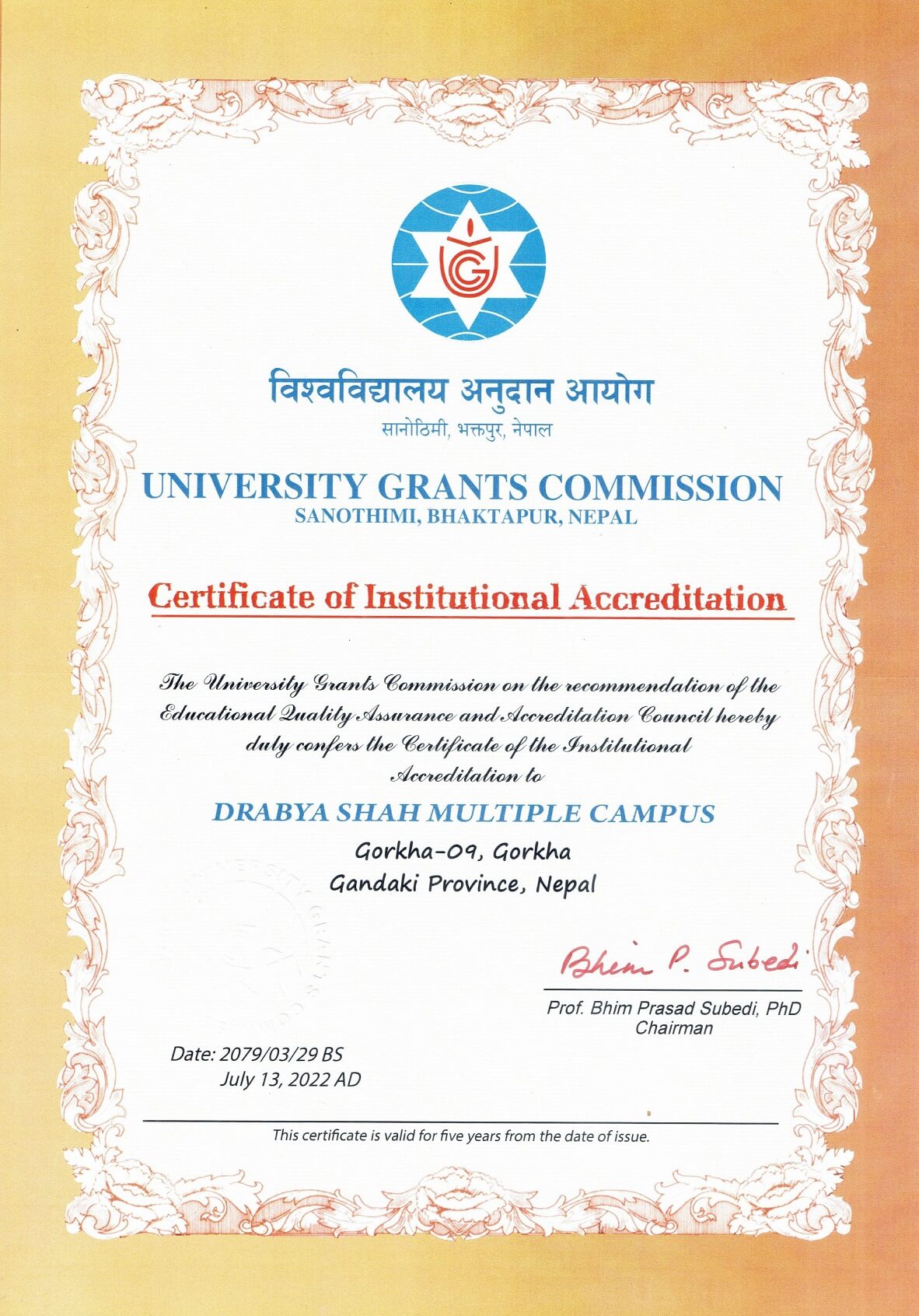
Recognition: QAA accredited by the University Grants Commission in 2079 B.S.
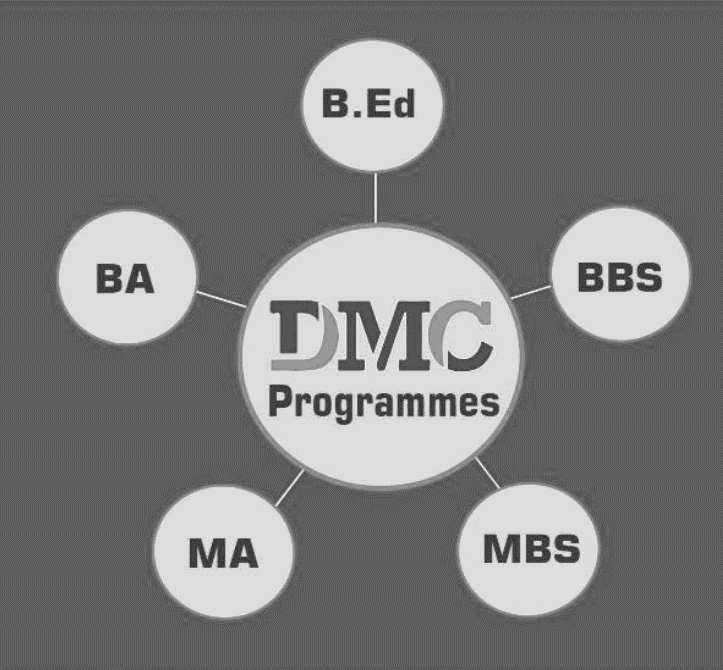
Main Programs: +2 Education, +2 Humanities, +2 Management, B.Ed., BBS, BA, MBS, and MA in Nepali
Academic Areas: Education, Management, and Humanities
Student Support: Scholarships, counseling, internal evaluation, parent-student interaction, study tours, and field visits
Contact: Email: drabyashah@gmail.com | Phone: | Website: dsmc.edu.np
Drabya Shah Multiple Campus holds an important place in the educational history of Gorkha. It is recognized as the first community campus in the district and, in terms of academic operation, one of the largest and oldest community campuses in Gorkha District. The institution began at Shree Shakti Secondary School in Patechaur, initially running certificate-level studies in humanities. Over time, it expanded its academic reach to include undergraduate and postgraduate education and later added +2 programs under the National Examinations Board.
The campus was established at a time when higher education opportunities in the district were limited beyond the humanities stream. Its formation through local initiative gave it a clear community-serving character from the start. Since 2051 B.S., it has been operating from its present location at Laxmibazar, Gorkha. The institutional direction centers on sustainability, self-reliance, student success, and service to the community. Its mission emphasizes knowledge, skills, positive thinking, collaboration, communication, and research, with the broader aim of producing capable human resources for local, national, and international contexts.
The campus goals extend beyond routine teaching. They include strengthening academic programs, improving infrastructure, building a research-oriented culture, supporting faculty and staff development, assisting students, promoting good governance, and working with national and international institutions for institutional growth. This gives the campus profile a balance between academic continuity and planned institutional development.
A quality assurance milestone came in 2079 B.S., when the campus received Quality Assurance and Accreditation from the University Grants Commission. Campus leadership connects that recognition with improvements in academic activities and working procedures. The institutional direction also includes plans to expand academic choices in response to changing educational demand.
The organizational structure shared for the campus shows a governance framework that includes the General Assembly, Campus Management Committee, Founder Board, Sub Committee, Performance Committee, Internal Quality Assurance Committee, Campus Chief, and Academic Council. It also shows academic departments in Management, Education, Humanities, and Language, along with administrative and student-support cells for research and publications, employment, internal examination, public relations, practice teaching, extracurricular activities, students counselling, information technology, and women-friendly initiatives.
Drabya Shah Multiple Campus runs programs across secondary, bachelor’s, and master’s levels. The main course list includes +2 Education, +2 Humanities, +2 Management, B.Ed., BBS, BA, MBS, and MA in Nepali. The campus academic structure also references humanities-related subject areas such as Social Work and Journalism.
+2 Education
+2 Humanities
+2 Management
These are NEB-affiliated programs delivered across Class 11 and Class 12 under the annual system. NEB procedures govern admission, registration, annual examinations, and final results. Class 11 admission and subject registration are handled through the college, while Class 12 is the final national board examination stage under NEB.
The +2 Management program builds a foundation in management studies and introduces students to basic areas such as accountancy, finance, office practice, and related business-oriented learning. The +2 Education stream introduces the background, functions, and systems of education, along with curriculum, administration, guidance, and counseling. The +2 Humanities stream provides foundation-level study for students interested in areas such as mass communication, sociology, English, and related social science fields.
Bachelor of Education (B.Ed.)
Bachelor of Business Studies (BBS)
Bachelor of Arts (BA)
The B.Ed. program follows Tribhuvan University’s four-year annual system. The curriculum is organized around communication skills, professional core areas, specialization major and minor study, and teaching internship or practicum. Subject areas include English Education, Nepali Education, Health and Physical Education, and Population Education. This gives the program both academic and professional teaching orientation.
The BA program is a four-year interdisciplinary bachelor’s degree under Tribhuvan University. The structure includes compulsory English, Nepali, and Nepal Studies, along with major and elective subjects. Internal assessment forms part of the evaluation pattern. Within the campus humanities area, published subject references include Social Work, Journalism, Sociology, Rural Development, Nepali Literature, and English Literature.
The BBS program is a four-year annual program under the Faculty of Management. Its curricular structure combines foundation areas, core business studies, concentration courses, business research methods, and a final project. Concentration options include accounting, finance, management, and marketing, while the local course structure places BBS within the management faculty and references accountancy and finance in the academic offering. The final project requirement adds a field-based component in the fourth year.
Master of Business Studies (MBS)
MA in Nepali
The MBS program follows the Faculty of Management framework under Tribhuvan University. The semester-based structure includes areas such as Marketing Management, Managerial Economics, Statistical Methods, Organizational Behavior, and Managerial Communication. It is a postgraduate option for students seeking advanced study in management and related professional fields.
MA in Nepali is listed among the campus’s postgraduate offerings under the humanities faculty. Together with MBS, it extends the campus academic pathway beyond the bachelor’s level for students in Gorkha and nearby areas.
Because the campus operates both TU and NEB programs, admission processes differ by academic level.
Admission generally begins after the publication of the campus or faculty admission notice.
Eligible applicants submit the prescribed application form with the required academic documents.
Depending on the program or campus procedure, admission may include entrance examination, merit-based selection, or both.
Selected applicants complete admission through document submission and payment of the prescribed fees.
Academic registration, examinations, and results follow TU rules, guidelines, and the applicable academic calendar.
Admission notice is published by the concerned campus, department, or faculty authority.
Applicants submit the prescribed form and required academic records.
Programs may include an entrance process depending on the course structure.
A merit list or selection result may be published by the concerned authority.
Final enrollment is completed according to TU rules and the schedule of the campus or faculty.
Admission to Class 11 usually starts after SEE results are published.
Students submit the application form and supporting documents.
Depending on the institution and stream, admission may include an entrance test, interview, or merit-based selection.
After selection and fee payment, enrollment in Grade 11 is completed.
Subject registration is processed through the college under the NEB framework.
For Class 12, NEB handles board examination application procedures, examination centers, schedules, and result publication.
Academic transcript or grade sheet of Class 12 / +2 or equivalent
Character certificate from the previous institution
Migration certificate if the previous board or university is different
Transfer certificate from the previous school or college
Citizenship certificate or birth certificate copy
Passport-size photographs
Entrance scorecard if required by the program or campus
Completed admission or application form
Admission fee payment receipt
Equivalence certificate for foreign qualifications
Bachelor’s degree transcript or marksheet
Bachelor’s degree certificate or provisional certificate
Character certificate from the bachelor-level institution
Migration certificate if the bachelor’s degree is from another university
Transfer certificate from the previous campus or college
Citizenship certificate or birth certificate copy
Passport-size photographs
Entrance scorecard if required
Completed admission or application form
Admission fee payment receipt
Equivalence certificate for foreign university qualifications
SEE marksheet or grade sheet
SEE character certificate or school leaving certificate
Transfer certificate from the previous school
Migration certificate if applicable
Citizenship certificate or birth certificate copy
Passport-size photographs
NEB Class 11 registration or subject registration form
NEB registration card or registration number issued in Class 11
Class 11 marksheet or transcript
Class 12 board examination application form
Passport-size photographs
Examination fee receipt
Admit card issued before the examination
The campus presents its faculty and staff as experienced and capable, supported by regular student evaluation systems. The academic environment is student-friendly and backed by internal examinations and continuous academic interaction. Departments and academic cells shown in the campus structure indicate organized coordination across management, education, humanities, and language areas.
The teaching approach has moved beyond a lecture-and-textbook pattern toward the use of ICT, multimedia, interactive classroom methods, student-centered learning, problem-based teaching, practical exercises, and guest-supported learning. This direction is consistent with the academic nature of programs such as BBS, B.Ed., and MBS, where discussion, practical work, project-based learning, and academic engagement play an important role.
The campus also reports remedial classes, dissertation-writing workshops for MBS students, career development workshops for undergraduate and postgraduate students, teacher training, and seminars on sustainable development and climate change. These activities indicate that academic support extends beyond routine class hours and includes skill-building and applied exposure.
The campus identifies a modern technology-based library with digital resources as one of its key academic features. Academic support is also tied to internal examination systems, career counseling, parent-student interaction, and a student-friendly administrative setting. These facilities reflect a campus model where academic service and student support are handled together.
Technology-based library with digital resources
Internal examination system
Career counseling support
Parent-student interaction mechanism
Administrative unit with Assistant Campus Chief and Program Coordinator
Account and Administration Section
Library and Examination Section
Store and Maintenance Section
Research and Publications Cell
Employment Cell
Internal Examination Cell
Public Relations Cell
Practice Teaching Cell
Extra Curricular Activities Cell
Students Counselling Cell
Information Technology Cell
Women Friendly Cell
The campus has also linked institutional improvement with practical needs. Published priorities include parking management for larger vehicles, development of the library into an e-library, repair and reactivation of the auditorium hall, and stronger reading habits among students through counseling and remedial academic support.
Student life at Drabya Shah Multiple Campus is closely tied to its community-campus identity. The campus experience includes regular interaction between students and parents, counseling services, study tours, and field observation visits. These features create a learning environment where classroom teaching is connected with supervision, communication, and practical exposure.
The organizational structure also shows student-facing and community-facing bodies such as the Free Student Union, Youth Red Cross Committee, Alumni Association, Student Quality Circle, Public Campus Teachers Association, and Campus Personnel Association. Together, these indicate that campus life is not limited to formal classes but includes student participation, support structures, and institutional dialogue.
The campus has also organized activities such as financial literacy training, teacher training, and career development workshops. These efforts show that student engagement extends into applied learning, personal development, and broader community relevance.
Study tours and field observation visits
Extra Curricular Activities Cell within the campus structure
Youth Red Cross Committee participation
Career development workshops for undergraduate and postgraduate students
Seminars on sustainable development and climate change
Financial literacy training
Teacher training activities
Student participation through the Free Student Union and Student Quality Circle
Scholarship support is one of the clearly defined parts of the campus profile. The campus refers to an extensive scholarship scheme, awards for academically strong students, and fee-waiver support for disadvantaged learners. Priority categories include talented students, economically disadvantaged students, Dalit, Janajati, women, and persons with disabilities.
A municipal scholarship fund of NPR 500,000 was established in fiscal year 2079/080 to support economically disadvantaged students from the Gorkha Municipality area. The same set of scholarship records notes expenditure on scholarships and fee waivers in subsequent fiscal years, showing that financial support remains part of the campus support structure.
Named scholarships are also part of the support system. These include the Late Ganesh Raj Banta Scholarship, the Late Bishnu Devi–Banta Scholarship, the Late Maha Prasad–Harimaya Pandey Scholarship, the Late Tek Bahadur and Harimaya Maske Scholarship, the Gorkha Municipality Scholarship, the Pawanraman Khanal Scholarship, the Late Medini Bahadur Basnet Scholarship, the GDS–UK Scholarship, the Gorkha Scholarship, the Late Ekamaya Khanal Scholarship, the Late Lok Akkal Scholarship, the Ronald Hook Scholarships, and the NMB Bank Scholarship.
This scholarship network shows that the campus has built financial support through both institutional and donor-backed arrangements. For students from disadvantaged backgrounds or those seeking merit-based recognition, this remains one of the notable features of the campus environment.
Established as the first community campus in the district in 2042 B.S.
Recognized as one of the largest and oldest community campuses in Gorkha District in terms of academic operation
Received Quality Assurance and Accreditation from the University Grants Commission in 2079 B.S.
Academic operations extend from +2 to postgraduate level
Internship and vocational training opportunities have been part of institutional progress
Departmental meetings are conducted regularly
An employment survey system is in place
A memorandum of understanding has been signed with another campus for academic cooperation
Research Management Cell work plans are prepared and presented annually
Mini research proposals and research presentations have been conducted
Faculty research article writing and publishing workshops have been organized
Anti-plagiarism software support has been introduced for academic use
Research and development activities have been carried out with institutional support
Long-standing community campus in Gorkha with local educational significance
Affiliated with Tribhuvan University for higher education and linked with the National Examinations Board for +2 programs
Academic pathway from +2 to postgraduate study
QAA accreditation from the University Grants Commission
Scholarship and fee-waiver support for deserving and disadvantaged students
Student support features such as counseling, parent-student interaction, and field visits
Digital library resources, internal examinations, and ICT-supported teaching
Research-oriented academic activities, workshops, and publication support
Organized academic and administrative structure across multiple departments and support cells
Campus leadership places the institution within the historical legacy associated with Drabya Shah and emphasizes academic discipline, ethical leadership, and community contribution. The leadership message connects the campus’s present identity with its quality assurance recognition and its continuing academic responsibilities.
The campus administration also presents the institution as a long-standing higher education center in Gorkha that has widened its program range over time, updated institutional plans and policies, and treated accreditation as an outcome of sustained academic work and administrative reform. The message highlights shared responsibility among students, faculty, staff, and the wider community.
Drabya Shah Multiple Campus represents a community-campus model that has grown from a locally initiated humanities center into a broader academic institution with NEB, bachelor’s, and postgraduate programs. Its profile is defined by district-level educational significance, TU affiliation, UGC accreditation, scholarship support, research activity, and a governance structure that connects academic departments with student-support cells.
Drabya Shah Multiple Campus is affiliated with Tribhuvan University for higher education programs and runs Grade 11 and Grade 12 under the National Examinations Board.
The campus is located at Gorkha-8, Laxmi Bazar, Gorkha, Nepal, within the area of Gorkha Municipality.
The main published course list includes +2 Education, +2 Humanities, +2 Management, B.Ed., BBS, BA, MBS, and MA in Nepali.
Yes. The campus received Quality Assurance and Accreditation from the University Grants Commission in 2079 B.S.
The campus operates scholarship and fee-waiver support, including a municipal scholarship fund, named scholarships, and priority support for talented students and students from disadvantaged groups.
Published facilities and support systems include a digital-resource library, counseling services, regular parent-student interaction, internal examinations, study tours, field visits, and dedicated cells for students' counseling, extracurricular activities, information technology, and women-friendly support.
For +2, Class 11 admission generally starts after SEE results, followed by document submission, selection, fee payment, and NEB registration through the college. For TU programs, admission follows the publication of a notice, application submission, document verification, and the relevant faculty or campus process for enrollment, examinations, and results.
Contact Drabya Shah Multiple Campus's administrative office for detailed information on the course, admissions, location, fees, scholarships, facilities, counseling, or eligibility.
Drabya Shah Multiple Campus
Email Address: drabyashah@gmail.com
Phone Number: 064-411088, 064-411228, 9856040228, 9856040787, 9856040788, 9846704143
Website: https://www.dsmc.edu.np
Location: Gorkha-8, Laxmi Bazar, Gorkha, Nepal