Haraiya Multiple Campus (हरैया बहुमुखी क्याम्पस, रूपन्देही) is a community campus in Haraiya, Ward No. 3 of Kanchan Rural Municipality, Rupandehi, Lumbini Province, Nepal. Established in 2064 BS (2007 AD), the campus was founded to extend access to higher education in a rural setting where local demand for undergraduate study had been growing. It is affiliated with Tribhuvan University and runs four-year bachelor’s degree programs in education and management.
The campus developed through local initiative, community participation, and support from public bodies and community stakeholders. Over time, it expanded its academic and physical base, added the Bachelor of Business Studies program, strengthened its library and digital learning resources, and worked toward institutional quality benchmarks. Its academic direction connects higher education with social responsibility, local needs, student support, and long-term institutional sustainability.
Community campus established in 2064 BS (2007 AD)
Located in Haraiya, Ward No. 3, Kanchan Rural Municipality, Rupandehi, Lumbini Province
Affiliated with Tribhuvan University
Offers four-year bachelor’s programs in:
Bachelor of Education (B.Ed.)
Bachelor of Business Studies (BBS)
Academic operation formally began on 2064 Mangsir 3
BBS program added from 2067 BS
Community-based and non-profit institutional character
QAA status: QAA-accredited by UGC Nepal
Member of the Public Campus Association
Library includes e-library arrangements, software-based circulation records, and RemoteXs service from the TU Central Library
Scholarships and awards are available through multiple funding sources, including internal and external support
Campus has developed income-generation land use through fish farming on land brought under campus use
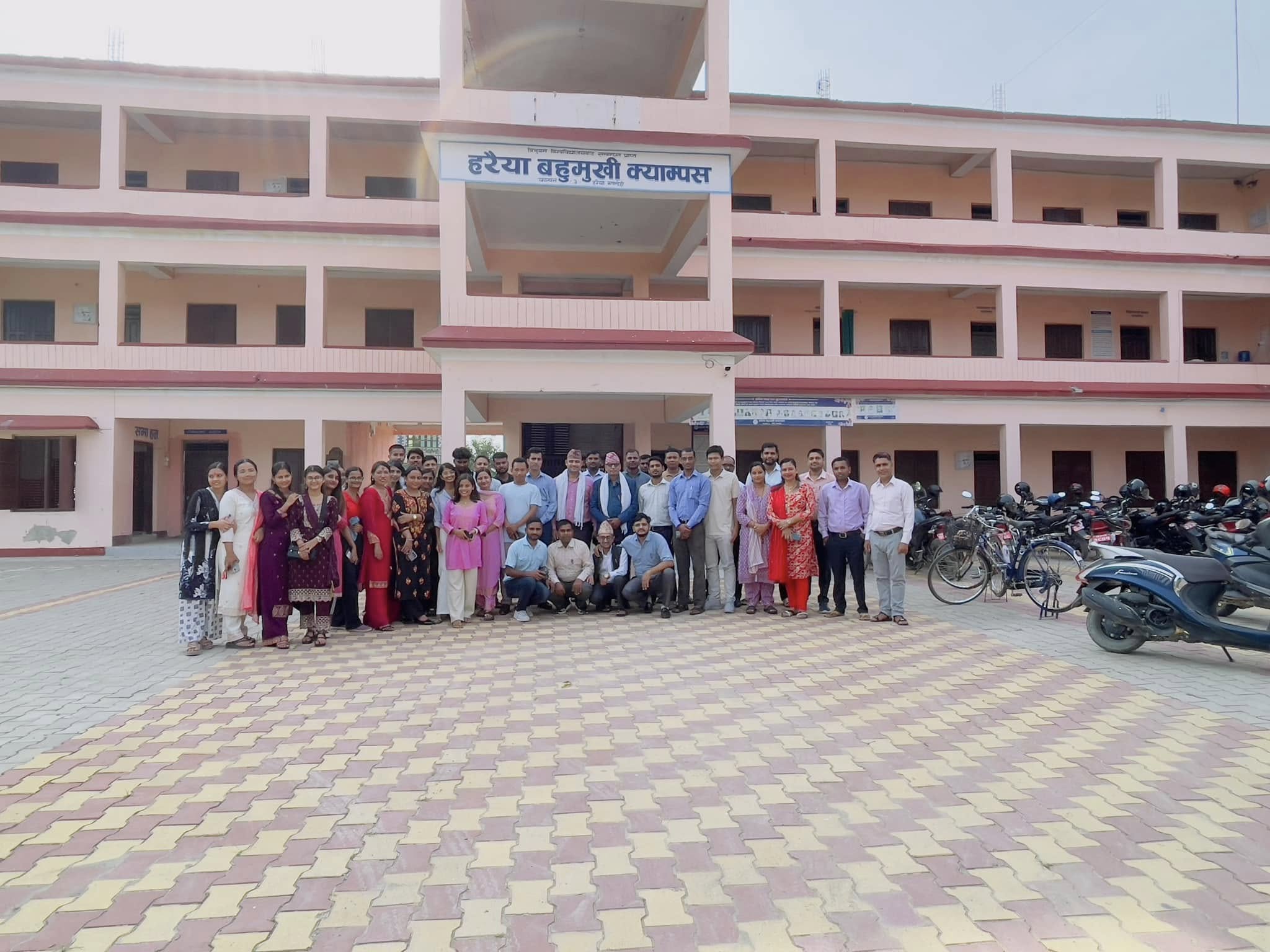
Haraiya Multiple Campus emerged from a local effort to make higher education accessible within a developing educational area of rural Rupandehi. The initiative involved Haraiya Secondary School, local parents, and education-focused community members who sought to create an undergraduate institution so that students in the area would not need to leave the region simply to begin higher studies.
Before the campus formally opened, groundwork had already begun through local committees formed to develop infrastructure and mobilize support. The Campus Infrastructure Development Committee, formed on 2061 Jestha 1 under the chairmanship of Bharatmani Sapkota, and the Mahayagya Committee, led by Mesh Bahadur Thapa, played important roles in preparing the conditions needed for establishment and operation.
The campus received approval from Tribhuvan University on 2064/7/12 and formally started academic operations on 2064 Mangsir 3. In its early stage, the institution began with the Faculty of Education. From 2067 BS onward, the Bachelor of Business Studies program was added, widening the campus’s academic scope from education into management studies.
Institutionally, Haraiya Multiple Campus functions as a community-based and non-profit campus. Its development reflects a pattern common to public higher education institutions in rural Nepal: community initiative, university affiliation, incremental infrastructure growth, and support from local government, public agencies, and individual contributors. The campus is also associated with the Public Campus Association, linking it to a wider public-campus network within Nepal’s higher education landscape.
The campus has articulated a long-term institutional direction around education, social change, research, cultural awareness, economic relevance, and sustainability. Its vision centers on education as a force for social, economic, and cultural progression in Nepal. Its mission emphasizes a learning environment that builds knowledge, skills, and a mindset for meaningful contribution to community and society.
This institutional direction is supported by six broad goals: academic quality, social responsibility and outreach, research and innovation, cultural awareness and diversity, economic impact through education, and long-term institutional sustainability. These goals are reflected in areas such as faculty development, student support, community engagement, entrepreneurship orientation, career services, and investment in facilities and technology.
Haraiya Multiple Campus currently offers two bachelor-level programs under Tribhuvan University.
The Bachelor of Education (B.Ed.) is a four-year full-time bachelor’s degree program. Students who have completed 10+2 or an equivalent examination are eligible to enroll in the program.
Subject areas mentioned for the program include:
English
Nepali
Mathematics
Health
The four-year B.Ed. structure includes 22 courses and a total of 2200 full marks. The curriculum is organized into communication skills, professional core areas, specialization major courses, specialization minor courses, and teaching internship or practicum. The annual distribution is 600 marks in the first year, 600 in the second year, 500 in the third year, and 500 in the fourth year.
The Bachelor of Business Studies (BBS) is a four-year bachelor’s degree program in the management stream. The program is designed to build academic grounding in business and management and includes subjects from economics, accounting, management, communication, law, taxation, finance, marketing, and research.
The BBS curriculum includes the following first-year subjects:
Business English
Business Statistics
Microeconomics
Accounting for Financial Analysis
Principles of Management
Second-year subjects include:
Business Communication
Macroeconomics
Cost and Management Accounting
Organizational Behavior and HRM
Foundations of Human Resource Management
Third-year subjects include:
Business Law
Foundation of Financial System
Business Environment and Strategy
Taxation in Nepal
Fundamental of Marketing
Fourth-year subjects include:
Entrepreneurship and Enterprise Development
Business Research Methods
Final Project
Specialization I
Specialization II
Specialization III
Specialization options are available in accounting, finance, marketing, and management. These subjects include areas such as accounting for banking, advanced financial accounting, corporate finance, commercial bank management, customer relationship management, foreign trade and export management in Nepal, international business, productivity management, and quality management.
Admission is open to students seeking bachelor-level study in education and management streams offered by the campus.
For the B.Ed. program, students who have completed 10+2 or an equivalent examination are eligible to enroll.
Academic programs follow the framework of Tribhuvan University.
The campus runs full-time four-year bachelor’s degree programs.
Academic certificates and mark sheets of 10+2 or equivalent level
Character certificate
Passport-size photographs
Citizenship or other identification documents as required during admission
The campus places academic quality at the center of its institutional goals. Its academic direction includes curricular and pedagogical improvement, regular professional development for faculty and non-teaching staff, and wider student support services. This approach shows an effort to strengthen both classroom teaching and the broader academic environment in which students learn.
Technology has been introduced into teaching and learning, and the campus has worked to expand academic support through modern ICT facilities, study materials, academic counseling, and soft-skill training. The institution also links learning with practical and community-oriented engagement through service-learning ideas and outreach work. In the B.Ed. program, the inclusion of teaching internship and practicum gives the academic structure a practice-based component. In the BBS program, the final project and specialization subjects connect study with applied business and management areas.
The campus also identifies faculty development, research participation, and publication support as part of its institutional direction. It has expressed interest in supporting faculty and students to engage in research and to participate in national and international conferences.
Administrative building
Classroom buildings
Cafeteria building
Library building
One under-construction four-storey building
Late Bal Bahadur Thapa Memorial Library
E-library arrangement
20 computers in library and e-library setup
Internet connectivity
Software-based library issue and return record system
RemoteXs service from TU Central Library
Textbooks and reference materials purchased with support from University Grants Commission (UGC)
Photocopy machine
158 desk-benches
215 chairs
14 tables
4 printers
12 projectors
21 laptops
5,245 books
7 toilets
Hot and cold drinking water facility
8 drinking water taps
3 filters
2 water dispensers
2 vending machines
1 generator
1 inverter
2 fire extinguishers
10 library racks
9 drawers
13 podiums
Saraswati Temple
27 hectares of land used for income generation
Haraiya Multiple Campus was established in response to a local educational need, and its campus experience remains closely tied to that community role. The institution serves students from the surrounding rural area and nearby localities, creating a setting where higher education is linked directly to local participation, public support, and regional social change.
Its academic environment reflects the realities faced by many rural campuses in Nepal. The institution has identified student dropout, outward migration, pass-rate challenges, and the need for expanded facilities and new academic programs as ongoing concerns. At the same time, it has continued to invest in student support, library services, digital access, and physical development. This gives the campus experience a practical character shaped by both community expectation and institutional effort.
Campus activities are carried out through different units formed within the institution, and the campus has also connected educational goals with outreach, volunteerism, inclusion, and local development. The campus direction includes attention to social equity, community service, and a more inclusive environment for students from different social and economic backgrounds.
Campus activities are conducted through various units formed within the campus
Outreach programs are part of the campus’s social responsibility direction
Service learning is intended to connect study with community development
Cultural events and festivals are part of the campus’s goal of promoting cultural awareness and diversity
Volunteerism is encouraged through social engagement initiatives
Scholarships are available under headings such as poor, talented, Dalit, Janajati, Madhesi, and disabled students
Scholarship support comes through the University Grants Commission (UGC), provincial sources, the rural municipality, and internal campus sources
The campus has established a scholarship fund in the form of an endowment fund
Total endowment fund amount mentioned is Rs. 1,153,145
The Late Devi Prasad Upadhyay Memorial Endowment Fund-2081 was established with a total of Rs. 500,005
Additional named funds include the Late Amrit Kshetri Memorial Endowment Fund-2078, Late Gurudatta Khanal Memorial Endowment Fund-2079, Late Bel Kumari Bhattarai Memorial Endowment Fund-2079/80, and Late Pashupati Poudel Memorial Current Fund-2080
Students obtaining excellent marks in the final examination receive a cash award of Rs. 2,000 per student
Students who pass regularly in all four years receive Rs. 1,000 per student
The student securing first position in the overall aggregate of all four years receives Rs. 4,000
Established in 2064 BS (2007 AD)
Received approval from Tribhuvan University on 2064/7/12
Formally started academic operations on 2064 Mangsir 3
Expanded from the Faculty of Education to include BBS from 2067 BS
QAA status identified as Peer Reviewed
SSR submitted and approved by the QAA Division of the UGC
Pre-visit process completed
Response report submitted after the pre-visit suggestions
Library automation and e-library arrangements put into operation
RemoteXs service connected from the TU Central Library
More than Rs. 500,000 worth of textbooks and reference materials purchased for the library in 2081 with UGC support
Pond constructed on campus-linked land for fish farming as an income-generation activity
The campus leadership presents Haraiya Multiple Campus as a community-based institution committed to accessible higher education in the rural area of Kanchan Rural Municipality and surrounding localities. The message from the Campus Chief links the institution’s purpose with academic progress, inclusive learning, public accountability, and community uplift.
The leadership also places the current stage of the campus within a longer institutional journey shaped by earlier local efforts. It acknowledges the role of senior local figures in establishing the campus and frames present development as a continuation of that work. The message highlights progress in physical infrastructure, technology use in teaching and learning, library development, and institutional quality processes connected to QAA.
Prakash Khanal - Campus Chief.
Haraiya Multiple Campus represents a community-built model of undergraduate education in rural Nepal. Its development has combined local initiative, university affiliation, public support, gradual infrastructure expansion, and a focus on widening access to higher study. The campus offers two established bachelor’s programs, maintains a growing academic support system, and has continued to strengthen facilities such as its library, digital resources, and campus buildings.
College Name: Haraiya Multiple Campus
Location: Kanchan Rural Municipality -3, Haraiya, Rupandehi, Lumbini Province, Nepal
Phone No.: +977-071-417022, +977-9857058126, +977-9857031167
Email: hmcharaiya@gmail.com
Website: hmc.edu.np
Contact Haraiya Multiple Campus's administrative office for detailed information on the course, admissions, location, fees, scholarships, facilities, counseling or eligibility.
Haraiya Multiple Campus is located in Kanchan Rural Municipality-3, Haraiya, Rupandehi, Lumbini Province, Nepal.
Haraiya Multiple Campus was established in 2064 BS (2007 AD).
Haraiya Multiple Campus is affiliated with Tribhuvan University.
The campus offers the four-year Bachelor of Education (B.Ed.) and Bachelor of Business Studies (BBS) programs.
Yes, Haraiya Multiple Campus is a community campus with a non-profit institutional character.
Students who have completed 10+2 or an equivalent examination are eligible to enroll in the B.Ed. program.
Yes, the campus provides scholarships and financial support through the University Grants Commission, provincial sources, the rural municipality, and internal campus funds. Scholarship headings include support for poor, talented, Dalit, Janajati, Madhesi, and disabled students.
The campus has the Late Bal Bahadur Thapa Memorial Library, e-library arrangements, 20 computers, internet access, software-based library records, and RemoteXs service from the TU Central Library.
The QAA status of Haraiya Multiple Campus is listed as Peer Reviewed.