Jana Adarsh Multiple Campus (JAMC) was established in 1996 AD (2050 BS) and is a community-managed institution located in Birendranagar-2, Chitwan, Nepal, along the East–West Highway corridor. Established through the collective initiative of social workers, intellectuals, education supporters, and local public representatives, JAMC was founded to expand access to quality higher education and to develop skilled human resources for Nepali society.
The campus has grown through strong community ownership, local leadership, and stakeholder support, including land provided under permanent usufruct rights and sustained contributions from supporters living in Nepal and abroad.
College Name: Jana Adarsh Multiple Campus (JAMC)
Location: Birendranagar-2, Chitwan, Nepal (East–West Highway access)
Type: Community campus
Affiliation / Board: Tribhuvan University (TU); National Examination Board (NEB)
Programs Mentioned: +2 (Management, Education, Humanities; HM and Computer Science also mentioned), B.Ed, BBS, MBS
Teaching Approach: Classroom teaching with field visits, educational tours, research activities, and multimedia use in selected classrooms
Facilities: Library and study room, computer lab, hotel lab, laboratories, canteen, seminar/conference hall, sports and ECA support
Scholarships (last fiscal year): NPR 640,857 distributed from internal and local sources
Quality Process: Participation in the UGC Nepal QAA cycle; Self-Study Report (SSR) submitted
JAMC was established to provide higher education that supports academic growth, practical skills, and social development. From the beginning, the campus focused on making education useful for daily life, technical and skill-based learning, and research-oriented work. The institutional objectives include conducting local consultation and surveys, strengthening research practice, and contributing to technology protection and development in ways that support community needs.
The campus’s early development was shaped by both challenges and community resilience. Land support played a foundational role: Shri Birendra Adarsh Secondary School provided 2 bigha of land to the campus under permanent usufruct rights. During the year of establishment, a severe flood affected local families and created enrollment challenges. The campus progressed through community fundraising and stakeholder leadership, including support associated with late Member of Parliament Jagrit Prasad Bhetwal, as well as contributions coordinated through community supporters in Nepal and abroad.
JAMC operates on land situated along the East–West Highway, with a permanent boundary wall completed for day-to-day operational security and management. The campus infrastructure is built to support teaching, administration, student services, and practical learning.
Three-storey RCC academic building
29 rooms used as classrooms
11 rooms used for department offices, a first-aid room, a meeting hall, and laboratories
Two-storey RCC administrative/services building
Ground floor: canteen (chamena-griha)
Upper floor: Campus Chief’s office, library, examination section, accounts section, and a study room
Three additional sheds inside the premises
A new building under construction planned for a caretaker’s house and commercial purposes
JAMC offers programs under two major affiliations: Tribhuvan University (TU) for bachelor and postgraduate programs, and the National Examination Board (NEB) for +2 level programs.
Ten Plus Two (+2) Management
Ten Plus Two (+2) Education
Ten Plus Two (+2) Humanities
Day shift also includes HM and Computer Science (+2) in the program list provided
Bachelor of Education (B.Ed)
Bachelor of Business Studies (BBS)
Master of Business Studies (MBS)
Permission to operate bachelor-level Management programs is referenced from 2059 BS.
Postgraduate-level Management teaching (MBS) is referenced as running from 2071 BS under TU affiliation.
The campus has operated academic programs under an expansion model since its establishment period, including Proficiency Certificate Level classes in Education, Management, and Humanities during earlier phases.
JAMC emphasizes structured academic delivery supported by classroom routines, internal assessment, and practical exposure.
Classroom teaching supported by multimedia projectors in selected classrooms
Student engagement through field visits, educational tours, and research-related activities
Department and faculty meetings used to plan academic improvement and coordinate decisions
Student outreach through advertisements and social media to support enrollment
Regular classes with an average of 180 classes conducted (including 60 at the postgraduate level as noted)
Two internal examinations, with results published on the campus notice board
Extended working days used for internal and final examinations
Library expansion through construction work and establishment of a study room with books
Increased investment to strengthen laboratory facilities
Student enrollment: 320
Class regularity: 180 (including 60 at postgraduate level)
Internal exams: 2
Students appearing in final exam: 228
Dropout rate: 8.7%
Pass percentage: 24.5%
Graduates and postgraduates: 32 (Bachelor: 28, Postgraduate: 4)
Library holdings: 8,392 books (with some older books damaged)
Academic tours: 4 (Bachelor: 3, Postgraduate: 1)
JAMC maintains facilities to support academic learning, practical training, and student services.
Library and study room
Computer lab (expanded)
Hotel lab (expanded)
Laboratories
Canteen (chamena-griha)
Conference/seminar hall
Sports and playground support
Counseling and student support
Journal and academic support resources
Multimedia teaching support in selected classrooms
Expansion of hotel lab and computer lab
Library strengthening through additional books
Purchase of a card-printing machine for student ID cards
Purchase of computers and furniture to strengthen departments
Funding support referenced from:
Bagmati Province Ministry of Social Development
Education Development Directorate, Bagmati Province
University Grants Commission (UGC)
Rapti Municipality Ward No. 7 Office
A separate allocation of around NPR 5,000,000 is referenced (two years prior) under a campus strengthening program that supported completion of the canteen and administrative building, with the canteen currently in operation.
A budget of NPR 1,000,000 is referenced under the Community Campus Quality Improvement Program (Education Development Directorate, Hetauda), used for equipment such as a projector, computers, and ID-card printing items.
JAMC participates in the University Grants Commission (UGC) Nepal Quality Assurance and Accreditation (QAA) cycle. The campus has submitted a Self-Study Report (SSR) to the QAA division as part of the accreditation process.
Scholarships are distributed to support poor but meritorious students and learners from disadvantaged and marginalized groups, including backward communities and earthquake-affected populations. In the last fiscal year, scholarships totaling NPR 640,857 were distributed from internal and local sources, including:
NPR 43,000 from Campus Management Committee Chair Mr. Govinda Prasad Kandel
NPR 149,500 from Rapti Municipality Ward No. 8
NPR 19,500 from Ward No. 10
Academic learning is supported by extracurricular activities and campus-based engagement.
Terminal/internal examinations and academic monitoring
Educational tours and field visits
Seminars and interaction programs
Sports and extracurricular activities (ECA)
Dance and music activities (listed under salient features)
Morning Shift: 6:00 AM – 11:00 AM
Day Shift: 11:00 AM – 4:00 PM
Administration (Sunday–Friday): 6:00 AM – 4:00 PM
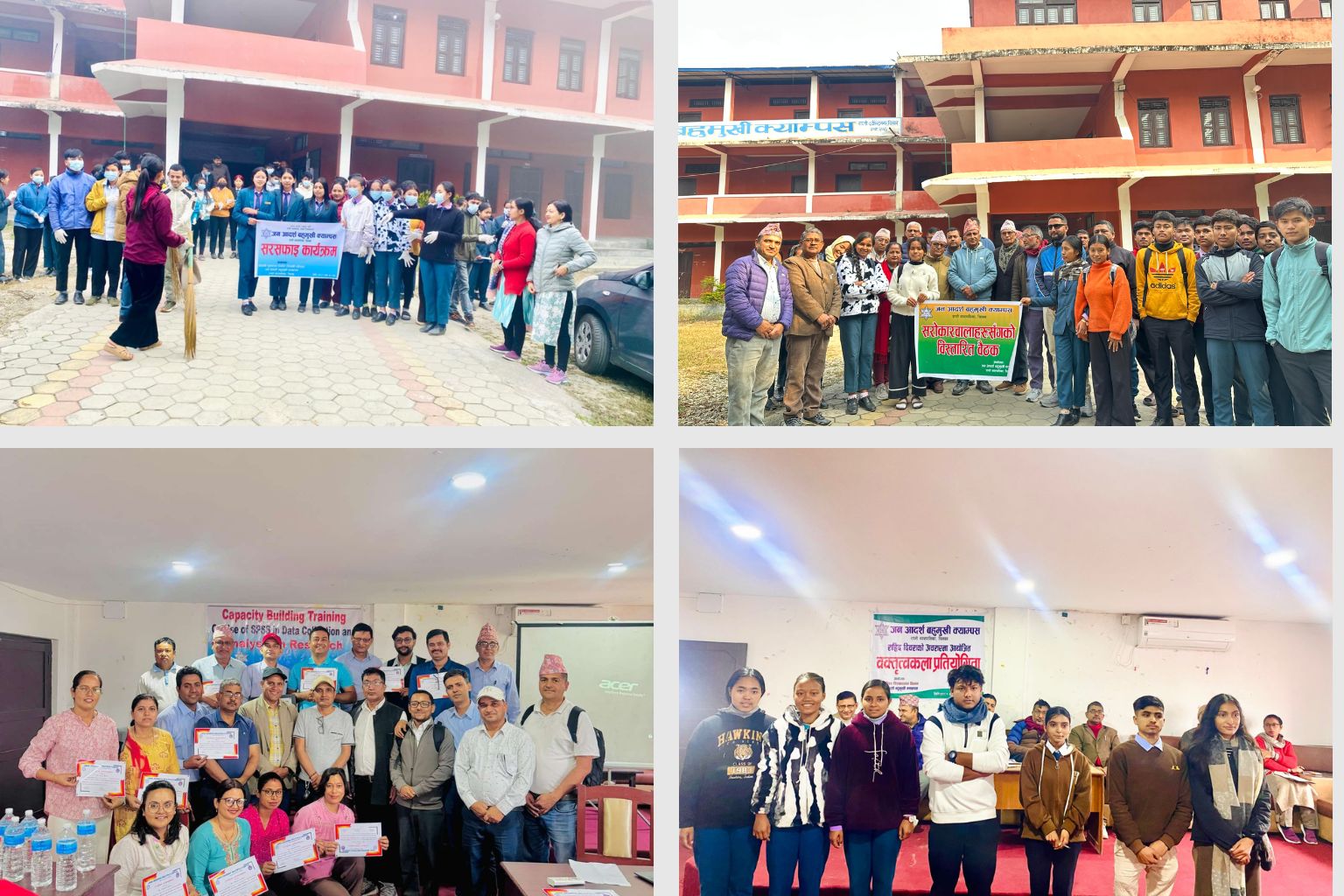
As a community campus, JAMC carries a social role alongside academic operations and coordinates programs that support public health, awareness, and community wellbeing.
Sanitation programs involving campus cleaning and nearby-area maintenance, including tree and hedge management
Blood donation program conducted on 2079-08-22 (BS)
Financial literacy programs in collaboration with local banks and financial institutions
Public awareness programs on dengue and communicable diseases
Campaigns against gender-based violence
Interaction programs with Nepal Police to reduce crimes such as drug abuse and human trafficking
Support to Rapti Municipality through expertise in education and management/economics
Community use of campus seminar hall and premises for approved social and awareness programs
Interaction programs with local school principals to strengthen communication about campus programs
JAMC operates through a Campus Management Committee and academic/administrative leadership structures.
Chairperson: Mr. Govinda Prasad Kandel
Vice-Chairperson: Mr. Rajendra Prasad Burlakoti
Member Secretary / Campus Chief: Mr. Khimananda Aryal
The management structure also includes members representing stakeholders such as local government leadership, teachers’ unit leadership, and alumni representation.
JAMC’s academic record includes notable student performance and institutional development initiatives.
A student from the Faculty of Education, Mr. Bal Krishna Sharma, secured first position in Tribhuvan University at the bachelor level in 2068 BS (2011/2012 AD).
Academic performance recognition includes a referenced gold medalist outcome in TU final examinations.
Institutional development initiatives include academic departments and support units such as a research management cell, placement support, and student counseling structures.
Environmental initiatives include plantation of trees within the premises to support an eco-friendly campus environment.
Students choose JAMC for clear, practical reasons tied to learning support and access:
Qualified and experienced teaching team across Education and Management streams
Affordable access to higher education through community management
Scholarships for meritorious and economically disadvantaged students
Library and study-room access with textbooks and references
Counseling and career guidance through student support structures
Regular internal exams, academic tours, and field-based learning exposure
Computer and hotel lab support for practical learning
Use of technology in selected classrooms
Campus environment that supports study and extracurricular participation
Jana Adarsh Multiple Campus serves as a community-supported academic institution in Birendranagar-2, Chitwan, offering +2, bachelor, and postgraduate programs under NEB and Tribhuvan University affiliations. Its growth reflects sustained community contribution, expanding infrastructure, academic administration focused on classroom regularity and assessment, and ongoing participation in national quality assurance processes. The campus continues to integrate classroom learning with practical exposure, student support, and local engagement.
JAMC is located in Birendranagar-2, Chitwan, Nepal, with access along the East–West Highway.
JAMC offers programs under Tribhuvan University (TU) and runs +2 level programs under the National Examination Board (NEB).
Programs mentioned include +2 Management, +2 Education, +2 Humanities, and TU programs such as B.Ed, BBS, and MBS. The program list also includes HM and Computer Science under +2/day shift.
Morning Shift: 6:00 AM – 11:00 AM
Day Shift: 11:00 AM – 4:00 PM
Administration (Sunday–Friday): 6:00 AM – 4:00 PM
Facilities include a library and study room, computer lab, hotel lab, laboratories, a canteen, seminar/conference space, sports support, counseling services, and multimedia-supported classrooms in selected rooms.
Yes. Scholarships totaling NPR 640,857 were distributed in the last fiscal year from internal and local sources, including support from campus leadership and local wards.
JAMC participates in the UGC Nepal QAA cycle and has submitted a Self-Study Report (SSR) to the QAA division.
Contact Jana Adarsha Multiple Campus's administrative office for detailed information on the course, admissions, location, fees, scholarships, facilities, counseling or eligibility.
Jana Adarsha Multiple Campus
Email Address: info@jamc.edu.np
Phone Number: +977-56-583023
Website: http://www.jamc.edu.np
Location: Birendranagar-2, Chitwan, Nepal