Janaprakash Multiple Campus (जनप्रकाश बहुमुखी क्याम्पस, पाेखरा) is a community campus in Ward No. 29 of Pokhara Metropolitan City, Kaski, connected to the Prithvi Highway. Established in 2005 A.D., the campus was formed through the initiative of local academicians, intellectuals, social workers, and education-minded community members who wanted to expand access to higher education in the eastern and middle parts of Kaski and nearby districts.
It is affiliated with Tribhuvan University and runs the Bachelor of Business Studies (BBS) program under the Faculty of Management. Over time, the campus has moved from operating in a school building to conducting academic activities in its own premises, with continued institutional development supported by community effort, grants, and internal governance structures.
Location: Pokhara-29, Bhandardhik, Kaski, Gandaki Province, Nepal
Type: Non-profit community campus
Affiliation: Tribhuvan University
Faculty: Management
Program Offered: Bachelor of Business Studies (BBS)
Academic Level: Bachelor’s level
Program Duration: Four years, full-time, annual system
Established: 2005 A.D.
Access: Connected to the Prithvi Highway
Motto: Quality Education for All
Facilities: Classrooms, library, computer lab, drinking water, playground, counseling support, examination support, and student welfare structures
Scholarship Support: Full and partial scholarships for deserving students
Email: info@janaprakash.edu.np
Phone: +977-61-564378, +977-9846059594, +977-9867547348, +977-9856061320, +977-9856061378
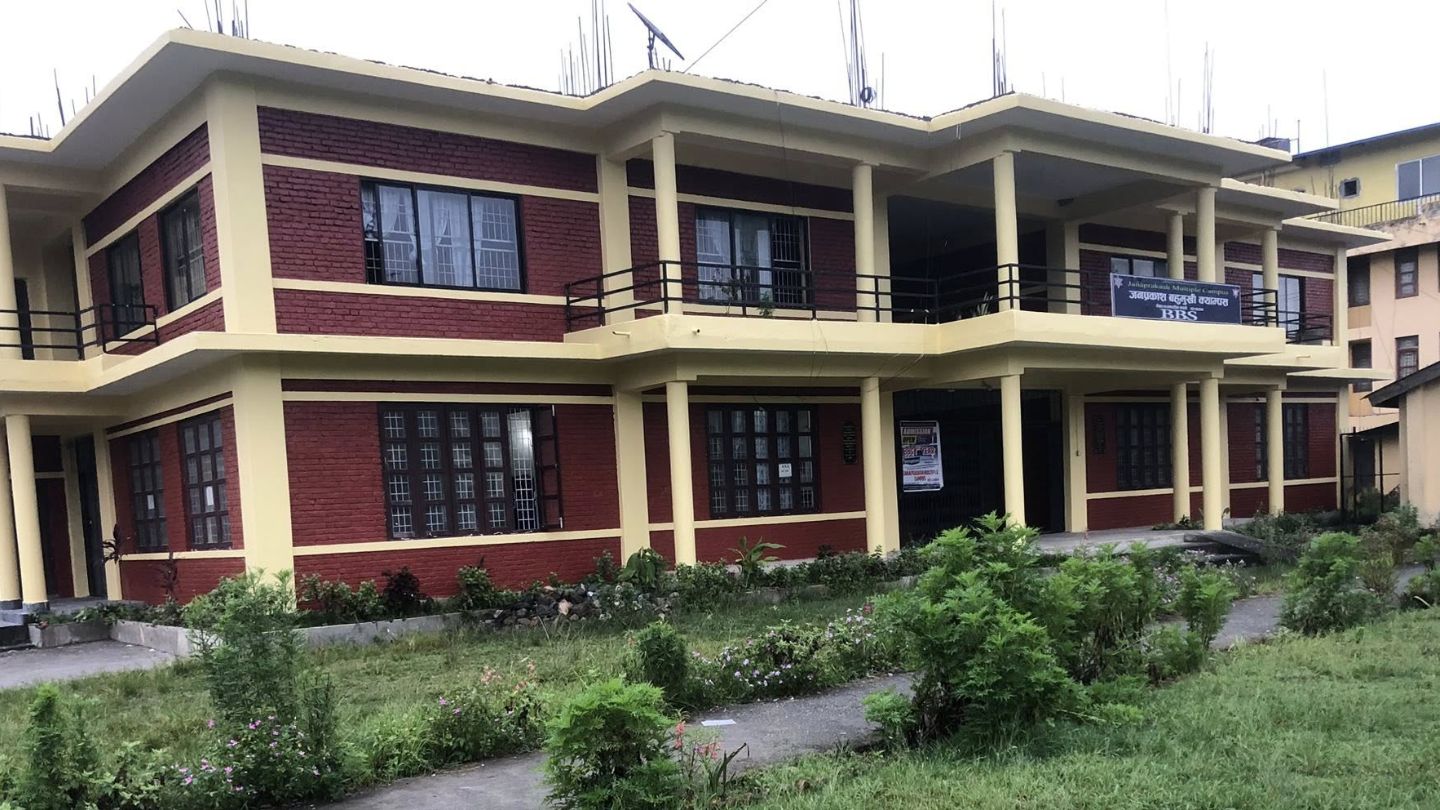
Janaprakash Multiple Campus emerged from a local effort to create access to bachelor-level education for students who might otherwise have had to travel farther for management studies. The campus was initiated by local educationists, social workers, and intellectual figures from the region who recognized the need for a community-based higher education institution in the area. Its academic operation began after affiliation from Tribhuvan University to run management studies, and the BBS program became the core academic offering.
The campus has served students from Pokhara-Lekhnath and from surrounding areas of Kaski, Syangja, Tanahun, Lamjung, Baglung, and nearby districts. Its local role has been linked closely with expanding educational access for students from farming, laboring, and low-income families. This social background remains central to understanding the campus’s identity as a community institution rather than a commercially driven one.
In its early phase, classes were conducted in the building of Janaprakash Higher Secondary School. After land acquisition and possession in the campus’s own name, physical development moved ahead with the support of community contributions, public bodies, and grants. Since 2073 B.S., the campus has been running academic activities in its own building. This shift marked an important stage in its institutional consolidation, because it gave the campus direct control over classrooms, administrative space, and learning facilities.
The campus has also received support from the University Grants Commission (UGC) and other public institutions for regular institutional support and physical infrastructure development. Its development path shows a combination of local initiative, public funding support, and structured academic administration. Alongside physical growth, the campus has built committees and internal systems for academic coordination, quality processes, research activity, examination management, student support, and grievance handling.
The stated vision of the campus centers on educational excellence, research promotion, and effective governance to serve local and national needs in higher education. Its goals include strengthening quality culture, promoting research and academic standards, and producing capable human resources aligned with national and international needs. These aims are reflected not only in academic delivery but also in the creation of internal councils, cells, and committees that support systematic management.
Janaprakash Multiple Campus currently runs the Bachelor of Business Studies program under Tribhuvan University’s Faculty of Management. The campus profile identifies the BBS stream as its continuing academic program at the bachelor’s level.
Program Name: Bachelor of Business Studies (BBS)
Affiliation: Tribhuvan University, Faculty of Management
Level: Bachelor’s
Duration: Four years, full-time
Academic System: Annual system
Program Focus: Management and business studies
Campus Delivery Areas Mentioned: Finance, Accountancy, and Marketing
The BBS program is designed to build a broad management foundation for students who plan to work in business, industry, public institutions, or related sectors. Its academic purpose is to develop conceptual understanding, applied business knowledge, communication skills, analytical ability, and a practical sense of how organizations operate. The structure combines foundation courses, core management studies, concentration options, and project-based academic work.
The curriculum follows a year-wise structure.
First Year: Business English, Business Statistics, Microeconomics for Business, Financial Accounting and Analysis, and Principles of Management
Second Year: Business Communication, Macroeconomics for Business, Cost and Management Accounting, Organizational Behavior and Human Resource Management, and Fundamentals of Financial Management
Third Year: Business Law, Foundation of Financial Systems, Business Environment and Strategy, Taxation in Nepal, and Fundamentals of Marketing
Fourth Year: Entrepreneurship, three concentration courses, Business Research Methods, and Final Project
The concentration areas identified in the BBS curriculum include Accounting, Finance, Marketing, and Management. This structure gives students a general management base while also allowing them to study a focused area in the final stage of the program. The final project is an academic requirement tied to field exposure and report writing, which helps students connect classroom study with organizational practice.
The BBS curriculum also sets minimum academic expectations for teaching days, attendance, and examinations. Students are expected to maintain attendance required by the university system in order to appear in annual examinations. Under the annual structure, final examinations are conducted by the Office of the Controller of Examinations of Tribhuvan University. Academic registration, examination schedules, and results follow TU rules, guidelines, and the applicable academic calendar.
The overall program structure suits students looking for a general management degree with grounding in communication, economics, accounting, finance, law, research, and entrepreneurship. At the campus level, this academic offering is supported by department-level teaching responsibilities in finance, accountancy, statistics, economics, English, and management-related subjects.
Admission to the BBS program generally follows the rules of the campus, the Faculty of Management, and Tribhuvan University. The process can be presented in a straightforward sequence:
Admission notices are published by the campus.
Eligible applicants submit the prescribed admission or application form.
Applicants submit the required academic records and supporting documents.
The campus completes the admission process according to applicable TU rules and its own schedule.
Selected applicants complete enrollment after document submission and fee payment.
Academic registration, examinations, and results proceed under Tribhuvan University rules and the annual academic calendar.
For BBS eligibility, the approved course standard allows admission for applicants who have successfully completed 10+2 in business or commerce, or an equivalent qualification from a board or university recognized by Tribhuvan University. Applicants may also qualify if they studied Mathematics or Economics as a full paper at the 10+2 level. The campus may apply additional entry requirements prescribed by the faculty or campus administration.
The common document set for TU bachelor-level admission includes the following:
Academic transcript or grade sheet of Class 12 / +2 or equivalent
Character certificate from the previous institution
Migration certificate, if the previous board or university is different
Transfer certificate from the previous school or college
Citizenship certificate or birth certificate copy
Passport-size photographs
Entrance examination scorecard, if required by the program or campus
Completed campus admission or application form
Admission fee payment receipt
Equivalence certificate, if the qualification is from a foreign board or university
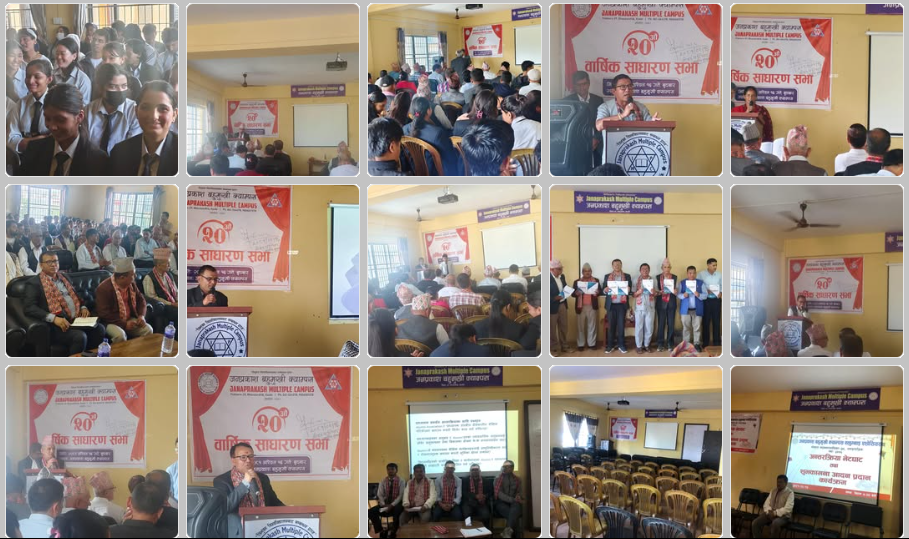
The campus has a defined academic and administrative structure for managing teaching and learning. It has 13 teachers and 3 staff members, with academic responsibility distributed across management, statistics, accountancy, economics, English, and commercial law-related teaching areas. The faculty listing includes the Campus Chief, Assistant Campus Chief, and teaching members in multiple subject areas. An Academic Council is also in place, with departmental responsibilities assigned to subject heads in statistics, finance, accountancy, economics, and English.
Beyond the regular teaching staff, the campus has formed structures such as the Internal Quality Assurance Cell, Research Management Cell, Examination Cell, Student Counselling and Placement Cell, Extension and Outreach Cell, EMIS Cell, and Grievance Redress Mechanism. These units show that academic delivery is linked with internal review, student support, record management, and examination coordination.
The BBS instructional model under Tribhuvan University combines lecture-based teaching with group discussion, problem-solving exercises, practical work, project work, guest lectures, and case-based learning where appropriate. This aligns with the academic purpose of preparing students for the practical realities of business, government, and organized work settings. At Janaprakash Multiple Campus, this approach is supported by faculty coordination and department-level academic roles.
Research and project exposure also form part of the learning process. The BBS structure includes Business Research Methods and a Final Project in the fourth year. The campus has assigned a Research Management Cell and related academic roles, which helps connect classroom learning with research-oriented academic practice. The presence of an internal examination cell, library operation committee, and counseling support units adds to the overall teaching-learning environment.
The campus objectives also mention improving the competencies of teachers and staff, maintaining an effective teaching-learning process, encouraging research and inquiry, and addressing student grievances through organized administrative systems. These institutional commitments give the academic environment a structured character that goes beyond classroom teaching alone.
Academic Council
Internal Quality Assurance Cell
Research Management Cell
Student Counselling / Placement Cell
Examination Cell
Extension and Outreach Cell
EMIS Cell
Grievance Redress Mechanism
Library Operation Committee
Sports / Extracurricular Activities Committee
The campus has developed its physical base over time and now conducts teaching and administrative work in its own building. The existing and identified infrastructure shows both current facilities and the scale of the campus’s planned building capacity.
Own land under campus possession rights
Two-storey slab building completed
Teaching and learning conducted in the campus’s own building
Nine classrooms for regular teaching and learning
One library, including a computer-equipped library
One accounts room
Assistant Campus Chief cabinet, staff cabinet, and departmental head cabinets
Computer lab
Drinking water arrangement
Toilet facilities for male and female students
Volleyball and badminton facilities
Playground access
Motorcycle parking
Sports access connected to Lekhnath Stadium
Seminar hall in planned building capacity
Auditorium hall in planned building capacity
Management committee room in planned building capacity
Space identified for research, journal publication, and examination work
Additional library and computer lab capacity in the proposed building layout
The campus has also identified areas needing expansion or completion, including a canteen building, library expansion, beautification through tree and flower planting, wire fencing between school and campus premises, and completion of basketball court slab work. These details show that physical development is being treated as an ongoing institutional task rather than a fixed endpoint.
Student life at Janaprakash Multiple Campus is shaped by its community background, local accessibility, and compact academic setting. Because the campus is connected to the Prithvi Highway and serves students from both Pokhara and nearby districts, it functions as an accessible management education option for learners from different social and geographic backgrounds.
The campus environment includes organized student representation through the Student Welfare Club, along with teacher representation through the Teachers’ Association. These structures support campus communication and student participation in institutional activity. The campus also maintains a Grievance Redress Mechanism and a Student Counselling / Placement Cell, which indicates attention to student concerns and guidance.
The setting of the campus reflects a local educational institution that grew from community need and collective effort. That history shapes the campus experience in practical ways: students study in a setting that is academically structured, locally rooted, and linked with internal committees that handle library services, extracurricular programs, research coordination, examination support, and outreach activity.
The campus has also emphasized a disciplined academic atmosphere alongside co-curricular and extracurricular engagement. Sports events, quizzes, and discussion-based programs contribute to campus life outside regular classroom hours. This mix of academic structure and student participation gives the campus a grounded educational character.
The campus has a dedicated Sports / Extracurricular Activities Committee and conducts student activities beyond classroom teaching. Reported activities include:
Annual sports week in the last week of Poush
Volleyball competitions for boys and girls
Football competitions for boys and girls
100-meter race for women and men
400-meter race for women and men
800-meter race
Tug of war
Badminton
Table tennis
Long jump
Shot put
Quiz competitions
Discussions related to industry and trade
Student participation through the Student Welfare Club
Dance, music, tour, and ECA-related participation mentioned in campus feature listings
Janaprakash Multiple Campus identifies scholarship support as part of its student support structure. The available material points to assistance for deserving learners and students from low-income backgrounds.
Full scholarships for selected deserving students
Partial scholarships for eligible students
Support aimed at students with low economic status
Affordable fee orientation as part of the campus’s community model
Institutional grant support from public bodies for campus development and infrastructure
The campus has crossed several organizational and developmental stages since its establishment.
Established in 2005 A.D. through community initiative
Affiliated with Tribhuvan University to run management studies and the BBS program
Land acquired for campus development
Land possession rights secured in the campus’s own name
Foundation stone of the building laid in 2070 B.S.
Classes began in the campus’s own building in 2073 B.S.
Building inauguration completed in 2073 B.S.
Initial Letter of Intention for the QAA process received on 31 August 2017
Self Study Report submitted and revised in stages
Peer Review Team formed and pre-visit completed
Monitoring by the University Grants Commission carried out in 2079 B.S.
Selected under HERP among 125 community campuses nationwide
Selected under NEHEP / EPBF among 89 community campuses nationwide
Proposal submitted for Entrepreneurship Development Training
Internal structures formed for IQAC, research management, examination management, student support, and outreach
These milestones indicate that institutional development at the campus has included both physical growth and quality-related administrative work.
Community-based campus with a non-profit educational orientation
Affiliated with Tribhuvan University for the BBS program
Located in Pokhara with road access through the Prithvi Highway
Four-year BBS annual system under the Faculty of Management
Own land and functioning academic building
Library and computer-supported learning environment
Teaching team distributed across key management and allied subjects
Student counseling, grievance handling, examination support, and research-related structures
Scholarships for deserving and low-income students
Sports, quiz, and discussion programs that support student participation
Institutional engagement with QAA, SSR, HERP, and NEHEP processes
Janaprakash Multiple Campus represents a community-driven approach to higher education in Pokhara. Its development from an initiative of local educators and social figures into a functioning TU-affiliated management campus reflects sustained local commitment to access, affordability, and organized academic growth.
For students seeking a bachelor-level management education in a community campus setting, the institution offers a clear academic focus through the BBS program, a structured teaching and support environment, and gradually expanding facilities. Its combination of local access, institutional systems, scholarship support, and ongoing quality-oriented work gives the campus a distinct place in the higher education landscape of the region.
Contact JanaPrakash Multiple Campus's administrative office for detailed information on the course, admissions, location, fees, scholarships, facilities, counseling or eligibility.
JanaPrakash Multiple Campus, Pokhara
Email Address: info@janaprakash.edu.np
Phone Number: +977-61-564378, +977-9846059594, +977-9867547348, +977-9856061320, +977-9856061378
Website: https://janaprakash.edu.np
Location: Pokhara-29, Bhandardhik, Kaski, Gandaki Province, Nepal
Janaprakash Multiple Campus is located at Pokhara-29, Bhandardhik, Kaski, Gandaki Province, Nepal, in Ward No. 29 of Pokhara Metropolitan City and connected to the Prithvi Highway.
It is a non-profit community campus established through the initiative of local academicians, intellectuals, social workers, and education-minded community members.
The campus is affiliated with Tribhuvan University and runs its academic program under the Faculty of Management.
The campus offers the Bachelor of Business Studies (BBS) program at the bachelor’s level.
The BBS program is a four-year full-time undergraduate program under the annual system.
Applicants who have completed 10+2 in business or commerce, or an equivalent qualification recognized by Tribhuvan University, can apply. Applicants may also qualify if they studied Mathematics or Economics as a full paper at the 10+2 level.
Common admission documents include the Class 12 transcript, character certificate, transfer certificate, migration certificate where applicable, citizenship or birth certificate copy, passport-size photographs, completed admission form, fee receipt, and equivalence certificate where applicable.
The campus has classrooms, a library, a computer-equipped library setup, computer lab access, drinking water, toilets for male and female students, playground facilities, motorcycle parking, and academic and administrative rooms.
Yes. The campus mentions full and partial scholarships for deserving students, including students from low-income backgrounds.
Yes. The campus runs sports and extracurricular activities such as volleyball, football, badminton, table tennis, races, tug of war, long jump, shot put, quiz competitions, and discussion programs related to industry and trade.