KIST Medical College is a health-professions institution based in Imadol, Lalitpur, within Mahalaxmi Municipality. The college is close to the Ring Road, which makes access practical for students, faculty, patients, and visitors coming from different parts of the valley. The institution operates a teaching hospital and a separate dental hospital, positioning academic learning alongside clinical service delivery.
KIST is presented as affiliated with the Institute of Medicine (IOM), Tribhuvan University (TU). The profile information also records a timeline where MBBS affiliation is noted from two thousand eight and BDS affiliation from two thousand eleven, along with program start years in 2006 for major undergraduate courses.
Here is the detailed information for admission decisions, seat availability, fee ceilings, and yearly criteria. Readers should confirm the latest intake notice from the institution and the concerned regulator.
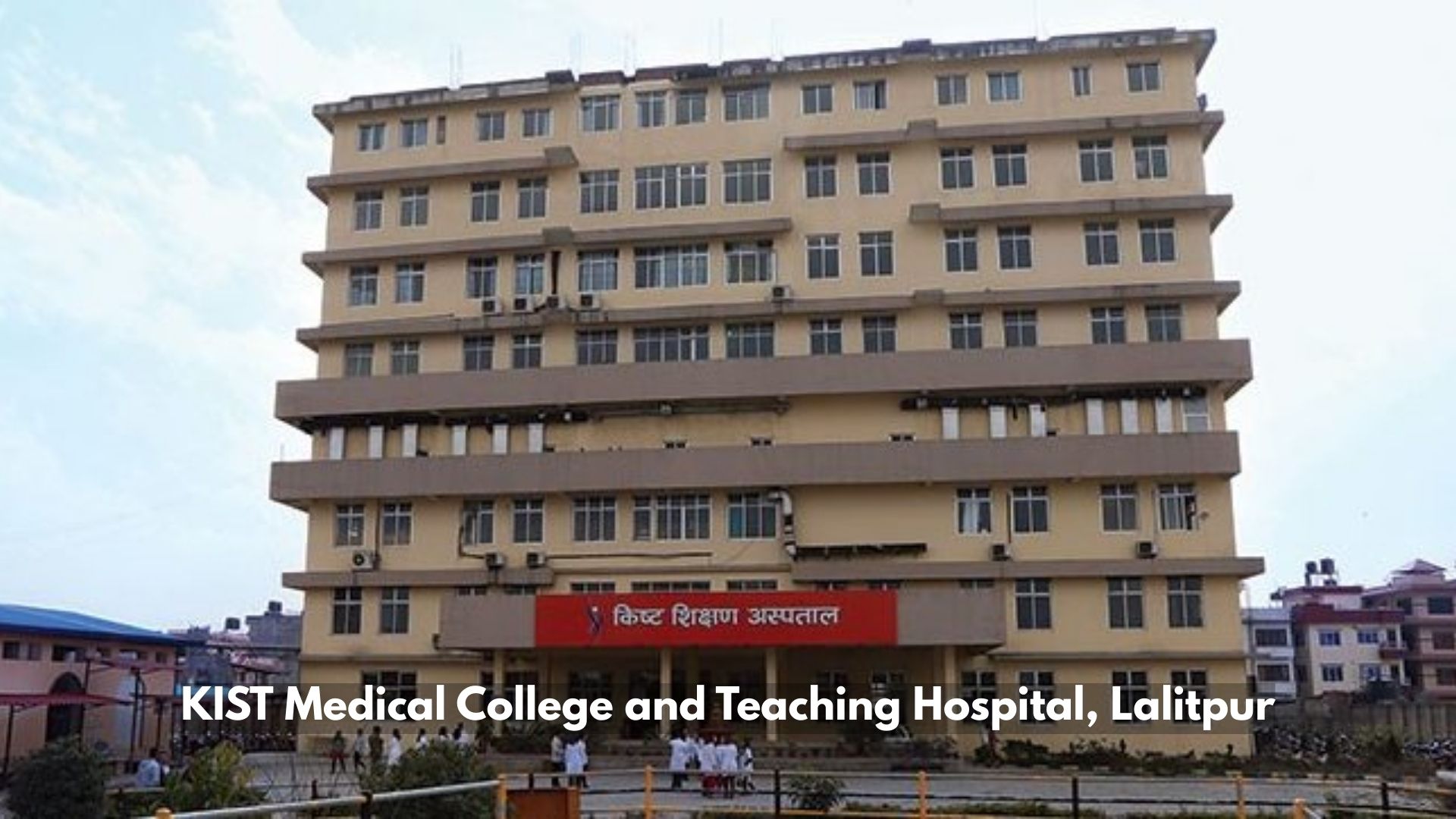
Location: Mahalaxmi Municipality–1, Imadol, Lalitpur (near the Ring Road)
Institution type: Medical college with its own teaching hospital and a separate dental hospital
University linkage: Institute of Medicine (IOM), Tribhuvan University (TU)
Undergraduate programs noted: MBBS, BDS, BPharm, BSc MLT
Program start years noted (BS): MBBS (2008), BDS (2010), BPharm and BSc MLT (2020)
Seat numbers listed (selected): MBBS (120), BDS (40), BPharm (40), BSc MLT (10)
Postgraduate and sub-specialty training listed: multiple MD/MS/MDS options and selected DM/MCh options with seat counts
Student facilities referenced: library with seating, internet access and e-library access, auditorium, canteen, hostel options with published monthly fees
KIST’s setting in Imadol places it within a dense urban–residential zone of Lalitpur where patient flow, public access, and connectivity can shape clinical exposure for students.
Proximity to the Ring Road is relevant for students commuting from other parts of Kathmandu Valley, and for patients who come for specialist services, diagnostic work, or emergency care.
For a teaching hospital, access matters because it affects both service continuity and the variety of clinical cases seen by learners.
The institution is run through a Board of Directors and an Executive Committee, with named leadership roles that include the chairmanship, managing directorship, principalship, hospital directorate, academic coordination, and administrative leadership positions.
A weekly Executive Committee meeting is mentioned for operational and policy direction connected to academic and hospital services.
For a medical college, this type of structure is often linked to how academic scheduling, hospital duties, clinical postings, student welfare, and service quality processes are managed across departments. When governance is active and routine, it supports timely decisions on academic calendars, hospital service expansion, and student support systems.
KIST is presented as running four undergraduate programs alongside postgraduate training and selected sub-specialty programs.
The undergraduate programs listed are MBBS, BDS, Bachelor of Pharmacy (BPharm), and Bachelor in Medical Laboratory Technology (BSc MLT).
Postgraduate programs span medical, surgical, dental, and selected sub-specialty areas, with seat numbers shown in the program list.
| Program | Seats |
|---|---|
| MD in Radio Diagnosis | 2 |
| Master in Dental Surgery (MDS) | 4 |
| DM Emergency Medicine | 1 |
| MCh Surgical Gastroenterology | 1 |
| MS General Surgery | 4 |
| MS Clinical Anatomy | 2 |
| MD Microbiology | 3 |
| MD in Psychiatry | 3 |
| MD Paediatrics | 4 |
| MD in Ophthalmology | 1 |
| MD in Obstetrics and Gynaecology | 4 |
| MD Internal Medicine | 8 |
| MD Anaesthesiology | 5 |
| MD General Practice (MDGP) | 3 |
| MS in Orthopaedic and Trauma Surgery | 4 |
| MD Pathology | 3 |
| Master of Public Health (MPH) | 6 |
| Bachelor of Pharmacy (B Pharm) | 10 |
| Bachelor in Medical Laboratory Technology (BSc MLT) | 10 |
| MS Clinical Otorhinolaryngology and Head and Neck Surgery | 2 |
| MD Biochemistry | 2 |
| MD Dermatology | 2 |
| MBBS | 120 |
| Bachelor of Dental Surgery (BDS) | 40 |
The MBBS program is stated as a four-and-a-half-year academic course followed by one year of compulsory internship under Tribhuvan University. The profile also links eligibility and fees to the rules of the Nepal Medical Education Commission (MEC), which is relevant because MEC frameworks govern entry criteria, seat allocation categories, and fee ceilings across Nepal’s medical education system.
From a student perspective, MBBS at a teaching hospital setting is shaped by three practical factors:
Clinical exposure across departments: posting schedules and patient flow influence how often students encounter emergencies, chronic disease management, diagnostics, and procedure-based learning.
Structured internal assessment: internal assessment and correlation seminars are referenced, which generally support exam preparation and day-to-day learning consistency.
Student support systems: counselling support involving parents or local guardians is mentioned, which can help students who face adjustment issues, academic stress, or attendance concerns.
BDS is stated as a five-and-a-half-year program in Nepal, including four years and six months of academic study and one year of compulsory rotating internship. The presence of a separate dental hospital matters for dental education because clinical skills in dentistry rely heavily on supervised hands-on patient work, equipment access, and consistent caseload in conservative dentistry, oral surgery, prosthodontics, and related areas.
Dental education also depends on imaging and diagnostic support. The service list includes dental imaging references such as OPG/Cephalometry, which are often used in diagnosis and treatment planning, especially for orthodontic and oral surgery cases.
BPharm is described as a four-year bachelor-level program under Tribhuvan University, introduced at KIST under the IOM framework. In Nepal’s health system, pharmacists work across hospital pharmacy services, community pharmacy, pharmaceutical industry roles, regulation and quality work, supply-chain and procurement functions, and clinical pharmacy support inside hospitals.
A hospital-linked environment can support pharmacy learning through exposure to medication counselling, rational drug use practices, hospital formulary approaches, and collaboration with clinicians on medication safety. The profile also references themes such as biostatistics, medical law and ethics, and pharmacoeconomics in the pharmacy learning context, which align with professional responsibilities that go beyond dispensing.
BSc MLT is described as a four-year bachelor’s program under Tribhuvan University. The profile outlines subject areas such as medical microbiology, clinical biochemistry, hematology, and histopathology/cytology. In practice, lab professionals are central to diagnosis support, treatment monitoring, infection detection, and public health surveillance, so a teaching hospital setting can provide exposure to both routine and advanced testing, sample processing workflows, and quality and safety practices.
A strong MLT environment usually depends on lab infrastructure, qualified supervision, specimen volume, and systematic protocols. Since these operational details vary across hospitals, students often verify lab posting schedules, equipment availability, and supervision ratios during their decision process.
The profile states that postgraduate programs started in BS two thousand seventy-seven, and DM/MCh programs have been running from BS two thousand eighty. The program list includes multiple MD/MS/MDS options and selected DM/MCh programs, each with seat counts. Examples shown include MD Internal Medicine, MD Anaesthesiology, MS General Surgery, MS Orthopaedics and Trauma Surgery, MDS, DM Emergency Medicine, and MCh Surgical Gastroenterology.
For residency and postgraduate applicants, seat numbers can change by regulator approval, department capacity, and yearly intake decisions. Applicants should confirm the current year’s seat allocation and the entry process through the university and relevant regulator notices.
The profile ties eligibility and fee structure to MEC rules for the MBBS program. For Nepal-based applicants, the practical admissions pathway typically involves the regulated selection system and documented eligibility requirements under MEC and the concerned university’s academic framework. Since the profile material does not list detailed step-by-step procedures for Nepal applicants, the safest publication approach is to state the regulator linkage and direct readers to confirm the current intake notice and MEC entry requirements for that year.
Students and families generally check:
Intake year notice and deadlines
Seat categories and quota rules
Fee ceilings and payment schedules
Academic eligibility requirements
Internship and licensing requirements after graduation (as defined by the relevant regulator and professional council)
The profile includes a foreign-student MBBS fee schedule for the session two thousand twenty-five–twenty-six and an eligibility note referencing NEET UG and grade twelve (ten plus two) requirements with PCB marks. It also includes installment and seat-booking details. This is useful for international readers because it shows how fees may be structured for foreign seats and what eligibility benchmarks are referenced for that intake cycle.
Because the profile includes repeated NEET references for different years, international applicants should focus on the intake year shown in the admission notice and confirm the latest thresholds and timelines with the admissions office.
The profile lists academic leadership roles such as principal, hospital director, and academic coordinator, and also notes coordination roles for undergraduate and BDS programs. For students, named leadership structures matter less as titles and more as functional systems: how teaching schedules are run, how attendance and assessments are managed, and how clinical postings are coordinated between academic and hospital departments.
The principal’s message notes the use of the IOM curriculum and references internal assessment and correlation seminars. It also mentions a Medical Humanities module and counselling support involving parents or local guardians. For medical and dental education, these components are often linked to professional behaviour, communication skills, ethical practice, and student wellbeing.
In a teaching hospital environment, learning also happens through:
ward rounds and case-based discussions
skill labs and supervised procedures (where allowed by curriculum stage)
postings in outpatient departments and emergency settings
interdisciplinary collaboration with nursing, lab, pharmacy, radiology, and allied services
The profile does not provide a year-wise teaching plan, so this article avoids adding unsourced module breakdowns.
The library is described as centrally located in the basic science (IBMS) block, with seating capacity for up to one hundred students and a collection that includes textbooks, reference books, and journals. Wi-Fi access is mentioned, along with e-library access for e-books and online journals. For health-professions students, library access and online resources often influence exam readiness, research writing, and clinical case referencing.
An auditorium capacity of about two hundred persons is noted, used for cultural and scientific programs such as seminars, conferences, and workshops. These platforms are often where students practice presentations, attend departmental updates, join guest lectures, and take part in academic events tied to continuing learning.
Hostels are described with separate accommodation for boys and girls, and a study-supportive environment. A more detailed hostel section lists twin-sharing and four-seater options, with published monthly fees. It also notes preference categories for hostel allotment, including students outside the country and outside Kathmandu Valley, girls, physically challenged students, Dalits, and Janajatis. Conduct rules include restrictions on entering opposite-gender rooms and prohibition of alcohol and intoxicating substances, with disciplinary outcomes stated.
For students and families, hostel details are not only about cost. They also influence daily routine, safety standards, and the ability to manage long academic hours in medical and dental education.
The campus is stated to have hygienic canteens providing food options at affordable rates. For students who spend long hours in hospital postings and classes, food access and sanitation standards play a direct role in day-to-day wellbeing.
A medical college’s academic strength is closely linked to its teaching hospital’s service scope because clinical postings depend on patient mix, diagnostic capacity, emergency readiness, and specialty departments.
The profile lists a wide service range, including twenty-four-hour emergency services, dialysis, intensive and critical care units, cardiology-related services including Cath Lab, neonatal and paediatric intensive care, endoscopy services, oncology-related care, diagnostics such as CT scan and ultrasound/color Doppler, and multiple specialty clinics and procedure services.
Emergency and critical care
Twenty-four-hour emergency services
Intensive care units (ICU/CCU and related units)
Neonatal intensive care (NICU) and paediatric intensive care (PICU)
Renal and transplant-related services
Dialysis services
Kidney transplant service is referenced in leadership messaging, with transplant counts mentioned for a specific period
Cardiac services
CCU/ICU support and related cardiac diagnostics
Cath Lab and related testing references
Medicine and specialty services
Pulmonology and sleep medicine services
Gastroenterology references including ERCP
Dermatology and venereology services
Psychiatric services and EEG references
Surgical and procedure services
Laparoscopic surgery
Urology surgery
Paediatric surgery
Oncology-related surgery references
Pre-anaesthesia checkup service
Women’s health
Antenatal, delivery, postnatal services
Family planning and adolescent health references
CAC service is listed in the profile
Orthopaedics and rehabilitation
Trauma and spine surgery references
Physiotherapy services
Arthroscopy/arthroplasty references
ENT and eye services
ENT surgeries and audiometry references
Cataract surgery and related ophthalmic services
Diagnostics and lab support
CT scan, digital X-ray, ultrasound and color Doppler
Histopathology and multiple lab test references
Cardiac biomarker and coagulation assay references
Support services
Preventive health checkup package reference
Diet counselling and medication counselling references
DOTS reference
Mortuary services reference
Medical social services including psychosocial counselling reference
This service grouping helps students understand where clinical exposure is likely to occur, and it also helps health planners and researchers identify service categories connected to tertiary-level care.
The profile lists institutional committees that are commonly linked to quality systems in teaching hospitals:
A journal editorial board with named roles
An IRC board with representation from clinical, dental, behavioural, social science, statistics, law, and community roles
An infection control committee with multi-department roles
A tumor board with oncology-related, radiology, pathology, and academic roles
For students, these structures often shape research proposal approval, academic writing support, infection control protocols used in hospital wards, and multi-department clinical review systems for complex cases.
The profile includes limited detail on clubs and sports. Still, it references basic supports that shape student life:
Hostel provisions with published fees and conduct standards
Canteen access for daily meals
Auditorium use for cultural and scientific programs
Library and online learning access for extended study hours
Medical and dental education in Nepal is time-intensive, so student experience often depends on routine supports: housing stability, access to study resources, predictable academic scheduling, and a campus environment where students can manage both learning and wellbeing.
The profile material does not provide a detailed scholarship table for students. It references government-linked health service listings connected to patient support programs, which are separate from student financial aid.
For publication accuracy, scholarship information should be added only when it is available from the institution’s official scholarship notice or regulator-linked seat category documents for the relevant intake. Students should confirm the exact scholarship categories, eligibility, and seat quotas for their intake year.
The profile includes several timeline markers:
Establishment year in BS two thousand sixty-two (two thousand six AD)
Program start years for MBBS, BDS, BPharm, and BSc MLT (as noted)
Graduate output counts for medical and dental graduates up to the beginning of BS two thousand eighty
Postgraduate start year and a note on DM/MCh running from BS two thousand eighty
Transplant service figures referenced in leadership messaging, linked to a timeline starting since two thousand twenty-one
These markers help readers understand how the institution has expanded across undergraduate, postgraduate, and clinical service areas over time.
This section is an evaluation guide for families and applicants comparing options in Nepal.
Confirm the current affiliation status and intake approvals under TU–IOM.
Confirm that admissions and fee ceilings follow MEC rules for the relevant intake year.
Check whether the seat numbers in the current intake match the published list.
Review the hospital service scope for areas that match your learning goals, such as emergency exposure, critical care, diagnostics, surgery, and specialty clinics.
Ask for a clear outline of clinical posting schedules and supervision practices for your program year.
Check library hours, online resource access, and reading room availability.
Review hostel availability, allotment rules, fee schedule, and code of conduct.
Ask about counselling and student welfare systems, including how academic issues and attendance concerns are handled.
One item that requires confirmation is bed capacity. The profile material presents two different figures in different sections. For a final decision, confirm the current licensed bed capacity directly through the hospital administration and regulator-recognized documentation for the present year.
Leadership messages in the profile describe the institution’s focus on medical education through TU–IOM alignment, service delivery through the teaching hospital, student support systems, and expansion of postgraduate and sub-specialty training. They also reference government-linked patient support services, dialysis services, and transplant service milestones. These points are best treated as institutional statements and should be cross-checked for the current year when used in official reporting.
KIST is located in Imadol, Lalitpur, within Mahalaxmi Municipality, and is described as near the Ring Road.
The profile links KIST with the Institute of Medicine (IOM), Tribhuvan University (TU).
The undergraduate programs listed are MBBS, BDS, BPharm, and BSc MLT.
The program list shows MBBS with one hundred twenty seats and BDS with forty seats. Seat counts should be confirmed for the current intake year.
MBBS is stated as four and a half years plus one year of compulsory internship under Tribhuvan University.
BDS is stated as five and a half years, including four years and six months of academic study and one year of rotating internship.
The profile references a library with seating capacity, Wi-Fi and e-library access, an auditorium for seminars and cultural programs, a canteen, and hostel accommodation options.
Yes. A foreign-student MBBS fee schedule is shown for a specific session with installment structure and eligibility references for that intake year. Applicants should confirm the latest intake details.
Services include twenty-four-hour emergency care, dialysis, ICU/CCU-related care, Cath Lab references, NICU/PICU, CT scan, endoscopy services, oncology-related services, and multiple specialty clinics and procedures.
KIST Medical College and Teaching Hospital is presented as a TU–IOM affiliated institution located in Imadol, Lalitpur, with undergraduate programs in medicine, dentistry, pharmacy, and medical laboratory technology, alongside postgraduate and selected sub-specialty training options. Its teaching hospital service range is broad and includes emergency, critical care, diagnostics, and specialty services that often shape clinical learning exposure.
For publication integrity and for student decision-making, the final step is to confirm intake-specific details each year: seat numbers, admission criteria, fee ceilings for Nepal seats, international eligibility thresholds where applicable, and the hospital’s current licensed bed capacity.
Contact KIST Medical College's administrative office for detailed information on the course, admissions, location, fees, scholarships, facilities, counseling or eligibility.
KIST Medical College
Email Address: info@kistmcth.edu.np
Phone Number: +977-1-5201496, +977-1-5201836
Website: https://www.kistmcth.edu.np
Location: Gwarko, Imadol, GPO Box: 14142, Mahalaxmi Municipality, Ward No 1, Lalitpur, Nepal