Kumarwarti Multiple Campus (कुमारवर्ती बहुमुखी क्याम्पस) is a publicly owned higher education institution in Kawasoti, Nawalparasi (Bardaghat–Susta East), Gandaki Province, Nepal. Established in 1988 AD (2044 BS), the campus grew out of a community effort led by local social activists, intellectuals, teachers, traders, peasants, and ex-servicemen who wanted wider access to higher education at an affordable cost. What began as Kumarwarti Vanijya Campus with PCL/I.Com in Management later expanded into a multiple-campus model with +2, bachelor’s, and master’s programs.
The institution carries the slogan “Betterment of life through quality education” and places strong emphasis on access, teacher development, student participation, library services, information technology, and community service. Its academic structure connects school-level and university-level study through National Examinations Board (NEB) and Tribhuvan University.
Established: 1988 AD (2044 BS)
Institution Type: Publicly owned, community-supported multiple campus
Location: Kawasoti-2, Shivamandir, Nawalparasi (Bardaghat–Susta East), Gandaki Province, Nepal
Affiliation: Tribhuvan University for higher education programs; National Examinations Board (NEB) for +2 programs
Affiliation Acceptance Date: 2045/03/03
Commencement Date: 2045/05/13
Programs Running: +2, BA, B.Ed., BBS, MA in Sociology, M.Ed., MBS
Academic Focus: Access to higher education, teacher development, project-based learning, use of information technology, student participation
Scholarship Support: Full or partial scholarships in different categories
Contact: +977-78-540115 | kmcampus@gmail.com | kumarwarti.edu.np
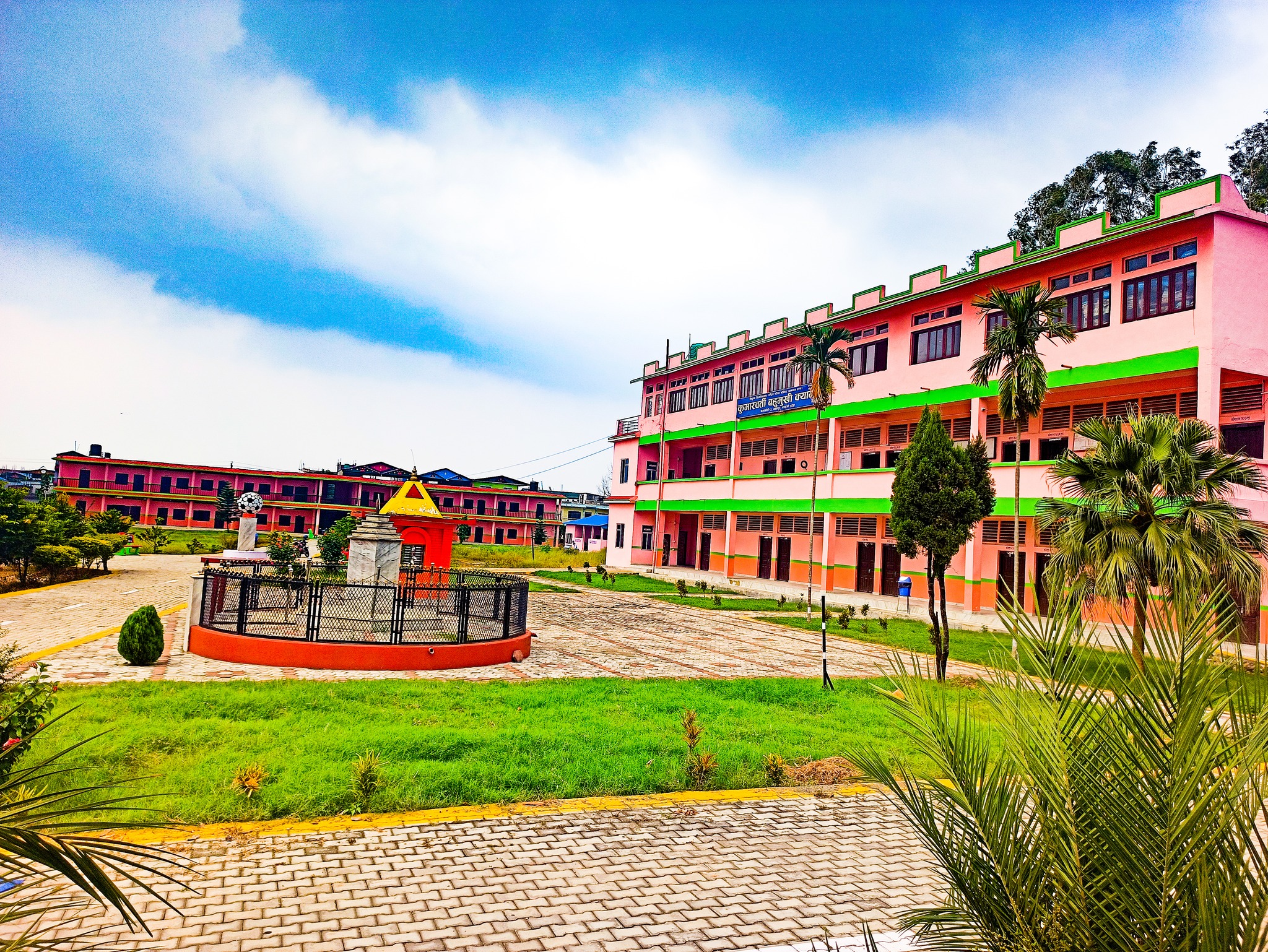
Kumarwarti Multiple Campus was established to widen access to higher education for students from the Nawalpur belt and nearby communities. Its early formation was tied to the initiative of the then 37 village panchayats, along with local social activists, intellectuals, teachers, traders, and peasants. The campus began as Kumarwarti Vanijya Campus with Tribhuvan University affiliation for the Proficiency Certificate Level in Management. Over time, it developed into a multiple campus serving different academic interests and study levels.
The institutional history also records the contribution of late Pandit Krishna Sharan Dumre, who organized a Dhana Dhanyanchal Yagya to raise funds for the establishment of the campus. This community-supported beginning remains central to the campus identity. The institution was shaped as a public-funded and publicly owned academic space, built to support students who could not easily pursue higher education in city colleges.
The campus vision centers on moving toward autonomous status and contributing to the betterment of human life in regional, national, and international contexts. Its mission connects that long-term direction with practical academic goals: widening higher education opportunities, producing skilled human resources, supporting community service, preserving national and traditional culture, promoting cross-cultural learning, and strengthening self-sustaining institutional capacity. The institutional objectives also place clear weight on access for underprivileged students, student participation, library development, modern information technology, clean campus surroundings, and continuous academic improvement.
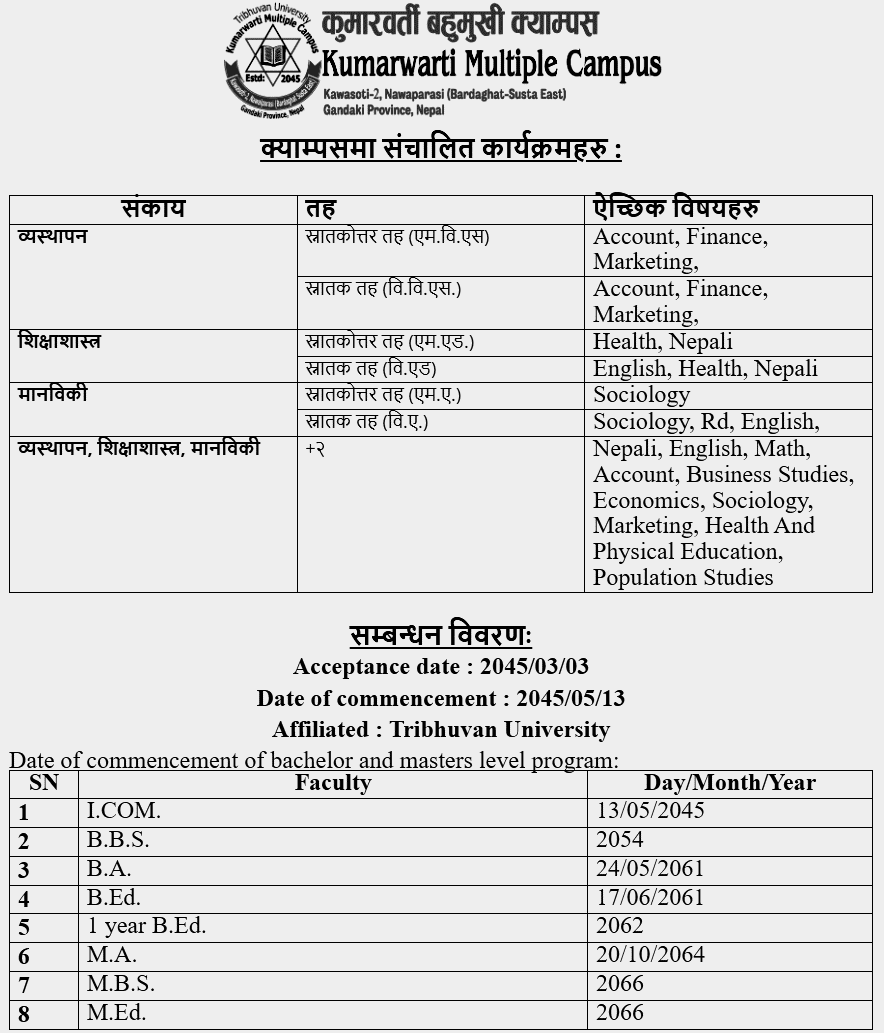
Kumarwarti Multiple Campus runs academic programs across the school, bachelor’s, and master’s levels. The +2 programs follow the National Examinations Board (NEB) framework, while university programs operate under Tribhuvan University and its relevant faculties.
Ten Plus Two in Management — 2 years, annual system, NEB framework
Ten Plus Two in Education — 2 years, annual system, NEB framework
At the +2 level, the campus records subject options such as Nepali, English, Mathematics, Accountancy, Business Studies, Economics, Sociology, Marketing, Health and Physical Education, and Population Studies.
Bachelor of Business Studies (BBS) — 4 years, annual system, TU Faculty of Management
Bachelor of Education (B.Ed) — 4 years, annual system, TU Faculty of Education
Bachelor of Arts (BA) — 4 years, annual system, TU Faculty of Humanities and Social Sciences
The campus table records BBS options in Account, Finance, and Marketing. For B.Ed., the listed subject areas include English, Health, and Nepali. For BA, the listed areas include Sociology, Rural Development, and English. TU annual-system bachelor programs follow the annual structure, and final examinations are conducted through the Office of the Controller of Examinations.
Master of Business Studies (MBS) — 2 years, 4 semesters, TU Faculty of Management
Master of Education (M.Ed) General — 2 years, 4 semesters, TU Faculty of Education
MA in Sociology — 2 years, 4 semesters, TU Faculty of Humanities and Social Sciences
The campus records MBS options in Account, Finance, and Marketing. For M.Ed., the listed specialization areas are Health and Nepali. MA is offered in Sociology. These master’s programs follow the semester structure, and semester-end examinations are conducted by the respective Dean’s Office under TU rules.
This progression from +2 to master’s study gives students a continuous academic route within one institution. It also reflects the campus plan to widen subject choice, add new programs, and build stronger academic depth over time.
Admission at Kumarwarti Multiple Campus follows the rules of the relevant board or university level.
Admission generally begins after the publication of SEE results.
Students submit the prescribed application form and academic records.
Depending on the stream and campus decision, admission may include an entrance test, interview, or merit-based selection.
After selection and fee payment, enrollment is completed in Grade 11.
Subject registration is completed under the NEB system through the campus.
Class 12 examinations and result publication follow NEB procedures and the NEB annual calendar.
Admission notices are published by the campus in line with TU rules and faculty regulations.
Eligible applicants submit the admission form with required academic documents.
Depending on the program or campus policy, admission may include an entrance examination, merit-based selection, or both.
Selected applicants complete admission after document submission and payment of the prescribed fees.
Academic registration, annual examinations, and results follow TU rules and the academic calendar.
Admission notice is published by the concerned campus or faculty structure.
Applicants submit the prescribed form for the relevant master’s program.
Admission may include an entrance examination depending on the program.
A merit list or selection result may be published.
Final enrollment is completed after document submission and payment of the required fees.
Semester-end examinations and academic administration follow TU rules and the schedule of the respective Dean’s Office.
The document requirements differ by academic level and system.
SEE marksheet or grade sheet
SEE character certificate or school leaving certificate
Transfer certificate from the previous school
Migration certificate, if applicable
Citizenship certificate or birth certificate copy
Passport-size photographs
NEB Class 11 registration or subject registration form
Academic transcript of Class 12 / +2 or equivalent
Character certificate from the previous institution
Migration certificate, if the previous board or university is different
Transfer certificate from the previous school or college
Citizenship certificate or birth certificate copy
Passport-size photographs
Entrance examination scorecard, if required
Completed admission or application form
Admission fee payment receipt
Equivalence certificate, if the qualification is from a foreign board or university
Bachelor’s degree transcript or marksheet
Bachelor’s degree certificate or provisional certificate
Character certificate from the bachelor-level institution
Migration certificate, if the bachelor’s degree is from another university
Transfer certificate from the previous campus or college
Citizenship certificate or birth certificate copy
Passport-size photographs
Entrance examination scorecard, if required
Completed admission or application form
Admission fee payment receipt
Equivalence certificate, if the bachelor’s degree is from a foreign university
The campus planning record places teacher skill development and staff capacity building among its core academic priorities. It also mentions further study opportunities for teaching staff, the use of modern information technology, and student support measures to improve academic performance and participation. This gives the teaching environment an institutional base that goes beyond routine classroom delivery.
The academic approach also reflects the structures of the programs the campus runs. The institutional mission includes project-based learning, and several TU program frameworks connected to the campus use lecture classes together with discussion, presentation, assignments, practical work, seminars, case studies, and field-based learning. In the annual-system bachelor’s environment, internal work and written examinations both appear in course structures, while the semester-based master’s programs place emphasis on continuous evaluation and end-semester examinations.
This mix supports a learning culture where classroom teaching, guided assignments, project work, and examination-based assessment all have a role. The campus objectives also stress pedagogy, management, financial sustainability, and stronger academic outcomes, which ties faculty development directly to student learning.

The campus has both existing infrastructure and a recorded development plan for immediate, mid-term, and long-term growth.
Three-storeyed concrete building — 1
Two-storeyed concrete building — 1
One-storeyed concrete building — 1
Canteens — 2
Rest rooms for boys, girls, and staff — 7
Motorcycle and bicycle stands — 2
Drinking water tanks — 6
Desks and benches — 368
Tables and chairs — 129
Drawers — 40
Computers — 25
Laptop — 1
Printers — 4
Fax or photocopy machine — 1
Projector — 1
Camera — 1
Podium — 1
Resource library support
Free e-mail and internet service for students
Games and sports facilities
Extracurricular activity support
Transportation facility
Faculty department development as an infrastructure priority
Immediate priorities
Renovation of the existing library
Completion of campus compounding and land protection
Gardening and park development
Vehicle parking stand
New toilets
Basketball court
Business shutters
Mid-term priorities
Separate library building
Free student union building
Computer lab modernization or renovation
Cafeteria
Long-term priorities
Administrative building
Hostel for students
Quarters for campus staff
The infrastructure plan shows a campus that has moved beyond a small single-program origin and is continuing to organize physical facilities around academic growth, student use, and day-to-day campus operations.
Student life at Kumarwarti Multiple Campus is closely tied to its community roots. The institution was established to widen higher education access for local students, and that social purpose still shapes the campus atmosphere. Its objectives mention student participation, community service, access for underprivileged groups, and a clean, healthy, and pleasant environment.
The presence of sports, extracurricular activities, transportation support, internet access, library services, and student support planning adds to day-to-day campus experience. The campus also has a continuing annual-report and guardians’ day tradition, which points to an institutional culture where academic review and community connection remain active parts of campus life.
For students, this means the campus offers more than classroom instruction alone. Its structure combines academic progression, community participation, and support services within one institution in Kawasoti.
Games and sports facilities are available on campus.
Extracurricular activities are part of campus services.
Student participation is one of the stated institutional objectives.
A basketball court appears in the campus infrastructure priority list.
The campus plan also links student activity with talent development and broader participation in institutional life.
Full or partial scholarships are available in different categories.
Scholarship categories include students with strong academic records, economically disadvantaged students, students with disabilities, Dalit students, and students recommended by cooperatives, social organizations, and community schools.
Students seeking scholarship support are required to submit an application within one month of admission.
The campus also records a special discount for students with excellent SLC results.
The broader institutional objective of widening access for disadvantaged communities aligns with this scholarship structure.
Established in 1988 AD (2044 BS) as a community-supported higher education institution
Affiliation accepted on 2045/03/03 and classes commenced on 2045/05/13
Began with PCL/I.Com in Management and later expanded into a multiple-campus model
Added bachelor’s and master’s programs across Management, Education, and Humanities and Social Sciences
Selected in the second Higher Education Reform Project by the University Grants Commission (UGC)
Quality Assurance and Accreditation (QAA) Accredited by UGC Nepal.
Formal publication of annual reports has continued since the 31st anniversary cum guardians’ day
Community-rooted institution with a long local academic history
+2, bachelor’s, and master’s study options within one campus
Academic connection with Tribhuvan University and National Examinations Board (NEB)
Scholarship categories for different groups of students
Resource library, internet service, transportation, sports, and extracurricular support
Clear institutional priorities around teacher development, student support, and academic improvement
Subject options across Management, Education, and Humanities and Social Sciences
Kumarwarti Multiple Campus reflects a long community effort to widen access to higher education in Kawasoti and the surrounding region. Its growth from a commerce-focused beginning into a multiple campus with +2, bachelor’s, and master’s programs shows steady academic expansion within a public institutional model.
The campus combines local roots with structured academic progression under TU and NEB frameworks. Its scholarship categories, student support priorities, library and internet services, sports and extracurricular activities, and continuing infrastructure plans make it a notable higher education option for students seeking study opportunities in Nawalparasi (Bardaghat–Susta East).
Contact Kumarwarti Multiple Campus's administrative office for detailed information on the course, admissions, location, fees, scholarships, facilities, counseling, or eligibility.
Kumarwarti Multiple Campus
Email Address: kmcampus@gmail.com
Phone Number: +977-78-540115
Website: http://kumarwarti.edu.np
Location: Kawasoti -2, Nawalparasi (Bardaghat – Susta East), Gandaki Province, Nepal
Kumarwarti Multiple Campus is located in Kawasoti-2, Shivamandir, Nawalparasi (Bardaghat–Susta East), Gandaki Province, Nepal.
The campus was established in 1988 AD (2044 BS).
The campus runs +2 programs under the National Examinations Board (NEB) and higher education programs under Tribhuvan University.
The campus runs Ten Plus Two in Management, Ten Plus Two in Education, Bachelor of Business Studies (BBS), Bachelor of Education (B.Ed), Bachelor of Arts (BA), Master of Business Studies (MBS), Master of Education (M.Ed) General, and MA in Sociology.
Yes. The campus records full or partial scholarships in different categories for academically strong, economically disadvantaged, disabled, Dalit, and recommended students from cooperatives, social organizations, and community schools.
The campus records library support, free e-mail and internet service, games and sports, extracurricular activities, transportation support, canteens, rest rooms, drinking water tanks, and computing equipment.
+2 admission generally begins after SEE results. Students submit the application form and academic records, and admission may include an entrance test, interview, or merit-based selection depending on the stream and campus decision.
For annual-system TU bachelor’s programs, final examinations are conducted through the Office of the Controller of Examinations. For semester-based TU master’s programs, semester-end examinations are conducted by the respective Dean’s Office. For +2, Class 12 examinations and result publication follow NEB procedures.
Students can contact the campus at +977-78-540115 or by e-mail at kmcampus@gmail.com. The website listed for the campus is kumarwarti.edu.np.