Lampantar Multiple Campus (लाम्पनटार बहुमुखी क्याम्पस, तीनपाटन, लाम्पनटार, सिन्धुली) is a community campus established in 2062 BS (2005 AD) in Tinpatan Rural Municipality-11, Lampantar, Sindhuli, Bagmati Province, Nepal. It is affiliated with Tribhuvan University and recognized by the University Grants Commission of Nepal. The campus runs +2 streams in Education, Humanities, and Management, along with bachelor’s and master’s programs in Education, Arts, and Business Studies.
It was set up to widen access to higher education for students in rural and educationally underserved communities. As a not-for-profit institution guided by service ethics, the campus has grown through local participation, public support, and gradual academic expansion. Its institutional direction links classroom teaching with community access, academic continuity, and practical student support.
Established: 2062 BS (2005 AD)
Institution Type: Community campus
Affiliation: Tribhuvan University
Recognition: University Grants Commission of Nepal
Location: Tinpatan Rural Municipality-11, Lampantar, Sindhuli, Bagmati Province, Nepal
Academic Levels: +2, bachelor’s, and master’s
Bachelor’s Programs: B.Ed., BA, BBS
Master’s Programs: M.Ed., M.A. in Population
Academic System: Annual system for TU bachelor’s and master’s programs
Student Support: Library, computer lab, counseling, scholarships, sports, hostel, ECA, conference facilities
Contact: lampantarcampus11@gmail.com | +977-49-690192 | lmctinpatan.edu.np
Lampantar Multiple Campus was founded through the combined efforts of local representatives, social workers, intellectuals, businesspersons, teachers, and community members who wanted to make higher education more accessible in the rural part of Sindhuli. The campus materials present it as a service-oriented institution formed to respond to the educational needs of communities that had limited access to higher studies outside major towns and district centers. The institution also identifies itself as a not-for-profit campus shaped by community participation and long-term local commitment.
Its early years were marked by financial difficulty and dependence on collective support. During the initial phase, classes were run in the building of Shree Higher Secondary School, Lampan, Batase. Teachers and staff of that school donated monthly salary support for the establishment of the campus, and additional support came from local donations mobilized under the leadership of Karna Bahadur Thapa and from youths working in Gulf countries. Over time, the campus expanded its physical and academic base with support from the University Grants Commission, provincial and local government bodies, and other community-backed income sources.
The campus materials also place Lampantar Multiple Campus within the wider educational history of Sindhuli by identifying it as the second higher education institution in the district and the first established beyond the district headquarters. This rural setting remains central to its role. The institution was set up not only to offer academic programs, but also to keep higher education within reach for students who might otherwise have had to leave their home area for further study.
LMC has set firm vision to output capable, competence and creative human resource motivated by positive thinking, moral and ethical values and civic responsibility to accelerate the nation towards development and prosperity
LMC is strongly committed to generate qualitative and competence manpower through the well developed academic infrastructure, proficient and capable teaching and non teaching staffs and consistent administration implementing innovative pedagogical practices and research culture.
LMC has set the following goals to meet the above mentioned vision and mission;
Make campus financially sustained by identifying self generating sustainable source of income.
Make presently offered education more effective, qualitative and time relative by extending technical faculties and introducing innovative pedagogical methods practicing by the leading academic institutions such as digital class room, online assignment, modern teaching aids, students' centered teaching, e-library etc...
Initiate to motivate teachers and staffs working in the campus in training. skill development and capacity building programs, seminar, workshop and research work for the professionalism development.
Offer special facilities to the teachers to pursuit further higher education such as M.Phil. and Ph. D.
Regulate internal evaluation and monitoring mechanism.
Set firm commitment to receive QAA award for ensuring recognition of the campus as a competence higher education institution.
Develop physical infrastructure like well facilitated class room, library, canteen, laboratory, toilet and pure drinking water.
LMC has been entirely dedicating to achieve the pre determined objectives to;
Make the teaching learning activities effective by developing well Facilitated physical infrastructure.
Maintain play ground and sports materials and equipments for all round personality development of the student.
Increase student enrollment rate
Make the campus financially resourceful by collaborating with organizations functioning within the campus' catchment area.
Make teaching learning activities effective
Output competitive and capable human resource
Enhance the proficiency of the teaching and non teaching faculties.
Motivate teachers in research and innovation
Make practical examination more managed and organized.
Keep and update record of students systematically.
Carry on ECA regularly
Make EMIS functional to keep educational information systematically applying convenient and appropriate technology.
Motivate students' in self study.
Develop reading culture in student and teacher
Develop skills transforming theoretical knowledge into practical life.
Make financial and administration management transparent and accountable.
Nurture problem solving skill of student encouraging research and extension.
Make provision of sanction and reward.
Lampantar Multiple Campus offers study options from the +2 level to postgraduate study. The available programs cover humanities, education, management, and population-related study under both school and university frameworks.
+2 Programs: Education, Humanities, Management
Bachelor’s Programs: B.Ed. (4 years, annual system), BA (4 years, annual system), BBS (4 years, annual system)
Master’s Programs: M.Ed. (2 years, annual system), M.A. in Population (2 years, annual system)
At the bachelor’s level, the campus operates under the relevant faculties of Tribhuvan University. B.Ed. is linked with the Faculty of Education, BA with the Faculty of Humanities and Social Sciences, and BBS with the Faculty of Management. The campus materials also reference subject availability across education and humanities streams and concentration choices within BBS. The academic structure places Lampantar Multiple Campus within the regular annual examination framework of TU-affiliated programs.
The campus has expanded its program base over time. BA and B.Ed. formed part of the early academic foundation, management education was added later through BBS, and postgraduate study was introduced through M.Ed. and M.A. offerings. This progression shows a move from basic local access to a wider set of continuing study options within the same institution.
For students, this means the campus supports more than one stage of academic progression. A student may enter through the +2 level, continue into bachelor’s study in Education, Arts, or Business Studies, and move onward to postgraduate study in the fields available on campus. That continuity is one of the practical strengths of the institution’s academic structure.
Lampantar Multiple Campus offers programs under both the NEB and TU frameworks, so admission procedures differ by academic level.
For +2 programs: Admission usually begins after the publication of SEE results. Students submit the prescribed form and academic records. Depending on the stream and campus policy, admission may include an entrance test, interview, or merit-based selection. After selection and fee payment, students are enrolled and subject registration is completed under the NEB system.
For TU bachelor’s programs: Admission follows the rules of the concerned faculty, Dean’s Office, and campus. Eligible applicants submit the prescribed form with academic documents. Selection may involve an entrance examination, merit, or both, depending on the program or campus policy. Final admission is completed after document submission and payment of the prescribed fees.
For TU master’s programs: Admission notices are published by the concerned campus, department, institute, or Dean’s Office. Eligible applicants submit the application form and required documents. Admission may include an entrance examination. A merit list or selection result may be published before final enrollment is completed.
For TU annual-system programs, academic registration, examinations, and results follow university rules and the applicable academic calendar. Final annual examinations for bachelor’s and master’s programs are conducted by Tribhuvan University through the Office of the Controller of Examinations. For +2 study, subject registration and board-related procedures move under the NEB framework through the institution.
The required documents vary by level of study. The campus materials support the use of the following standard lists for NEB and TU admissions.
For +2 admission (NEB Class 11):
SEE marksheet / grade sheet
SEE character certificate / school leaving certificate
Transfer certificate (TC) from the previous school
Migration certificate, if applicable
Citizenship certificate or birth certificate copy
Passport-size photographs
NEB Class 11 registration / subject registration form
For TU bachelor’s admission:
Academic transcript of Class 12 / +2 or equivalent
Character certificate from the previous institution
Migration certificate, if the previous board or university is different
Transfer certificate (TC)
Citizenship certificate or birth certificate copy
Passport-size photographs
Entrance examination scorecard, if required
Completed admission or application form
Admission fee payment receipt
Equivalence certificate, if the qualification is from a foreign board or university
For TU master’s admission:
Bachelor’s degree transcript / marksheet
Bachelor’s degree certificate or provisional certificate
Character certificate from the bachelor-level institution
Migration certificate, if the bachelor’s degree is from another university
Transfer certificate (TC)
Citizenship certificate or birth certificate copy
Passport-size photographs
Entrance examination scorecard, if required
Completed admission or application form
Admission fee payment receipt
Equivalence certificate, if the bachelor’s degree is from a foreign university
The campus materials refer to 23 teaching faculties and 7 non-teaching staff. The teacher list includes academic personnel working in areas such as Nepali, English, Account, Economics, Population, Physics, Mathematics, and Marketing. The named leadership within the academic structure includes Campus Chief Ananantaraj Shrestha and Assistant Campus Chief Tarannath Koirala. This staffing pattern shows that the campus supports multiple disciplines across humanities, education, and management.
The teaching approach has been described as largely lecture-based and teacher-centered, with a visible shift toward ICT-supported classroom practice. The campus materials mention audio-visual teaching, smart boards, projectors, laptops for faculty, and a research laboratory. They also refer to efforts to strengthen self-study, reading culture, student record management, EMIS-based information systems, practical learning, internal evaluation, and research-linked teaching. This shows a blended academic approach where conventional annual-system teaching remains central, while digital tools and organized academic support are being added to the classroom environment.
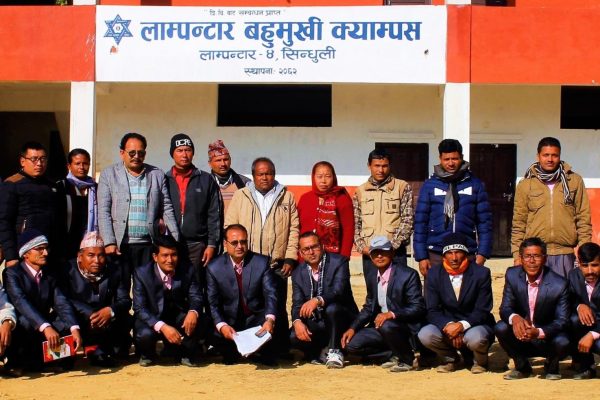
The campus has moved from borrowed classroom space in its early stage to its own land and institutional buildings. The campus materials refer to six buildings and 63 rooms, along with academic, administrative, hostel, library, and support spaces. This physical base supports both classroom teaching and student services.
Own land and campus buildings
Academic and administrative blocks
Library block and department library access
Computer lab
Research lab
Meeting and seminar halls
Classrooms and conference facilities
Boys’ and girls’ hostel facilities
Canteen and kitchen spaces
Playground and sports facilities
Drinking water and rest rooms
Garden and parking shed
Students’ union room
Health desk and counseling room
The library resources are described in some detail. The collection includes 3,772 textbooks, 342 reference books, daily newspapers, journals, research publications, literary works, and thesis holdings. The library also has a reading zone that can seat fifty students at a time, and the service is described as automated. Alongside the library, the campus materials mention department-level reference collections and plans for broader digital access.
In terms of instructional aids, the campus materials mention 10 laptops, 24 desktops, 4 projectors, 3 smart boards, printers, sound systems, globes, and mathematics instruments. Two classrooms had already been upgraded for audio-visual teaching at the time reflected in the campus materials. These details show that the learning environment is not limited to conventional classroom delivery. It also includes digital equipment, research space, and subject-based teaching support.
Student life at Lampantar Multiple Campus is shaped by its role as a rural community campus. The campus environment combines classroom study with hostel access, library use, sports, counseling, and structured student support. In addition to regular classes, the institution mentions coaching classes and extra boost-up classes for students who need additional academic support. These features suggest an educational setting where student continuity and day-to-day academic assistance receive institutional attention.
The support structure also extends beyond classrooms. The campus materials refer to committees and units such as IQAC, EMIS, the Examination Committee, the Scholarship Committee, the ECA Committee, the Grievance Redressed and Psycho Counseling Committee, the Employment Cell, and the Library Management Committee. This committee-based structure points to an organized campus environment with defined mechanisms for student support, internal monitoring, academic administration, and extracurricular coordination.
Campus experience also includes hostel life, cafeteria access, sports participation, reading habits, and community connection. The institution mentions maintaining student records systematically, motivating self-study, carrying ECA regularly, and strengthening campus-community relationships through a public information committee. This makes campus life broader than the timetable of formal classes alone.
Regular ECA activities
Indoor and outdoor sports
Educational tours
Yoga class
Music and dance class
Journal and publication-related activity
Seminar and conference participation through campus facilities
Student engagement through the ECA Committee and related campus committees
Meritorious scholarship
Dalit scholarship
Women scholarship
Physically impaired scholarship
Coaching and extra support classes for students needing academic assistance
Institutional financial backing through UGC, provincial and local government support, income sources such as Chakmake Bazar, land-based resources, and student fees
Established in 2062 BS as a community campus
BA and B.Ed. classes were permitted from the early institutional phase
Undergraduate examinations have been conducted at campus expense since 2065 BS
Joined the QAA program of the University Grants Commission in 2068 BS
Submitted the Self Study Report to UGC in 2069 Mangsir
Selected under Scheme D of UGC’s Second Higher Education Project in 2070 BS
Received first QAA monitoring in 2073 Push
Selected under the UGC Higher Education Reform Plan (HERP) in 2073 BS
Campus materials also refer to support under SHEP in later years
Community-run and not-for-profit institutional model
Rural access to +2, bachelor’s, and master’s study in one campus
TU affiliation and UGC recognition
Annual-system bachelor’s and master’s programs
Library, computer lab, research lab, counseling, hostel, sports, and conference facilities
Scholarships for merit and inclusion categories
Academic support through coaching classes, extra classes, and organized student-service committees
Long-standing local and public institutional support for campus growth
The message attributed to Chairman Pradip Kumar Katuwal centers on education as a social responsibility linked with broader national development. It also highlights cooperation with Tribhuvan University, the University Grants Commission, provincial government, Tinpatan Rural Municipality, parents, teachers, and staff for the academic, economic, and physical development of the campus. The message presents continuity of support and resource mobilization as necessary for the future direction of the institution.
The message attributed to Campus Chief Ananantaraj Shrestha presents the campus as a response to the lack of higher education access in villages and remote communities. It connects the institution’s origin to local participation, academic expansion from BA and B.Ed. to later postgraduate offerings, and long-term engagement with UGC processes such as QAA, Scheme D, and HERP. The message gives a picture of an institution built around access, gradual expansion, and public educational responsibility.
Lampantar Multiple Campus stands as a community-based higher education institution in Sindhuli with programs ranging from +2 study to postgraduate education. Its development reflects local initiative, steady academic expansion, and a practical focus on rural access to higher learning. With TU affiliation, UGC recognition, library and lab facilities, scholarship support, and a mix of traditional and ICT-supported teaching practices, the campus occupies an important place in the educational landscape of its area. For students seeking study options within Sindhuli across education, humanities, and management, it offers a structured academic path within a community-run setting.
Contact Lampantar Multiple Campus's administrative office for detailed information on the course, admissions, location, fees, scholarships, facilities, counseling, or eligibility.
Lampantar Multiple Campus
Email Address: lampantarcampus11@gmail.com
Phone Number: +977-49-690192
Website: https://lmctinpatan.edu.np
Location: Tinpatan Rular Municipality-11, Lampantar, Sindhuli, Bagmati Province, Nepal
Lampantar Multiple Campus is a community campus established in 2062 BS (2005 AD). It is also described as a not-for-profit institution guided by service ethics.
The campus is located in Tinpatan Rural Municipality-11, Lampantar, Sindhuli, Bagmati Province, Nepal.
Lampantar Multiple Campus is affiliated with Tribhuvan University and recognized by the University Grants Commission of Nepal.
The campus offers +2 programs in Education, Humanities, and Management; bachelor’s programs in B.Ed., BA, and BBS; and master’s programs in M.Ed. and M.A. in Population.
The bachelor’s and master’s programs mentioned in the campus materials run under the annual system. Bachelor’s programs are four years in duration, and the master’s programs are two years.
Yes. The campus materials mention meritorious, Dalit, women, and physically impaired scholarships.
The campus mentions a library, computer lab, research lab, counseling room, health desk, sports facilities, hostel, canteen, conference and seminar spaces, and extracurricular activities such as yoga, music, and dance.
The available materials name Pradip Kumar Katuwal as Chairman and Ananantaraj Shrestha as Campus Chief.