Lumbini Integrated Academy (LIA) is an independent co-educational institution established in 2023 at Laxmi Prasad Marg, Janakinagar, Tilottama-3, Rupandehi, Nepal. Affiliated with Purbanchal University, the academy began its academic activities with two undergraduate programs: Bachelor of Arts and Bachelor of Laws (B.A. LL.B.) and Bachelor of Science in Forestry (B.Sc. Forestry).
Its academic environment combines classroom instruction with practical work, field-based study, research activities, and student development opportunities. The campus includes classrooms, laboratories, a library, recreational areas, and spaces for creative work. Student activities include clubs, cultural programs, sports, and community engagement. The two programs serve students interested in legal studies, forest management, conservation, biodiversity, environmental science, and natural resource planning.
| Category | Details |
|---|---|
| Institution Name | Lumbini Integrated Academy |
| Short Name | LIA |
| Established | 2023 |
| Institution Type | Independent co-educational institution |
| Affiliation | Purbanchal University |
| Location | Laxmi Prasad Marg, Janakinagar, Tilottama-3, Rupandehi |
| Province | Lumbini Province |
| Programs | B.A. LL.B. and B.Sc. Forestry |
| Website | www.lia.edu.np |
Lumbini Integrated Academy was founded and is managed by a team of professionals and academicians. The institution is situated in Tilottama, Rupandehi, and follows a multidisciplinary academic direction under Purbanchal University.
The academy introduced law and forestry as its initial areas of study for the 2023 academic session. These disciplines cover social, legal, environmental, scientific, and natural-resource concerns.
Its academic approach places attention on subject knowledge, analytical thinking, practical exposure, communication, research, and professional responsibility. Students are encouraged to examine problems, connect theory with practice, and take part in academic and extracurricular activities.
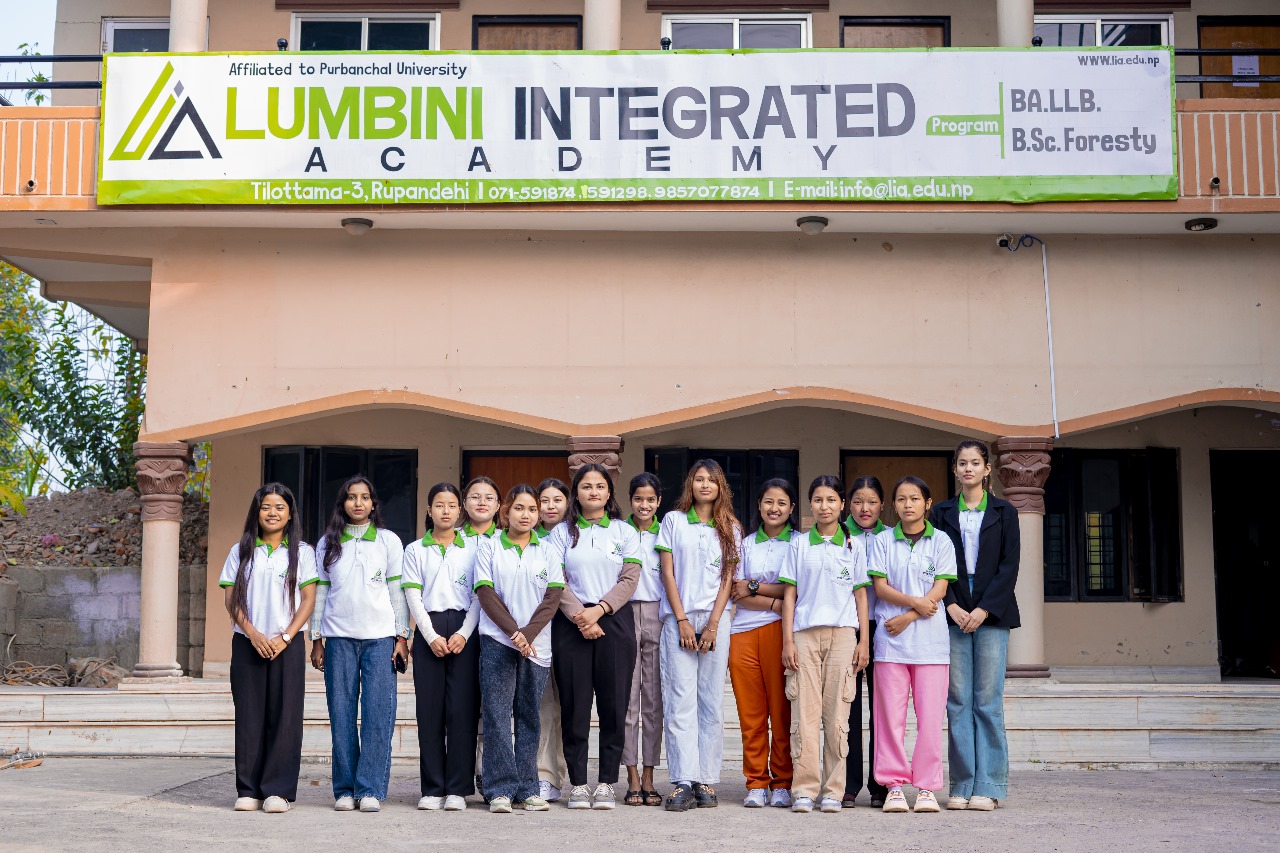
The academy is located at Laxmi Prasad Marg, Janakinagar, Tilottama-3, Rupandehi, Lumbini Province, Nepal.
The address places the institution within Tilottama Municipality. Its academic and administrative activities are conducted from the Janakinagar campus.
Lumbini Integrated Academy is affiliated with Purbanchal University. Its B.A. LL.B. and B.Sc. Forestry programs operate within the academic framework of the university.
The affiliation connects the academy’s undergraduate programs with the university’s curriculum, examination, and academic requirements. Program titles, course duration, semester structure, and entrance provisions follow the relevant Purbanchal University arrangements.
Lumbini Integrated Academy offers undergraduate study in law and forestry. The two programs differ in academic focus but both combine theoretical study with applied learning.
The Bachelor of Arts and Bachelor of Laws, commonly written as B.A. LL.B., is a five-year integrated undergraduate program.
It combines legal education with subjects from the humanities and social sciences. The program is intended to develop knowledge of law while helping students understand the social, political, economic, and institutional settings in which legal systems operate.
Major areas of legal study include:
Constitutional Law
Civil Law
Criminal Law
Environmental Law
Business and taxation-related law
Intellectual Property
Law of Equity and Torts
Consumer Protection
Energy Law
Civil Aviation and Tourism Law
The curriculum also covers legal writing, interpretation, analysis, communication, and related social science subjects. This combination supports an understanding of legal principles as well as the wider issues that affect legislation, justice, governance, and public institutions.
Students completing the program may consider professional and academic pathways connected with legal practice, judicial services, legal consultancy, advisory work, public institutions, and further legal study. Professional practice remains subject to the applicable legal and regulatory requirements.
The Bachelor of Science in Forestry, written as B.Sc. Forestry, is a four-year undergraduate program divided into eight semesters.
The program covers forest ecosystems, biodiversity, wildlife, forest management, conservation, environmental assessment, watershed management, community forestry, forest products, and natural resource planning. It combines theoretical instruction with practical exercises, field training, research, and project work.
The curriculum carries 165 credit hours. About one-third of the academic workload is allocated to practical components, while the remaining portion covers theoretical study.
The semester structure moves through several stages:
The first and second semesters cover foundation subjects and social sciences.
The third, fourth, and fifth semesters introduce general forestry subjects.
The sixth and seventh semesters contain advanced and major forestry courses.
The eighth semester concentrates on professional skills, research, seminars, and a project paper.
Students study areas such as forest botany, soil science, forest ecology, wildlife biology, silviculture, forest laws, forest economics, forest management, agroforestry, forest protection, environmental assessment, remote sensing, biodiversity conservation, watershed management, urban forestry, geographic information systems, climate change, and natural resource monitoring.
Field training and practical assignments form part of the curriculum. Students must also conduct research and prepare a project paper in an area related to their academic interest or specialization.
The program relates to work and further study in forestry, biodiversity conservation, wildlife management, environmental organizations, forest departments, natural resource planning, research, and academic institutions.
The academy’s learning approach connects academic study with practical application. The law program brings together legal theory, social sciences, legal interpretation, and professional communication. The forestry program includes laboratory work, field training, resource assessment, research, and project preparation.
Critical and analytical thinking are included within the wider academic environment. Students are expected to examine evidence, understand different perspectives, communicate clearly, and apply subject knowledge to practical situations.
The forestry curriculum gives particular attention to livelihoods, conservation, and the management of natural resources. It addresses the relationship between forests, communities, wildlife, watersheds, climate, land use, and economic activity.
The law curriculum addresses legal systems alongside social and institutional issues. This allows students to study legislation and legal practice in relation to governance, rights, public policy, business, environmental concerns, and social justice.
The faculty includes educators, researchers, and professionals from relevant academic and professional fields. Their roles cover classroom teaching, practical guidance, academic supervision, and support for student research.
Students may work with faculty members during research assignments, seminars, projects, field activities, and other academic exercises. This interaction helps connect course content with observation, analysis, discussion, and written work.
The academy also places attention on communication, professional ethics, research methods, and academic writing. These areas are especially visible in the forestry curriculum through courses on professional ethics, scientific writing, research methodology, statistical analysis, seminars, and project work.
The campus includes facilities intended to support classroom instruction, practical learning, independent study, and student activities.
Facilities and learning spaces include:
Classrooms
Laboratories
Library resources
Recreational areas
Spaces for creative activities
Areas for clubs and student programs
Sports-related activities
The laboratories support the practical requirements of the academic programs. The library provides space and resources for reading, coursework, assignments, and research.
Recreational and activity spaces support participation beyond regular classes. These areas are connected with cultural programs, sports, student clubs, and other forms of campus engagement.
Research is included within the academy’s academic setting, particularly in the B.Sc. Forestry program. Students encounter research methods, statistical analysis, scientific communication, seminars, field training, and project preparation.
Forestry students complete practical and field-based components throughout the program. The final semester includes a project paper through which students examine a selected forestry or natural-resource topic.
Research activities may involve forest ecosystems, biodiversity, wildlife, community forestry, watershed management, climate change, forest products, land management, or related environmental concerns.
The law program also develops research and analytical abilities through legal subjects, writing, interpretation, case-based learning, and the examination of social and institutional issues.
Campus life includes academic, cultural, recreational, and community-oriented activities. Students can take part in clubs, cultural events, sports, leadership activities, and community service.
These activities provide opportunities to work with peers, take responsibility, communicate with different groups, and participate in events outside regular classroom instruction.
The academy’s co-educational setting brings together students from its law and forestry programs. Shared activities allow students from different academic backgrounds to interact within the same institutional community.
Career-related support includes guidance, workshops, networking activities, internship exposure, and professional development discussions.
The purpose of these activities is to help students understand possible pathways connected with their field of study and prepare for the transition from academic study to further education or professional work.
For law students, relevant areas include legal practice, consultancy, advisory roles, judicial services, and public or private institutions. Forestry students may examine pathways connected with forest management, conservation, wildlife, environmental organizations, government departments, research, and academic work.
Career outcomes depend on academic performance, professional requirements, further qualifications, recruitment procedures, and individual preparation.
Program-specific admission requirements may differ according to the course and academic session. Prospective students can contact the academy’s administration through the listed telephone numbers, email address, or website for admission-related communication.
Applicants interested in B.A. LL.B. should be prepared for the entrance and selection provisions connected with Purbanchal University. Forestry applicants should review the relevant academic eligibility and admission requirements for the B.Sc. Forestry program.
Institution: Lumbini Integrated Academy
Address: Laxmi Prasad Marg, Janakinagar, Tilottama-3, Rupandehi, Lumbini Province, Nepal
Telephone: +977 071-591298, 071-591874
Mobile: +977-9857077874
Email: info@lia.com.np
Website: www.lia.edu.np
Lumbini Integrated Academy is located at Laxmi Prasad Marg, Janakinagar, Tilottama-3, Rupandehi, Lumbini Province, Nepal.
The academy was established in 2023.
Lumbini Integrated Academy is affiliated with Purbanchal University.
The academy offers Bachelor of Arts and Bachelor of Laws (B.A. LL.B.) and Bachelor of Science in Forestry (B.Sc. Forestry).
The B.A. LL.B. program is completed over five years.
The B.Sc. Forestry program runs for four years and is divided into eight semesters.
Yes. The curriculum includes practical courses, field training, seminars, research activities, and a final project paper. About one-third of the program’s credit structure is assigned to practical work.
The campus includes classrooms, laboratories, a library, recreational areas, creative activity spaces, and facilities for student clubs, cultural events, and sports.
Students can contact the academy by telephone at +977 071-591298, 071-591874, or +977-9857077874. The email address is info@lia.com.np, and the website is www.lia.edu.np.