



The Bachelor of Science in Forestry (B.Sc. Forestry) at Lumbini Integrated Academy is a four-year undergraduate program affiliated with Purbanchal University. The program is divided into eight semesters and carries 165 credit hours.
The curriculum combines forestry science, natural resource management, biodiversity conservation, environmental studies, forest products, community forestry, field training, research, and project work. Almost one-third of the curriculum is assigned to practical study, while the remaining portion covers theoretical courses. The program is offered at Lumbini Integrated Academy in Tilottama-3, Rupandehi.
| Field | Details |
|---|---|
| Course Name | Bachelor of Science in Forestry |
| Abbreviation | B.Sc. Forestry |
| Institution | Lumbini Integrated Academy |
| Affiliation | Purbanchal University |
| Level | Undergraduate |
| Duration | Four years |
| Academic System | Eight semesters |
| Total Credit Hours | 165 |
| Entrance Examination | Conducted by Purbanchal University |
| Selection | Based on entrance examination merit |
| Attendance | At least 80% in theory and practical classes for each subject |
| Location | Laxmi Prasad Marg, Janakinagar, Tilottama-3, Rupandehi |
 Course Overview
B.Sc. Forestry examines forests as ecological, biological, social, and economic resources. Students study forest ecosystems, plants, wildlife, soil, water, forest products, rural communities, conservation practices, and natural resource planning.
The program combines classroom instruction with laboratory exercises, surveying, field training, statistical analysis, research methods, seminars, and project work. Students study how forests are measured, managed, protected, restored, and connected with communities and livelihoods.
The first two semesters cover foundation subjects and social sciences. The third, fourth, and fifth semesters introduce general forestry courses. Major forestry subjects appear mainly in the sixth and seventh semesters, while the eighth semester concentrates on professional study, research, seminars, and a project paper.
The program may suit students interested in:
Forest ecosystems and plant sciences
Wildlife and biodiversity conservation
Forest and natural resource management
Soil and water conservation
Community forestry
Climate change and environmental assessment
Field-based scientific study
Research and resource planning
Students should be prepared for scientific coursework, practical exercises, field training, report writing, data analysis, seminars, and independent research.
Applicants must have passed one of the following:
I.Sc.
Diploma in Forestry
10+2 with Biology or Mathematics
Three-year Diploma in Forestry from a recognized university
Candidates must have obtained at least 50% marks in aggregate or a C grade with a CGPA of 2.00.
All applicants must appear in the entrance examination conducted by Purbanchal University. Admission selection is based on entrance examination merit.
Admission to the B.Sc. Forestry program follows the entrance and merit-selection process of Purbanchal University.
The principal stages are:
Meeting the stated academic eligibility criteria.
Appearing in the entrance examination conducted by Purbanchal University.
Qualifying for selection based on the entrance merit score.
Completing the institutional enrollment process.
The curriculum contains 165 credit hours across eight semesters. Practical components account for almost one-third of the program and include laboratory work, surveying, nursery practice, field training, remote sensing, geographic information systems, statistical analysis, seminars, and project research.
| Semester | Courses | Total Credits |
|---|---|---|
| First | Forest Botany; Technical English; Economics; Rural Sociology; Soil Science; Mathematics and Calculus; Forest Zoology; Forest Professional Ethics | 19 |
| Second | Wood Anatomy; Forest Surveying and Engineering; Tree Physiology; Dendrology; Forest Ecology; Plant Biochemistry and Biotechnology; Wildlife Biology; Field Skill and Physical Training | 21 |
| Third | Principles and Practices of Silviculture; Forest Policy, Laws and International Conventions; Office Management Governance; Geology; Tree Harvesting and Supply Management; Forest Economics; Forest Mensuration and Biometrics; Forest Hydrology and Meteorology; Field Training | 22 |
| Fourth | Non-Timber Forest Products I; Protected Area Management; Forest Management; Agroforestry Systems and Practices; Forest Protection; Forest Extension; Nursery Management and Practices; Ethnobotany | 21 |
| Fifth | Timber Utilization; Plantation Forestry and Tree Improvement; Pasture and Rangeland Management; Environmental Assessment; Soil and Water Conservation Engineering; Elementary Statistics and Computer Application; Forest Business Management; Tropical Forestry; Field Training | 21 |
| Sixth | Wood Science and Technology; Remote Sensing; Park Recreation and Ecotourism Management; Community-Based Forest Management; Forest Research and Methodology; Biodiversity Conservation; Watershed Management; Silvicultural Systems | 23 |
| Seventh | Scientific Writing and Communication Skill; Urban Forestry; Experimental Design and Statistical Analysis; Non-Timber Forest Products II; Ecosystem Services and Payment; GIS in Natural Resource Management; Bioenergy; Field Training; Seminar I | 21 |
| Eighth | Climate Change, Adaptation and Mitigation; Soil Survey, Mapping and Degraded Land Management; International Forestry Practices and Organizational Study; Natural Resource Planning, Monitoring and Evaluation; Project Paper; Seminar II | 17 |
Students begin with subjects such as Forest Botany, Forest Zoology, Soil Science, Tree Physiology, Dendrology, Forest Ecology, Plant Biochemistry, Biotechnology, and Wildlife Biology.
These courses establish a scientific basis for studying trees, forest vegetation, animals, soil systems, ecological relationships, and biological processes.
The curriculum includes Silviculture, Forest Mensuration and Biometrics, Forest Management, Plantation Forestry, Tree Improvement, Tropical Forestry, and Silvicultural Systems.
Students examine forest establishment, growth, measurement, harvesting, planning, regeneration, protection, and long-term management.
Subjects related to conservation include Wildlife Biology, Protected Area Management, Biodiversity Conservation, Forest Protection, and Park Recreation and Ecotourism Management.
These courses address wildlife, habitat, protected areas, biological diversity, forest threats, recreation, and conservation-related management.
Community-Based Forest Management, Forest Extension, Rural Sociology, Forest Economics, Forest Business Management, Agroforestry, and Natural Resource Planning connect forestry with communities, institutions, livelihoods, and resource use.
The curriculum also covers forest policies, laws, international conventions, organizational study, monitoring, and evaluation.
Students study Soil Science, Forest Hydrology and Meteorology, Soil and Water Conservation Engineering, Watershed Management, Environmental Assessment, and Climate Change, Adaptation and Mitigation.
The eighth semester also includes Soil Survey, Mapping and Degraded Land Management.
The program covers Wood Anatomy, Tree Harvesting and Supply Management, Timber Utilization, Wood Science and Technology, Non-Timber Forest Products, Ethnobotany, and Bioenergy.
These courses examine timber and non-timber resources, harvesting, processing, plant use, wood properties, supply systems, and forest-based energy.
Technical courses include Forest Surveying and Engineering, Remote Sensing, GIS in Natural Resource Management, Mathematics and Calculus, Elementary Statistics and Computer Application, and Experimental Design and Statistical Analysis.
These subjects support forest measurement, spatial analysis, research planning, mapping, data handling, and resource assessment.
Practical learning appears throughout the curriculum. Many subjects include separate theory and practical credit hours, and field training is included in the third, fifth, and seventh semesters.
Practical components cover areas such as:
Forest and plant identification
Soil and ecological observation
Forest surveying
Nursery management
Forest measurement
Resource mapping
Remote sensing
Geographic information systems
Statistical analysis
Field reporting
Research design
Seminar presentation
Students must complete all eight semesters and carry out research leading to a project paper in an area related to their interest and specialization.
Research preparation develops through Forest Research and Methodology, Experimental Design and Statistical Analysis, Scientific Writing and Communication Skill, and the two seminar courses.
The final semester includes a six-credit project paper. Students select a forestry or natural-resource topic, carry out research, and prepare a written paper.
Possible academic areas within the curriculum include biodiversity, community forestry, forest products, watersheds, climate change, forest management, soil conservation, wildlife, and natural resource planning.
The academic and practical components address:
Forest and biodiversity assessment
Forest measurement and surveying
Nursery and plantation practices
Natural resource planning
Soil and water conservation
Wildlife and protected-area study
Statistical and research methods
Remote sensing and GIS
Scientific writing
Field reporting
Seminar presentation
Project research
Development in these areas depends on classroom participation, practical work, field experience, research performance, and individual effort.
Students must attend at least 80% of the theory and practical classes for each subject.
The attendance requirement applies to classroom courses, practical components, and other subject-based academic activities.
Graduates may consider work connected with:
Environmental organizations
Wildlife conservation bodies
Forest departments
Forestry and natural resource projects
Forest management
Environmental conservation
Research institutions
Academic institutions
Career options depend on academic performance, practical ability, recruitment requirements, further qualifications, experience, and available positions.
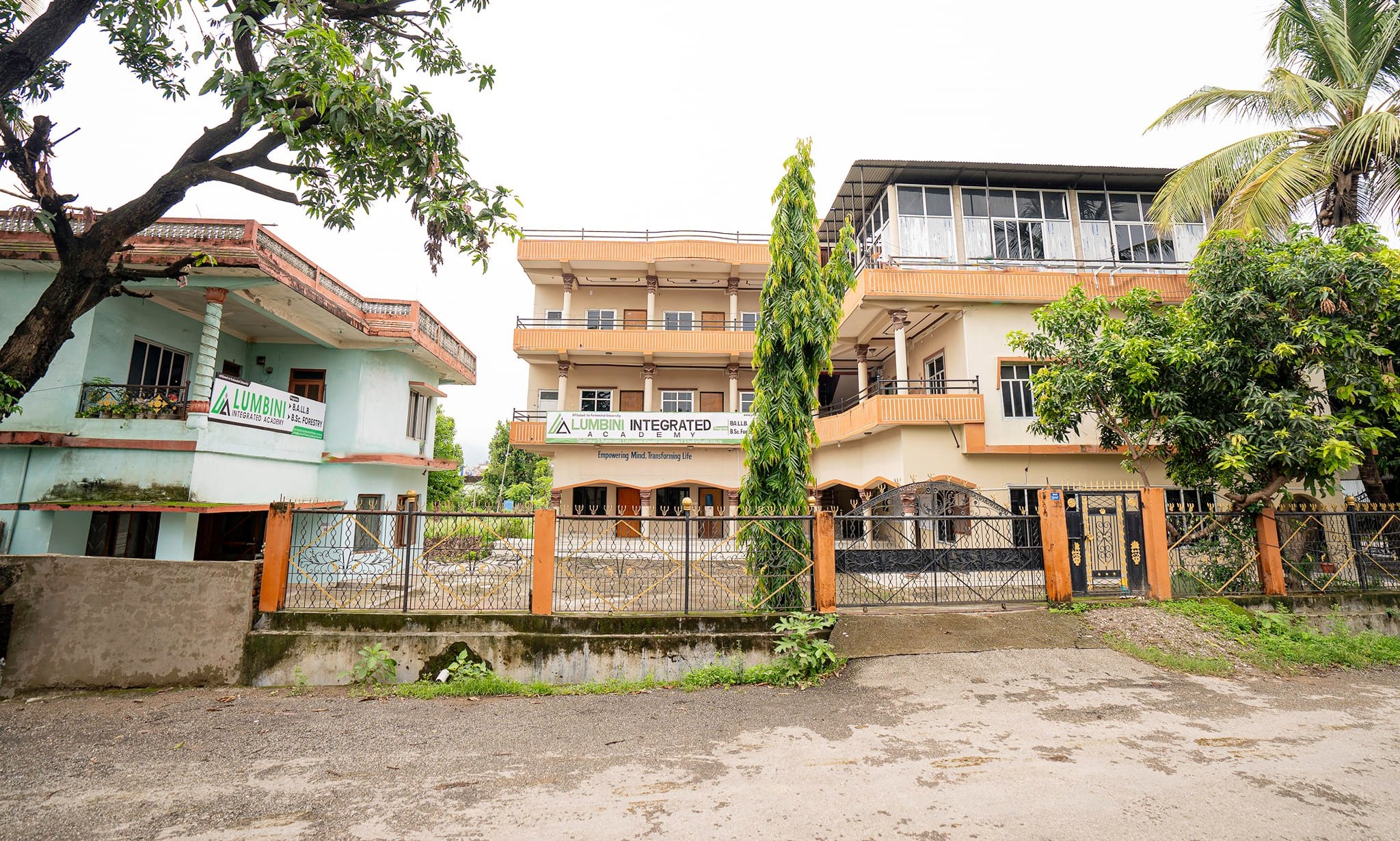
Lumbini Integrated Academy is an independent co-educational institution located at Laxmi Prasad Marg, Janakinagar, Tilottama-3, Rupandehi. It offers the B.Sc. Forestry program under the affiliation of Purbanchal University.
The campus includes classrooms, laboratories, library resources, recreational areas, and spaces for student activities. The course itself includes laboratory-based study, field training, seminars, and project research.
B.Sc. Forestry stands for Bachelor of Science in Forestry.
The program takes four years and is divided into eight semesters.
The B.Sc. Forestry program at Lumbini Integrated Academy is affiliated with Purbanchal University.
The curriculum contains 165 credit hours.
Applicants must have passed I.Sc., Diploma in Forestry, 10+2 with Biology or Mathematics, or a three-year Diploma in Forestry from a recognized university. They must have at least 50% aggregate marks or a C grade with a CGPA of 2.00.
Yes. Applicants must sit for the entrance examination conducted by Purbanchal University.
Students are selected according to their entrance examination merit scores.
Yes. Field training is included in the third, fifth, and seventh semesters.
Yes. Students complete research and prepare a project paper during the program. The final semester includes a six-credit project paper.
Students must maintain at least 80% attendance in the theory and practical classes of each subject.






