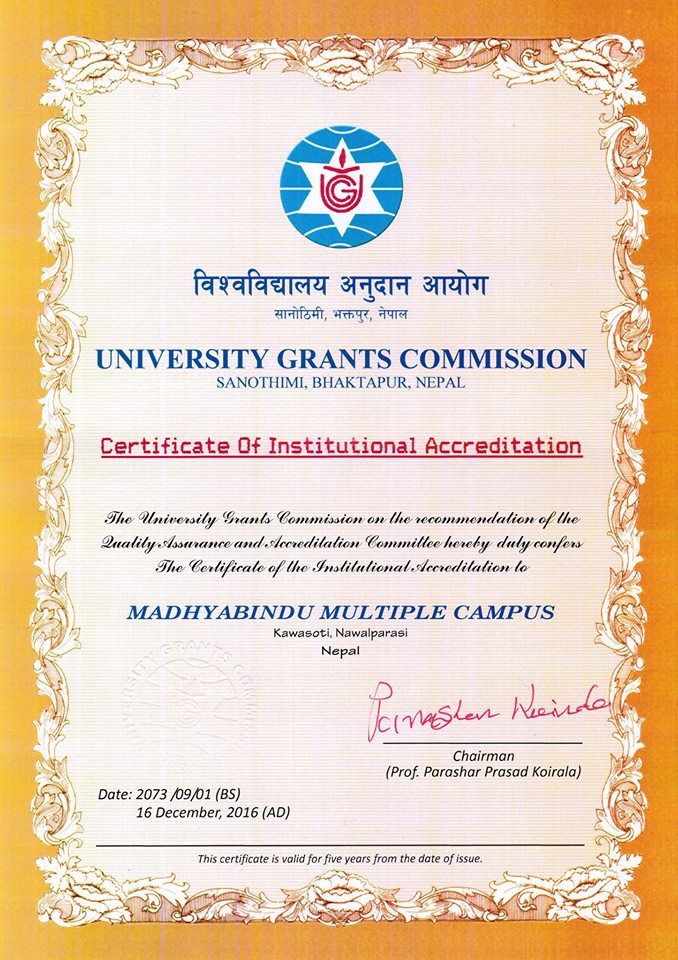
Madhyabindu Multiple Campus is a community campus in Kawasoti, Nawalparasi, Nepal. Established in 2006 (2063 B.S.), the campus runs academic programs from Grade 11 to the master’s level under Tribhuvan University (BA, BBA, BBS, BEd, BICTE, MEd, MBS programs) and the National Examinations Board (NEB). It has also received Quality Assurance and Accreditation recognition from the University Grants Commission (UGC).
The Madhyabindu Campus was started to widen access to higher education for the local community and to prepare skilled, ethical, and academically grounded graduates. Over time, it has grown into a multi-level institution with academic, administrative, research, and community service functions. Its programs, support units, scholarships, research activities, and physical expansion reflect a campus built with local participation and a long-term focus on access, discipline, and academic quality.
Established in 2006 (2063 B.S.)
Located at Kawasoti Municipality–3, Nawalparasi, Gandaki Province, Nepal
Affiliated with Tribhuvan University for bachelor’s and master’s programs
Affiliated with the National Examinations Board (NEB) for Grade 11 and 12 programs
QAA certified and re-accredited by UGC in 2022
Ranked 22nd in the Higher Education Reform Project among around 1,200 community campuses
Offers programs from +2 to master’s level
Runs classes in multiple shifts from early morning to evening
Grade 11 and 12 Science started in 2070 B.S. (2013 AD)
Students Birendra Kafle and Sujan Pandey secured district-first positions in the NEB examination of 2072 B.S.
Campus governance includes a Campus Senate, Campus Management Committee, and subject-specific committees and support units
Separate library building with e-library and more than 12,691 textbooks and reference materials
Provides at least 3% scholarship support from total student tuition fees
Operates a Research Management Cell and publishes Madhyabindu Journal
Madhyabindu Multiple Campus was established in Kawasoti to respond to the educational needs of the surrounding area. Its stated purpose is to extend access to affordable higher education and to prepare qualified human resources for national and international needs. The campus serves students from different social and economic backgrounds, with special attention to minority groups, marginalized communities, and students who need financial support.
The institution now offers a continuous academic path from Grade 11 through the master’s level. This multi-level structure has made the campus relevant to students seeking foundation-level education, undergraduate study, professional teacher education, management education, and postgraduate study in education and business. The campus also links academic work with community engagement, student support, and research activity.
Its vision is to grow into a deemed university. Its mission focuses on widening educational access at affordable cost, building a strong academic center, and preparing quality graduates. The strategic goals of the campus include maintaining academic quality, encouraging participation from faculty, staff, students, and community members, and expanding access for deprived and minority groups at minimum cost.
Madhyabindu Multiple Campus functions as a non-profit, community-based public campus. It operates under its own constitution and bylaws and follows a democratic governance model. The Campus Senate serves as the supreme legislative body, while the Campus Management Committee oversees policy execution, administration, and academic coordination. The Senate includes representation from education, politics, business, and social service sectors, which reflects the community-based structure of the institution.
The Campus Management Committee appoints key officials such as the Campus Chief, Assistant Campus Chiefs, Faculty Heads, and Program Coordinators. Roles of teaching, non-teaching, and administrative staff are formally defined. The campus also runs a set of committees and units that support academic and institutional management, including the Academic Cell, Publication Cell, Quality Monitoring Committee, Library Advisory Committee, Discipline Committee, Research Committee, Internal Audit Unit, Health Unit, Employment Counselling and Student Support Unit, EMIS Unit, Environmental and Social Risk Management Committee, Transportation Management Committee, and Grievances Redress Mechanism.
Community participation has shaped the campus from its early years. Land was purchased through campus-led efforts, buildings were developed in phases with public and institutional support, and parent gatherings have remained part of campus-community dialogue. This pattern of local involvement continues through social audits, planning committees, and regular consultations.
Madhyabindu Multiple Campus offers programs under NEB and TU at different levels.
These +2 programs are NEB affiliated and follow the annual examination system for Class 11 and Class 12. They provide the foundation for higher study in science, education, humanities, and management-related fields. The Science stream has been running on the campus since 2070 B.S. (2013 AD).
The BA is a four-year TU humanities program. It allows subject combinations across humanities and social sciences and follows TU’s four-year bachelor structure.
The B.Ed. is a four-year annual system program under the Faculty of Education. It combines communication skills, professional core courses, major and minor specialization areas, and teaching practicum.
The BICTE is a four-year, eight-semester undergraduate program under the Faculty of Education. It combines ICT studies with pedagogy and includes communication skills, core education courses, ICT core courses, mathematics and analytical courses, life skills, capstone work, and teaching practice.
The BBS is a four-year annual program under the Faculty of Management. It is designed for management study through language, economics, business law, statistics, accounting, organizational behavior, finance, entrepreneurship, research methods, and concentration areas.
The BBA is a four-year, eight-semester management program under the Faculty of Management. It uses a semester structure and includes lectures, case studies, project work, assignments, seminar and practicum components, and an internship in the final semester.
The M.Ed. runs in the semester system and normally takes 24 months across four semesters. It includes core education courses, specialization courses, teaching practice or practicum, and thesis writing.
The MBS is a two-year, four-semester program. Its structure includes core courses, specialization courses, and dissertation work. The program is intended for advanced study in management fields such as accounting, finance, marketing, and general management.
Admission at Madhyabindu Multiple Campus follows the rules of the relevant university, board, faculty, and campus. Since the campus runs both NEB and TU programs, the admission process differs by academic level and program structure.
Admission usually begins after SEE results are published.
Applicants submit the prescribed application form and the required records.
Depending on the stream and institutional decision, admission may include an entrance test, interview, or merit-based selection.
Students complete admission after selection and fee payment.
Subject registration is completed under the NEB framework through the college.
NEB annual examinations and final results follow NEB rules and calendar.
Admission notices are published by the campus in line with TU faculty and campus rules.
Eligible applicants submit the application form with academic documents.
Depending on the program, admission may include merit-based selection, entrance examination, or both.
Students selected for admission complete enrollment after document submission and fee payment.
Annual-system bachelor’s final examinations are conducted by TU through the Office of the Controller of Examinations.
Semester-system bachelor’s examinations are conducted by the concerned Dean’s Office.
BBA admission includes the CMAT and interview under TU Faculty of Management rules.
BICTE admission includes the Central Education Admission Test (CEAT), followed by interview for shortlisted applicants.
Other bachelor’s and master’s admissions follow the applicable faculty and campus notice.
Admission notices are published by the concerned campus, department, institute, or Dean’s Office.
Applicants submit the prescribed application form.
Some programs include an entrance examination.
A merit list or selection result may be published.
Final enrollment is completed after document submission and fee payment.
Semester-end examinations for semester-based master’s programs are conducted by the concerned Dean’s Office.
The campus uses standard NEB and TU document requirements according to level and program.
SEE marksheet or grade sheet
SEE character certificate or school leaving certificate
Transfer certificate from the previous school
Migration certificate, if applicable
Citizenship certificate or birth certificate copy
Passport-size photographs
NEB Class 11 registration or subject registration form
NEB registration card or registration number issued in Class 11
Class 11 marksheet or transcript
Class 12 board examination application form
Passport-size photographs
Examination fee receipt
Admit card issued before examination
Class 12 or equivalent academic transcript
Character certificate from the previous institution
Migration certificate, if the previous board or university is different
Transfer certificate
Citizenship certificate or birth certificate copy
Passport-size photographs
Entrance scorecard, if required
Completed admission form
Admission fee payment receipt
Equivalence certificate, if the qualification is from a foreign board or university
Bachelor’s transcript or marksheet
Bachelor’s degree certificate or provisional certificate
Character certificate from the bachelor-level institution
Migration certificate, if the bachelor’s degree is from another university
Transfer certificate
Citizenship certificate or birth certificate copy
Passport-size photographs
Entrance scorecard, if required
Completed admission form
Admission fee payment receipt
Equivalence certificate, if the bachelor’s degree is from a foreign university
The campus has faculty members and coordinators with qualifications that include M.Ed., MBS, MBA, MCA, MSc, M.Phil., and PhD study. Academic coordination is supported by program-specific leadership, including a BBA coordinator and assistant campus chiefs. The presence of faculty with backgrounds in education, management, statistics, finance, marketing, production, and ICT-related study gives the campus a broad academic base across its offered disciplines.
Teaching and learning practices vary by program, though several methods appear across the academic structure. These include class lectures, group discussion, assignments, case studies, guest lectures, project work, field visits, seminar work, and practicum components. In BICTE, instructional techniques include demonstrations, seminars, case analysis, problem solving, field work, and technology-integrated teaching. In BBA, the pedagogy includes lectures, group discussion, case studies, role play, research work, project work, and assignments. The M.Ed. structure includes project work, assignments, seminar, case studies, and field studies in addition to lecture sessions.
At the campus level, academic support also includes extra classes and exam-oriented classes for students at different levels each year. This suggests that classroom teaching is combined with structured academic support before examinations. The campus research activities also show staff engagement with faculty development and digital pedagogy training, which adds to the institutional teaching culture.
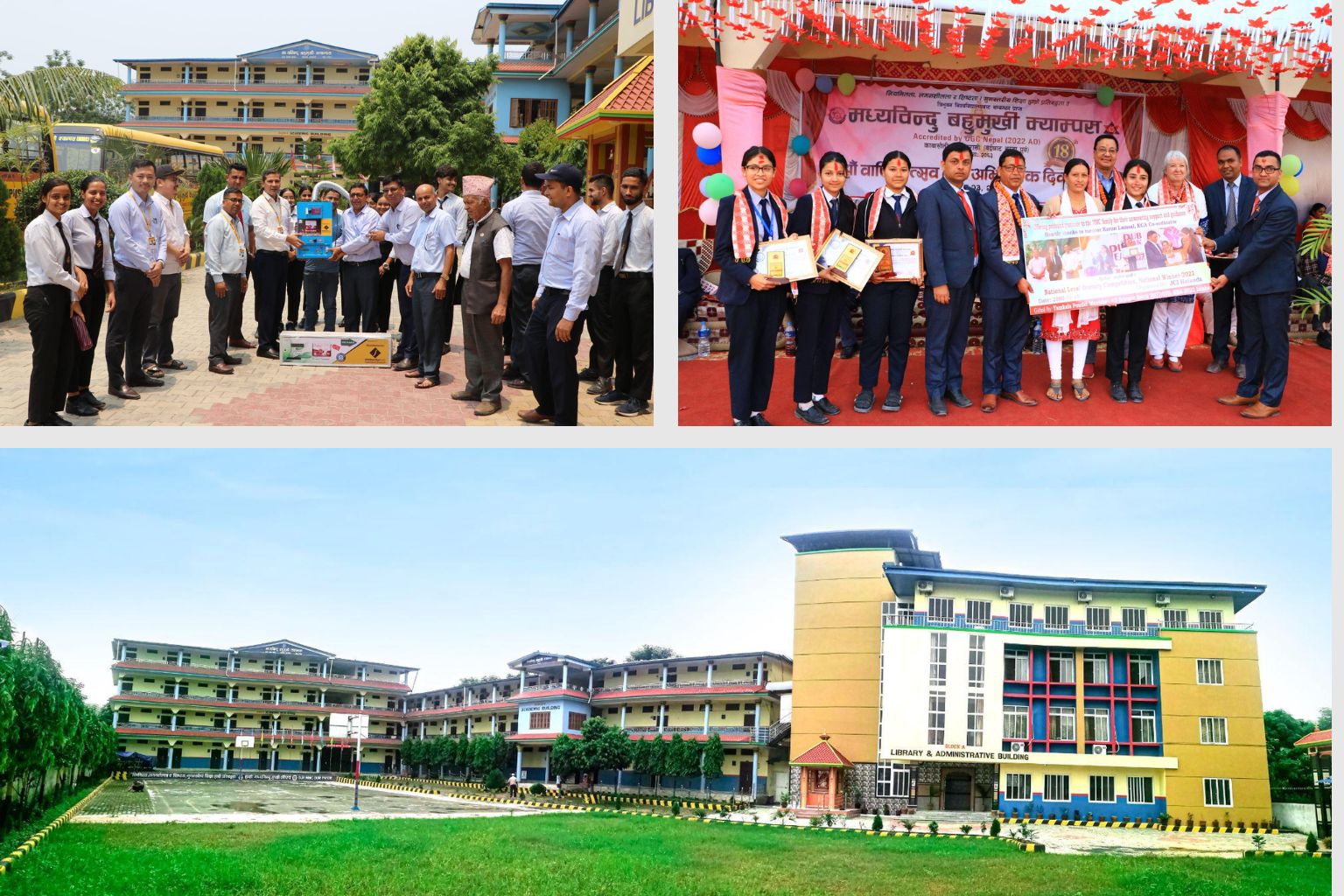
Permanent library and administrative building
Permanent teaching buildings, with one additional building under construction
Caretaker’s quarters
Total of 48 rooms in current use and campus building stock
27 classrooms
3 science laboratories
1 computer lab / e-library room
1 meeting hall
1 guest room
5 department rooms
1 store room
Separate library building with e-library
More than 12,691 textbooks and reference materials
Barcode-based book record system in the library
Periodicals, journals, magazines, newspapers, and encyclopedic materials in the library collection
Cafeteria on the ground floor of the administrative building
Computerized networking of administrative sections
SMS information system for parents linked to fee payment records
Multimedia projector support received through UGC
Furniture support received from the Gandaki Province ministry
Gate management, identity card entry, and uniform-based discipline system
Construction underway for a semester building for semester-based programs
Student life at Madhyabindu Multiple Campus is shaped by a full-day academic schedule, campus discipline, student organizations, library use, social service activity, and interaction with the local community. Since the campus runs classes in different shifts from early morning to evening, students across levels use the same institutional setting through different academic time blocks. This creates a campus routine that is active across the day.
The campus has student-centered structures such as the Students’ Union, Alumni Association, Youth Red Cross, Literary Forum, and Employment Counselling and Student Support Unit. These units add to academic life by linking students with service, literary activity, support systems, and community participation. Parent gatherings are also held to collect views on educational programs and local needs. The campus has served as an educational counseling center as part of its community role.
Discipline is maintained through gate management, identity card use, and uniform rules. This has been tied to a more organized academic environment. The cafeteria, library, classrooms, laboratories, and computer-related facilities form the everyday academic setting for students. The SMS system for parents also reflects a direct communication channel around fee-related records.
Research culture adds another layer to student and faculty life. The Research Management Cell has organized workshops, surveys, conference participation, a national conference, digital pedagogy training, and Madhyabindu Journal publication work. These activities place the campus within a wider academic conversation beyond routine classroom instruction.
Youth Red Cross volunteer service in local trade festivals and large public events
Blood donation programs
Health camps
City cleanliness campaigns
Literary Forum activity
Student union participation
Alumni association engagement
Parent gatherings connected to academic planning and campus-community dialogue
Workshops and conferences through the Research Management Cell
Student satisfaction survey presentation
Faculty and student participation in national and international conferences
Campus-level support for community service and public health-related programs
At least 3% scholarship provision from total student tuition fees
Scholarship support for students who are unable to pay fees
Scholarship focus on genuine or poor students
Scholarship focus on students from minority and marginalized groups
Scholarship support for children of martyrs
Dalit students in bachelor annual programs receive at least six months’ tuition support if they meet the required criteria
Named scholarships include:
Madan Bhandari Memorial Scholarship
Late Bimal Raj Acharya Memorial Scholarship
Late Santosh Neupane Memorial Scholarship
Bhagawati Shrestha Scholarship
Pushpa Sarada Intelligent Scholarship
Prem Kumar Yamkala Intelligent Scholarship
Chandra Raj Laxmi Devi Scholarship
Shiva Kabita Scholarship
Hem Parbati Scholarship
Late Shiva Prasad Lamsal Scholarship
Naresh Sharada Scholarship
Laxmi Venkatesh Memorial Scholarship
Bhupal Jaisara Memorial Scholarship
Kshitiz Kunwar Memorial Scholarship
Girdhari Keshari Scholarship – 2078
Majhilal Tharu Thanet Scholarship – 2079
Devilal Ramadevi Scholarship – 2079
GPA 3.6 and above: 100% annual management and tuition fee
GPA 3.4 and above: 100% annual management fee and 25% tuition fee
GPA 3.2 and above: 75% annual management fee
GPA 3.0 and above: 100% entrance fee
GPA 2.8 and above: 75% entrance fee
GPA 2.6 and above: 50% entrance fee
In semester-based master’s programs, scholarship is based on CMAT score result, internal evaluation, and university result according to Dean’s Office rules
Higher scorer in annual examinations receives cash support of Rs. 2,000
Faculty and level toppers receive Rs. 4,000
Three genuine students from internal examinations in different faculties and levels receive Rs. 1,500, Rs. 1,200, and Rs. 1,000 respectively
QAA certification from UGC within about a decade of establishment
Re-accredited by UGC Nepal in 2022
Ranked 22nd in the Higher Education Reform Project among around 1,200 community campuses
Grade 11 and 12 Science introduced in 2070 B.S. (2013 AD)
Birendra Kafle (Class XI) and Sujan Pandey (Class XII) secured district-first positions in the NEB examination of 2072 B.S.
Permanent campus infrastructure developed from an initial zero-base setup
Two-storey permanent building with 10 rooms completed in an early construction phase
Three-storey permanent building with 15 rooms developed in a later phase
Science laboratory expansion completed with UGC construction grant support
Library, e-library, science lab, and classroom facilities expanded
Semester building construction started, with slab casting of three storeys completed
Madhyabindu Journal publication activity continued through the Research Management Cell
National Conference on “Reforming Higher Education in Times of Crisis” organized on 27–28 March 2025
Conference drew 175 participants from 14 districts and 26 campuses, with 35 multidisciplinary papers presented
Faculty development training held on Digital Pedagogy and LMS
Workshops organized on research presentation and advanced data analysis using SmartPLS 4.0
Offers a study path from +2 to master’s level within one institution
Runs both NEB and TU programs in science, education, humanities, and management fields
Community-based campus structure with public participation in growth and governance
QAA recognition and UGC re-accreditation
Scholarship support for financially weak and socially marginalized students
Separate library building, e-library, laboratories, and computer-related facilities
Extra classes and exam-focused academic support
Research activity through the Research Management Cell and Madhyabindu Journal
Student organizations and support units linked to counseling, health, and campus engagement
Location in Kawasoti with academic access for surrounding communities
A message from campus leadership presents the institution through the motto: “Regularity, Industriousness, and Courtesy; Quality Education is Our Determination.” The message places emphasis on the campus’s growth as a public educational institution and points to QAA recognition and UGC re-accreditation as markers of sustained academic work.
The message also links the campus’s progress with founder members, parents, students, educators, social workers, donors, and stakeholders. It highlights classrooms, physical infrastructure, committed faculty, and staff as core strengths of the institution. The overall tone of the message reflects gratitude to the community that helped build and sustain the campus.
Madhyabindu Multiple Campus has developed from a community initiative into a multi-level academic institution with NEB and TU affiliations, research activity, scholarship support, and expanding physical infrastructure. Its academic range covers foundational +2 study, undergraduate education, teacher preparation, ICT education, management education, and postgraduate study.
The campus combines formal governance, community participation, student support systems, and academic growth within a public-campus model. Its QAA status, UGC re-accreditation, scholarship structure, library resources, and research initiatives show an institution that has grown through long-term local involvement and structured academic planning. For students in Kawasoti and nearby areas, it offers a broad academic route within one campus setting.
Contact Madhyabindu Multiple Campus's administrative office for detailed information on the course, admissions, location, fees, scholarships, facilities, counseling, or eligibility.
Email Address: info@madhyabindu.edu.np
Phone Number: +977-78-540473, +977-78-540479, +977-9857040627 / +977-9857040627 /+977-540351
Website: www.madhyabindu.edu.np
Location: Kawasoti Municipality, Ward No -03, Nawalparasi, Nepal, Gandaki Province, Nepal
Madhyabindu Multiple Campus is affiliated with Tribhuvan University for bachelor’s and master’s programs and with the National Examinations Board (NEB) for Grade 11 and 12 programs.
The campus is located at Kawasoti Municipality–3, Nawalparasi, Gandaki Province, Nepal.
The campus offers +2 in Science, Education, Humanities, and Management, along with BA, B.Ed., BICTE, BBS, BBA, M.Ed. General, and MBS.
Yes. The campus provides at least 3% scholarship support from total student tuition fees, along with named scholarships, merit-based tuition and fee support, and targeted support for poor, marginalized, Dalit, and martyr-family students.
The campus has classrooms, science laboratories, a computer lab/e-library room, a separate library building with more than 12,691 books and reference materials, a cafeteria, computerized administrative networking, and an SMS information system for parents.
Student support is linked to units and organizations such as the Students’ Union, Alumni Association, Youth Red Cross, Literary Forum, Employment Counselling and Student Support Unit, Health Service and Social Welfare Committee, and Grievances Redress Mechanism.
Yes. The campus runs a Research Management Cell, supports workshops and conferences, publishes Madhyabindu Journal, and organized a national conference on higher education reform in March 2025.
BBA admission includes the CMAT and interview under TU Faculty of Management rules. BICTE admission includes the Central Education Admission Test (CEAT) and interview for shortlisted applicants.