Mangala Shiksha Campus (मंगला शिक्षा क्याम्पस) is a community-based higher education institution located in Mangala Rural Municipality-2, Lampata, Babiyachaur, Myagdi, Gandaki Province, Nepal. Established in 2066 BS (2009 AD), the campus was founded to expand access to bachelor-level education in a rural area.
It is affiliated with Tribhuvan University under the Faculty of Education and is supported by the University Grants Commission (UGC). The campus offers a four-year Bachelor of Education (B.Ed.) program under the annual examination system with specialization options in Nepali, English, Mathematics, and Economics. Along with its academic focus, the campus has developed hostel and classroom facilities, library and computer resources, and a student environment shaped by community participation, local support, and continuing institutional growth.
Established in 2066 BS (2009 AD)
Community-based higher educational campus
Located in Mangala Rural Municipality-2, Lampata, Babiyachaur, Myagdi, Gandaki Province
Affiliated with Tribhuvan University, Faculty of Education
Supported by UGC Nepal
Pursuing Quality Assurance and Accreditation (QAA)
Offers a four-year B.Ed. program under the annual system
Specialization options at the campus: Nepali, English, Mathematics, and Economics
Campus Chief: Pitam Bahadur Khatri
Management Committee Chairman: Yam Bahadur Thapa
13 assistant professors and 3 non-teaching staff
Total student enrollment recorded at 113
Total bachelor’s graduates recorded at 102 by Asar 2082
Contact: +977-9848265581 | mangalashikshacampus@gmail.com | mangalacampus.edu.np
Mangala Shiksha Campus, also referred to as Mangala Education Campus, began in 2066 BS from the premises of Mangala Secondary School. Its establishment was supported by local educationists, donors, intellectuals, and community stakeholders. The institution is identified as the second community campus of Myagdi District and the first community campus in the western region.
The campus was created in response to the need for accessible higher education in the area, especially for rural students, women, and disadvantaged groups. Over time, it moved from its original operating base to land registered in its own name at Lampata, where it now functions with dedicated academic, administrative, and hostel buildings.
Its present development reflects a community-campus model in which academic growth, infrastructure expansion, and local cooperation move together. Support from Tribhuvan University, UGC, federal and provincial bodies, Mangala Rural Municipality, and local contributors has helped the campus strengthen both its academic base and physical facilities.
Bachelor of Education (B.Ed.), four years, annual system, TU affiliated
Specialization options available at the campus: Nepali, English, Mathematics, and Economics
The B.Ed. program is the core academic offering of the campus. It is conducted under the TU Faculty of Education and follows the annual examination system. As a four-year full-time bachelor-level program, it is designed for students preparing for secondary-level teaching and related education work.
Under the TU annual B.Ed. structure, students complete 22 courses with a total of 2200 full marks. The course framework includes communication skills, professional core courses, specialization major courses, specialization minor courses, and teaching practice or practicum. Communication skills include General Nepali and General English. Professional core areas include Philosophical and Sociological Foundations of Education, Educational Psychology, Curriculum and Evaluation, and one elective related to instructional technology or ICT.
At Mangala Shiksha Campus, students can study Nepali Education, English Education, Mathematics Education, and Economics Education. The structure allows students to study a major and a minor subject area, while teaching practice remains a compulsory part of the final year. This gives the program an academic and professional character rather than a subject-only model.
Admission opens after the publication of the campus or faculty notice
Eligible applicants submit the prescribed application form with required academic records
Admission may include an entrance examination, merit-based selection, or both, depending on campus or program requirements
Selected applicants complete admission after document submission and fee payment
Academic registration, examination, and result processes follow TU rules and the applicable academic calendar
As the campus runs an annual-system B.Ed. program, final examinations are conducted by TU through the Office of the Controller of Examinations
For the general four-year B.Ed. program, students who have completed Grade 12, Higher Secondary, PCL, or an equivalent qualification are eligible to apply. Subject-specific entry conditions apply to specialization areas. For Nepali Education, applicants need Nepali major with at least 200 marks. For English Education, applicants need English or Linguistics major, or 50 percent in General English, or 50 percent in the entrance examination conducted by the concerned campus department. For Mathematics Education, applicants need Mathematics major with at least 200 marks. For Economics Education, Grade 12, PCL, or equivalent from any faculty is accepted.
Academic transcript or grade sheet of Class 12, +2, PCL, or equivalent
Character certificate from the previous institution
Migration certificate, if the previous board or university is different
Transfer certificate (TC) from the previous school or college
Citizenship certificate or birth certificate copy
Passport-size photographs
Entrance examination scorecard, if applicable
Completed campus admission or application form
Admission fee payment receipt
Equivalence certificate, if the qualification is from a foreign board or university
The campus has 13 assistant professors, including 3 full-time and 10 course-contract faculty members, along with 3 non-teaching staff. This staffing structure supports the operation of the B.Ed. program and daily academic administration.
Teaching and learning follow the curriculum and academic calendar prescribed by Tribhuvan University. The academic process combines classroom teaching with continuous assessment, academic discipline, seminar participation, and practical engagement. The teaching approach is described as student-centered, with attention to subject understanding, classroom participation, and regular study.
Seminars and workshops in Nepali, English, Economics, and Mathematics provide an additional academic space for discussion and applied learning. Visiting scholars and experts also contribute to these activities. The library, classrooms, and multimedia resources support classroom teaching, while the teaching practice component within the B.Ed. structure adds practical professional preparation.
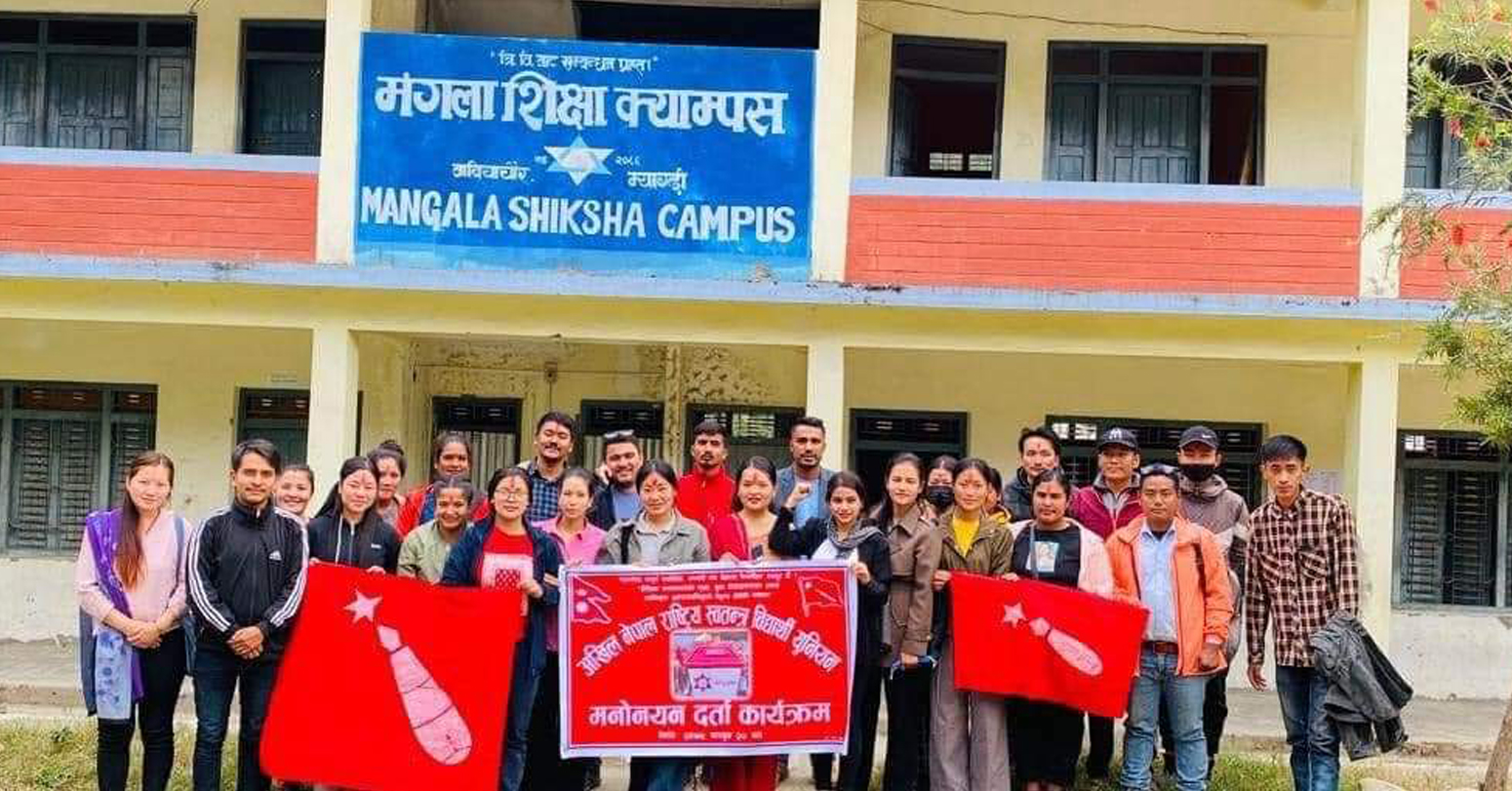
Campus land registered in its own name at Lampata
Two academic and administrative buildings in operation
Two hostel buildings in operation
Additional administrative construction in progress
Building A with 11 rooms, including an assembly hall
Building B with 8 rooms
Spacious and well-ventilated classrooms
Seminar hall for academic discussions, workshops, examinations, and orientations
Library with textbooks, reference materials, journals, and academic resources
Computer lab
Multimedia facilities
Sports facilities
Counseling support
Scholarships listed among student support features
Conference hall
Playground and toilets
Educational tour and ECA-related facilities
The present infrastructure reflects gradual expansion from a school-based start to a campus with its own buildings and land. Federal government grants, UGC support, provincial support, and contributions from Mangala Rural Municipality have all contributed to this physical growth.
Student life at Mangala Shiksha Campus is shaped by its rural setting and community orientation. The campus draws students from secondary schools across Mangala, Malika, and Dhaulagiri rural municipalities, which gives it a wider local catchment than a single-village institution. This regional connection makes the campus part of the broader education network of western Myagdi.
The campus environment combines formal academic study with local participation and campus-based events. Students use the library for self-study, attend seminars and workshops connected to their subjects, and take part in activities that build confidence, communication, and group participation. Hostel facilities also expand access for students who need residential support during their studies.
The campus has also conducted financial literacy and environmental awareness activities, including the Doko Dustbin initiative. Such programs place student life within community concerns rather than limiting it to classroom routines alone.
Sports competitions
Cultural events
Literary programs
Celebration of traditional festivals and national events
Educational tours
Social awareness programs
Literacy campaigns
Environmental initiatives
Health awareness activities
Sustainable agriculture awareness programs
Disaster preparedness programs
Seminars and workshops across subject areas
Scholarships are included among the campus’s student support features
The campus receives regular support from UGC
Mangala Rural Municipality provides regular grant support
Malika Rural Municipality also provides grant support
Other financial sources include student fees, interest from the fixed deposit fund, and donations
A fixed deposit and economic collection campaign has been running with a target of 2 crore
More than 60 lakh has already been collected for the campus fund
The financial model of the campus shows a mix of institutional grants and community contribution. This support structure has helped sustain academic operations and physical development.
Established in 2066 BS (2009 AD)
Started from the premises of Mangala Secondary School
Identified as the second community campus in Myagdi District
Identified as the first community campus in the western region
Shifted operations to land registered in the campus’s own name
Expanded to academic, administrative, and hostel buildings
Hostel buildings constructed through federal budget support
Recent development includes an independent administrative building
Pursuing QAA
Produced its first bachelor’s graduates in 2069
TU-affiliated B.Ed. program under the Faculty of Education
Four-year annual-system bachelor program focused on teacher education
Community-based institution with local academic reach
Located to serve students of Myagdi and nearby rural municipalities
Subject options in Nepali, English, Mathematics, and Economics
Hostel, library, classroom, computer, and seminar facilities
Academic environment supported by seminars, workshops, and teaching practice
Institutional support from UGC and local bodies
Track record of bachelor-level graduates, including strong female participation
Ongoing infrastructure expansion and QAA process
The chairperson’s message places emphasis on academic excellence, institutional governance, transparency, accountability, and sustainable campus development. It also stresses the importance of affordable higher education for the region and continued cooperation among faculty, staff, students, local governments, Tribhuvan University, and supporters.
The campus chief’s message highlights the history of the institution from its start at Mangala Secondary School to its operation on its own land at Lampata. It also records the expansion of academic and hostel buildings, the role of local educationists and donors, the present faculty structure, and the campus’s continuing effort to strengthen higher education access in Myagdi.
Mangala Shiksha Campus has developed from a community initiative into a bachelor-level institution with a defined academic identity in Myagdi. Its TU-affiliated B.Ed. program, rural access mission, expanding infrastructure, and community-backed support system give the campus a clear place in the local higher education landscape. For students seeking education studies within western Myagdi, it offers a focused academic option shaped by local participation and steady institutional growth.
Mangala Shiksha Campus is located in Mangala Rural Municipality-2, Lampata, Babiyachaur, Myagdi, Gandaki Province, Nepal.
Yes. The campus is affiliated with Tribhuvan University under the Faculty of Education.
The campus offers a four-year Bachelor of Education (B.Ed.) program under the annual examination system.
The B.Ed. program at the campus offers specialization options in Nepali, English, Mathematics, and Economics.
The B.Ed. program is four years in duration and follows the annual examination system.
Yes. The campus has hostel buildings, a library, classrooms, a seminar hall, computer and multimedia facilities, and sports-related facilities.
The campus is led academically by Campus Chief Pitam Bahadur Khatri, and the Campus Management Committee is chaired by Yam Bahadur Thapa.