Myagdi Multiple Campus (म्याग्दी बहुमुखी क्याम्पस) is a community-based campus in Phulbari, Beni, Myagdi, Gandaki Province, Nepal. Established in 2048 B.S. (1992 A.D.), it was formed through local initiative at a time when Myagdi district did not have an institution for higher education. The campus is affiliated with Tribhuvan University for bachelor’s and master’s programs and with the National Examinations Board (NEB) for Ten Plus Two programs.
It also receives support from the University Grants Commission (UGC). Over time, the campus has expanded from an intermediate-level beginning to a multi-level academic institution with programs in management, education, humanities, social sciences, and ICT education.
Established: 2048 B.S. (1992 A.D.)
Type: Community-based, autonomous, not-for-profit campus
Location: Phulbari, Beni, Myagdi, Gandaki Province, Nepal
Affiliation: Tribhuvan University for bachelor’s and master’s programs; NEB for Ten Plus Two programs
Support: University Grants Commission and local governments support the campus financially
Departments: Management, Education, Humanities and Social Sciences
Programs: +2 in Education, Humanities, and Management; BA, B.Ed., BBS, BICTE, MBS, and M.Ed.
Study systems: BA, BBS, and B.Ed. run under the annual system; BICTE, MBS, and M.Ed. run under the semester system
Student body: 628 students at bachelor’s and master’s levels, including 408 female and 220 male students; 71 students belong to Educationally Disadvantaged Janajati communities, including Dalits
Key facilities: Hostels, auditorium hall, playground, library, computer labs, multimedia classrooms, Wi-Fi, counseling, health care, and Research Management Cell
Contact: info@myagdicampus.edu.np | +977-69-520109, +977-69-520609 | myagdicampus.edu.np
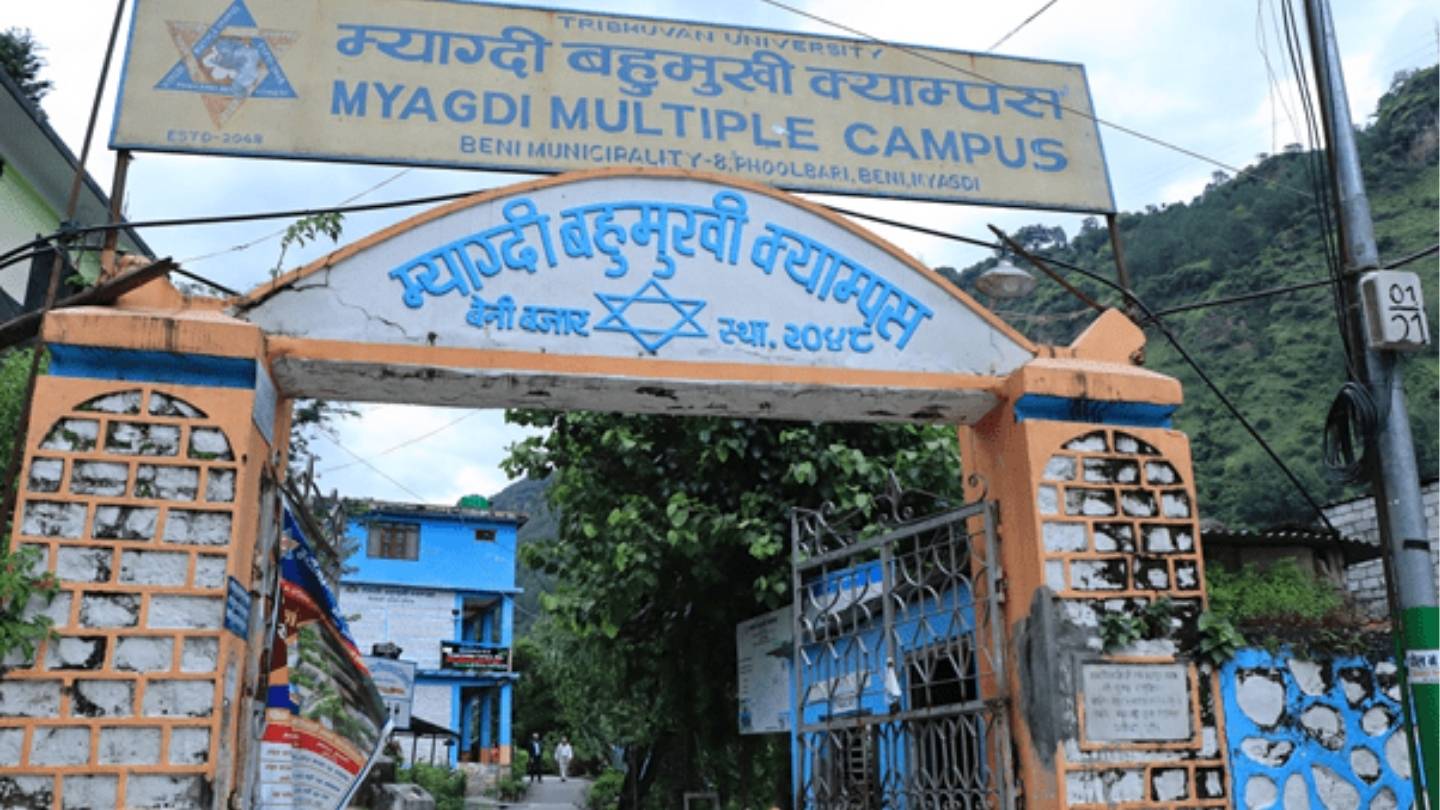
The campus was founded through community effort to open access to higher education in Myagdi. Before its establishment, students from the district often had to leave Beni and travel to larger cities such as Kathmandu and Pokhara for post-SLC study. Local residents and people from Myagdi living in Kathmandu raised financial and other resources for the campus. The first classes were conducted at Prakash Secondary School, and the initial batch had fewer than 50 students. In 2052 B.S., the campus shifted to its own premises.
Myagdi Multiple Campus identifies itself as a community-based and not-for-profit institution created for higher education. It serves students from Myagdi district and also from the northern parts of Parbat and Baglung. Over the years, it has expanded its academic reach and physical base while keeping its local social role. The campus also notes that it has served students from lower and lower-middle-class communities and has kept inclusion in view within its student body and campus policies.
The campus motto is “Quality Education for Successful life.” Its vision is to contribute to a civilized society through quality education. Its mission links education with research, exploration, creative thinking, critical thinking, and sustained study. The stated goals include research, creativity, student engagement in academics and co-curricular work, institutional effectiveness, inclusion, and equitable behavior across campus environments.
Institutional development has also taken a formal administrative shape. The campus has a Campus Constitution, employee regulations, financial regulation, Scholarship Guideline, Hostel Guideline, Library Operation Guideline, Educational Counseling Guideline, and other procedures related to admissions, extra classes, peer observation, and quality circle activity. At the start of each academic session, the administration prepares a Comprehensive Operational Annual Plan, while departments prepare academic calendars and teachers prepare yearly work plans.
Myagdi Multiple Campus offers programs from Ten Plus Two to master’s level. The academic structure includes NEB-affiliated +2 streams and TU-affiliated bachelor’s and master’s programs. The college page for Myagdi Multiple Campus gives an overview of the institution, while the campus and course pages below cover the individual programs.
These programs run under NEB and follow the annual exam system. The standard academic duration is two years, covering Class 11 and Class 12. Admission generally begins after SEE results, and subject registration is completed through the institution under the NEB system.
BA, B.Ed., and BBS run under the TU annual system at the bachelor’s level. The standard TU structure for bachelor’s study is four years. BA is a four-year program under the Faculty of Humanities and Social Sciences. B.Ed. is a four-year program that combines academic and professional study and prepares students for school-level teaching and related education work. BBS is offered under the management stream at the bachelor’s level.
BICTE is different in structure from the annual bachelor’s programs. It is a four-year, eight-semester program under the Faculty of Education of Tribhuvan University. The curriculum combines professional/core education courses with ICT core courses, mathematics and analytical courses, life skills, a capstone project, and teaching practice. The program includes areas such as programming, database management, computer graphics, digital pedagogy, network and information security, artificial intelligence in education, and teaching methods for ICT.
The campus offers MBS and M.Ed. under the TU semester system. MBS is a two-year, four-semester postgraduate program built around core courses, specialization courses, and dissertation work. The source material notes specializations in Accounting, Finance, Marketing, or Management. M.Ed. is a two-year, four-semester program that includes foundation courses, educational psychology, research methods, education and development, and major-area study.
For NEB Class 11: Admission usually begins after SEE results are published. Students submit the required form and academic records, and the process may include an entrance exam, interview, or merit-based selection, depending on campus practice. After selection and fee payment, the student is enrolled in Grade 11 and subject registration is completed under the NEB system.
For TU bachelor’s programs: Admission follows the regulations of the concerned faculty, Dean’s Office, and campus. Students submit the prescribed application form with academic documents after the admission notice is published. Depending on the program, admission may include an entrance exam, merit-based selection, or both. Selected applicants complete admission by submitting documents and paying the prescribed fee.
For TU master’s programs: The campus, department, institute, or Dean’s Office publishes the notice. Eligible applicants submit the prescribed form. Admission may include an entrance examination depending on the program, followed by selection and final enrollment under TU rules and the campus schedule. Students exploring TU master’s entrance pathways may also read TU CMAT (Masters).
For BICTE: Admission includes the Central Education Admission Test (CEAT) conducted by the Faculty of Education. The written test covers ICT skill and interest, language understanding, logical reasoning, and educational philosophy understanding. Applicants who pass the cutoff are shortlisted for interview and selected as per campus need.
Academic transcript or grade sheet of Class 12 / +2 or equivalent
Character certificate from the previous institution
Migration certificate if the previous board or university is different
Transfer Certificate (TC)
Citizenship certificate or birth certificate copy
Passport-size photographs
Entrance scorecard if required by the program
Completed admission or application form
Admission fee payment receipt
Equivalence certificate for a foreign qualification
Bachelor’s transcript or marksheet
Bachelor’s degree certificate or provisional certificate
Character certificate from the bachelor-level institution
Migration certificate if the bachelor’s degree is from another university
Transfer Certificate (TC)
Citizenship certificate or birth certificate copy
Passport-size photographs
Entrance scorecard if required
Completed admission or application form
Admission fee payment receipt
Equivalence certificate for a foreign degree
Application form
SEE academic documents
Photographs
Other records required by the institution at admission time
The campus works through the departments of Management, Education, and Humanities and Social Sciences. Departmental academic calendars guide yearly teaching plans, and teachers prepare work plans before classes begin. The source material also notes that teachers are involved in reading, writing, academic discourse, student support, research, consultancy, and extension work. A quality circle group reports monthly on teacher timing and classroom activities.
The teaching methods used on campus include lecture, demonstration, class presentation, discussion, field visit, project work, group work, orientation, seminar, library study, PowerPoint-based teaching, and online classes. The campus has allocated budget for research-based teaching and for research training for faculty members. It has also installed a Learning Management System (LMS), which has been used for online and virtual classes. For BICTE, the curriculum points to group discussion, demonstration, guest lecture, seminar, case analysis, problem solving, field work, technology integration, and digital pedagogy.
The academic support structure extends beyond classroom delivery. The campus provides remedial classes after internal examinations for weaker students, refers students for internships in organizations as required, runs non-credit courses alongside regular study, and offers entrepreneurship and vocational training. These practices show that academic support is tied to both course completion and broader student development.
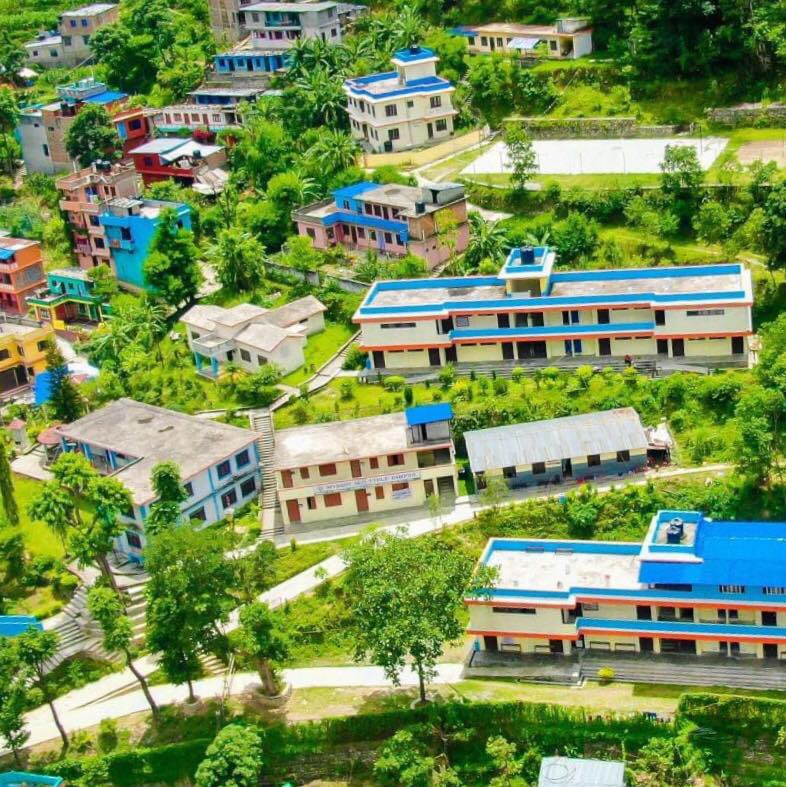
Campus land and buildings: The campus moved to its own premises in 2052 B.S. after securing 45 ropanies of land from Balmukteshwor Mahadev Guthi.
Master plan and construction: The campus has developed a master plan and is replacing older structures through ongoing infrastructure work.
Auditorium hall: An auditorium hall is part of the physical setup.
Hostels: Separate hostels are available for girls and boys, with capacities of 32 and 18 students.
Playground: The campus has a playground with a stage for basketball, volleyball, badminton, and other games.
Computer labs: Two computer labs with 32 computers support ICT-based learning.
Classrooms: The campus has multimedia-equipped classrooms, with the source noting 12 classrooms with projectors and separate mention of 10 multimedia rooms.
Library: The library is housed in a separate building and has 11,737 books, along with journals, reference materials, and daily newspapers.
Internet access: Free Wi-Fi and internet service are available, and the library includes a small computer lab connected to open knowledge sources.
Administrative block: Accounts, examination, and general administration units are housed in a dedicated block.
Student support rooms: The campus has a Student Counseling Section, a Lady’s Room, and a Health Care Unit.
Research support: A Research Management Cell works to build a research culture.
Student life at Myagdi Multiple Campus is shaped by academic study, residential facilities, local community connection, and structured student support. Hostel access for both girls and boys, free Wi-Fi, library services, counseling, health care, and sports facilities give the campus a practical day-to-day support base. The presence of multimedia classrooms, computer labs, and LMS access also means students work in a setting that connects traditional classroom study with digital tools.
The campus also keeps students linked with activities beyond formal classes. Field visits, project work, excursion programs, remedial teaching, internships, vocational training, and non-credit courses are part of the student experience described in the institutional material. The campus chief’s message also places attention on social responsibility, yoga and meditation, environmental awareness, and disaster-related engagement, which shows a student life model that is tied to both study and civic awareness.
Community participation remains a visible part of the campus culture. Students, guardians, and community members are involved in campus operation and public programs. The campus takes part in workshops, seminars, rallies, and interactions with social organizations, and students have worked as volunteers during natural disasters and large community gatherings such as GaleshorMela. The institution also provides consultancy and resource support in areas such as training, inclusion, journalism, translation, and proofreading.
Workshops, seminars, rallies, and interaction programs with different social organizations
Excursion programs with budget provision for field visits, project work, and refreshment
Sports activities on the campus playground, including basketball, volleyball, and badminton
Entrepreneurship and vocational training programs
Non-credit courses that complement regular academic study
Volunteer participation during natural disasters and major local social gatherings
Student engagement in social issues, environmental awareness, yoga, meditation, and disaster-related concern in the broader campus message
A Scholarship Guideline-2068 B.S. is one of the formal campus policies.
The major financial sources of the campus are student fees, regular and performance-based grants from UGC, and support from local governments.
UGC is identified as a major stakeholder in campus development.
The campus has served lower and lower-middle-class communities and reports 71 EDJ students, including Dalits, at bachelor’s and master’s levels.
The campus also maintains student counseling support, which may be relevant to students navigating academic and personal needs during study.
Established in 2048 B.S. (1992 A.D.) through community initiative in Myagdi district
Began classes at Prakash Secondary School and shifted to its own premises in 2052 B.S.
Bachelor’s study under Humanities and Social Sciences began in 2001 A.D.
Faculty of Management programs expanded in 2006 A.D., and Faculty of Education programs in 2007 A.D.
MBS was introduced in 2018 A.D. and BICTE in 2021 A.D.
Received the Institutional Accreditation Award from UGC in January 2020 A.D.
Submitted its Letter of Intent and entered the second cycle of the Quality Assurance and Accreditation process
Publishes Myagdi Guru A Journal since 2018 A.D. and Academia: A Journal of Humanities and Social Sciences since 2024 A.D.
Adopted EMIS and Pathashala software for information sharing and administrative work
Community-rooted history: The campus was built through local initiative to expand access to higher education in Myagdi.
Multiple academic levels in one institution: Students can study from +2 to master’s level on the same campus.
Annual and semester options: The campus offers both annual-system and semester-system programs under TU and NEB structures.
Academic support beyond lectures: Remedial classes, internships, field visits, non-credit courses, and vocational training are part of campus practice.
Research and digital learning support: LMS, Research Management Cell, computer labs, and campus journals strengthen the academic environment.
Student support services: Hostels, counseling, health care, and library access are available on campus.
Regional service role: The campus serves students from Myagdi and nearby parts of Parbat and Baglung.
Chairman Deependra Shrestha places focus on academic seriousness, ethical leadership, and social responsibility. His message presents the campus as a place where academic programs, faculty work, and campus facilities are tied to the wider social role of education. He also connects the institution’s future with its stated vision, mission, and goals.
Campus Chief Shreedhar Subedi links the campus identity with community effort, UGC recognition, and the expansion of bachelor’s and master’s programs. His message also points to research work, non-credit courses, skill-based training, entrepreneurship, yoga and meditation, environmental concern, and disaster-related awareness as areas that matter to campus life and student formation.
Myagdi Multiple Campus has grown from a community response to an educational gap into a multi-level institution with NEB and TU programs, annual and semester study systems, hostel facilities, digital learning support, library resources, research activity, and student services. Its history is closely tied to Myagdi district, but its academic reach extends across neighboring areas as well. For students seeking a community-based campus in Beni with programs in education, management, humanities, social sciences, and ICT education, Myagdi Multiple Campus presents a broad academic structure within one institution.
Contact Myagdi Multiple Campus's administrative office for detailed information on the course, admissions, location, fees, scholarships, facilities, counseling, or eligibility.
Myagdi Multiple Campus
Email Address: info@myagdicampus.edu.np / myagdicampus@gmail.com
Phone Number: +977-69-520109, +977-69-520609
Website: www.myagdicampus.edu.np
Location: Phulbari, Beni, Myagdi, Gandaki Province, Nepal
Yes. Myagdi Multiple Campus is affiliated with Tribhuvan University for bachelor’s and master’s programs and with the National Examinations Board for Ten Plus Two programs.
The campus offers Ten Plus Two programs in Education, Humanities, and Management. At the bachelor’s level, it offers BA, B.Ed., BBS, and BICTE. At the master’s level, it offers M.Ed. and MBS.
BA, B.Ed., and BBS follow the annual system. BICTE, M.Ed., and MBS follow the semester system.
Yes. The campus has separate hostel facilities for girls and boys.
Students have access to a library, computer labs, multimedia classrooms, Wi-Fi, an auditorium hall, playground, counseling support, health care support, and research-related academic facilities.
Admission begins after the publication of the relevant academic results and notices. Students submit the required application form and academic documents, and admission may include merit-based selection, an entrance examination, or an interview depending on the program.
Admission to BICTE includes the Central Education Admission Test conducted by the Faculty of Education. Shortlisted applicants also go through an interview process.
Yes. The campus provides remedial classes, project work, field visits, internships, non-credit courses, vocational training, and counseling support as part of the broader learning environment.
Yes. The campus publishes Myagdi Guru A Journal and Academia: A Journal of Humanities and Social Sciences.
Students can contact the campus through email, telephone, or the official website of Myagdi Multiple Campus.