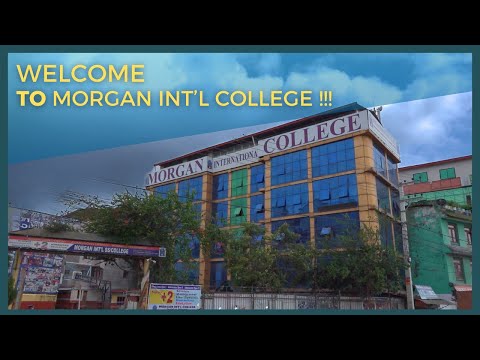
Morgan International College is a higher education institution located at Basundhara-3, Kathmandu, Nepal. Established in 2010, it runs secondary and tertiary programs that span information technology, management, and social sciences for students from Nepal and abroad.
The college runs Ten Plus Two (Grade 11–12) programs under the National Examinations Board (NEB) and bachelor’s and master’s programs affiliated with Tribhuvan University (TU). Its flagship courses include Bachelor in Computer Application (BCA), Bachelor of Information Technology Management (BITm), Bachelor of Business Management (BBM), Bachelor of Business Studies (BBS), Bachelor of Social Work (BSW), and Master of Business Studies (MBS).
With more than 5,500 students and over 350 faculty members across six major streams, the college functions as a large academic community. It aims to combine academic depth, practical exposure, and community engagement so that graduates can contribute to Nepal’s development and participate in regional and global job markets.

College Name: Morgan International College
Location: Basundhara-3, Kathmandu, Nepal
Year of Establishment: 2010
Ownership: Private, co-educational college
Affiliations:
National Examinations Board (NEB) – Ten Plus Two programs
Tribhuvan University (TU) – BCA, BITM, BBM, BBS, BSW, MBS
Approximate Student Strength: 5,500+
Faculty and Staff: 350+ teaching and academic staff
Major Streams: Information Technology, Management, Social Work, Social Sciences
Morgan International College offers NEB-affiliated Ten Plus Two programs for students who have completed SEE or equivalent. These courses build the academic base for bachelor’s and professional studies and are delivered in both morning and day shifts, depending on demand.
The Science stream focuses on Physics, Chemistry, Biology, Mathematics, and Computer Science, complemented by English and Nepali. It suits students aiming for medicine, engineering, agriculture, information technology, and research-focused disciplines.
Practical work in laboratories, numerical problem-solving, and project assignments form the core of learning. Students participate in internal tests, model exams, and counseling sessions that help them prepare for national entrance exams such as MBBS, BE, and BSc programs under different universities.
The Management stream introduces students to the fundamentals of business and commerce. Core subjects include Principles of Accounting, Business Studies, Economics, English, and optional courses such as Computer Science or Hotel Management.
The curriculum builds basic skills in financial recording, business communication, and entrepreneurship concepts. Students who complete this track commonly move towards BBS, BBA, BBM, BHM, or related business degrees across various universities.
The Humanities stream brings together subjects such as Sociology, Population Studies, History, Political Science, Psychology, and Mass Communication, combined with language courses.
It is appropriate for students interested in media, social sciences, public service, education, law, and development studies. Classroom discussion, presentations, and field-based assignments help learners connect theory with Nepal’s social and cultural contexts.
The Law stream provides an early foundation in constitutional principles, legal systems, and basic civil and criminal law. Students are introduced to legal institutions, rights, and responsibilities along with social science subjects.
This track prepares students for bachelor-level law degrees (BALLB, BLL.B) or related careers in legal support services and public administration.
The Education stream links pedagogy, psychology, and subject-area knowledge. It is suitable for students considering teaching, early childhood education, or education management in the future. Coursework highlights classroom practice, child development, and basic research tasks related to school education in Nepal.
BCA at Morgan is a four-year, eight-semester IT degree offered under the Faculty of Humanities and Social Sciences, Tribhuvan University.
The curriculum covers programming, data structures, database systems, web technologies, operating systems, networking, software engineering fundamentals, and emerging fields such as data science and cyber security. Students complete practical labs, minor and major projects, and often build applications related to banking, business, e-commerce, and community services.
Graduates can continue towards MIT, MCA, MBA, or other IT-related master’s programs or work as software developers, system analysts, web developers, database administrators, or IT officers in public and private organizations.
BITM is an IT-and-management-focused bachelor’s program that combines computing knowledge with business management courses. The curriculum includes programming languages, web and multimedia technologies, networking, system analysis, software project management, and core management subjects such as accounting, marketing, and organizational behavior.
Students learn to manage information systems in industries, banks, development projects, and service organizations. The program suits those who want to work at the intersection of technology and business or move on to master’s programs in IT management or business.
BBM is a four-year, eight-semester management degree under TU’s Faculty of Management. It focuses on managerial skills needed for corporate and entrepreneurial roles.
Courses cover management principles, economics, business law, organizational behavior, finance, marketing, operations, business communication, and entrepreneurship. Through presentations, case discussions, internships, and project work, students gain exposure to real business situations in Nepalese banks, trading houses, manufacturing, and service firms.
BBS is a four-year annual program that remains one of Nepal’s most popular management degrees. It provides a broad grounding in accounting, finance, marketing, human resource management, and business law.
The TU BBS curriculum seeks to develop graduates who can handle basic managerial responsibilities, understand business environments, and pursue careers in banking, corporate services, entrepreneurship, and public sector organizations. Morgan complements the university syllabus with periodic tutorials, exam-focused support classes, and project work linked to local enterprises.
BSW is a four-year degree under the Faculty of Humanities and Social Sciences that prepares students for professional social work practice. The program combines theory on social work methods, sociology, psychology, human rights, and social policy with extensive fieldwork in communities, NGOs, and public institutions.
Learners engage in casework, group work, community organization, and research assignments. Graduates can work in NGOs/INGOs, local governments, development agencies, media, and academic institutions or continue to Master of Social Work (MSW) or related graduate studies.
MBS at Morgan is a two-year, four-semester postgraduate program under Tribhuvan University’s Faculty of Management. It builds advanced knowledge in accounting, finance, marketing, human resource management, and strategic management.
The course includes core theory, specialization subjects, seminars, research methodology, and a mandatory thesis or project work. Graduates often take up roles in banking, corporate management, consulting, academia, and development projects, or continue to MPhil and PhD-level study in management disciplines.
For each intake, Morgan publishes admission notices on its official website, social media pages, and campus notice boards. Interested students collect or download the application form, submit academic transcripts, certificates, and photographs, and, where required, sit for entrance examinations conducted by Tribhuvan University or the college.
Admission decisions usually combine entrance test scores (where applicable), previous academic performance, and an interview or counseling session. Applicants are advised to review current notices because detailed criteria can change with NEB or TU policy updates.
Completion of SEE or equivalent from a recognized board
Minimum GPA and subject-grade thresholds as set by NEB and the college for each stream
Personal interaction or counseling to match student interests with stream choice
BCA:
Completion of 10+2, PCL, or equivalent in any discipline from a recognized board
Minimum grades and division as specified by TU (currently a minimum prescribed grade in each subject and an overall CGPA threshold)
Passing the TU BCA entrance examination conducted by the Faculty of Humanities and Social Sciences
BBM and BITm:
10+2, PCL, or equivalent in any stream, meeting minimum grade requirements
Mandatory participation in the Central Management Admission Test (CMAT) run by TU Faculty of Management
Shortlisted candidates undergo group discussions or interviews as per college policy
BBS and BSW:
Completion of 10+2 or equivalent with required subject combinations and minimum marks as per TU regulations
College-level screening, which may include written tests and interviews
Bachelor’s degree in management or a relevant field from TU or a recognized university
Participation in the CMAT for the master’s level, conducted by TU Faculty of Management
Final selection based on CMAT score, previous academic record, and interview performance
Morgan reports more than 350 faculty members across its streams, including professors, associate professors, lecturers, and industry practitioners. Many teachers have long experience in TU-affiliated colleges, professional practice, or research, which supports subject depth and applied examples in the classroom.
Teaching combines interactive lectures, tutorials, lab sessions, presentations, case analysis, project assignments, and field visits. IT courses rely heavily on computer labs, coding exercises, and group project work, while management and social work courses include case studies, role plays, internships, and report writing.
Continuous assessment through internal tests, assignments, viva voce, and presentations supplements annual or semester examinations. Regular workshops, guest lectures, and research-design trainings—highlighted in the college’s news and events section—provide exposure to advanced topics and research skills.
Morgan International College operates from a multi-storey campus building with classrooms, labs, and open courtyard spaces used for assemblies, cultural events, and sports.
Key facilities commonly highlighted by the college and independent listings include:
Well-furnished classrooms supported by multimedia teaching aids
Computer laboratories for BCA, BITm, and other IT-related courses
Science laboratories for Ten Plus Two Science
Library with textbooks, reference materials, journals, and e-resources
Internet access and e-library services
Separate hostels for male and female students
Cafeteria providing meals and refreshments
Transportation services for day scholars from different parts of Kathmandu Valley
Seminar hall, conference spaces, and an auditorium for academic programs
Dedicated spaces for sports and physical education
These resources help students carry out laboratory experiments, project work, presentations, and group activities within a structured academic environment.

Student life at Morgan combines formal academic schedules with a range of co-curricular and extracurricular activities. Regular orientation programs, poem recitation events, research-design trainings, and seminars are documented on the college’s website and social media pages.
Students interact across streams through clubs, group assignments, and participation in college-level festivals. IT students often collaborate on software and web projects, business students run survey-based studies and mini business plans, while social work students carry out community visits and social awareness campaigns.
Internal mentoring and counseling support students in adjusting to college life, choosing specializations, and planning for higher studies in Nepal or abroad.
College life at Morgan is not limited to lectures and exams. Students have many chances to try new interests, meet friends from different programs, and build confidence outside the classroom.
Common activities include:
Regular sports practice and inter-house or inter-college matches in football, basketball, volleyball, athletics, and other games
Cultural events with music, dance, poetry recitation, drama, and visual arts
Quiz contests, debates, and essay or creative-writing competitions that sharpen speaking and writing skills
Educational tours, industrial visits, and field trips that connect classroom learning with workplaces and communities
Short workshops on leadership, communication, time management, and personal growth
The college also runs a sports academy initiative. Under this setup, interested students train with coaches on a fixed schedule, plan their practice around class timings, and prepare for tournaments without losing focus on their studies.
For many families, fee levels are a serious concern. Morgan International College has a scholarship system that tries to recognize hard work and support students who might otherwise struggle to continue their education.
Merit Scholarships for High Achievers
Students who score 90% or above in SLC/SEE may receive full tuition waivers or large fee reductions, depending on the program and intake year.
Entrance exam toppers (one boy and one girl) are often granted full admission-fee waivers as a reward for their performance.
District Topper Scholarships
Students who stood first in their district in SLC/SEE may be eligible for full admission-fee waivers in selected programs.
Performance-Based Fee Waivers
Toppers in internal terminal examinations can receive partial or full waivers on monthly fees for the next term.
This policy encourages students to maintain steady effort throughout the year, not only during final exams.
Admission-Fee Waivers by Percentage Brackets
Students with strong SLC/SEE results (for example, 85% and above, 80% and above, 75% and above) may receive graded admission-fee discounts.
The exact percentages and categories are set by the college and are announced in each admission session.
Inclusive Scholarships
Students from remote areas, families of martyrs, and socially marginalized communities can apply for special admission-fee waivers, often around one-fourth of the admission fee, depending on the rules in force during that year.
Because scholarship rules may change over time, applicants are encouraged to read the latest scholarship notice carefully and, if needed, speak with the college administration or scholarship desk before finalizing admission.
Since 2010, Morgan International College has grown from a single-stream institution into a campus with higher secondary, bachelor’s, and master’s programs, particularly in information technology and management.
Some key developments include:
Students from Morgan achieving strong results in TU and NEB examinations, with several board toppers and high scorers mentioned in college announcements
Participation in the Quality Assurance and Accreditation (QAA) process of the University Grants Commission, including the preparation and publication of Self-Study Report (SSR) documents
Academic links and exposure programs with institutions in countries such as Japan, the United States, Australia, and India, creating pathways for interaction, further study, and cultural exchange
Taken together, these achievements show how the college has moved step by step from a local institution serving nearby communities to one that has regular contact with national and international academic networks, while still focusing mainly on students from Nepal and the region.
From a student and parent perspective, several aspects of Morgan may be relevant while comparing institutions:
Range of Programs in One Campus - NEB Ten Plus Two streams and TU-affiliated bachelor’s and master’s programs in IT, management, and social work allow students to plan long-term academic pathways within a single institutional environment.
Strong Focus on IT and Management - Programs such as BCA, BITm, BBM, BBS, and MBS reflect the demand for computing and business skills in Nepal’s labor market, providing options for both technical and managerial careers.
Accessible Location - Basundhara-3 is within Kathmandu Metropolitan City with road connectivity to major residential areas, simplifying daily travel for day scholars.
Structured Scholarship and Support System - Clearly articulated scholarship schemes help academically strong and financially disadvantaged students reduce fee burdens.
Active Academic and Co-curricular Environment - Workshops, research-design trainings, poem competitions, and sports activities help students build confidence beyond examination scores.

Chairman Mr. Kul Prasad Chapagain addresses students, parents, guardians, and well-wishers with an invitation to view Morgan as an academic space that pursues high standards in teaching and learning. In his message, he highlights the college’s goal of providing a disciplined learning environment with clear academic targets and strong assessment practices.
He notes that the college has grown each year in terms of student numbers, program range, and activities. He also stresses that support for students extends beyond the classroom through counseling, mentoring, and preparation for higher studies in Nepal and abroad.

Principal and Campus Chief Dr. Dipendra Bhandari expresses a sense of responsibility for guiding students, working closely with faculty, and maintaining communication with parents. In his message, he underlines the importance of cooperation among students, teachers, and families to achieve academic goals.
Morgan International College in Basundhara-3, Kathmandu, represents a sizeable academic institution combining NEB Ten Plus Two programs and Tribhuvan University–affiliated bachelor’s and master’s courses in IT, management, and social work. With more than a decade of operation, a large student body, and growing academic networks, it has become part of the urban higher-education landscape of the Kathmandu Valley.
1. Where is Morgan International College located?
Morgan International College is located at Basundhara-3, Kathmandu Metropolitan City, easily accessible from various parts of the Kathmandu Valley.
2. Which boards and universities is the college affiliated with?
The college runs Ten Plus Two programs under the National Examinations Board (NEB) and bachelor’s and master’s programs—BCA, BITm, BBM, BBS, BSW, and MBS—under Tribhuvan University.
3. What major academic programs are currently offered?
Programs include Ten Plus Two in Science, Management, Humanities, Law (Special), and Education; bachelor’s degrees in BCA, BITm, BBM, BBS, and BSW; and the MBS postgraduate program. Additional courses may be introduced over time, so applicants should confirm the latest list from official notices.
4. How does the admission process work for bachelor’s programs?
Admission to bachelor’s programs is based on completion of 10+2 or equivalent with required grades and, for selected programs, success in national entrance exams. BCA applicants must pass the TU BCA entrance test, while BBM and BITM applicants must sit for the Central Management Admission Test (CMAT). BBS and BSW follow TU eligibility rules and college-level screening.
5. What scholarship opportunities are available?
Morgan offers several scholarship categories, including full or partial fee waivers for high SLC/SEE scorers, entrance and district toppers, internal exam toppers, and students from remote or marginalized backgrounds. Specific criteria and percentages are updated in annual scholarship notices.
6. Does the college provide hostel and transportation facilities?
Yes. The college runs separate hostels for male and female students and offers transportation services for day scholars commuting from different areas of the Kathmandu Valley.
7. What kind of learning environment can students expect?
Students can expect structured classroom teaching, lab-based learning for IT and science subjects, regular internal assessments, and opportunities to participate in workshops, research trainings, cultural programs, sports, and community-based activities.
Contact Morgan International College's administrative office for detailed information on the course, admissions, location, fees, scholarships, facilities, counseling, or eligibility.
Morgan International College
Email Address: morganintlcollege@gmail.com
Phone Number: +977-1-4954088 +977-1-4956876
Website: http://morgancollege.edu.np
Location: Basundhara-3, Kathmandu, Nepal