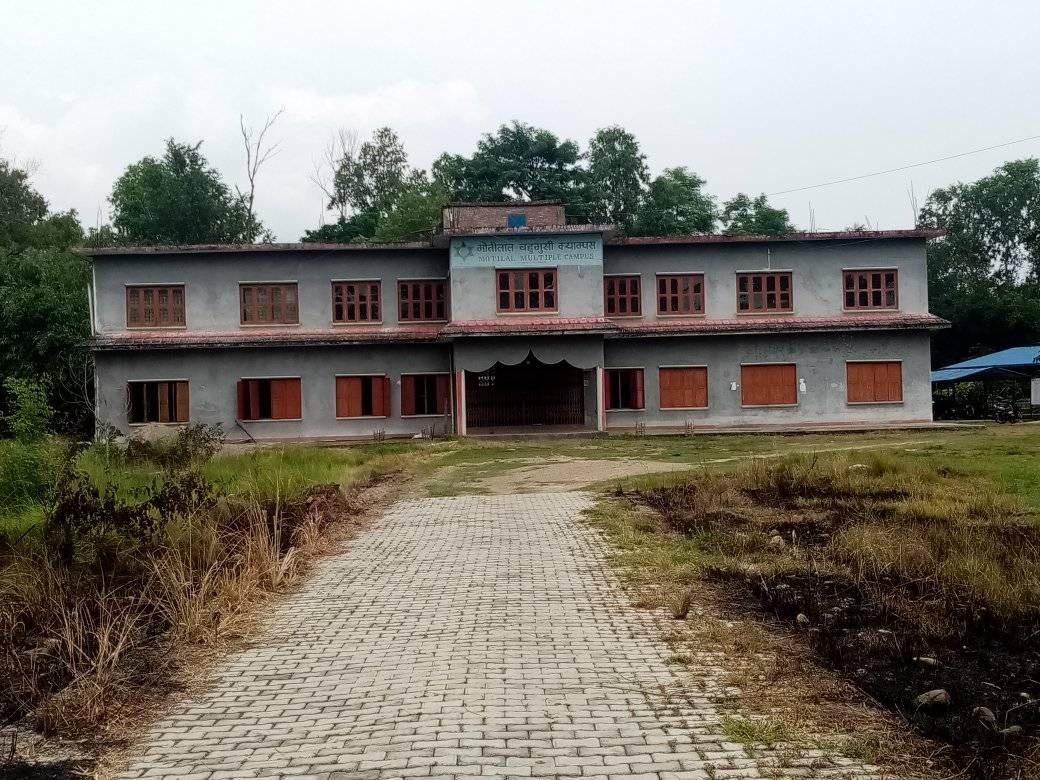
Motilal Multiple Campus is a community-based campus in Nawalparasi that provides bachelor-level education with affiliation from Tribhuvan University. The campus operates under the Faculties of Management and Humanities and offers full-time four-year programs in BA and BBS. Its development reflects a strong local community effort, donor participation, and continuing institutional support from local bodies and the University Grants Commission (UGC).
The campus was established to expand access to higher education for students from surrounding areas, including underprivileged and geographically distant communities. Over time, it has built classroom space, ICT facilities, sports infrastructure, a cafeteria, transport support, and student services such as counseling, scholarships, and extracurricular activities. The institution serves both academic and social needs by making higher education available at the local level.
College Name: Motilal Multiple Campus
Nepali Name: माेतिलाल बहुमुखी क्याम्पस, नवलपरासी
Type: Community-based campus
Location: Ramnagar-2 Bhumahi, East West Highway, Ramnagar, Nawalparasi, Nepal
Affiliation: Tribhuvan University
Recognition/Support: University Grants Commission (UGC) support and recognition are mentioned in the campus materials
Established: 2066 BS / 2009 AD
Academic Faculties: Faculty of Management and Faculty of Humanities
Programs Offered: Bachelor of Business Studies (BBS), Bachelor of Arts (BA)
Study Mode: Full-time bachelor-level study
Campus Leadership: Campus Chief Toyanath Neupane
Service Area: Sunwal Municipality, Ramgram Municipality, Sarawal Rural Municipality, and Bardaghat Municipality
Contact Numbers: +977-78-420032, +977-78-420024, +977-9857081992
Motilal Multiple Campus was built through community initiative in the Nawalparasi area to address the need for local access to higher education. The campus growth is linked to a Dhan-Dhanyanchal Gyan Mahayagya conducted in 2065 BS, which brought together donors, local education supporters, social workers, traders, and community members. The campus was later named after the late Shri Motilal Nyaupane, whose contribution to the fundraising effort was the highest.
The institution was formed with a social purpose. Its stated focus includes students from Dalit, Janajati, Madhesi, poor, backward, marginalized, and geographically distant communities who otherwise faced difficulty in pursuing bachelor-level education. This community-centered foundation remains part of the campus identity.
Administrative and academic management have been organized through a college assembly, management committee, campus chief, research committee, faculty units, and administration/accounts section. The campus materials also note that statutes and regulations have been developed for academic administration, finance, and personnel management. This indicates a structured governance model rather than an informal community initiative alone.
Support from local bodies, the municipality, donors, provincial authorities, UGC, and Tribhuvan University has contributed to the institution’s physical and academic development. Over time, this support has helped the campus expand facilities, add equipment, and maintain bachelor-level teaching in both management and humanities.
Motilal Multiple Campus currently runs two bachelor-level programs:
Bachelor of Business Studies (BBS): Four-year full-time program under the Faculty of Management, Tribhuvan University
Bachelor of Arts (BA): Four-year full-time program under the Faculty of Humanities and Social Sciences, Tribhuvan University
The campus received affiliation for the BBS program in 2066 BS and has been running the BA program since 2067 BS. Under the management stream, the campus materials mention subject areas such as Accounting, Finance, and Management. Under the humanities stream, the listed subject areas include English, Nepali, and Rural Development.
The BBS program follows the TU annual structure and is designed to build knowledge in business, administration, communication, economics, accounting, financial management, organizational behavior, entrepreneurship, and research. The program also includes concentration study in the final year and project work as part of the academic structure.
The BA program is also a four-year bachelor program under TU. Its broader TU structure includes compulsory subjects and major/elective combinations within humanities and social sciences. For students at Motilal Multiple Campus, the local academic focus mentioned in the available materials includes English, Nepali, and Rural Development.
Admission to bachelor-level programs at Motilal Multiple Campus follows the general framework used for TU-affiliated bachelor programs. The process usually includes these steps:
Publication of an admission notice by the campus
Submission of the prescribed application form
Submission of required academic documents
Selection based on campus and faculty rules, which may include merit-based selection, entrance procedures, or both if applicable
Completion of admission through document submission and fee payment
Academic registration under TU rules and the applicable academic calendar
For annual-system TU bachelor programs, final examinations are conducted by Tribhuvan University through the Office of the Controller of Examinations. Academic registration, examinations, and results follow TU rules, guidelines, and the applicable calendar.
Students applying for TU-affiliated bachelor programs generally submit the following documents:
Academic Transcript or Grade Sheet of Class 12 / +2 or equivalent
Character Certificate from the previous institution
Migration Certificate if the previous board or university is different
Transfer Certificate (TC) from the previous school or college
Citizenship Certificate or Birth Certificate copy
Passport-size photographs
Entrance Examination Scorecard, if required by the program or campus
Completed admission or application form
Admission fee payment receipt
Equivalence Certificate, if the qualification is from a foreign board or university
The campus materials describe the faculty as skilled, experienced, and professor-led. Academic and administrative responsibilities are distributed between the Faculty of Management, Faculty of Humanities, and administrative support sections such as library, examination/accounts, computer, office, and support staff.
The teaching-learning process uses multiple instructional methods rather than a single lecture pattern. These methods include:
Lecture method
Demonstration method
Group discussion
Role play method
Field trip
Use of multimedia
Sample practice teaching
Project work and report writing
This combination suggests an academic environment that includes classroom teaching, discussion-based learning, practical exposure, and guided project work. The presence of a research committee also supports the academic structure of final-year study and internal academic management.
The campus has developed a growing physical and academic infrastructure to support bachelor-level education. The available materials mention two two-storey buildings, one built from internal resources and another built with support from UGC. The main two-storey building includes teaching rooms, library and accounts space, staff room, office rooms, a meeting room, and a computer lab. The building has 21 rooms in total, while the UGC-supported building has 4 rooms.
Facilities and learning resources mentioned for the campus include:
Library and e-library
ICT lab with network facilities
Computer sets, laptops, printers, scanners, projectors, and photocopy machines
Classrooms and lecture stands
Journal
Counseling support
Conference hall
Educational tour activity support
Cafeteria
Guard house
Campus vehicle / bus
Furniture for classrooms, offices, and library use
Pure drinking water with taps and electronic filters
Toilets including a disability-friendly toilet
Compound wall and campus security arrangements
The cafeteria can serve more than 100 students at a time. The campus also purchased furniture through the UGC grant support. Taken together, these details show continued investment in both basic infrastructure and teaching support resources.
Student life at Motilal Multiple Campus is shaped by its local service mission. The campus was established so students from nearby municipalities and rural areas would not need to travel far for higher education. This local access remains one of its strongest features.
The service area includes Sunwal Municipality, Ramgram Municipality, Sarawal Rural Municipality, and Bardaghat Municipality. The campus materials also present a social objective that connects education with access, employment, and community awareness. Students from underprivileged backgrounds are part of the intended beneficiary group, and the institution links higher education with local opportunity.
The environment described in the campus materials is peaceful and safe, with social security arrangements, drinking water, sports space, and a community-connected setting. The presence of a bus, cafeteria, counseling support, and extracurricular activities adds to everyday campus life beyond formal classroom teaching.
The campus mentions a range of extracurricular and co-curricular activities, including:
Sports activities
Extracurricular activities (ECA)
Literary programs conducted on occasion
Educational tours
Counseling activities
Awareness programs related to financial literacy
Field trips and project-based learning support
Sports space includes basketball, volleyball, badminton, and table tennis arrangements. Cricket and football activities are conducted at a nearby community stadium to the east of the campus.
Financial support appears in several parts of the campus materials and is tied closely to the institution’s community mission. The campus mentions scholarships as one of its salient features and notes that it receives regular grants, capital grants, and scholarship support from the provincial government and UGC.
The social role of the campus also includes making higher education accessible to underprivileged communities through scholarships and minimum fees. Support for poor, deprived, minority, and backward groups is a recurring theme in the institutional narrative. This makes financial assistance part of the campus’s broader access agenda rather than a separate service alone.
Several points stand out as institutional milestones in the growth of Motilal Multiple Campus:
Establishment through a community fundraising movement
Naming of the campus after the late Shri Motilal Nyaupane
TU affiliation for BBS in 2066 BS
Operation of BA since 2067 BS
Expansion under both Management and Humanities faculties
Development of two major campus buildings
Construction of cafeteria support from Sunwal Municipality
Purchase of a campus bus through municipal financial support
Continued support from donors, local bodies, provincial authorities, UGC, and TU
Satisfactory examination results mentioned in campus records
Development of library, e-library, ICT resources, and sports infrastructure
Operation under formal statutes, financial regulations, and administrative rules
The campus also identifies future institutional directions such as QAA-related work, library strengthening, staff development, digital boards, additional academic programs, and long-term self-reliance.
Students seeking bachelor-level study in the Nawalparasi area may find this campus relevant for several practical reasons:
TU-affiliated bachelor programs in management and humanities
Community-based campus with a local access mission
Four-year BA and BBS programs
Experienced and skilled faculty support
Library, e-library, ICT lab, and multimedia-based teaching support
Sports, counseling, literary activities, and tours
Scholarships and minimum-fee access for selected groups
Transport support and campus cafeteria
Peaceful and safe campus environment
Campus Chief Toyanath Neupane presents the campus as a community-run institution created to extend higher education opportunities to students who faced social, economic, and geographic barriers. His message places strong emphasis on access for Dalit, Janajati, backward, poor, and distant-area students, along with affordable study and local enrollment.
The message also reflects confidence in the campus’s academic progress, continued public support, and the role of grants and scholarships from provincial authorities and UGC. It frames the campus as a local institution built for long-term educational service.
Motilal Multiple Campus represents a community-rooted higher education institution in Nawalparasi with a clear local service role. Its TU affiliation, two bachelor programs, structured governance, growing infrastructure, and student support systems show a campus that has expanded through community participation and institutional support.
For students seeking BA or BBS study in a local setting, the campus offers an academic option connected to both educational access and community development. Its continued focus on facilities, inclusion, and academic organization gives it a distinct place in the area’s bachelor-level education landscape.
Motilal Multiple Campus is a community-based campus in Nawalparasi that offers bachelor-level education under Tribhuvan University.
The campus is located at Ramnagar-2 Bhumahi, East West Highway, Ramnagar, Nawalparasi, Nepal.
The campus offers Bachelor of Business Studies (BBS) and Bachelor of Arts (BA).
Yes. The campus is affiliated with Tribhuvan University for its bachelor-level programs.
Both BA and BBS are four-year bachelor-level programs.
The campus runs programs under the Faculty of Management and the Faculty of Humanities.
The Campus Chief is Toyanath Neupane.
The campus has classrooms, library and e-library support, ICT lab and computer facilities, multimedia equipment, sports infrastructure, cafeteria, counseling, conference hall, journal support, tour activity support, drinking water facilities, toilets, and a campus vehicle.
Scholarships are mentioned as part of the campus support system, and the campus materials also note scholarship support from the provincial government and UGC.
Students generally submit academic transcripts, character certificate, migration certificate if applicable, transfer certificate, citizenship or birth certificate copy, passport-size photographs, application form, fee payment receipt, and other required documents under TU admission procedures.
Contact Motilal Multiple Campus's administrative office for detailed information on the course, admissions, location, fees, scholarships, facilities, counseling or eligibility.
Motilal Multiple Campus
Location: Ramnagar-2 Bhumahi, East West Highway, Ramnagar, Nawalparasi, Nepal
Phone Number: +977-78-420032, +977-78-420024, +977-9857081992
Email: motilalcam13@gmail.com