Pokhara Nursing Campus is a constituent campus of Tribhuvan University under the Institute of Medicine, located at Pokhara-12, Ramghat, Kaski, Gandaki Province, Nepal. Established in 2039 BS, the campus has developed from earlier health-worker and certificate-level nursing education into bachelor- and master-level nursing education.
Its academic environment combines classroom teaching, nursing skills laboratories, clinical and community practice, research activities, library and digital learning resources, hostel accommodation, student welfare services, and campus administration. The campus currently offers BSc Nursing, Bachelor in Nursing Science (BNS), and Master in Nursing (MN), with postgraduate specialty study in nursing fields.
The campus operates within the academic structure of Tribhuvan University and the Institute of Medicine while maintaining its own academic departments, administrative sections, research support, student services, and campus-level quality assurance mechanisms.
| Field | Details |
|---|---|
| Campus Name: | Pokhara Nursing Campus |
| Institution Type: | Constituent campus |
| Established: | 2039 BS (1982 AD) |
| Location: | Pokhara-12, Ramghat, Kaski, Gandaki Province, Nepal |
| University: | Tribhuvan University |
| Institute: | Institute of Medicine |
| Academic Field: | Nursing education |
| Programs: | BSc Nursing, Bachelor in Nursing Science (BNS), Master in Nursing (MN) |
| Academic Departments: | Adult Health Nursing, Midwifery, Child Health Nursing, Community Health Nursing |
| Professional Regulator: | Nepal Nursing Council |
| Admission Framework: | Medical Education Commission common entrance and merit-based matching or selection |
| Quality Assurance: | UGC QAA accreditation granted in September 2022 |
| Learning Resources: | Library, e-library, classrooms, nursing skills laboratories, internet, and digital academic systems |
| Student Support: | Hostel, first aid, counseling, academic guidance, Wi-Fi, sports, student welfare, and transport for academic activities |
Pokhara Nursing Campus operates within the academic structure of the Institute of Medicine, Tribhuvan University. It is a constituent campus of Tribhuvan University, with nursing education forming the central focus of its academic work.
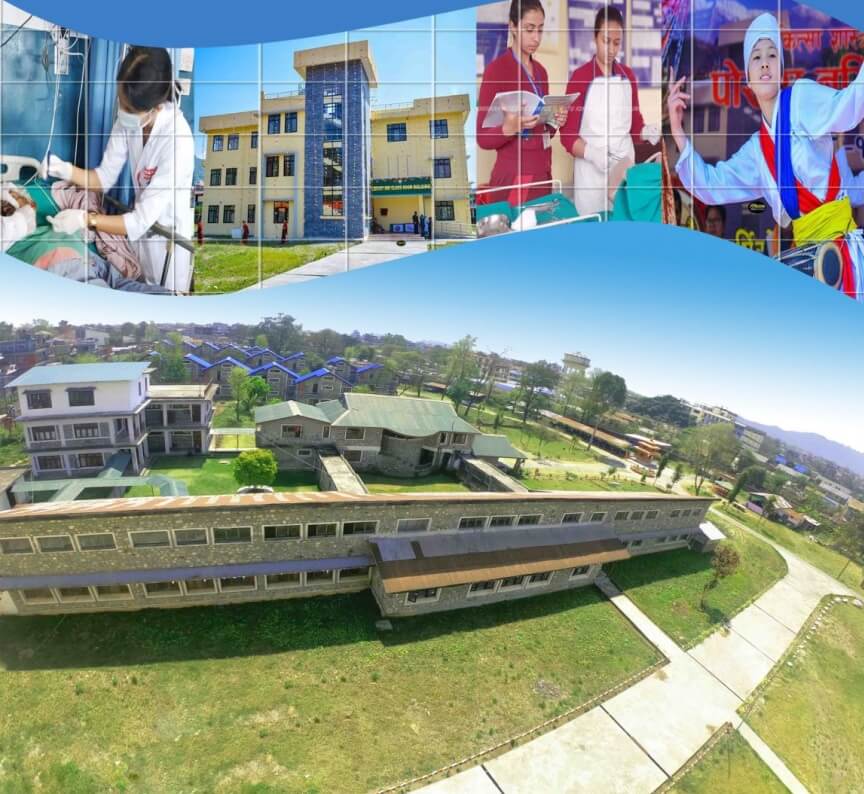
The history of the campus reflects a gradual transition from earlier health-worker and certificate-level education to university-level nursing programs. Its earlier academic activities included CMA and PCL Nursing education. The institution later expanded into bachelor-level nursing education and subsequently into postgraduate nursing study.
The Post Basic Bachelor of Nursing program was introduced in 2062 BS. It was later revised into the three-year Bachelor in Nursing Science program in 2070 BS. Master in Nursing was introduced in 2068 BS, while BSc Nursing was added in 2073 BS. PCL Nursing is no longer part of the current academic offering.
This academic progression has shaped the campus into an institution focused on bachelor- and master-level nursing education. Undergraduate students study nursing theory, laboratory-based practical components, clinical subjects, community health, management, education, and research-related areas. Postgraduate nursing education adds advanced specialty study, research, thesis work, and higher-level nursing practice.
The development of the campus is also visible in its academic departments, nursing laboratories, library and e-library, research support system, hostel facilities, administrative sections, and student welfare arrangements.
Pokhara Nursing Campus is located at Pokhara-12, Ramghat, Kaski, Gandaki Province, Nepal. The campus brings together teaching spaces, academic departments, nursing skills laboratories, library facilities, administrative units, hostel accommodation, and other student services within one institutional setting.
Nursing education extends beyond classroom teaching. Students move between classrooms, laboratories, health institutions, and community settings according to the requirements of their academic programs. Campus transport supports academic activities such as community posting, observation visits, leadership and management activities, institutional visits, and other field-based learning.
The campus also has open space used for student activities and sports. Indoor and outdoor events are organized alongside formal academic work. Meeting and seminar spaces provide venues for workshops, seminars, training, departmental meetings, and institutional discussions.
Students and families comparing TU nursing campuses may also consult the separate profile of Birgunj Nursing Campus, Parsa.
Pokhara Nursing Campus functions under the academic and administrative framework of the Institute of Medicine and Tribhuvan University while managing its own campus-level academic and administrative operations.
Campus governance includes a Campus Administration Committee and an Internal Quality Assurance Committee. Academic departments and administrative sections handle teaching, student records, examinations, finance, library operations, institutional support, and day-to-day campus administration.
The campus has four academic departments:
These departments support teaching and academic activities across the nursing programs offered by the campus. Academic departments and degree programs have different roles: departments organize subject-based teaching and professional areas, while programs follow specific degree structures and curricula.
Administrative responsibilities are distributed across general administration, academic administration, examination-related work, finance, library services, store management, and other institutional functions.
The campus also uses digital systems for academic and administrative management. Its Education Management Information System supports the management of student and staff information, financial records, library operations, attendance, and institutional records.
Library functions include barcode-based management of books and circulation. Electronic attendance and other digital systems are also used within campus administration.
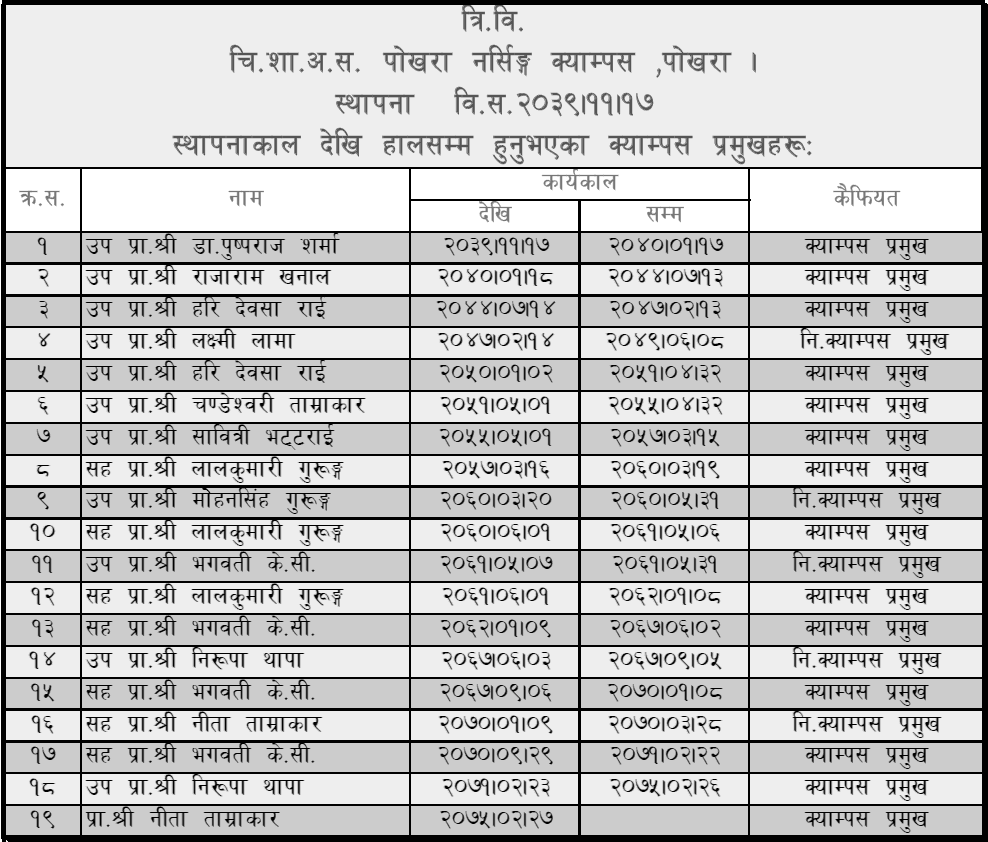
Pokhara Nursing Campus places nursing education, health service, research, and professional preparation at the center of its academic work.
Its institutional vision connects nursing education with health and wellness across the lifespan. Its mission brings together education, nursing practice, research, professional integrity, and healthcare responsibilities.
The academic objectives include:
These objectives are reflected in classroom teaching, nursing skills laboratories, community placements, clinical practice, research assignments, and student learning activities.
The teaching and learning environment at Pokhara Nursing Campus combines theory, practical preparation, clinical experience, community learning, and research.
Students attend formal classes and use nursing skills laboratories to practice procedures and techniques before or alongside clinical exposure. Clinical placements and community postings allow students to apply academic knowledge in health-service and community settings.
Classrooms include multimedia projection facilities, whiteboards, electrical connections, internet access, and supporting infrastructure. Power backup arrangements help maintain academic and administrative activities during interruptions in the regular electricity supply.
The campus has dedicated meeting and seminar spaces. A meeting hall supports departmental and interdepartmental meetings, while a seminar and conference hall is used for workshops, seminars, training, and academic discussions. Multimedia, sound, and internet facilities support these activities.
Clinical and community learning remain important parts of nursing education. Students participate in placements, field activities, and institutional visits according to program requirements. Specialized health institutions may also be used for observation and academic exposure.
The exact placement sites may differ by academic program, specialty, learning requirement, and schedule. The long-term institutional feature is the integration of clinical and community practice into nursing education.
Pokhara Nursing Campus has four identified laboratory areas that support practical preparation:
The Fundamentals of Nursing Skills Lab supports the learning and practice of basic nursing procedures. Students can observe demonstrations and practice relevant nursing skills in an academic setting before or alongside clinical learning.
The Midwifery and Paediatric Nursing Skills Lab supports practical learning connected with maternal health, reproductive health, newborn care, and child-health nursing.
The Community Health Nursing and Nutrition Lab supports practical learning related to community nursing, public health, family and population-based nursing practice, and nutrition.
The Basic Science Lab supports the science components included within nursing education.
These laboratories form part of the campus learning structure because nursing curricula require both theoretical understanding and practical competence.
The campus library supports undergraduate students, postgraduate students, faculty members, and research activities.
Its collection includes nursing and health-related textbooks, reference books, journals, periodicals, and academic research materials. A reading area provides space for individual study and reference work.
Pokhara Nursing Campus also operates an e-library. Digital access supports students working on assignments, literature reviews, research proposals, theses, and other academic tasks requiring electronic academic resources.
Electronic resource access includes:
Internet-connected e-library facilities allow students, faculty members, and researchers to access academic databases and electronic materials. The library also maintains research work and other academic resources produced within the institution.
The library and e-library are connected with the campus's broader digital information infrastructure. Digital systems are used for circulation records and other library-management functions.
Internet connectivity supports academic, administrative, and library activities across the campus.
Wired and wireless access is available in areas used by administration, academic departments, faculty members, students, the library, and other institutional units.
The campus uses digital systems for more than general internet access. EMIS supports the management of student and staff records, financial information, library services, attendance, and administrative data.
Digital arrangements include:
These systems support the administrative structure behind teaching, registration, record management, library services, and other campus functions.
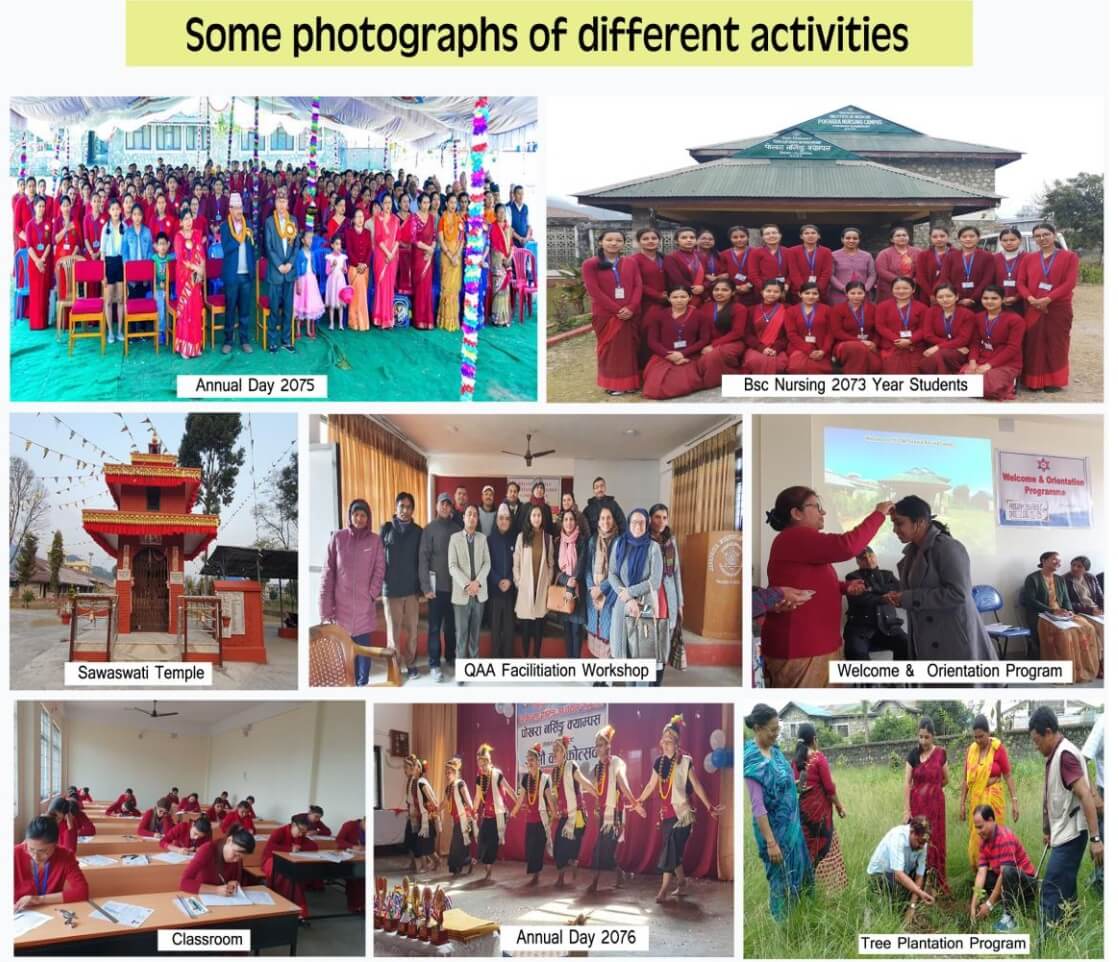
Research is part of both faculty and student academic activity at Pokhara Nursing Campus.
The campus established a Research Management Cell in 2073 BS with support connected to the University Grants Commission. The cell provides an institutional mechanism for research-related activities and academic research support.
Its activities include research support, training, grants, and academic capacity-building for faculty members and students.
The campus has research-grant arrangements for faculty and student research. This gives research activities a defined institutional base rather than leaving them entirely within individual academic departments.
Research becomes particularly important in advanced undergraduate study and postgraduate nursing education. Bachelor-level nursing curricula include research and biostatistics, while master-level study includes research work, thesis preparation, and viva voce.
Faculty members also participate in research, seminars, workshops, and academic publication activities. The campus has publication activity associated with the Journal of Nursing and Health Sciences Nepal.
Research at the campus connects nursing practice with academic inquiry in areas such as clinical care, community health, nursing education, management, and specialty nursing.
Clinical and community learning are integral parts of nursing education at Pokhara Nursing Campus.
Students participate in hospital clinical practice, community posting, institutional visits, observation visits, leadership and management activities, and other field-based learning according to academic requirements.
Academic field activities include:
These activities connect classroom and laboratory learning with healthcare and community settings.
Community placements are particularly relevant to areas such as community health, preventive care, family health, health education, and population-based nursing practice.
Campus transport supports some academic movements between the campus, community fields, hospitals, and other institutional sites.
Clinical rotation planning forms part of academic administration. Individual placements can change according to program requirements, institutional arrangements, and academic schedules.
Pokhara Nursing Campus provides hostel accommodation for students.
The hostel includes student rooms, kitchen facilities, and dining arrangements. A warden is responsible for hostel administration and residential matters, and security support is included in the hostel arrangement.
On-campus accommodation provides a residential option for students managing classroom study, practical learning, clinical activities, community placements, and other academic responsibilities.
The campus also has residential quarters for faculty members and staff. These facilities are separate from student hostel accommodation.
Hostel allocation operates according to campus procedures and available accommodation.
The campus has a first-aid facility for immediate health needs that may arise during campus activities.
The first-aid room includes basic equipment and supplies for initial care. It functions as a campus support facility rather than a replacement for hospital or specialist medical services.
Counseling and academic guidance also form part of student support. Student welfare arrangements connect academic assistance, hostel support, extracurricular activities, access to learning resources, and other campus services.
Student support at the campus includes:
The campus has a cafeteria serving students, faculty members, and staff. The cafeteria provides a place for meals and breaks during the academic day and includes Wi-Fi access.
Meeting and seminar halls support institutional activities beyond regular classes. These spaces are used for departmental meetings, academic discussions, workshops, training, and seminars.
Vehicle parking is available within the campus premises, with arrangements for different types of vehicles and residential areas.
Power backup systems include generator, solar, and inverter arrangements. These facilities support academic and administrative continuity during electricity interruptions.
Together, these campus services support the daily environment in which teaching, research, administration, meetings, study, and student activities take place.
Pokhara Nursing Campus organizes sports and cultural activities through its student welfare structure.
Students have access to indoor and outdoor recreational activities, including:
Students are also organized into four houses named Nightingale, Orem, Handerson, and Johnson.
Cultural and institutional activities include welcome and farewell programs, annual events, and Nurses Day programs.
These activities give students opportunities to participate in campus life outside formal lectures, laboratories, clinical practice, and field assignments.
Pokhara Nursing Campus received Quality Assurance and Accreditation from the University Grants Commission in September 2022.
Campus-level quality assurance also includes an Internal Quality Assurance Committee. This committee operates alongside campus administration, academic departments, and other institutional units.
Quality assurance at a nursing campus covers academic planning, teaching, laboratory learning, research, administrative processes, and student services.
UGC quality assurance concerns the institution, while professional nursing registration and licensing are separate matters administered through the Nepal Nursing Council.
Pokhara Nursing Campus offers nursing education at bachelor and master levels. As this is a campus profile, the academic programs are presented in summary form.
| Level | Program | Duration |
|---|---|---|
| Undergraduate | Bachelor of Science in Nursing (BSc Nursing) | 4 years |
| Undergraduate | Bachelor in Nursing Science (BNS) | 3 years |
| Postgraduate | Master in Nursing (MN) | 2 years |
| Postgraduate Specialty | MN Adult Nursing | Under MN |
| Postgraduate Specialty | WHD / Maternal Health Nursing | Under MN |
| Postgraduate Specialty | Pediatric / Child Health Nursing | Under MN |
BSc Nursing is a four-year undergraduate program. Its academic areas include integrated health sciences, fundamentals of nursing, community health nursing, adult and geriatric nursing, psychiatric nursing, midwifery, child health nursing, family and reproductive health nursing, management, educational science, research, and biostatistics.
BNS is a three-year nursing degree for candidates entering through the applicable nursing qualification route.
Master in Nursing is a two-year postgraduate program with specialty-based nursing study, advanced nursing practice, education, management, research, thesis work, and viva voce.
Admission to nursing education at Pokhara Nursing Campus operates within the Medical Education Commission framework.
Bachelor-level medical and nursing admission follows the MECEE-BL system. Master-level nursing admission follows the applicable MECEE-PG process.
Admission procedures operate under prevailing Medical Education Commission rules concerning entrance examinations, merit-based matching or selection, scholarship provisions, seat allocation, fees, admission procedures, and the official admission calendar.
For BSc Nursing, eligibility follows the prescribed science or equivalent educational route applicable to the program.
BNS follows the nursing qualification route for candidates who have completed the required Nursing Proficiency Certificate Level or diploma-level qualification and meet the applicable professional registration requirement.
Professional nursing practice is regulated separately from academic degree completion. Graduates entering regulated nursing practice must meet the applicable registration and licensing requirements of the Nepal Nursing Council.
The following seat distribution represents the supplied program-wise structure for Pokhara Nursing Campus. Seat numbers and category allocations may change from one admission year to another under Medical Education Commission determinations.
| Program | Total Seats | Allocation |
|---|---|---|
| BSc Nursing | 40 | Foreign: 3; Paying: 7; Scholarship: 30 |
| BNS | 40 | Foreign: 3; Paying: 7; Scholarship: 30 |
| Masters in Adult / Medical Surgical Nursing | 6 | Foreign: 1; Open: 3; Government: 2 |
| Masters in Paediatric / Child Health Nursing | 3 | Foreign: 0; Open: 2; Government: 1 |
| Masters in WHD / Maternal Health Nursing | 2 | Foreign: 0; Open: 1; Government: 1 |
| Total | 91 | Foreign: 7; Paying/Open: 20; Scholarship/Government: 64 |
Bachelor-level and master-level seat distribution follows the prevailing MEC framework. Scholarship categories, paying or open categories, foreign seats, fees, and admission arrangements are governed by the applicable MEC determination for the relevant admission cycle.
The academic environment at Pokhara Nursing Campus brings together classroom teaching, laboratory-based preparation, clinical learning, community exposure, research, and student support.
A nursing student may move between theory classes, skills laboratories, the library, e-library, hospital placements, community settings, and research activities at different stages of study.
Laboratory sessions support practical preparation. Clinical rotations connect nursing theory with healthcare settings. Community placements introduce population-based and family-oriented nursing practice. Research work develops academic inquiry and evidence-based learning.
Hostel accommodation, first-aid support, counseling, student welfare activities, sports, cultural programs, and campus transport operate alongside the academic system.
Academic administration, EMIS, library management, departmental coordination, and campus committees provide the organizational framework behind these activities.
Pokhara Nursing Campus can therefore be understood as a nursing education setting in which classroom learning, skills preparation, community practice, clinical experience, research, and student services function as connected parts of the academic environment.
Several institutional features define the campus:
Pokhara Nursing Campus is a constituent campus of Tribhuvan University under the Institute of Medicine. Its academic focus is nursing education at bachelor and master levels.
The campus is located at Pokhara-12, Ramghat, Kaski, Gandaki Province, Nepal.
Pokhara Nursing Campus was established in 2039 BS.
The campus offers Bachelor of Science in Nursing, Bachelor in Nursing Science, and Master in Nursing. Postgraduate specialty study includes Adult Nursing, WHD or Maternal Health Nursing, and Pediatric or Child Health Nursing.
Yes. The campus has the Fundamentals of Nursing Skills Lab, Midwifery and Paediatric Nursing Skills Lab, Community Health Nursing and Nutrition Lab, and Basic Science Lab.
Yes. The campus provides student hostel accommodation with residential, kitchen, and dining arrangements under campus hostel administration.
Yes. Pokhara Nursing Campus has a library and e-library. Electronic academic resources include HINARI, AGORA, GOALI, OARE, and ARDI.
Yes. Clinical practice, community postings, institutional visits, observation visits, and other field-based activities form part of nursing education at the campus.
Bachelor-level nursing admission follows the MECEE-BL system under the Medical Education Commission framework.
Master-level nursing admission follows the applicable MECEE-PG process.
Professional nursing registration and licensing in Nepal fall under the Nepal Nursing Council.
Yes. The campus has a Research Management Cell and includes research activity within undergraduate, postgraduate, and faculty academic work.
Yes. Pokhara Nursing Campus received UGC Quality Assurance and Accreditation in September 2022.