Shepherd College is located in Shantinagar, New Baneshwor, Kathmandu. Established in 2002 A.D., the college focuses on media technology, mass communication, journalism, and information technology education. It is affiliated with Purbanchal University and is part of the DV Education Group.
The college began with media-focused education and later broadened its academic scope. Its current programs are the Bachelor in Media Technology (BMT), Bachelor of Information Technology (BIT), and Master in Media Technology (MMT). Teaching combines classroom study with media production, reporting, digital work, laboratory activities, field exposure, projects, workshops, and interaction with working professionals. Its campus facilities include media production spaces, computer and multimedia laboratories, a digital newsroom, library resources, classrooms, and student support facilities.
| Particular | Details |
|---|---|
| Institution | Shepherd College of Media Technology |
| Established | 2002 A.D. |
| Location | Shantinagar, New Baneshwor, Kathmandu |
| Affiliation | Purbanchal University |
| Academic Areas | Media Technology, Mass Communication, Journalism, Information Technology |
| Programs | BMT, BIT, MMT |
| Institutional Group | DV Education Group |
| Phone | 01-4588274 |
| info@shepherd.edu.np | |
| Website | www.shepherd.edu.np |
Shepherd College of Media Technology started its academic journey in 2002 with an emphasis on media education and professional preparation. Its early academic work centered on the Bachelor in Media Technology, alongside activities connected with journalism, mass communication, and practical media work.
The college later expanded its academic offerings as its media programs developed. The Bachelor in Media Technology, initially structured as a three-year course, was extended to a four-year degree. The Master in Media Technology was added for postgraduate study, while the Bachelor of Information Technology broadened the institution's academic coverage into computing and information technology.
This development has created a college environment where media studies and information technology operate within the same institution. Students in the media programs work across journalism, broadcasting, digital content, photography, production, and communication, while BIT students concentrate on computing, software, networks, databases, and related technology areas.
The college is also involved in training and orientation activities for journalists and media professionals. Students may participate alongside working professionals in selected training sessions, seminars, and related academic activities.
Shepherd College of Media Technology is affiliated with Purbanchal University. Its three academic programs—BMT, BIT, and MMT—are offered under this university affiliation.
The college's academic direction combines formal university study with practical work. Depending on the program, this includes reporting, media production, photography, laboratory exercises, computing, digital content work, field activities, projects, workshops, and professional exposure.
The institution is also part of the DV Education Group.
| Program | Duration | Seats |
|---|---|---|
| Bachelor in Media Technology (BMT) | 4 Years | 48 |
| Bachelor of Information Technology (BIT) | 4 Years | 48 |
| Master in Media Technology (MMT) | 2 Years / 4 Semesters | 33 |
The Bachelor in Media Technology is a four-year undergraduate program that brings together journalism, mass communication, broadcasting, digital media, photography, media production, and technology-related areas.
Its academic coverage includes reporting, radio and television production, print and online journalism, photojournalism, digital media, and media management. Students also encounter areas such as film and documentary production, graphic design, animation, digital marketing, social media work, content production, visual storytelling, and immersive media.
Practical work forms a significant part of the learning environment. Students are exposed to field assignments, photography, reporting, video and media production, projects, workshops, and internship-related activities. The aim is to connect academic study with the tools and working processes used in different forms of contemporary media.
The program also extends beyond traditional reporting. Digital publishing, social platforms, visual communication, broadcasting, multimedia work, and newer forms of media production are included within its wider academic scope.
With 48 seats, BMT is one of the college's two undergraduate programs.
The Bachelor of Information Technology is a four-year undergraduate program with 48 seats. It expands the college's academic work beyond media and communication into computing and information technology.
The program covers areas such as software development, networking, database management, computing fundamentals, systems, and emerging technologies. Practical laboratory work is part of the learning setting, supported by computer facilities and technology resources available on campus.
BIT students study in an institution where technology and media education are both present. This setting also provides exposure to digital production, multimedia environments, and technology used within communication and content-based work.
The college has identified industry-oriented learning, practical training, internship exposure, and professional interaction as parts of its approach to BIT education. It also refers to institutional links with Leapfrog Connect and Broadway Infosys in connection with technical training and professional exposure.
The Master in Media Technology is a two-year postgraduate program divided into four semesters. The program has 33 seats.
MMT builds on advanced study in media and mass communication. Its academic areas include media research, media management, development journalism, digital technologies, and professional media practice. The program also covers major media streams such as print, radio, and television.
The postgraduate setting gives students opportunities to study media from both practical and analytical perspectives. Alongside academic work, students may take part in training sessions and orientations involving journalists and other media professionals.
This interaction with professional media practice is also connected with the college's wider involvement in journalist training and professional development activities.
Practical work is a recurring part of the college's academic approach. Media students work with reporting, photography, video, broadcasting, multimedia, digital content, and production activities, while IT students use computing laboratories and technical resources for their program work.
Learning activities may include:
Reporting and journalism assignments
Radio, television, and digital media production
Photography and visual storytelling
Film and documentary work
Multimedia and animation activities
Digital newsroom practice
Software and computing laboratory work
Projects and field activities
Workshops, seminars, and training sessions
Internship and industry exposure
Industry visits and professional interaction
The combination varies by program, but practical participation is integrated with academic study across the college's media and technology courses.
Shepherd College maintains facilities for classroom learning, media production, computing, multimedia work, research, and student activities.
The campus facilities include:
Classrooms equipped for interactive and practical teaching
A library with books and journals related to media, journalism, and information technology
Media production facilities for radio, television, and digital content work
Computer laboratory facilities with media and IT software
A dedicated multimedia and animation laboratory
A digital newsroom for journalism practice
Sports facilities
Health support and student welfare services
These facilities correspond with the academic requirements of the college's media technology and information technology programs.
The academic environment covers a broad set of related media and technology subjects. Media students work with both conventional and digital forms of communication, while the BIT program introduces a separate computing-focused pathway.
Areas represented within the college's teaching and practical activities include:
Journalism and mass communication
Digital media and broadcasting
Radio and television production
Film and documentary production
Photography and visual communication
Graphic design and animation
Digital marketing
Social media strategy
Content creation
Multimedia
Web and digital technology
Software development
Networking
Database management
Information technology
This range reflects the college's development from a media-focused institution into one offering both media technology and information technology degrees.
The college conducts training and orientation activities involving journalists and media professionals. Students may join relevant sessions, giving them opportunities to observe professional discussions alongside their regular studies.
Other activities include industry visits, press conferences, seminars, inter-college and intra-college competitions, workshops, and student club activities. Such participation adds a practical and social dimension to classroom learning.
The institution also includes career placement and alumni support among its student support areas. Its alumni network includes graduates working in journalism and media-related fields.
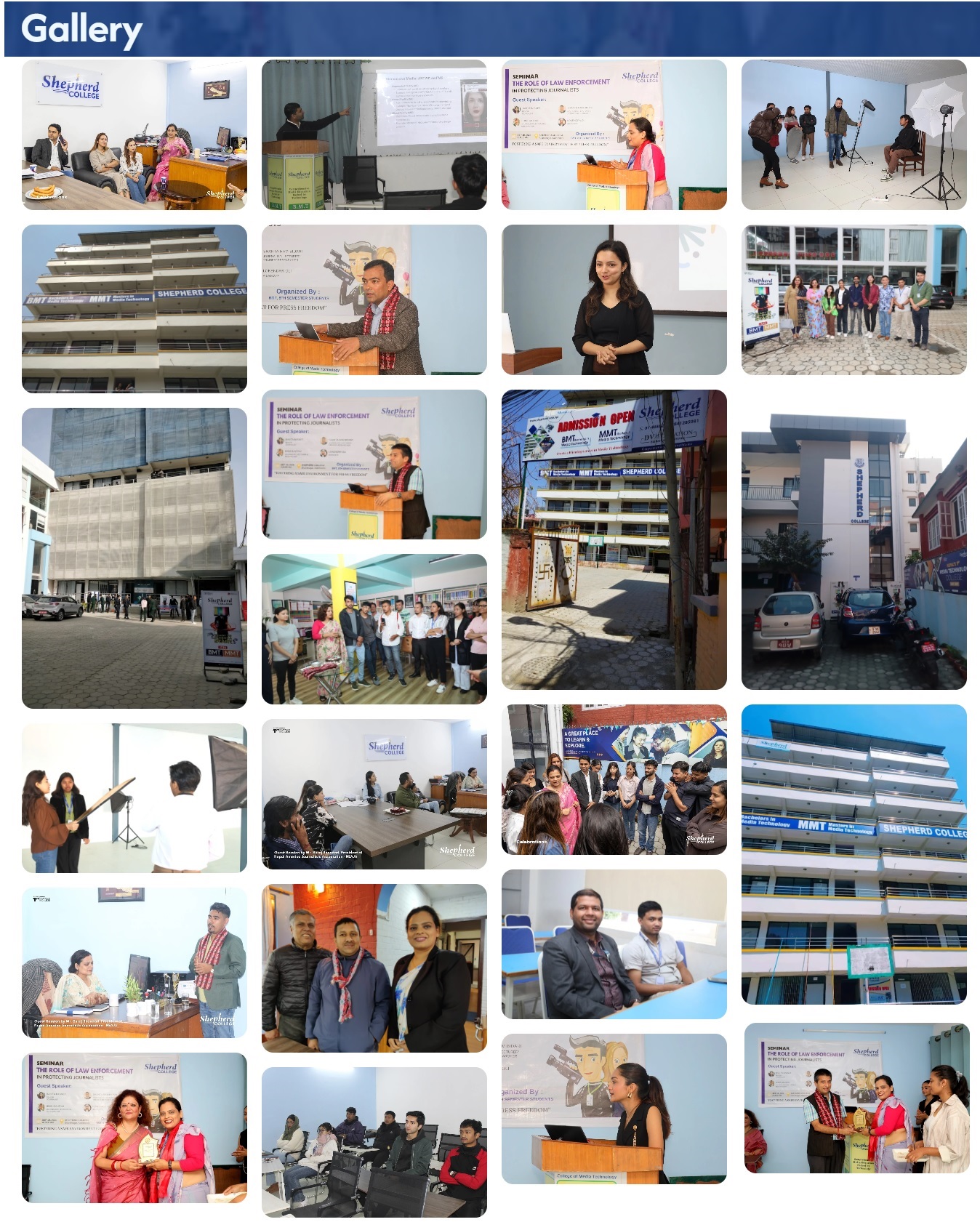
Student life at Shepherd College extends beyond scheduled classroom sessions. Students participate in competitions, clubs, training activities, industry visits, workshops, seminars, and practical assignments related to their programs.
Media students may spend part of their academic time producing, reporting, recording, photographing, editing, or working on digital content. IT students use computing and technical environments associated with software, networks, databases, and related subjects.
Student clubs provide another setting for participation, collaboration, and leadership activities within the college community.
The college's mission centers on active learning in media and journalism education, supported by technology, practical experience, and resources connected with professional practice.
Its vision focuses on becoming a preferred choice in Nepal for education in Media Technology, Information Technology, and Mass Communication.
Across BMT, BIT, and MMT, the common academic thread is the connection between formal study and practical work. Media production spaces, digital newsroom facilities, laboratories, training activities, and industry interaction are used to support this approach.
Shepherd College of Media Technology is located in Shantinagar, New Baneshwor, Kathmandu.
Location: Shantinagar, New Baneshwor, Kathmandu
Phone: 01-4588274
Email: info@shepherd.edu.np
Website: www.shepherd.edu.np
Shepherd College of Media Technology was established in 2002 A.D. Its academic work began with a focus on media education and later expanded into postgraduate media study and information technology.
The college is located in Shantinagar, New Baneshwor, Kathmandu.
Shepherd College of Media Technology is affiliated with Purbanchal University.
The college offers Bachelor in Media Technology (BMT), Bachelor of Information Technology (BIT), and Master in Media Technology (MMT).
BMT has 48 seats, BIT has 48 seats, and MMT has 33 seats.
Both Bachelor in Media Technology and Bachelor of Information Technology are four-year undergraduate programs.
Facilities include classrooms, a library, media production facilities, a computer lab, a multimedia and animation lab, a digital newsroom, sports facilities, and health and student welfare support.
Yes. Shepherd College of Media Technology is part of the DV Education Group.





-9075.jpg)