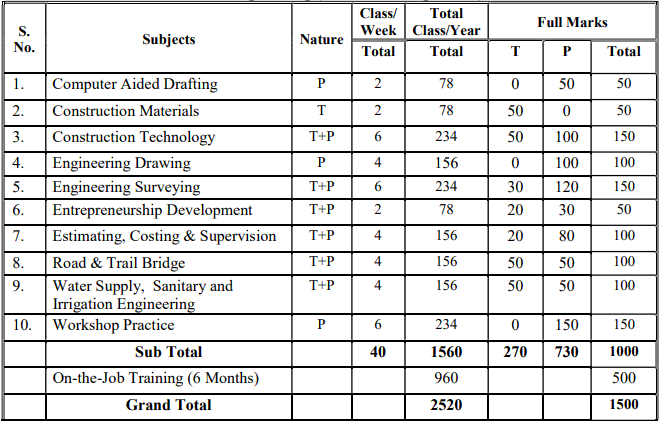
The Chitwan Academy for Technical Education, Bharatpur, Chitwan, offers a Pre-Diploma in Civil Engineering (Civil Sub-Overseer), which is an 18-month vocational training program designed to produce skilled Civil Sub-Overseers who can contribute to Nepal's growing infrastructure sector. Affiliated with the CTEVT, this program equips students with practical knowledge and technical skills in construction engineering, surveying, and infrastructure development. Graduates are prepared to work in building construction, water supply, irrigation, and road and bridge construction or to start their construction ventures.
The program comprises:
18 months of theoretical and practical classes (1560 hours).
6 months of On-the-Job Training (OJT) (960 hours) in real-world construction projects.
The curriculum follows a competency-based approach, with 20% theoretical knowledge and 80% practical training to ensure job readiness.
Applicants must meet the following requirements:
Successful completion of SEE (Secondary Education Examination).
Pass the CTEVT entrance examination.
Submission of:
SEE pass certificate and mark sheet.
Character certificate.
Citizenship certificate for verification.
Special Quotas: Quotas are provided per CTEVT policies, prioritizing female candidates, Dalits, Janjatis, disadvantaged groups (DAGs), conflict-affected individuals, and persons with disabilities.
Application Submission:
Fill out the application form and attach the necessary documents.
Entrance Examination:
Conducted by CTEVT to evaluate academic aptitude.
Selection:
Based on merit list from entrance exam scores.
The curriculum is competency-based, emphasizing practical performance and technical knowledge to meet industry standards.
First Year:
Introduction to Civil Engineering
Engineering Drawing and Graphics
Basics of Construction Materials
Soil Mechanics and Foundation Engineering
Fundamentals of Surveying
Second Year:
Structural Mechanics
Water Supply and Sanitation
Road and Bridge Construction
Irrigation Systems
Construction Management
On-the-Job Training (OJT):
Hands-on experience in surveying, construction supervision, and project management.
The program aims to:
Train students to be competent civil sub-overseers capable of delivering services for civil engineering projects.
Equip students with skills for surveying, drawing, and supervising construction works.
Foster entrepreneurship for self-employment opportunities in construction and infrastructure development.
Contribute to poverty alleviation by creating a skilled workforce for employment in Nepal and abroad.
Interactive Lectures: Covering theoretical aspects of civil engineering.
Practical Training: Focused on hands-on application of construction techniques.
Field Visits: Real-world exposure to construction sites and projects.
Project-Based Learning: Solving real construction challenges through group projects.
E-Learning Resources: Access to online tools and digital resources.
Graduates of the program will:
Conduct detailed surveying for construction projects.
Prepare engineering drawings for small-scale projects.
Supervise construction works for buildings, roads, bridges, water supply, and irrigation systems.
Use construction materials and tools efficiently.
Manage construction projects at the local level.
Demonstrate knowledge of safety standards and environmental considerations in construction.
Graduates can explore various opportunities for career advancement and higher education:
Further Studies:
Diploma in Civil Engineering.
Bachelor's programs in Civil Engineering or Construction Management.
Professional Opportunities:
Employment in government and private construction companies.
Work with NGOs/INGOs on infrastructure development projects.
Self-employment in construction and consulting services.
Graduates can pursue roles such as:
Civil Sub-Overseer
Survey Technician
Site Supervisor
Construction Estimator
Infrastructure Project Assistant
Potential Employers:
Government bodies (e.g., Department of Roads).
Private construction firms and consultancies.
NGOs/INGOs involved in rural development.
International opportunities in construction and infrastructure development.
CTEVT mandates 10% of seats as free scholarships for deserving students. Scholarships may also be available for:
Merit-based achievements.
Candidates from underrepresented groups.
CTEVT is subject to institutional policies.
Participation in technical workshops and seminars.
Field visits to construction sites and infrastructure projects.
Community service programs to develop rural infrastructure.
Academic competitions and project exhibitions.
The program emphasizes:
Hands-on training through OJT in construction projects.
Real-world problem-solving in infrastructure development.
Exposure to advanced tools and techniques in civil engineering.
It promotes sustainable construction practices.
It contributes to rural development by training a skilled workforce.
It supports poverty alleviation through job creation and self-employment.
Key skills developed include:
Surveying and mapping.
Construction supervision and management.
Engineering drawing and design.
Communication and teamwork in project settings.
The curriculum aligns with international civil engineering standards, preparing graduates for global infrastructure projects and construction consulting opportunities.
Modern laboratories for construction material testing.
On-site workshops for practical training.
Digital resources for design and engineering software.
Hostel and transportation facilities for students.
Practical, hands-on curriculum tailored to Nepal's infrastructure needs.
High demand for skilled sub-overseers in public and private sectors.
Opportunities for employment in Nepal and abroad.
This program is ideal for individuals who:
Who are interested in infrastructure development and construction.
Enjoy problem-solving and working in outdoor settings.
Seek practical, hands-on learning experiences.
Over the next 15–20 years, the demand for civil sub-overseers will grow due to:
Increasing infrastructure development in Nepal.
Expansion of road networks, water supply, and sanitation systems.
Rising global demand for skilled construction professionals.
To excel in civil engineering:
Spend time in labs and on construction sites.
Maintain well-structured notes and review them regularly.
Participate in group projects to learn teamwork.
Familiarize yourself with engineering software and tools.
Learn from experienced professionals in the field.