The Chitwan Academy for Technical Education offers Pre-Diploma in Veterinary Science is an 18-month program designed to produce skilled Junior Technical Assistants (JTA) capable of providing veterinary clinical services, livestock management, and extension services. Offered under the affiliation of the Council for Technical Education and Vocational Training (CTEVT), the program empowers students with practical skills and knowledge to contribute effectively to Nepal's agriculture and livestock sectors, which form a significant portion of the nation's economy.
This program addresses the growing demand for trained agro-veterinary technicians in government organizations, NGOs/INGOs, and private enterprises.
The program is structured into:
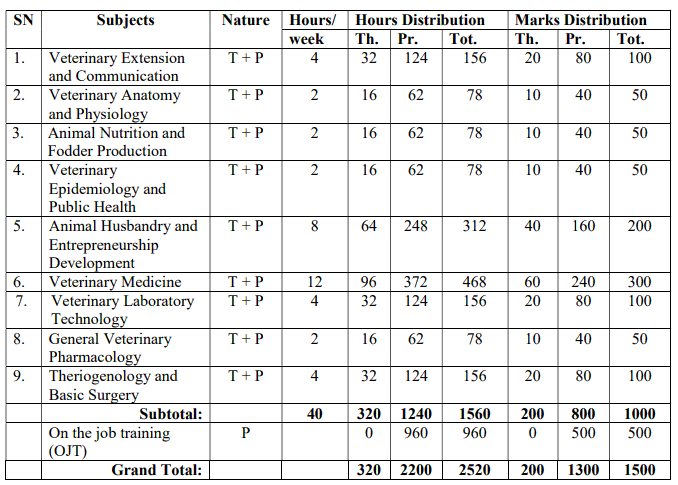
18 months of academic coursework, comprising 1560 hours of classroom and practical sessions.
6 months (960 hours) of On-the-Job Training (OJT) in veterinary clinics, hospitals, and field settings.
Total Duration: 2 years (including OJT).
Applicants must meet the following requirements:
Successful completion of SEE (Secondary Education Examination).
Pass the CTEVT entrance examination.
The final selection of students is based on the merit list.
Required Documents:
SEE pass mark sheet and certificate.
Character certificate.
Citizenship certificate for verification purposes.
Special quotas apply as per CTEVT policy, with preference given to female candidates, Dalits, Janjatis, conflict-affected individuals, and Disadvantaged Groups (DAGs).
Application Submission:
Complete the application form and attach all required documents.
Entrance Examination:
Administered by CTEVT to assess academic readiness.
Selection:
Based on the merit list from entrance exam scores.
The curriculum is structured to include both core theoretical concepts and hands-on practical skills.
First Year:
Basic Anatomy and Physiology of Livestock
Introduction to Animal Nutrition and Fodder Production
Fundamentals of Veterinary Epidemiology
Basic Microbiology and Parasitology
Principles of Livestock Management
Second Year:
Animal Diseases: Diagnosis, Treatment, and Management
Basics of Poultry Farming and Management
Veterinary Pharmacology and Toxicology
Reproductive Health: Gynaecology and Obstetrics
Fundamentals of Surgery and Clinical Practice
On-the-Job Training (OJT):
Field visits and internships in veterinary clinics, research labs, and community settings.
The program aims to:
Equip students with veterinary clinical skills to manage livestock health and production.
Develop expertise in diagnosing and treating animal diseases.
Promote knowledge about animal nutrition and scientific livestock farming.
Train graduates to handle simple surgical and gynecological cases.
Prepare professionals to provide veterinary extension services and educate communities on public health.
Interactive Lectures: Facilitating foundational knowledge in veterinary science.
Hands-On Training: Practical sessions in laboratories and clinics.
Field Visits: Exposure to real-world livestock farming practices.
Case-Based Learning: Tackling common veterinary challenges through case studies.
E-Learning Support: Digital resources for self-paced learning.
Graduates of the program will:
Perform basic diagnostic and treatment procedures for livestock and poultry.
Provide nutrition advice and fodder production techniques to farmers.
Manage veterinary extension services for community development.
Diagnose and treat common animal diseases.
Handle simple surgical and reproductive cases in livestock.
Assist in public health initiatives to mitigate veterinary epidemiological hazards.
The Pre-Diploma in Veterinary Science offers diverse career and academic opportunities:
Further Studies:
Diploma in Veterinary Science.
Bachelor's programs in Animal Science or Veterinary Technology.
Professional Opportunities:
Work as a Junior Technical Assistant (Veterinary-JTA) in government, NGOs, or private sectors.
Self-employment in livestock health services or entrepreneurial ventures in farming.
Graduates can pursue roles such as:
Veterinary Assistant in clinics and hospitals.
Livestock Health Advisor for farming communities.
Field Technician in animal husbandry and poultry industries.
Research Assistant in animal health and nutrition projects.
Entrepreneur in veterinary practices or livestock management.
Potential Employers:
Government agencies (e.g., Department of Livestock Services).
NGOs/INGOs focusing on agriculture and livestock development.
Private veterinary clinics and farms.
International opportunities, such as Israel-based agricultural projects.
CTEVT provides 10% of seats as free scholarships for deserving candidates. Additional scholarships may be available for:
Merit-based achievements.
Underrepresented groups, including women and disadvantaged communities.
CTEVT determines the Fee structure.
Fees are subject to institutional policies and government regulations.
Participation in livestock health camps.
Community outreach programs to educate farmers.
Academic seminars on animal health and sustainable farming practices.
Inter-institutional competitions and events.
The program emphasizes practical application through:
Hands-on clinical training in accurate veterinary setups.
Problem-solving for livestock health issues in rural and urban settings.
Participation in public health initiatives to prevent zoonotic diseases.
Contributes to sustainable agriculture by enhancing livestock productivity.
Promotes animal welfare and public health awareness.
Empowers rural communities with skills for self-reliance.
Key skills developed include:
Veterinary diagnostics and treatment.
Communication and advisory services for farming communities.
Technical skills in managing livestock health and production.
The curriculum aligns with international veterinary standards, preparing graduates for opportunities in global markets, including research, clinical practice, and agricultural development.
Fully equipped veterinary laboratories.
On-site livestock for practical training.
Library and digital learning resources.
Hostel and transportation facilities for students.
Comprehensive curriculum tailored to Nepal's agricultural needs.
Hands-on training with experienced faculty.
There is a high demand for veterinary technicians in Nepal and abroad.
This program is ideal if you:
Have a dedication to animal health and welfare.
Enjoy practical, hands-on learning.
Want to contribute to agricultural and rural development?
Over the next 15–20 years, the demand for veterinary technicians is projected to grow due to:
Increased livestock production for food security.
Advancements in veterinary medicine and technologies.
Global challenges like zoonotic diseases and climate impact agriculture.
To excel in veterinary science:
Engage in Practical Learning: Spend time in labs and clinics to strengthen your skills.
Stay Organized: Keep notes and review them regularly to reinforce knowledge.
Collaborate: Participate in group discussions and learn from peers.
Stay Updated: Follow the latest advancements in veterinary practices and technologies.
Seek Mentorship: Regularly consult instructors or professionals for guidance.