The Chitwan Academy for Technical Education, Bharatpur, Chitwan, offers a Certificate in Medical Laboratory Technology (CMLT) program, a unique three-year vocational education course, and is affiliated with the Council for Technical Education and Vocational Training (CTEVT). Its comprehensive blend of theoretical knowledge and practical training in diagnostic procedures, laboratory techniques, and healthcare methodologies stands out. This program is designed to prepare students for middle-level roles in the medical laboratory sector, where graduates play a pivotal role in diagnosing, treating, and preventing diseases, forming an essential part of healthcare teams.
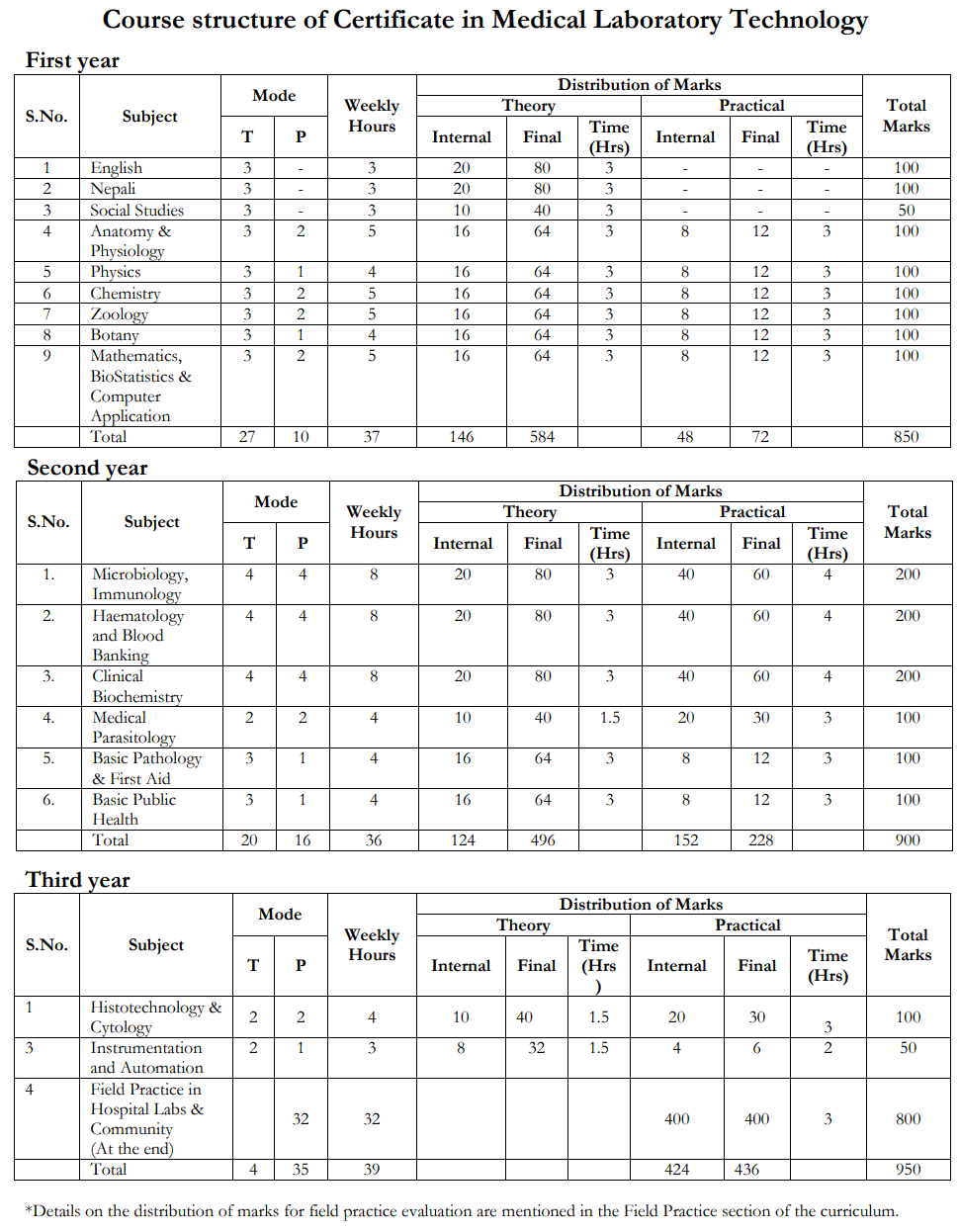
The CMLT program spans three academic years. Each year is structured as follows:
Year 1: Focus on foundational sciences and basic concepts of medical laboratory technology.
Year 2: Introduction to specialized laboratory subjects and hands-on practical learning.
Year 3: Advanced applications and comprehensive real-world training in hospitals and laboratories.
Each academic year includes 39 weeks, with 32–37 hours of coursework per week.
To be eligible for the CMLT program, candidates must meet the following criteria:
Minimum Grade C in Mathematics, English, and Science with a GPA of at least 2.0 in the School Leaving Certificate (SLC) examination.
For TSLC (Technical SLC) graduates, a first division in Lab Technology is required.
Candidates must pass the CTEVT entrance examination.
Applicants must follow these steps:
Submit Required Documents:
SLC/TSLC pass certificates
Character certificate
Citizenship certificate
Physical fitness certificate
Entrance Examination:
Administered by CTEVT, the entrance exam evaluates candidates' academic readiness.
Quota Policy:
Reserved seats are available based on CTEVT policies, such as scholarships for specific categories.
The curriculum includes core and elective subjects, with a balanced path to theoretical knowledge and practical skills.
First Year:
Basic Anatomy and Physiology
General Chemistry
Basic Microbiology
Medical Ethics and Professionalism
Second Year:
Clinical Biochemistry
Hematology and Blood Banking
Advanced Microbiology
Laboratory Management and Safety
Third Year:
Diagnostic Pathology
Histology and Cytology
Immunology and Serology
Internship and Project Work
The CMLT program is designed to:
Train students in routine and specialized diagnostic laboratory procedures.
Develop skills for quality control, reagent preparation, and laboratory management.
Enable graduates to establish and manage medical laboratories at primary and district levels.
Support research initiatives and assist healthcare professionals with reliable diagnostic data.
Interactive Learning: Combines lectures, group discussions, and presentations.
Practical Training: Hands-on laboratory sessions and internships in healthcare settings.
Case Studies: Real-world problem-solving to enhance critical thinking.
E-Learning: Use of multimedia resources for enhanced understanding.
Upon completion of the program, graduates will be able to:
Perform routine and advanced diagnostic tests with accuracy.
Prepare reagents and maintain laboratory equipment.
Ensure quality control in medical laboratories.
Collaborate with healthcare teams to provide accurate diagnostic data.
Apply technical and analytical skills in laboratory management.
Graduates can pursue:
Employment in hospitals, diagnostic centers, and research laboratories.
Self-employment through private laboratory setups.
Further education in:
Bachelor of Medical Laboratory Technology (BMLT)
Bachelor of Public Health (BPH)
MBBS
Potential roles for CMLT graduates include:
Medical Laboratory Technician
Pathology Assistant
Diagnostic Lab Supervisor
Research Assistant in medical and pharmaceutical labs
Industries that hire CMLT graduates:
Healthcare (hospitals, nursing homes, diagnostic centers)
Research and Development
Public Health Organizations
Pharmaceutical Companies
CTEVT mandates that 10% of seats in every program are reserved as free scholarships for deserving students. Additional financial aid may be available through:
Merit-based scholarships
Community service grants
Need-based financial assistance
The CTEVT determines the Fee structure.
Note: Fees may vary based on institutional policies.
Students can participate in:
Health awareness campaigns
Community service programs
Workshops on laboratory safety and ethics
Intercollegiate academic competitions
The CMLT program emphasizes practical training through:
Internships in hospitals and diagnostic labs
Case studies based on real-world medical scenarios
Exposure to advanced diagnostic equipment
Graduates contribute to:
Enhanced healthcare access in underserved areas.
Reduced healthcare costs through efficient diagnostic services.
Public health awareness and preventive care.
Key skills gained include:
Analytical thinking
Technical proficiency in laboratory equipment
Communication and teamwork
Problem-solving abilities in diagnostic settings
The CMLT curriculum aligns with international standards, preparing graduates for research, diagnostics, and public health opportunities abroad.
Air-conditioned classrooms and laboratories
51-bed practical training hospital
A well-stocked library and e-learning resources
Hostel and canteen facilities
Renowned faculty with extensive experience.
Comprehensive curriculum combining theory and practice.
High employability with opportunities in Nepal and abroad.
This program is ideal for students with:
A passion for healthcare and diagnostics.
Strong analytical and observational skills.
A desire to contribute to public health.
Over the next 15–20 years, demand for skilled medical lab technicians is expected to grow due to:
Advancements in diagnostic technology.
Increased emphasis on preventive healthcare.
Rising global healthcare challenges.
Effective study tips for CMLT students:
Set Clear Goals: Divide tasks into manageable segments.
Create a Schedule: Allocate specific hours for studying and practice.
Active Learning: Engage with materials through discussions and practice tests.
Seek Help: Approach instructors for clarifications and guidance.
Stay Organized: Keep track of assignments, exams, and deadlines.