The Chitwan Academy for Technical Education, Bharatpur, Chitwan, offers a re-Diploma in Agriculture (Plant Science - Agriculture JTA), an 18-month program designed to prepare skilled Junior Technical Assistants (JTAs) in agriculture. Affiliated with CTEVT, the program equips students with the knowledge, skills, and approach required to meet Nepal's growing demand for trained agriculture professionals. This curriculum emphasizes sustainable farming practices, crop management, and entrepreneurship, enabling graduates to contribute effectively to the country's predominantly agriculture-based economy.
The program consists of:
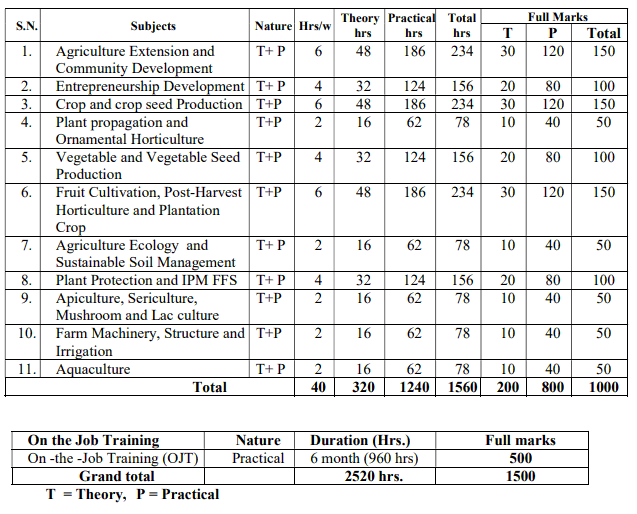
18 months of classroom instruction and practical sessions, totaling 1560 hours.
6 months (960 hours) of On-the-Job Training (OJT) in farms, research institutions, and agricultural businesses.
The total duration of the course is 2 years (including OJT).
Applicants must fulfill the following requirements:
After completing the Secondary Education Examination (SEE).
Pass the CTEVT entrance examination.
Submit the following documents:
SEE pass certificate and mark sheet.
Character certificate.
Citizenship certificate for verification purposes.
Special Quotas: Quotas apply per CTEVT policies, prioritizing female candidates, Dalits, Janjatis, conflict-affected individuals, and disadvantaged groups (DAGs).
Application Submission:
Complete the application form and attach all required documents.
Entrance Examination:
Conducted by CTEVT to assess academic readiness.
Selection:
Based on the merit list from the entrance exam scores.
The curriculum includes theoretical knowledge with practical training to ensure a well-rounded education.
First Year:
Introduction to Agriculture
Fundamentals of Soil Science
Basics of Crop Science
Agricultural Tools and Mechanization
Agriculture Economics and Farm Management
Second Year:
Plant Protection and Pest Management
Sustainable Farming Practices
Seed Science and Technology
Post-Harvest Technology
Agro-Entrepreneurship and Marketing
On-the-Job Training (OJT):
Field training in crop management, pest control, and sustainable farming techniques.
The program aims to:
Train students in sustainable crop production and management practices.
Develop skills for soil and plant health management.
Promote entrepreneurship in agriculture.
Equip graduates to support community-level agricultural development.
Foster the ability to apply scientific knowledge to practical agricultural challenges.
Interactive Lectures: Covering fundamental and advanced topics in agriculture.
Field Visits: Practical exposure to farming practices and agribusiness operations.
Hands-On Training: Focus on using modern tools, machinery, and techniques.
Case Studies: Real-life problem-solving in agriculture.
E-Learning Resources: Multimedia tools and online content for enhanced learning.
Graduates of this program will be able to:
Apply scientific farming techniques to improve crop yield.
Manage soil health and conduct soil testing.
Protect crops from pests and diseases using sustainable methods.
Utilize agricultural tools and machinery effectively.
Advise farmers on best practices in crop management and post-harvest technology.
Start and manage their agribusiness ventures.
The program offers a variety of opportunities for academic and professional growth:
Further Studies:
Diploma in Agriculture
Bachelor's programs in Agricultural Science or Agribusiness
Professional Opportunities:
Work as an Agriculture JTA in government or private sectors.
Employment in agricultural research institutions.
Self-employment in agribusiness and farming.
Graduates can pursue roles such as:
Agricultural Extension Worker
Soil and Crop Technician
Pest Control Specialist
Farm Manager
Agribusiness Entrepreneur
Potential Employers:
Government bodies like the Department of Agriculture.
NGOs and INGOs focused on rural development.
Private farms and agribusinesses.
International opportunities in agricultural research and sustainable farming.
CTEVT mandates 10% of seats as free scholarships for deserving students. Additional financial aid may be available for:
Merit-based achievements.
Candidates from underrepresented groups.
Fees are subject to institutional policies and government regulations.
Participation in agricultural fairs and exhibitions.
Community service programs for rural farmers.
Academic seminars on sustainable agriculture and entrepreneurship.
Hands-on workshops in crop management and farm mechanization.
The program emphasizes practical knowledge through the following:
On-the-job training in farms and research centers.
Exposure to modern farming techniques and tools.
Problem-solving in real agricultural settings.
It promotes sustainable agriculture and environmental conservation.
It enhances food security through scientific farming practices.
It empowers rural communities with agricultural knowledge and skills.
Key skills developed include:
Practical farming and crop management techniques.
Analytical skills for soil and plant health evaluation.
Communication and advisory services for farmers.
Entrepreneurial skills for agribusiness development.
The program aligns with international standards in agriculture, preparing graduates for opportunities in global markets, including research, agribusiness, and sustainable farming initiatives.
Modern laboratories for soil and plant analysis.
On-site farms for practical training.
Library and digital learning resources.
Hostel and transportation facilities for students.
Comprehensive curriculum tailored to Nepal's agricultural needs.
Practical training with experienced faculty.
There is high demand for agricultural technicians in Nepal and abroad.
This program is ideal if you:
Are passionate about agriculture and rural development.
Enjoy practical, hands-on learning experiences.
Seek a career that contributes to food security and sustainability.
Over the next 15–20 years, the demand for skilled agriculture technicians is expected to rise due to:
Increasing focus on food security and sustainability.
Advancements in farming technologies.
The need for innovative solutions to climate-related agricultural challenges.
To excel in plant science:
Spend time on farms and in labs to deepen your understanding of concepts.
Regularly read about advancements in agriculture and crop science.
Keep concise notes and review them frequently.
Learn from experienced farmers and instructors.
Share knowledge and experiences to enhance learning.