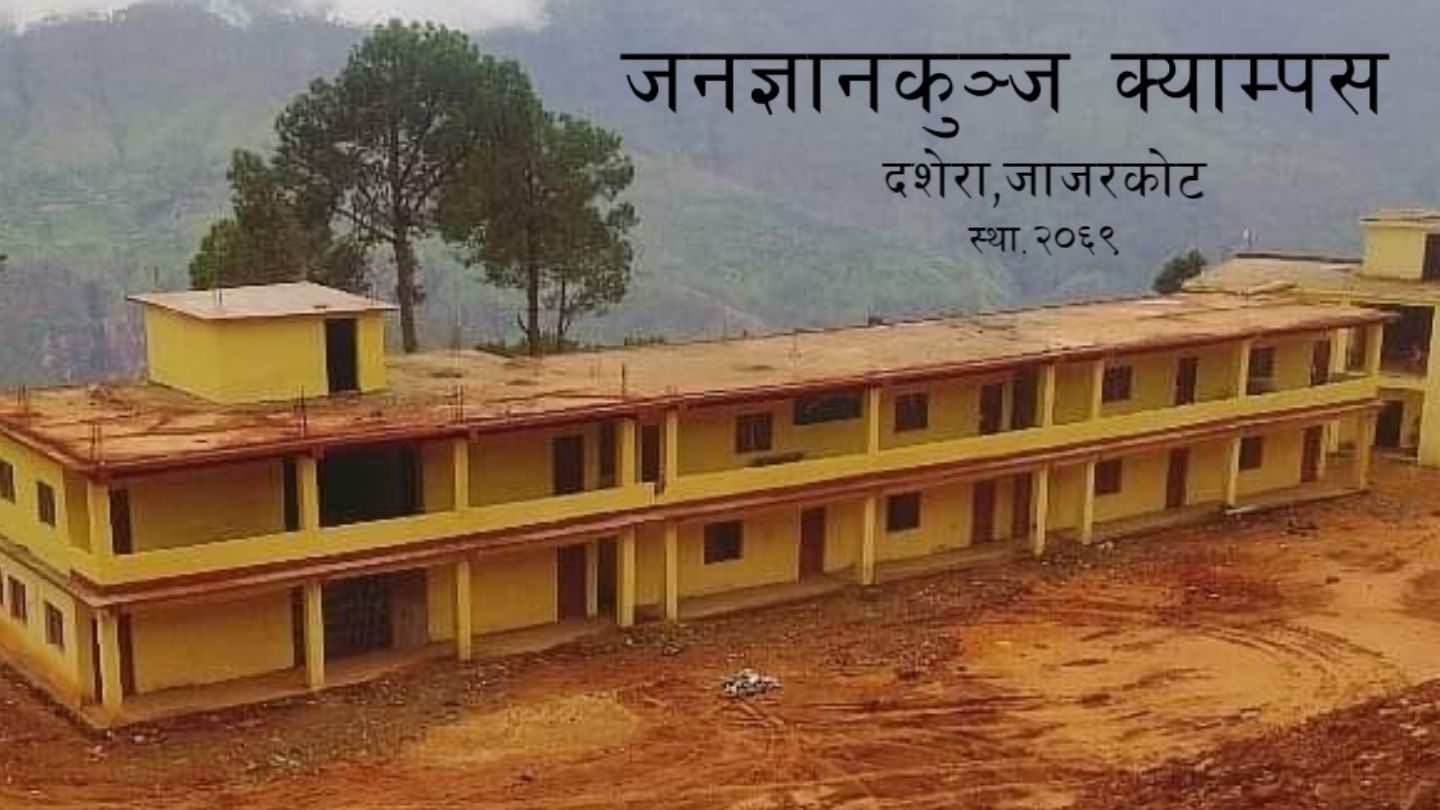
The Master of Education (M.Ed.) at Janagyankunj Campus is a two-year, four-semester program affiliated with Tribhuvan University. The campus is located in Chhedagad Municipality-03, Dashera, Jajarkot, Karnali Province, Nepal, and is approved by the University Grants Commission (UGC) of Nepal.
Janagyankunj Campus introduced the M.Ed. program under the Faculty of Education after receiving affiliation approval from Tribhuvan University on 2078/09/18 BS. Class operation began on 2079/10/25 BS. The program gives students in Jajarkot access to postgraduate study in education through a community-based campus.
Program: Master of Education (M.Ed.)
College: Janagyankunj Campus
Location: Chhedagad Municipality-03, Dashera, Jajarkot
Affiliation: Tribhuvan University
Approval: University Grants Commission (UGC), Nepal
Academic area: Faculty of Education
Duration: Two years
Academic system: Four semesters
M.Ed. approval date: 2078/09/18 BS
M.Ed. class operation date: 2079/10/25 BS
Curriculum components: core courses, specialization courses, teaching practice or practicum, and thesis writing
Student support: scholarship distribution for economically and socially disadvantaged communities
The TU M.Ed. program follows the semester system and carries 69 credit hours. It includes professional core courses, specialization courses, teaching practice or practicum, and thesis writing.
Core professional courses: 21 credit hours
Specialization courses: 39 credit hours
Teaching Practice / Practicum: 3 credit hours
Thesis Writing: 6 credit hours
Total: 69 credit hours
Duration: 24 months, four semesters
Core courses include areas such as Foundations of Education, Advanced Educational Psychology, Curriculum Practices, Education and Development, Research Methodology in Education, Measurement and Evaluation in Education, and Contemporary Educational Issues.
Specialization areas under the TU Faculty of Education M.Ed. curriculum include Curriculum and Evaluation, Educational Planning and Management, English Education, Nepali Education, Science Education, Mathematics Education, Health Education, Physical Education, Economics Education, Geography Education, History Education, Political Science Education, Special Needs / Inclusive Education, and Information and Communication Technology Education.
Prepare students for advanced academic study in education.
Build professional knowledge for teaching, educational planning, administration, supervision, and research.
Develop understanding of education policy, pedagogy, curriculum, evaluation, and educational research.
Connect theory with practice through teaching practice, practicum, assignments, seminars, case studies, field studies, and thesis work.
Support advanced subject study through specialization areas under the Faculty of Education.
The M.Ed. program is relevant for students who want to continue postgraduate study in education after completing an eligible bachelor’s degree or equivalent education-related qualification. At Janagyankunj Campus, the program has local significance because it allows students in Jajarkot to pursue master’s level education within their own district context.
The program supports advanced study in educational theory, specialization subjects, research, teaching practice, and thesis writing. It is suited for students preparing for academic, teaching, administrative, supervisory, and research-related roles in the education sector.
Understand advanced concepts in education and pedagogy.
Study educational research methods and academic writing.
Develop subject knowledge through a selected specialization area.
Complete assignments, seminars, case studies, and field-based academic work.
Engage in teaching practice or practicum according to TU Faculty of Education requirements.
Prepare and complete thesis work under the M.Ed. curriculum.
Follow TU semester-system academic, evaluation, examination, and result procedures.
Educational research
Academic writing
Curriculum analysis
Measurement and evaluation
Pedagogical planning
Seminar presentation
Field-study preparation
Thesis development
Teaching practice or practicum readiness
Subject-specialization knowledge
Teaching and learning at Janagyankunj Campus mainly use lecture and discussion methods. The campus has arranged subject-specific lecturers for its subjects. Practical activities have also included project work in subject-specific learning.
The TU M.Ed. curriculum includes lecture sessions, project work, assignments, seminars, case studies, field studies, teaching practice or practicum, and thesis work.
Lecture sessions
Discussion-based learning
Project work
Assignments
Seminars
Case studies
Field studies
Teaching practice or practicum
Thesis writing
School-level teaching roles
Education administration roles
Educational planning and management roles
Supervision-related education roles
Research-related education work
Teacher training and education support roles
Further academic study in education
Work in public, community, or non-government education sectors
Scholarship distribution has helped students from economically and socially disadvantaged communities access education.
The campus has identified scholarship distribution as part of its student support and social participation work.
Admission notice is published by the concerned campus, department, institute, or Dean’s Office.
Eligible applicants submit the prescribed application form.
Admission may include an entrance examination depending on the program.
A merit list or selection result may be published by the concerned authority.
Selected students submit required documents and pay the prescribed admission fee.
Final enrollment is completed according to TU rules and the schedule of the respective campus, department, institute, or faculty.
Students with B.Ed. or Post-Graduate Diploma in Education from Tribhuvan University or a recognized university are eligible for admission to the M.Ed. program. Subject-specific requirements apply for different specialization areas under the TU Faculty of Education curriculum.
Bachelor’s Degree Transcript / Marksheet
Bachelor’s Degree Certificate or Provisional Certificate
Character Certificate from the bachelor-level institution
Migration Certificate, if the bachelor’s degree is from another university
Transfer Certificate from the previous campus or college
Citizenship Certificate or Birth Certificate copy
Passport-size photographs
Entrance Examination Scorecard, if required by the program or faculty
Completed Admission/Application Form
Admission Fee Payment Receipt
Equivalence Certificate, if the bachelor’s degree is from a foreign university
The M.Ed. program follows the semester system of Tribhuvan University. Entrance, admission, course curriculum, examinations, and results follow TU rules, guidelines, and the applicable academic calendar.
Student performance during semester teaching and learning activities carries 40 percent of the total evaluation mark of each subject. At the end of each semester, students appear in semester-end examinations conducted by the Office of the Dean. Practice Teaching / Practicum and Thesis are practical in nature, and final examinations for these courses are conducted by the Dean’s Office of the Faculty of Education.
The Master of Education (M.Ed.) at Janagyankunj Campus is a TU-affiliated postgraduate program under the Faculty of Education. It follows a two-year, four-semester structure with core courses, specialization courses, teaching practice or practicum, and thesis writing.
For students in Jajarkot, the program provides a local route to postgraduate education in the field of education through a UGC-approved community campus affiliated with Tribhuvan University.
The M.Ed. program at Janagyankunj Campus follows the two-year, four-semester system of Tribhuvan University.
The M.Ed. program at Janagyankunj Campus is affiliated with Tribhuvan University.
M.Ed. classes began on 2079/10/25 BS after affiliation approval from Tribhuvan University on 2078/09/18 BS.
Students with B.Ed. or Post-Graduate Diploma in Education from Tribhuvan University or a recognized university are eligible. Subject-specific requirements apply for different specialization areas.
The curriculum includes core professional courses, specialization courses, teaching practice or practicum, and thesis writing.
Scholarship distribution has supported students from economically and socially disadvantaged communities at the campus.