B.Tech Food Technology, Lalitpur Valley College (LVC), Jawalakhel, Lalitpur is a four-year Tribhuvan University (TU) affiliated bachelor’s program that started at the college in 2005 and follows a defined course structure for bachelor-level study.
Food Technology studies food as a material, then studies what happens to it during handling, processing, storage, packaging, and distribution. The course links science and real processing practice so you can understand how safe, nutritious, stable food products are produced and supplied for consumers.
Many students choose this program because they want a science-based degree with laboratory work, field exposure, and project writing. LVC sets the learning pattern around experiments, industry visits, in-plant training, and fourth-year project work with a dissertation.
Four-year degree course (total 2000 marks)
Cross-disciplinary coverage that includes food chemistry, microbiology, enzymes, nutrition, processing, storage, analysis, quality control, operations research, and food plant management
Learning approach based on visuals, experiments, presentations, case studies, group discussion, seminars, guest lectures, and regular visits to industrial and institutional sites
45 days in-plant training in food-industry related companies
Fourth-year project work and dissertation, supported by laboratory work during the project period
Two-month training after graduation on selected lab instruments and lab quality topics (UV/HPLC/FTIR, GC/GCMS, ISO 17025:2005, laboratory accreditation)
LVC lists the following year-wise course areas for Food Technology.
Students start with core science subjects that later support food processing and lab testing.
Physics
Chemistry
Mathematics & Statistics
Instrumental Techniques of Analysis
Basics of Food Microbiology
Basic Principles of Engineering
A student scenario helps here. You may feel confident in theory, then feel stuck during early lab reporting. This first year builds your base so you can read lab results, write observations, and handle measurement tools with care.
Second year shifts closer to food materials and processing systems.
Food Chemistry
Principles of Food Processing
Food Engineering
Biochemistry & Human Nutrition
TFP I (Cereals, Legumes, Oilseed & Protein foods)
This stage often decides your comfort level in the field. Students who keep lab notes clean and revise small concepts regularly usually manage practical work more smoothly.
Third year expands product groups and adds stronger industrial and quality control focus.
TFP-II (Fruits & Vegetables, Chocolates & Sugar Confectionary, Tea, Coffee & Spices)
TFP-III (Meat, Fish & Poultry)
Biochemical Engineering
Industrial Microbiology
Food Quality Control & Analysis
Students often start connecting course topics to everyday products at this level. You begin noticing how processing steps affect shelf life, safety risks, and packaging choices.
Fourth year brings plant-level topics and the required academic outputs.
Storage & Packaging Technology
Operation Research & Food Plant Management
Dairy Technology
Dissertation
In-Plant Training & Class Seminar
Fourth year usually feels heavier because you are managing research writing, field learning, and final academic evaluation at the same time. Clear planning matters.
The program aims include the following learning goals:
Knowledge in food science and principles behind food processing
Wider knowledge in advanced food engineering
Familiarity with industrial management practices
Training in product-specific specialization areas
These goals matter for students because Food Technology work is rarely only “lab work” or only “factory work.” The job often needs both technical accuracy and process understanding.
Food production and distribution, including agriculture and dairy-related services, are major economic activities in Nepal, and they create demand for qualified food technologists and specialists in the wider food supply system.
Food Technology also connects with public needs such as safe processing, quality control, and stable packaging for distribution. If you are a student who wants applied science with real products and real systems, this field stays relevant across industries.
Students who complete the program are expected to build capability in areas that the course content covers at LVC, such as:
Understanding food composition and how food behaves under processing and storage conditions
Using knowledge from chemistry, microbiology, enzymes, nutrition, and analysis for food-related problem solving
Applying quality control and food analysis concepts in practical settings
Understanding packaging, distribution, and plant management topics at an applied level
A realistic outcome is confidence with documentation. Lab work, project writing, and dissertation preparation can strengthen your ability to record results, explain methods, and present findings clearly.
LVC’s Food Technology learning pattern includes specific activities that build skills beyond exam preparation.
The learning approach uses visuals and experiments, and students work in laboratories during project periods.
This supports skills such as measurement accuracy, observation writing, hygiene discipline, and handling instruments safely.
Presentations, case studies, and group discussions are part of the learning method. Seminars and guest lectures also support student interaction with working professionals.
These activities help when you need to present a project, explain results, or write a dissertation in a clear structure.
Regular visits to industrial manufacturing sites, regulatory institutions, marketing, and related institutional sites are included.
The 45 days in-plant training program places students in food-industry related companies for practical exposure.
After graduation, a two-month training (free of cost) is listed on selected lab instruments and lab quality topics, including UV/HPLC/FTIR, GC/GCMS, ISO 17025:2005, and laboratory accreditation.
This is relevant if your career interest is lab testing, compliance-based laboratory work, or roles where standard procedures and documentation matter.
Food Technology learning at LVC uses a mix of lecture-based classes and practical methods.
Visual learning and experiments
Presentations, case studies, and group discussions
Seminars and guest lectures
Regular site visits to industry and related institutions
In-plant training, project work, and dissertation writing
Students often feel pressure when they first face real lab routines. A steady routine helps: read the practical manual early, write notes the same day, and ask questions before the next lab session. This approach supports your learning without panic before exams.
Eligibility points listed for admission include:
Second division I.Sc from Tribhuvan University, or certificate level Food Technology from CTEVT, and +2 Science with final grade “C” in English, Math, Physics, and Chemistry
I.Sc or +2 (Science) and certificate level Food Technology or Laboratory Technology from Tribhuvan University or a TU-recognized institute
Selection is based on merit in the entrance examination.
If you are preparing for admission, focus on your science base and basic numerical ability. Entrance performance matters for selection, so routine revision helps more than last-minute reading.
The following job roles are listed as career options connected with the field:
Production Supervisor
Food Safety Inspector
Public Health Officer
Operation Manager
Quality Safety Scientist
Your exact role depends on your skills, project exposure, and the type of organization you join. Students who build strength in lab work, reporting, and practical exposure tend to adjust faster in technical workplaces.
Scholarship support is listed for college toppers and intelligent students from socially marginalized and economically deprived families.
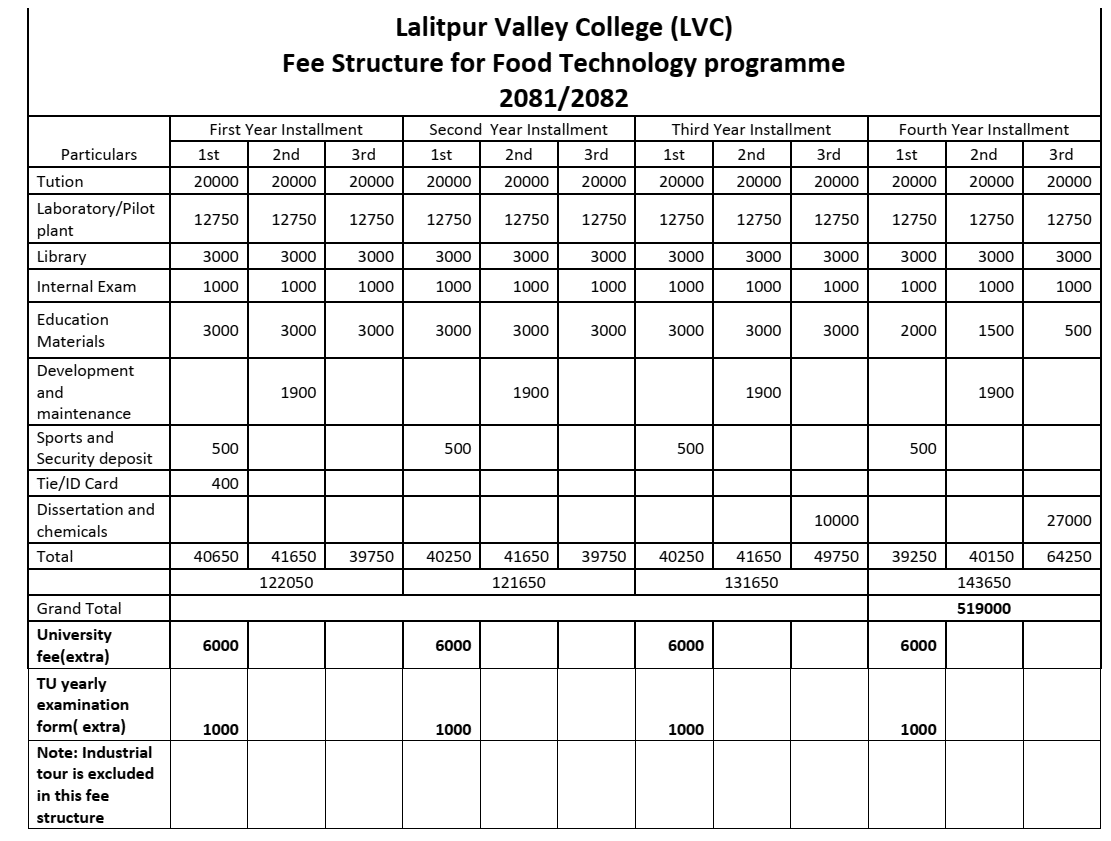
Students and parents should confirm the latest scholarship rules and fee details during admission inquiry because yearly policies can change.
B.Tech Food Technology fits students who want applied science and practical learning connected with real products and real systems.
The course includes lab-focused learning, field visits, and in-plant training, which helps you understand how classroom concepts connect to workplaces.
Fourth-year project work and dissertation build research habits and professional writing habits that matter for jobs and further study.
B.Tech Food Technology at Lalitpur Valley College (LVC), Jawalakhel is a TU-affiliated four-year program introduced at the college in 2005, built around food science, food processing, laboratory work, and applied management topics.
The learning structure includes experiments, presentations, seminars, site visits, 45 days in-plant training, and fourth-year dissertation work.
If you want a science-based degree connected to food industries and laboratory systems, this program gives a clear study pathway with practical exposure.
The program runs for four years and is listed as a 2000 marks degree course.
Learning includes visuals, experiments, presentations, case studies, group discussion, seminars, guest lectures, site visits, in-plant training, and fourth-year project work with dissertation.
Yes. A 45 days in-plant training program in food-industry related companies is included.
Year-wise course areas include science and analysis tools in first year, food chemistry and processing in second year, product technologies and quality control in third year, and packaging, plant management, dairy technology, dissertation, and in-plant training in fourth year.
Eligibility includes second division I.Sc from TU or certificate level Food Technology from CTEVT with +2 Science grade “C” in English, Math, Physics, and Chemistry, along with selection by entrance merit. Another eligibility line includes I.Sc/+2 (Science) and certificate level Food Technology/Laboratory Technology from TU or a TU-recognized institute.
Listed roles include Production Supervisor, Food Safety Inspector, Public Health Officer, Operation Manager, and Quality Safety Scientist.
A two-month training after graduation is listed on UV/HPLC/FTIR, GC/GCMS, ISO 17025:2005, and laboratory accreditation.