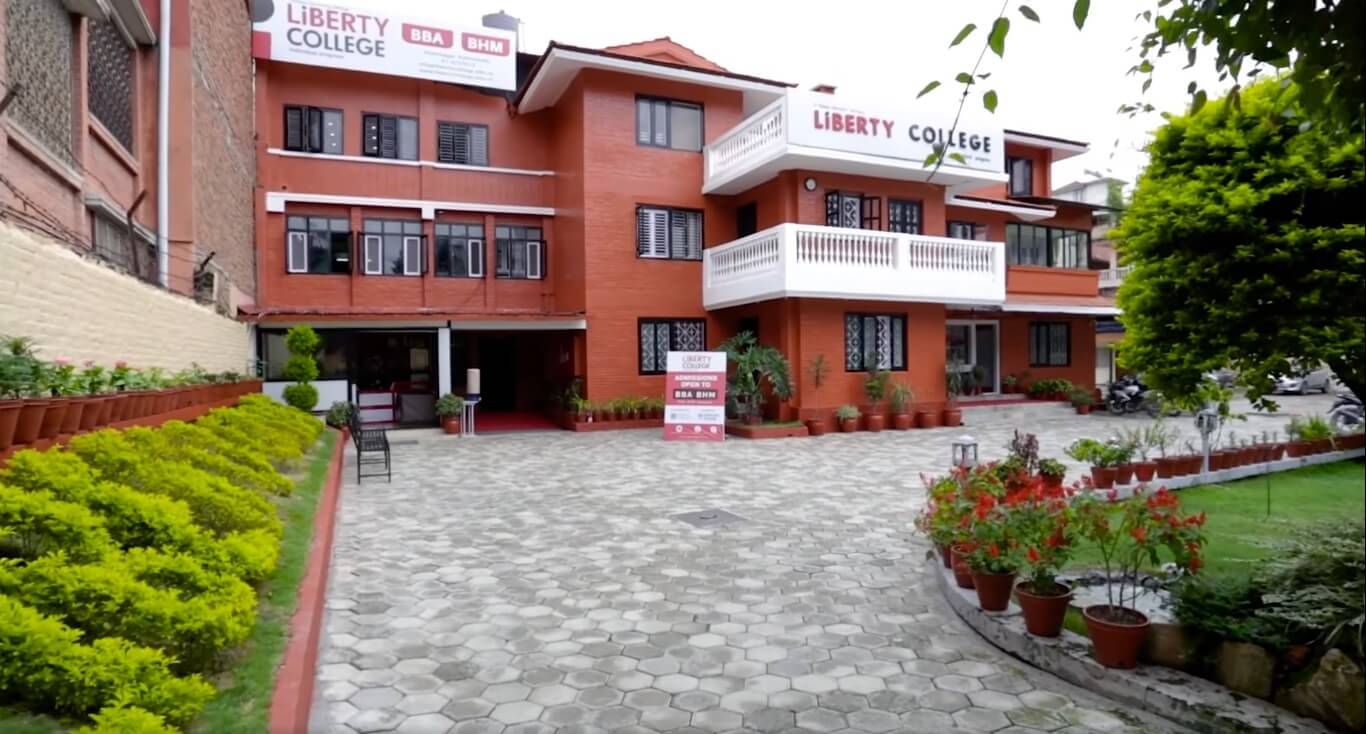
The Bachelor of Hotel Management (BHM) at Liberty College, Anamnagar, Kathmandu, is a four-year undergraduate program affiliated with Pokhara University. Offered under the Faculty of Management Studies, the program combines hospitality operations with management education, practical training, project work, specialization and elective study, and extended industry exposure.
The program runs across eight semesters and requires 120 credit hours for graduation. Liberty College has 48 seats for BHM.
| Particular | Details |
|---|---|
| Course | Bachelor of Hotel Management (BHM) |
| College | Liberty College |
| Location | Anamnagar, Kathmandu |
| Affiliation | Pokhara University |
| Faculty | Faculty of Management Studies |
| Level | Bachelor |
| Duration | 4 years |
| Semesters | 8 |
| Total Credits | 120 |
| Seats | 48 |
| Medium | English |
| Internship | 48 weeks across Semesters VII and VIII |
BHM begins with hospitality-specific operational subjects from the first semester rather than postponing them until later years. Students start with food production and patisserie, food and beverage service, accommodation operations, tourism and hospitality, and hospitality communication.
The second year continues the practical hotel-management sequence while adding hospitality statistics, accounting and costing, management information systems, and hospitality marketing. The fifth semester shifts further toward management through financial management, hospitality human resources, entrepreneurship, research methodology, and behavioral science in hospitality management.
Semester VI is built around project work, specialization, and elective choices. The final two semesters are reserved for internship.
| Semester | Main Courses | Credits |
|---|---|---|
| I | Business Communication for Hospitality Industry; Food Production and Patisserie I Theory and Practical; Food and Beverage Service I Theory and Practical; Accommodation Operations I Theory and Practical; Fundamental of Tourism and Hospitality | 19.5 |
| II | Food Hygiene & Nutrition; Food Productions and Patisserie II Theory and Practical; Food and Beverage Service II Theory and Practical; Accommodation Operations II Theory and Practical; Foundation of Management | 19.5 |
| III | Hospitality Statistics; Food Productions and Patisserie III Theory and Practical; Food and Beverage Service III Theory and Practical; Room Division Management I Theory and Practical; Introduction to Management Information System | 19.5 |
| IV | Hospitality Accounting and Costing; Food Productions and Patisserie IV Theory and Practical; Food and Beverage Service IV Theory and Practical; Room Division Management II Theory and Practical; Hospitality Marketing | 19.5 |
| V | Fundamentals of Financial Management; Hospitality Human Resources Management; Fundamentals of Entrepreneurship; Research Methodology; Behavioral Science in Hospitality Management | 15 |
| VI | Project Work; Specialization I; Specialization II; Elective I; Elective II | 15 |
| VII | Internship | 6 |
| VIII | Internship | 6 |
The semester totals add up to 120 credits.
The curriculum gives more than half of its academic credits to hotel-management core study and internship.
| Curriculum Component | Credits |
|---|---|
| Foundation Courses | 12 |
| Core Management Courses | 27 |
| Core Hotel Management Courses | 54 |
| Specialization Courses | 6 |
| Elective Courses | 6 |
| Project Work | 3 |
| Internship | 12 |
| Total | 120 |
Core Hotel Management Courses account for 54 credits, making hospitality operations the largest single component of the degree.
BHM is structured around both classroom study and operational practice. Core hotel-management areas such as food production, food and beverage service, room division, and accommodation operations carry separate theory and practical components during the earlier semesters.
A typical hotel-management core theory course carries 3 credits with 48 class hours, while associated practical components carry 1.5 credits with 24 hours. Foundation and management core courses generally carry 3 credits.
Practical study develops progressively. Students begin with introductory food production, service, and accommodation operations and continue through more advanced operational work in later semesters.
At Liberty College, BHM learning also includes practical activities connected with food production, confectionery, food and beverage service, front office work, accommodation operations, and room division.
Semester VI includes two specialization courses.
For Specialization I, students select one of:
Advanced Food and Beverage Management
Advanced Accommodation Operation
For Specialization II, students select one of:
Advanced Food Production Management
Advanced Room Division Management
Each specialization course carries 3 credits, giving the specialization component a total of 6 credits.
These choices allow students to give greater attention to either food-related operations or accommodation and room-division management during the later stage of the academic program.
Students also complete two elective courses in Semester VI.
Elective I includes a choice between:
Strategic Management
Tourism Business Environment
Elective II includes options such as:
Hotel Engineering and Management
Event Management
Casino Management and Inflight Catering
Bakery and Confectionery
The two elective courses contribute 6 credits to the degree.
Project Work is placed in Semester VI and carries 3 credits.
The project serves as a capstone academic component before students move into the internship phase. Students can prepare a business plan related to a hotel, resort, bakery, restaurant, coffee shop, theme park, or similar hospitality venture, or undertake a research paper in an area of tourism and hospitality.
The completed work is presented before a panel that may include college teachers and industry professionals.
The project therefore brings together research, planning, hospitality knowledge, and presentation within a single academic requirement.
A substantial portion of the final year is devoted to internship. Students undertake 48 weeks of industrial exposure across Semesters VII and VIII, carrying 6 credits in each semester and 12 internship credits in total.
Placement may be in fine-dining restaurants or three- to five-star hotels and resorts. Depending on the placement and assigned responsibilities, students may gain exposure to areas such as:
Food production
Food and beverage service
Room division
Accommodation operations
Front desk
Events
Bakery
Other hospitality operations
Students work under departmental managers or supervisors and maintain structured observations and reports during the internship. A mid-term internship report is submitted at the end of Semester VII, followed by final evaluation after Semester VIII.
This makes internship considerably more prominent in the BHM curriculum than in programs where organizational exposure is limited to a shorter placement period.
Applicants must have completed one of the following qualifications recognized by Pokhara University:
Intermediate level
Higher Secondary Level (10+2)
Proficiency Certificate Level (PCL)
Equivalent qualification
The minimum academic requirement is either:
CGPA 1.80 with at least a D grade in each subject, or
45 percent or second division.
Applicants must also pass the entrance test conducted by the concerned college.
Liberty College uses the Liberty College Admission Test (LCAT) as part of its admission process. Shortlisted candidates may also be called for a personal interview, with previous academic performance considered during final selection.
For BHM admission, applicants are required to complete the prescribed application process and submit academic documents.
Pokhara University's BHM admission requirements include:
Completed and signed BHM application form
Official transcripts from previously attended academic institutions
Properly attested photocopies of academic certificates
Eligible applicants proceed to the entrance examination, while an interview may also form part of final selection.
Liberty College has 48 seats for BHM.
The university curriculum supports lectures with several other teaching methods, including:
Case studies
Group discussions
Project assignments
Presentations
Field visits
Demonstrations
Practical work
Individual course outlines also use methods such as discussion, question-answer sessions, brainstorming, lab work, project work, and fieldwork.
This matters particularly in BHM because operational subjects require students to work with procedures and practical tasks as well as theoretical concepts.
Assessment generally combines internal evaluation with semester-end examination.
For many theory courses:
Semester-end examination carries 50 marks.
Internal evaluation carries 50 marks.
Internal assessment may include assignments, quizzes, attendance, class participation, presentations, projects, field activities, and term examinations depending on the course.
Practical courses use assessment patterns suited to operational work and may include practical examination and viva, task evaluation, hygiene and grooming, teamwork, hospitality etiquette, attendance, and quizzes.
Students must secure at least 45 percent in internal evaluation and maintain at least 80 percent class attendance to qualify for the semester-end examination.
The BHM curriculum gives students repeated academic and practical exposure to areas including:
Hospitality communication
Food production and patisserie
Food and beverage service
Accommodation operations
Room division management
Tourism and hospitality concepts
Food hygiene and nutrition
Hospitality accounting and costing
Hospitality marketing
Management information systems
Financial management
Hospitality human resource management
Entrepreneurship
Research methodology
Hospitality-focused behavioral science
Project planning and presentation
Students also work with teamwork, customer-facing service procedures, operational coordination, research, and workplace reporting through practical courses, projects, and internship.
BHM may suit students whose academic interests extend beyond general business management into hospitality operations.
The course involves significant practical study in food production, food and beverage service, accommodation, and room division. Students should therefore consider whether they are comfortable with a program that combines classroom study with demonstrations, practical work, field activities, operational assignments, and a long internship.
It can be particularly relevant to students interested in the management and operation of hotels, restaurants, catering services, accommodation departments, food-service operations, events, tourism and hospitality businesses, or related service organizations.
Pokhara University's program objectives include preparing graduates for supervisory responsibilities in hotel and catering operations and developing the technical, social, and managerial abilities required in hospitality work. The curriculum also includes entrepreneurship as part of its academic direction.
Depending on individual skills, internship experience, specialization, and recruitment requirements, graduates may explore work related to:
Hotel operations
Food production
Food and beverage operations
Front office
Accommodation and room division
Catering operations
Hospitality supervision
Event-related hospitality work
Bakery and food-service operations
Tourism and hospitality businesses
Hospitality entrepreneurship
Career outcomes vary according to experience, practical ability, location, employer requirements, and available opportunities. The degree covers several operational and management areas rather than preparing every graduate for one fixed position.
The structure of BHM differs noticeably from a general management degree. The first four semesters contain repeated theory-and-practical sequences in food production, food and beverage service, accommodation operations, and room division. The fifth semester introduces more management-oriented study, while the sixth allows specialization and elective choices.
The seventh and eighth semesters then move completely into internship.
For students comparing BHM with another bachelor-level management program, this balance is important. BHM places much more academic time on hospitality operations, practical assessment, service environments, and extended industrial exposure.
The BHM program takes four academic years and is divided into eight semesters.
Students must complete 120 credit hours covering foundation courses, management courses, hotel-management core courses, specialization courses, electives, project work, and internship.
Liberty College has 48 seats for the Bachelor of Hotel Management program.
BHM at Liberty College is affiliated with Pokhara University and follows the curriculum of its Faculty of Management Studies.
Applicants need Intermediate, Higher Secondary Level (10+2), PCL, or an equivalent qualification recognized by Pokhara University. They need a minimum CGPA of 1.80 with at least a D grade in each subject, or 45 percent/second division, and must pass the concerned college's entrance test.
Yes. Food production, food and beverage service, accommodation operations, and room-division subjects include separate practical components during the earlier semesters.
Yes. Project Work is included in Semester VI and carries 3 credits. Students undertake a hospitality-related business plan or research project and present their work.
The curriculum provides 48 weeks of industrial exposure across the seventh and eighth semesters. Internship carries 12 credits in total.
Specialization choices cover Advanced Food and Beverage Management or Advanced Accommodation Operation, followed by Advanced Food Production Management or Advanced Room Division Management.
Students need at least 80 percent attendance and must secure the required minimum in internal evaluation to qualify for the semester-end examination.