The Bachelor of Education (B.Ed.) at Namuna Bageshwori Multiple Campus, Dhading is a four-year, full-time undergraduate program offered under the Tribhuvan University (TU) annual system. The program prepares future educators to teach two subject areas at the secondary level through a structured combination of communication skills, professional education foundations, specialization coursework, and supervised teaching practice.
Students complete a planned pathway of core education courses alongside a specialization major and a specialization minor, then finish with a Teaching Internship/Practicum. At the campus, learning is supported through core academic services such as a library, computer lab, multimedia-supported instruction, journal access, counseling, and student activities that strengthen confidence and communication.
Course Name: Bachelor of Education (B.Ed.)
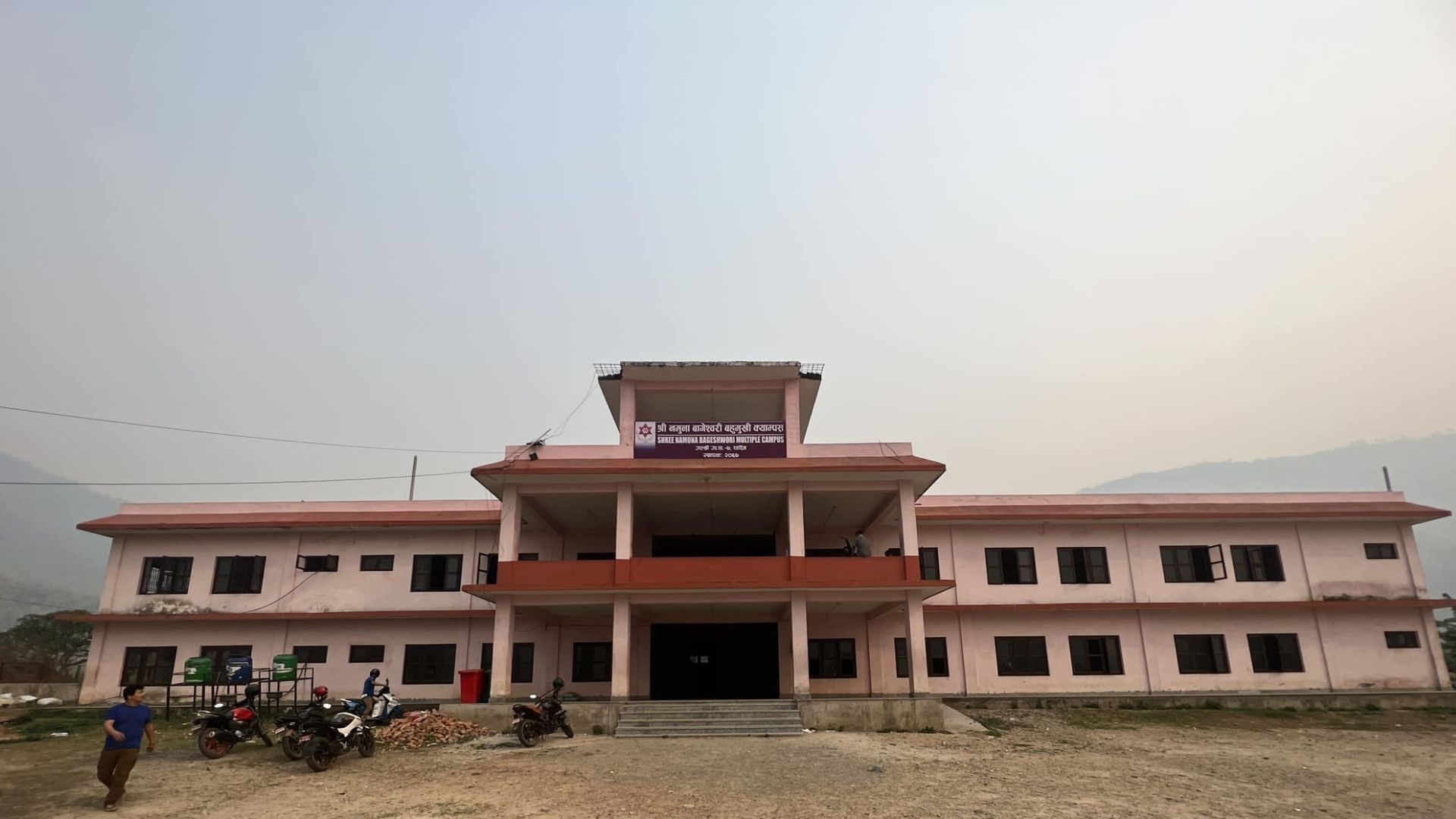
College: Namuna Bageshwori Multiple Campus, Dhading
Location: Galchhi Rural Municipality–6, Baireni Bazar, Dhading, Nepal
Affiliation: Tribhuvan University (TU), Faculty of Education
Duration: 4 years (Annual system)
Study Mode: Full-time
Program Requirement: 22 courses, 2200 full marks
Specialization Model: 1 Major subject area + 1 Minor subject area (different from the major)
Teaching Component: Teaching Internship/Practicum (1 course, 100 marks)
Contact: +977-9860397266, +977-9851048250
B.Ed. at Namuna Bageshwori Multiple Campus builds the academic and professional foundation needed for school teaching and related education roles. The annual structure supports steady subject progression across four academic years. Students develop classroom communication skills, strengthen understanding of learners and learning, learn curriculum and evaluation practices, and deepen subject-specific pedagogy through specialization courses.
The campus environment supports study routines, group learning, and presentation work through access to basic learning facilities and guidance services.
The four-year B.Ed. program includes 22 courses grouped into five areas (A–E). Total marks are distributed year-wise as:
First Year: 600
Second Year: 600
Third Year: 500
Fourth Year: 500
General Nepali
General English
Philosophical and Sociological Foundations of Education
Educational Psychology
Curriculum and Evaluation
One elective from:
Ed. 442 Instructional Technology, or
Ed. 443 ICT in Education, or
Ed. 444 ICT in Specialized Subject
Students select one major specialization area with 10 courses. Major options include:
Nepali Language Education
English Language Education
Mathematics Education
Science Education
Health and Physical Education
Population Education
Geography Education
Economics Education
History Education
Political Science Education
Students select one minor specialization area with 5 courses, different from the major. Minor options include:
Nepali Language Education, English Language Education, Mathematics Education, Science Education
Health Education, Physical Education, Population Education
Geography Education, Economics Education, History Education, Political Science Education
Primary Education*, Early Childhood Development Education*, Vocational Education*, Non-Formal Education*, Education Management*
*Course preparation status depends on TU implementation.
A key rule applies for Science Education (Physical Science) majors: Biology is selected as the minor subject.
Teaching Internship/Practicum is a dedicated component of the program and carries 100 marks. It is the program’s practical teaching requirement and forms an important part of professional preparation.
B.Ed. admission is open to students who have passed Grade 12/HSE (Higher Secondary Education) or PCL (or an equivalent level). Entry requirements vary by major specialization area. Examples include:
Nepali Education: Grade 12/HSE or PCL with Nepali major (minimum 200 marks)
English Education: English/Linguistics background or 50% in General English; an entrance examination route applies in some cases
Mathematics Education: Mathematics major (minimum 200 marks)
Science Education: Physics, Chemistry, and Biology with at least 100 full marks in each
Health and Physical Education: Health & Physical Education background, or related backgrounds; physical fitness testing may apply
Population Education: Accepted from several related backgrounds such as Population Studies, Geography, Economics, Health/PE, Science, Mathematics, and others
Geography/Economics/Political Science/History Education: Grade 12/HSE or PCL from any faculty
Students benefit from core campus services that support study, lesson preparation, and academic writing:
Library and journal access
Computer lab and multimedia-supported learning
Counseling and scholarship support
Classrooms and conference hall
Sports, dance, and extracurricular activities
B.Ed. supports career pathways in school teaching, education support roles, tutoring and learning support, and participation in education-related projects and community learning initiatives. The major–minor model strengthens subject readiness for classroom practice and creates a foundation for further study in education and related fields.
B.Ed. runs for four academic years under the TU annual system.
Students complete 22 courses with a total of 2200 full marks.
Yes. Students study one specialization major and one specialization minor, and the minor must be different from the major.
Major options include Nepali, English, Mathematics, Science, Health and Physical Education, Population, Geography, Economics, History, and Political Science Education.
Yes. The program includes Teaching Internship/Practicum as a separate course carrying 100 marks.
Applicants must have passed Grade 12/HSE, PCL, or an equivalent level. Major-wise entry requirements apply for some subject areas.