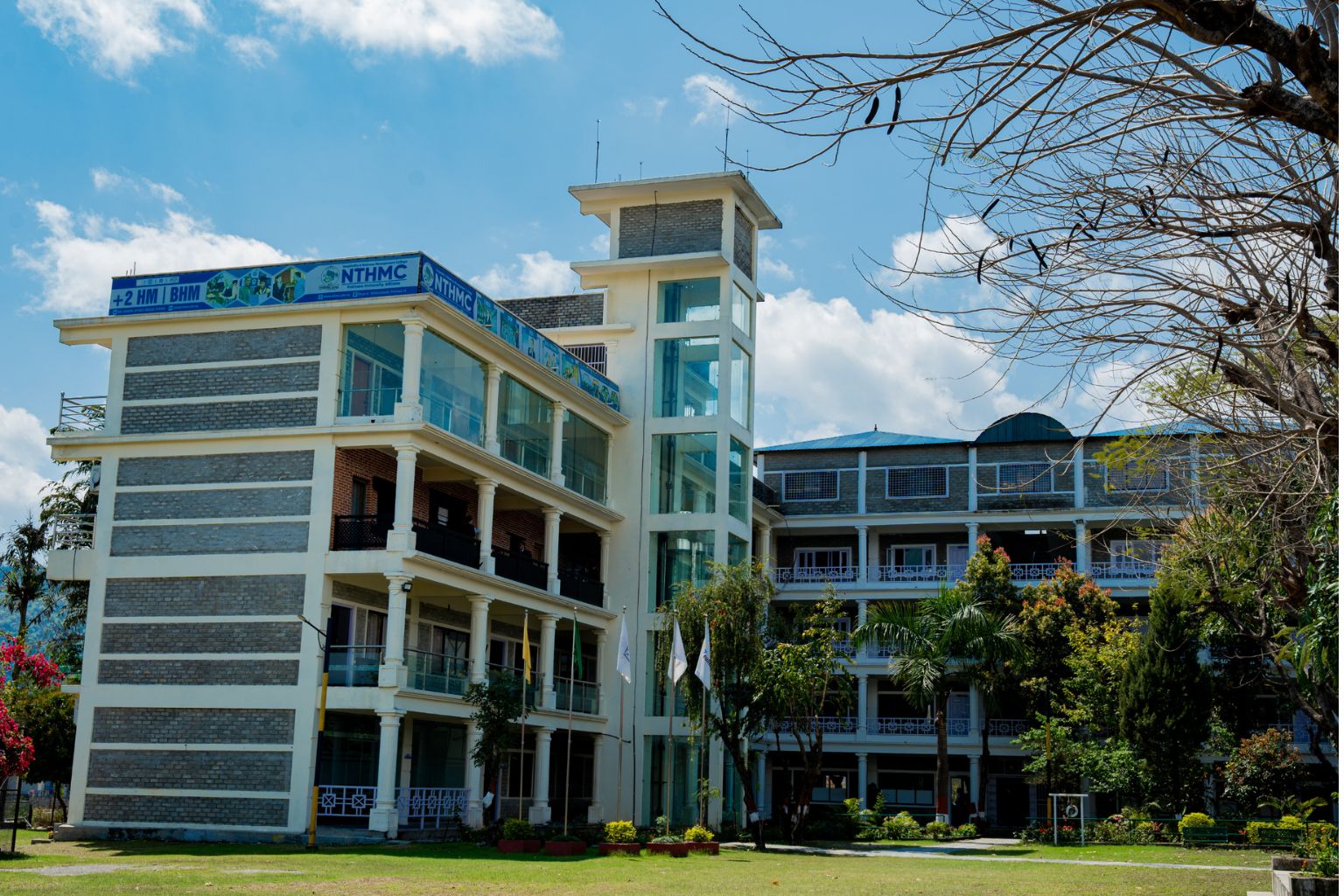
The Bachelor of Hotel Management (BHM) at Nepal Tourism and Hotel Management College (NTHMC), Pokhara is a four-year undergraduate hospitality management program. It is conducted at the Hotel Management Campus in Chhinedanda, Pokhara-14, and is affiliated with Pokhara University.
The program runs for eight semesters and requires 120 credit hours. Its structure combines hospitality operations, management subjects, laboratory practice, specialization and elective courses, project work, and 48 weeks of industrial exposure during the seventh and eighth semesters.
| Particular | Details |
|---|---|
| Course: | Bachelor of Hotel Management (BHM) |
| Level: | Bachelor's Degree |
| Duration: | 4 Years |
| Semesters: | 8 |
| Total Credits: | 120 |
| Affiliation: | Pokhara University |
| College: | Nepal Tourism and Hotel Management College |
| Campus: | Chhinedanda, Pokhara-14 |
| Medium: | English |
| Seats: | 96 |
| Project Work: | 3 Credits |
| Internship: | 12 Credits across Semesters VII and VIII |
The normal duration is four years or eight semesters, while the maximum period permitted for completion is eight years.
The BHM curriculum combines hotel operations with business and management study. Students begin with food production, food and beverage service, accommodation operations, tourism and hospitality, and communication. Management subjects become more prominent as the program progresses, while practical hotel-operation courses continue through the first four semesters.
Later study includes hospitality accounting, marketing, finance, human resource management, entrepreneurship, behavioral science, research methodology, specialization courses, electives, project work, and internship.
Pokhara University's curriculum allocates the 120 credits as follows:
| Curriculum Component | Credits |
|---|---|
| Foundation Courses | 12 |
| Management Core Courses | 27 |
| Hotel Management Core Courses | 54 |
| Specialization Courses | 6 |
| Elective Courses | 6 |
| Project Work | 3 |
| Internship | 12 |
| Total | 120 |
Hotel management core courses carry a substantial practical component. Food Production, Food and Beverage Service, Room Division, and Accommodation Operations include separate theory and practical courses during the early stages of the degree.
| Semester | Main Courses | Credits |
|---|---|---|
| I | Business Communication for Hospitality Industry; Food Production and Patisserie I Theory & Practical; Food and Beverage Service I Theory & Practical; Accommodation Operations I Theory & Practical; Fundamental of Tourism and Hospitality | 19.5 |
| II | Food Hygiene & Nutrition; Food Productions and Patisserie II Theory & Practical; Food and Beverage Service II Theory & Practical; Accommodation Operations II Theory & Practical; Foundation of Management | 19.5 |
| III | Hospitality Statistics; Food Productions and Patisserie III Theory & Practical; Food and Beverage Service III Theory & Practical; Room Division Management I Theory & Practical; Introduction to Management Information System | 19.5 |
| IV | Hospitality Accounting and Costing; Food Productions and Patisserie IV Theory & Practical; Food and Beverage Service IV Theory & Practical; Room Division Management II Theory & Practical; Hospitality Marketing | 19.5 |
| V | Fundamentals of Financial Management; Hospitality Human Resources Management; Fundamentals of Entrepreneurship; Research Methodology; Behavioral Science in Hospitality Management | 15 |
| VI | Project Work; Specialization I; Specialization II; Elective I; Elective II | 15 |
| VII | Internship | 6 |
| VIII | Internship | 6 |
The first four semesters each carry 19.5 credits. Semester V and Semester VI each contain 15 credits, followed by six internship credits in each of the final two semesters.
Semester VI allows students to move from broad hospitality study into selected advanced areas.
The specialization options are:
Advanced Food and Beverage Management
Advanced Accommodation Operation
Advanced Food Production Management
Advanced Room Division Management
Students take two specialization courses for a total of six credits.
Elective options include:
Strategic Management
Tourism Business Environment
Hotel Engineering and Management
Event Management
Casino Management and Inflight Catering
Bakery and Confectionery
Students complete six credits from the elective component.
Eligibility: Applicants must have completed Intermediate, Higher Secondary level (10+2), Proficiency Certificate Level (PCL), or an equivalent qualification recognized by Pokhara University.
The minimum academic requirement is either:
A minimum CGPA of 1.80, with at least a D grade in each subject; or
45% marks or second division.
Applicants must also pass the entrance test conducted by the concerned college.
Eligible applicants are informed about the entrance test after their applications are reviewed. The college may also conduct an interview as part of the final selection process.
Required application documents include:
Completed and signed BHM application form
Official transcripts from previously attended academic institutions
Properly attested photocopies of academic certificates
Admission is completed after the required formalities are fulfilled.
BHM students at NTHMC study at the Chhinedanda campus, where the hospitality facilities include a Food Production Lab, Bakery & Confectionery area, F&B Service Lab, Front Office Lab, library, computer lab, accommodation block, seminar hall, and sports and recreation facilities.
These facilities relate directly to several areas of the curriculum. Food production and patisserie, food and beverage service, accommodation operations, room division management, bakery, and related hospitality subjects contain practical or applied components.
For example, the practical Food Production and Patisserie curriculum includes workstation preparation, equipment handling, cooking techniques, menu preparation, and practical cuisine work.
Project Work is a three-credit component in Semester VI. Students undertake an independent capstone assignment involving fieldwork and empirical analysis.
The project is intended to develop experience in research, data collection, processing, analysis, and report writing. Students work under an assigned supervisor after approval of their project proposal.
The project may involve a business plan connected with a hotel, resort, bakery, restaurant, coffee shop, theme park, or research in a tourism and hospitality area. Students also present their work as part of the project process.
Internship occupies the seventh and eighth semesters and carries 12 credits in total, with six credits assigned to each semester.
The curriculum provides for 48 weeks of industrial exposure. Students may work in one or several hospitality departments, including:
Food Production
Food and Beverage Service
Room Division
Accommodation Operations
Front Desk
Bakery
Events
Bar
Casino
In-flight Catering
The internship includes workplace observation, assigned responsibilities, reporting, supervisor evaluation, and viva voce. Students submit a mid-term internship report after Semester VII and complete final reporting and evaluation at the end of Semester VIII.
BHM teaching uses lectures together with case studies, group discussions, project assignments, presentations, field visits, demonstrations, practical work, and other suitable methods. English is the medium of instruction and examination.
Academic performance is evaluated internally and through semester-end examinations. Each part carries 50 percent of the evaluation.
Internal assessment may include assignments, quizzes, laboratory work, projects, class participation, presentations, attendance, and term examinations, depending on the nature of the course. Practical subjects use assessment methods suited to practical performance.
Students must secure at least 45 percent in internal evaluation and maintain at least 80 percent attendance to qualify for the semester-end examination.
To complete the BHM degree, a student must:
Earn at least a D grade in each required course
Complete the internship with a Pass grade
Complete all required coursework, project work, and internship
Maintain a minimum CGPA of 2.0
A CGPA of 3.6 or higher qualifies for the BHM degree with distinction, while a CGPA of 3.7 or higher meets the academic threshold stated for the Dean's List.
The curriculum may help students develop abilities related to:
Food production and kitchen operations
Food and beverage service
Accommodation and room division operations
Hospitality accounting and costing
Hospitality marketing
Human resource management
Financial management
Tourism and hospitality operations
Research and report writing
Entrepreneurship and business planning
Hospitality information systems
Teamwork and workplace communication
These areas are developed through a combination of theory, laboratory work, projects, field-based activities, and internship.
The BHM curriculum is designed for work in hotel, catering, tourism, and hospitality operations. Its stated objectives include preparing graduates for supervisory responsibilities in hotel and catering environments and developing the technical, social, and management knowledge required for hospitality operations.
Graduates may explore work across food production, food and beverage service, accommodation operations, room division, front office, events, bakery, and other hospitality functions covered during the degree and internship.
The program also includes entrepreneurship study and aims to develop the knowledge needed to consider small or medium hotel and restaurant ventures. Career outcomes depend on individual skills, academic performance, practical experience, location, and available opportunities.
The BHM takes four years and is divided into eight semesters.
Students must complete 120 credit hours, including coursework, specialization, electives, project work, and internship.
The BHM at Nepal Tourism and Hotel Management College is affiliated with Pokhara University.
The program is conducted at the Hotel Management Campus in Chhinedanda, Pokhara-14.
The stated intake for the BHM program at NTHMC is 96 seats.
Yes. Food Production and Patisserie, Food and Beverage Service, Accommodation Operations, and Room Division Management include practical components during the program.
Yes. Semesters VII and VIII are devoted to internship, carrying 12 credits in total and covering 48 weeks of industrial exposure.
Students must maintain at least 80 percent attendance to qualify for the semester-end examination.