



Rampratap Ramprasad Tamang Janta Multiple Campus (RRTJMC), located in Golbazar, Siraha, offers the Master of Arts in Sociology under the affiliation of Tribhuvan University (TU).
This graduate-level program reflects the vision of late Rampratap Tamang, a devoted social worker who generously donated 12 kathhas of land to establish this campus. Since its inception in 2059 B.S. (2002 AD), RRTJMC has played a pivotal role in advancing education in the region. Today, it produces qualified graduates contributing to diverse sectors in Nepal and abroad.
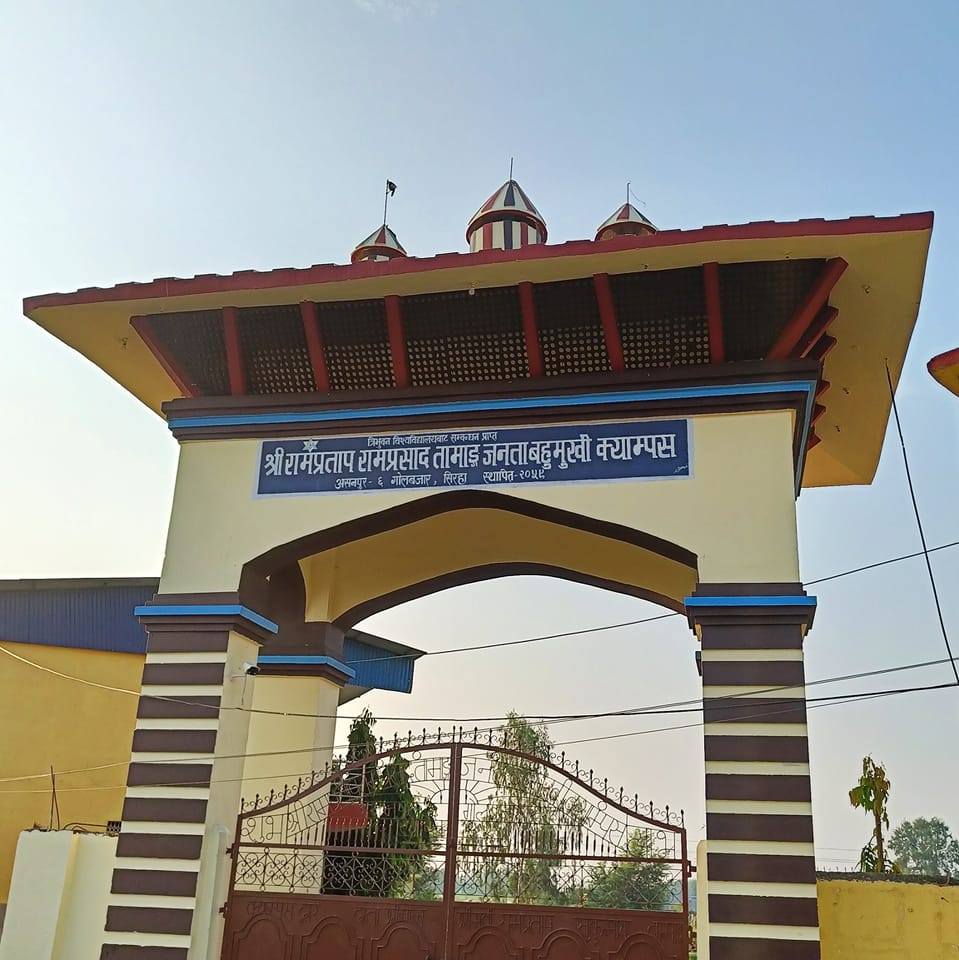
MA in Sociology at RRTJMC is a two-year, four-semester program that explores the structure, function, and dynamics of human societies.
The program emphasizes both theoretical foundations and applied research, providing students with deep insight into sociological thought, human behavior, social institutions, inequality, development, and change.
Provide updated knowledge of sociological theories and research methods.
Train students in fieldwork, data analysis, and sociological writing.
Develop professional skills needed for social research, policymaking, teaching, and development sectors.
Promote values of social justice, equity, and human rights.
Duration: 2 years (4 semesters)
Evaluation System:
Internal Assessment: 40%
Attendance (10 marks)
Class Participation and Presentation (10 marks)
Term Paper (10 marks)
Internal Test (10 marks)
External Examination: 60% (conducted by TU's Dean’s Office)
Practical courses include external practical assessments in labs.
Applicants must have completed a Bachelor's degree in any of the following disciplines:
Sociology, Anthropology, Social Work, Psychology, History, Geography, Political Science, Economics, Home Science, or related Humanities subjects
Degrees from Education, Management, Law, or technical fields such as Medicine, Engineering, Forestry, Agriculture
Candidates must appear for the TU Entrance Exam, which the Faculty of Humanities and Social Sciences conducts.
Admission is granted based on entrance performance and seat availability.
Introduction to Sociology
Qualitative Research Methods
Structural-functional Approach
Caste and Class
Theories of Social Change and Development
Marxist Perspective
Quantitative Research Methods
(Optional – choose 3):
Practice of Social Change in Asia
Politics and Society
Sociology of Health
Household and Family in Transition
World-System Perspective
Basic Statistics in Sociology
(Optional – choose 3):
Sociology of Gender
Identity and Inequality
Migration and Development
Sociology of Ageing
Leadership and Governmentality
Urban Sociology
Sociology of Disaster
Agency vs Structure Perspectives
Survey Research and Computer Data Analysis (Practical)
Thesis
(Optional – choose 1):
Gender, Power, and Sexuality
Changing Livelihoods
Market and Society
Sociology of Education
Sociology of Tourism
Research Design and Writing
Graduates of the MA in Sociology may pursue careers in:
Academia and Research
Social Work and NGOs
Government Policy and Planning
Community Development
Public Health and Education
International Organizations
Skills such as critical thinking, data interpretation, fieldwork, and policy analysis make MA Sociology graduates valuable in addressing complex social challenges.
RRTJMC supports academic excellence with the following facilities:
Well-equipped Library
Computer and Science Laboratories
Modern Multimedia Classrooms
Conference Halls for seminars and discussions
Cafeteria
Counselling Services
Sports and Extracurricular Activities
Educational Tours and Fieldwork
Scholarship Programs for merit-based and marginalized students
Contact Rampratap Ramprasad Tamang Janata Multiple Campus's administrative office for detailed information on the Master of Arts (MA) in Sociology course, including fees, scholarships, facilities, counseling, eligibility criteria, etc.






