



National Earthquake Safety Day: History, Science, and a Roadmap for a Safer Future
Nepal is geographically one of the world’s most earthquake-prone regions. Every year, on Magh 2, we observe “National Earthquake Safety Day.”
This is not merely a formal event or a tradition passed down through generations. It is a technical and social commitment to learn from past wounds and build a safer future.
This day has been observed since B.S. 2055 in remembrance of the devastating mega-earthquake that struck on Magh 2, B.S. 1990.
This article takes a deeper look at what we have learned and what still remains to be done.
Historical Background: A Mirror from 1990 to 2072 BS
Nepal’s earthquake history has been written in blood and tears. On Magh 2, B.S. 1990, at 2:24 PM, an 8.4 magnitude earthquake caused severe damage in the Kathmandu Valley and surrounding areas. According to official figures, 8,519 people died in Nepal, while thousands more lost their lives across the border in Bihar, India.
Another major shock came later on Bhadau 5, B.S. 2045, when a 6.7 magnitude earthquake struck with its epicenter in Udayapur. It claimed 721 lives. However, the most recent and modern lesson came from the Gorkha Earthquake of B.S. 2072, Baisakh 12 (7.8 magnitude). It killed around 9,000 people and destroyed more than 800,000 homes.
One fact we must understand clearly is this: earthquakes do not directly kill people. Weak structures and unsafe construction are what take lives. During the B.S. 1990 earthquake, Kathmandu’s population was lower, houses were largely weak, but open spaces were more available. Today, rapid urbanization has multiplied the risk many times over.
Geoscience: Why Is Nepal at Risk?
To understand Nepal’s geological setting, we must understand the concept of tectonic plates. Nepal lies at the collision boundary between the Indian Plate and the Eurasian Plate.
-
Indian Plate movement: The Indian Plate is pushing northward and subducting beneath the Eurasian Plate at about 4 to 5 centimeters per year.
-
Energy accumulation: This process stores a large amount of stress beneath the Himalayan region. When rocks can no longer withstand that pressure, the ground shakes and an earthquake occurs.
-
Scientific warning: According to geoscientists, Nepal’s western region (from Gorkha westward up to Dehradun) has not experienced a major earthquake for more than 500 years. This is called a “Seismic Gap.” Research indicates that this area could experience an earthquake larger than magnitude 8 at any time.
This is not said to spread fear. It is a warning provided by science. Young people must understand that we are living in an active seismic zone, much like being positioned above a “ready-to-erupt volcano.”
The Core Problem: Where Are We Failing?
When discussing earthquake safety, the biggest mistake is to treat the celebration of a “day” as an achievement. The real problems include the following:
a) Weak implementation of the Building Code
Nepal has the National Building Code (NBC 105: 2020) in place. However, compliance is weak not only in rural areas, but also in narrow inner city lanes. Most houses are “non-engineered” structures.
b) Neglect of retrofitting
Compared to building new houses, strengthening older and weak homes to make them earthquake-resistant (retrofitting) is a cheaper and more effective approach. Yet in Nepal, both public awareness and government support for this method remain limited.
c) Lack of urban planning
Cities like Kathmandu face an extreme shortage of open spaces. During an earthquake, there is nowhere to run, and roads are often too narrow for ambulances or fire engines. This is one of the most terrifying realities of an “urban disaster.”
d) Low earthquake literacy
Many people still believe earthquakes are divine disasters and cannot be avoided. This is a misconception. Earthquakes are natural processes, but the damage they cause can be reduced through human-made technology and safer practices.
Practical Solutions: From Individuals to Government
National Earthquake Safety Day becomes meaningful only when these solutions are applied in real life:
a) Safe building construction (The Golden Rule)
If you are building a new house, do not take an engineer’s signature only to pass the municipal drawing approval.
-
Soil test: Before construction, test the soil’s load-bearing capacity.
-
Quality materials: Do not compromise on the quality of cement, sand, and steel rods.
-
Technical supervision: Ensure skilled technical supervision from rebar tying to pillar casting.
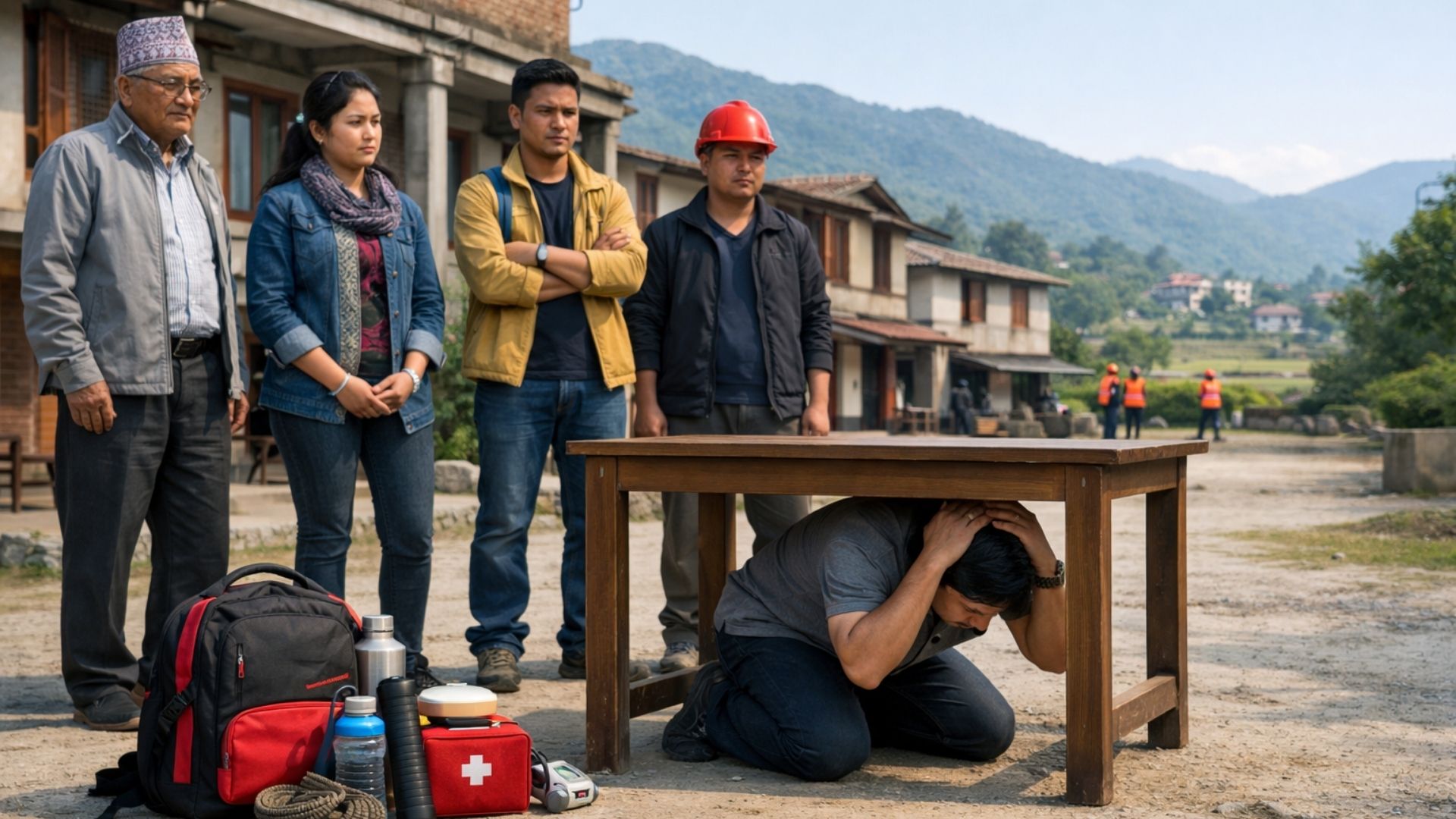
b) Preparing a “Go-Bag”
Every household should have an emergency bag. It should include supplies sufficient for at least 72 hours:
-
Dry food and water
-
Primary medical supplies (First Aid Kit)
-
Torchlight and extra batteries
-
Photocopies of important documents
-
Some cash and a whistle
c) “Drop, Cover, and Hold On”
During an earthquake, panicking and running outside can be risky. To protect yourself from falling objects, it is considered safest to take cover under a strong table or shelter. Since many homes in Nepal are at risk of wall collapse, safe spots should be identified in advance.
d) Safety of schools and hospitals
Public buildings, especially schools and hospitals, must be earthquake-resistant. If the 2072 earthquake had not happened on a Saturday, thousands of children could have lost their lives inside school buildings. Therefore, retrofitting educational institutions must be a priority.
Institutional Structure and Policy Arrangements
In Nepal, the “National Disaster Risk Reduction and Management Authority” (NDRRMA) has been established for disaster management. It works on preparedness, response, and recovery.
-
Sendai Framework: Nepal has made an international commitment to reduce disaster-related losses by 2030.
-
Role of local government: The Constitution assigns disaster management responsibility to local levels. Now, a “Disaster Management Committee” must be active in every ward.
The Role of Youth: Leadership and Awakening
Young readers of this article must understand that you are the drivers of change. Youth can play these roles in earthquake safety:
-
Information flow: Use social media to spread correct earthquake safety information.
-
Technical education: Engineering and science students can visit communities and teach safe construction practices.
-
Volunteering: Get trained in rescue methods and form local “response teams” for emergencies.
Conclusion
While observing National Earthquake Safety Day, we must not limit ourselves to speeches. We must ask ourselves whether our own homes are truly safe. We cannot change Nepal’s geographic location, but we can definitely change our mindset and construction practices.
Earthquake safety is not a destination. It is a continuous process. Until the last person in society can sleep in an earthquake-resistant home, the true meaning of this day will remain incomplete.
Let us take a pledge this Magh 2: “We will not fear earthquakes; we will build the capacity to withstand them.”
Our slogan should be: Earthquake-resistant structures are the foundation of a safe life.
Research and References
-
National Building Code (NBC 105: 2020), Ministry of Urban Development, Government of Nepal.
-
Study reports on past mega-earthquakes, Department of Mines and Geology.
-
Seismic Hazard Assessment of Nepal, International Journal of Geophysics.
-
Post-Disaster Needs Assessment (PDNA) report after the 2072 earthquake, National Planning Commission.
-
Sendai Framework for Disaster Risk Reduction (2015–2030).
Editorial Note
This content is fully based on facts and its purpose is to raise public awareness. Before carrying out any construction work, consultation with an authorized engineer or technical expert is mandatory.


.png)

Comments 0
No comments yet. Be the first to start the conversation.