



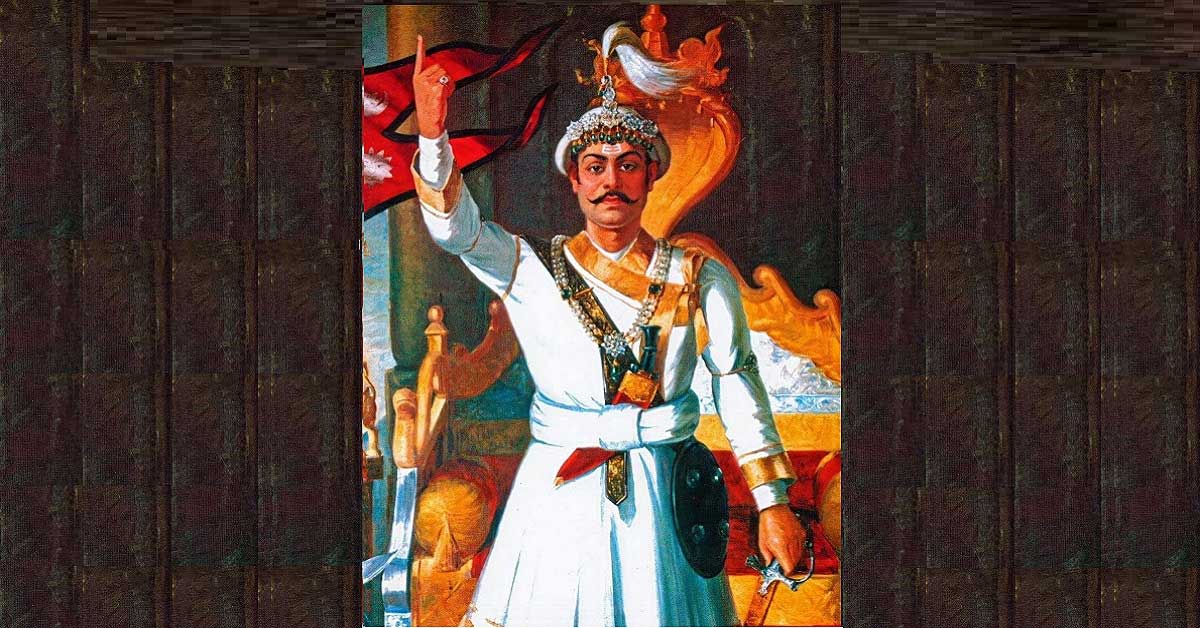
National Unity Day in Nepal: Historical Background, Relevance, and a Future Roadmap
Poush 27 holds special significance in Nepal’s history. This day is not only the birthday of a single historical figure; it also marks a starting point for the existence and identity of modern Nepal.
The unification campaign initiated by Prithvi Narayan Shah brought the scattered Baise and Chaubise states into a single thread and established a sovereign nation called “Nepal.”
In the 21st century, as the world stands at the intersection of globalization and identity politics, it is essential to understand the meaning of National Unity Day (Prithivi Jayanti) and transfer its core message to the younger generation.
In this article, we present a research-based, in-depth analysis of the historical depth of National Unity Day, the problems it addressed at the time, the economic and diplomatic principles found in Prithvi Narayan Shah’s Divyopadesh, and its continuing relevance today.
Historical background: Nepal before unification
By the mid-18th century, what is now Nepal was divided into many small states. In the east there were Kirat states, in the Kathmandu Valley there were three Malla kingdoms, and in the west there existed the Baise and Chaubise states. Conflicts, border disputes, and power struggles among these states were common.
Challenges of that time:
-
Security threat: In the south, the East India Company was expanding its empire. Small and divided states did not have the capacity to stop foreign powers.
-
Economic instability: Each state had its own currency, taxation system, and trade rules. This created obstacles to trade movement, and economic progress was almost stalled.
-
Social fragmentation: People were divided across small states. When one state treated another as an enemy, a shared Nepali identity was lacking.
Amid these serious problems, King Prithvi Narayan Shah of Gorkha felt the need for unification. His aim was not only territorial expansion; it was to build an “invincible fortress” to protect the country from foreign powers.
The unification campaign
The unification campaign led by Prithvi Narayan Shah did not succeed only through military force. Diplomacy, economic blockade, and public participation played major roles.
The conquest of Nuwakot and a strategic beginning
In B.S. 1801, by conquering Nuwakot, he gained control over the trade route to the Kathmandu Valley. This was a form of economic strategy that weakened the Malla rulers of the Valley.
Public participation
According to historian Baburam Acharya, Shah did not discriminate on the basis of ethnicity or religion during the unification campaign. He took advice and support from ordinary citizens such as Bise Nagaarchi to military strategists such as Kalu Pande. This “shared effort of all” became the backbone of unification.
Divyopadesh: a national guiding doctrine
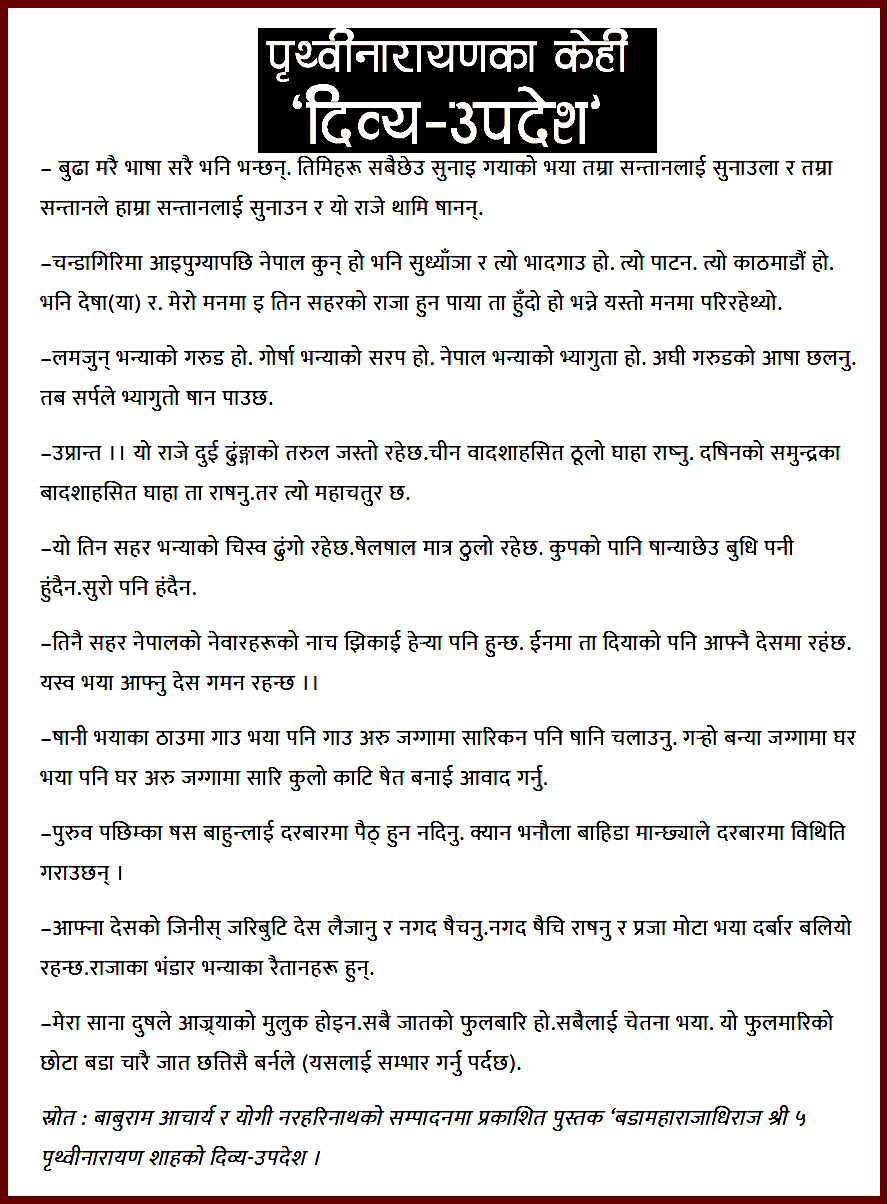
The Divyopadesh, delivered by Prithvi Narayan Shah in the final phase of his life, remains relevant for Nepal’s administration, diplomacy, and economy. It can be considered one of the world’s earliest “strategic documents.”
a) Diplomatic balance (a yam between two boulders)
He described Nepal’s geography as “a yam between two boulders.” His understanding was that Nepal’s security is guaranteed by a balanced foreign policy while living between powerful neighbors—China to the north and India to the south. In today’s geopolitical context, this principle has become even more important.
b) Economic self-reliance and domestic production
He emphasized preventing foreign traders from entering the country and prioritizing domestic cloth and production. His advice—“weave and wear your own country’s cloth; do not use foreign cloth”—reflects the spirit of today’s “Make in Nepal” or the promotion of domestic industries. He also gave clear direction on protecting mines and preventing capital flight.
c) Good governance and control of corruption
His statement, “Both the giver and the taker of bribes are enemies of the nation,” aimed to make the justice system and administration impartial. In his view, delivering justice to the people and protecting the state’s property were the fundamental duties of a king and ruler.
National unity: the foundation of unity in diversity
Nepal is a multilingual, multi-religious, and multicultural country. Prithvi Narayan Shah defined Nepal as “a common garden of four varnas and thirty-six castes.” This definition accepted Nepal’s diversity and tied everyone to a single national identity.
Learning for the younger generation
Today’s youth need to understand that national unity does not mean sameness; it means respect for diversity. No matter our geography, caste, or language, our shared home is Nepal. This feeling is the first step toward national development.
Challenges of unification and historical facts
History must be viewed objectively. During unification, many difficulties arose, and strict decisions also had to be taken. Although there are differences among historians regarding the Kirtipur war and subsequent events, overall these steps were driven by the broader goal of nation-building.
Scholars such as researcher Rishikesh Shah and Ludwig Stiller have explained Nepal’s unification as a unique event in South Asia. While other small states were being absorbed into the British Empire, Nepal succeeded in preserving its independent existence. Behind this success, the spirit of national unity was a key factor.
The importance of Unity Day in the present context
In today’s time, celebrating National Unity Day does not mean only honoring a historical figure; it means strengthening the foundations of nationhood.
-
Protection of sovereignty: For a small nation like Nepal, national unity is the greatest security shield. Internal unity is essential to remain free from external interference and influence.
-
Economic prosperity: Without political and social unity, economic development is not possible. The “domestic identity” campaign begun during unification needs to be connected to industrial transformation in today’s context.
-
Identity and pride: A nation without history has no future. The younger generation should not forget the sacrifice and contribution of their ancestors. National Unity Day reminds us of our proud history.
What should youth do?
Among today’s youth, the tendency to migrate abroad and to show limited interest in the country’s history is increasing. To address this, attention can be given to the following points:
-
Deep study of history: Study various historical documents and research, not only limited to textbooks.
-
Skills and entrepreneurship: Follow Prithvi Narayan Shah’s economic thinking and create self-employment opportunities within the country.
-
Social harmony: Avoid spreading hatred in society through social media or other means; spread messages of unity instead.
-
Positive citizenship: Question state institutions to make them accountable, but remain united on matters of national interest.
Impartial analysis and takeaway
Some of Prithvi Narayan Shah’s policies may have been shaped by the feudal context of that time, but his central objective was “Nepal’s existence.” If he had not taken the bold step toward unification then, our map and identity today could have been different.
National Unity Day is a day for every Nepali. It teaches us that:
-
Unity is strength.
-
The feelings of a nation’s people are greater than geography.
-
Those who respect history can build a bright future.
Conclusion
National Unity Day in Nepal (Poush 27) inspires us to unite in a shared thread. Turning the pages of history shows us that Nepal’s formation and protection were built through the blood and sweat of many. The responsibility of the present generation is to make this independent and sovereign Nepal more advanced, prosperous, and united.
We must not limit our ancestors’ contributions to statues alone; we must bring their vision and love for the nation into our own work. The true meaning of celebrating National Unity Day is realized only when every Nepali can proudly say— “I am Nepali, and my nation is my identity.”
References
-
Acharya, Baburam, Shri 5 Prithvi Narayan Shahko Sankshipta Jibani.
-
Stiller, Ludwig F., The Rise of the House of Gorkha.
-
Pant, Nayaraj and others, Itihas Prakash.
-
Shah, Rishikesh, Modern Nepal: A Political History.
-
Government of Nepal, archival records of the Department of Information and Broadcasting.

.png)

Comments 0
No comments yet. Be the first to start the conversation.