



-Building.jpg)
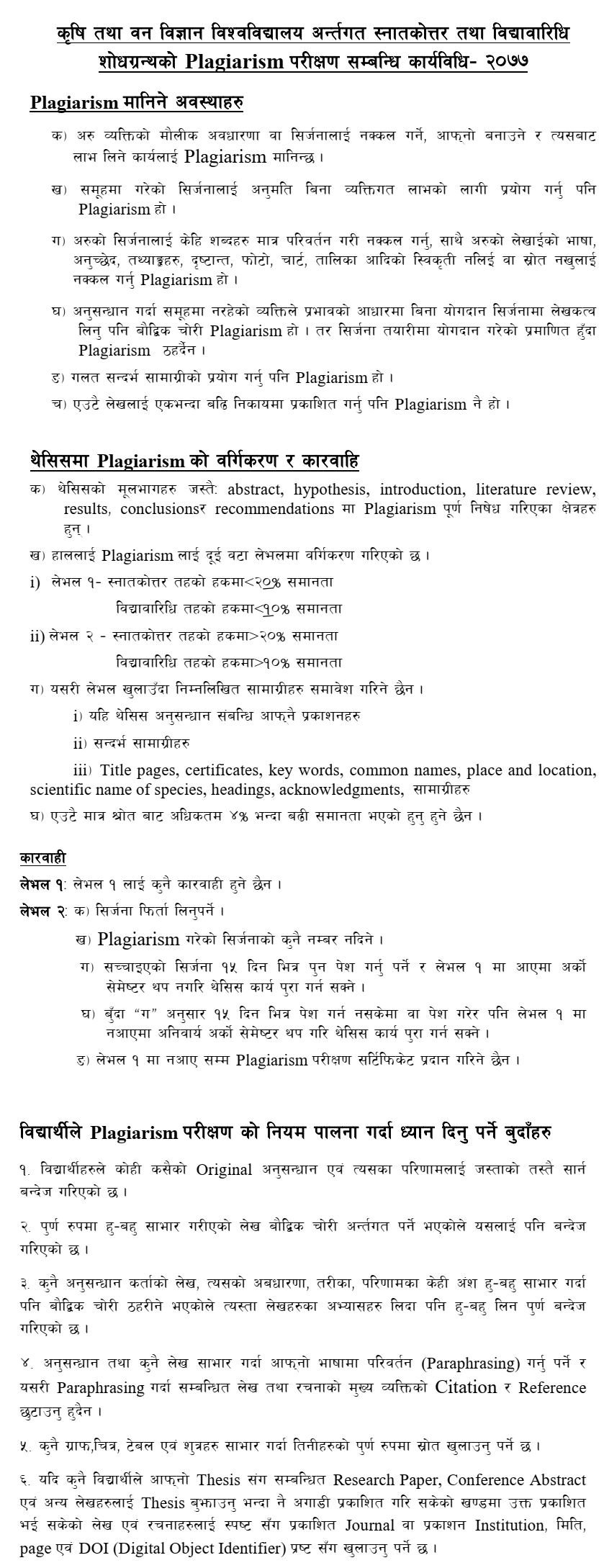
Procedure 2077 on Plagiarism Testing for Postgraduate and Doctoral Theses under Agriculture and Forestry University
Situations Considered Plagiarism
a) Plagiarism is considered an act of copying another person’s original concept or creation, presenting it as one’s own, and taking benefit from it.
b) Using a creation produced in a group for personal benefit without permission is also plagiarism.
c) Copying another person’s creation by changing only a few words, and copying another person’s writing language, paragraphs, data, examples, photos, charts, tables, etc. without obtaining approval or without disclosing the source is plagiarism.
d) In research, when a person who is not part of the group takes authorship of a creation without contribution on the basis of influence, it is also intellectual theft (plagiarism). However, if contribution to the preparation of the creation is proven, it will not be considered plagiarism.
e) Using incorrect reference materials is also plagiarism.
f) Publishing the same article in more than one institution is also plagiarism.
Classification of Plagiarism in a Thesis and Disciplinary Actions
a) In the core parts of a thesis such as abstract, hypothesis, introduction, literature review, results, conclusions, and recommendations, plagiarism is a strictly prohibited area.
b) For now, plagiarism has been classified into two levels.
i) Level 1
-
For the postgraduate level: similarity < 20%
-
For the doctoral level: similarity < 10%
ii) Level 2
-
For the postgraduate level: similarity > 20%
-
For the doctoral level: similarity > 10%
c) While determining these levels, the following materials will not be included.
i) The student’s own publications related to the same thesis research
ii) Reference materials
iii) Title pages, certificates, key words, common names, place and location, scientific name of species, headings, acknowledgments, and related materials
d) Similarity from a single source must not exceed a maximum of 4%.
Actions
Level 1: No action will be taken for Level 1.
Level 2:
a) The work must be withdrawn.
b) No marks will be awarded for the plagiarized work.
c) The corrected work must be resubmitted within 15 days, and if it comes under Level 1, the thesis work can be completed without adding another semester.
d) If it cannot be submitted within 15 days as per point (c), or if it is submitted but does not come under Level 1, the thesis work can be completed only by mandatorily adding another semester.
e) A plagiarism testing certificate will not be provided until it comes under Level 1.
Points Students Must Consider While Following Plagiarism Testing Rules
-
Students are prohibited from copying anyone’s original research and its results exactly as they are.
-
Fully verbatim copied writing falls under intellectual theft, therefore this is also prohibited.
-
Even copying verbatim any part of a researcher’s writing—its concept, method, or part of the results—will be considered intellectual theft; therefore, taking such practices verbatim is strictly prohibited.
-
When citing research and any writing, it must be rewritten in one’s own language (paraphrasing), and while paraphrasing, the citation and reference of the main author of the concerned writing and creation must not be omitted.
-
When citing any graphs, figures, tables, and formulas, their sources must be fully disclosed.
-
If a student has already published a research paper, conference abstract, or other writings related to the thesis before submitting the thesis, the already published writings and creations must clearly mention the published journal or publishing institution, date, page, and DOI (Digital Object Identifier).
.jpg)




Comments 0
No comments yet. Be the first to start the conversation.