Itahari Sub-Metropolitan City is a local government located in Sunsari District of Koshi Province, Nepal. Situated at the intersection of the East-West Mahendra Highway and the north-south Koshi Highway, Itahari is an urban area connected to transportation and commercial activities in eastern Nepal.
Itahari Sub-Metropolitan City comprises 20 wards and covers an area of 93.78 square kilometres. According to the National Population and Housing Census 2021 (2078 BS), it had a total population of 197,241 and 50,350 households.
Under the Constitution of Nepal and the Local Government Operation Act, 2074 BS (2017 AD), Itahari Sub-Metropolitan City is responsible for local governance, lawmaking, development planning, basic and secondary education, basic healthcare, local infrastructure, revenue administration, and public services.
Official Name: Itahari Sub-Metropolitan City (इटहरी उप-महानगरपालिका))
Local Government Type: Sub-Metropolitan City
Province: Koshi Province
District: Sunsari
Number of Wards: 20
Total Area: 93.78 square kilometres
Total Population (2021): 197,241
Male Population: 93,290
Female Population: 103,951
Total Households: 50,350
Literacy Rate (2021): 85.30%
Published Office Address: Itahari-6, Sunsari
Official Website: https://itaharimun.gov.np/
Source: National Statistics Office, Nepal Statistical Year Book 2023, Table 1.7 (2021 data), and the official website of Itahari Sub-Metropolitan City.
The present administrative structure of Itahari Sub-Metropolitan City developed through different stages of local government formation and administrative restructuring.
According to the municipality's official institutional profile, Itahari was declared a Sub-Metropolitan City following a decision of the Government of Nepal (Council of Ministers) on Mangsir 16, 2071 BS.
The decision incorporated the former Itahari Municipality and the Village Development Committees (VDCs) of Khanar, Pakali, Ekamba, and Hansposa into the Sub-Metropolitan City.
Following the promulgation of the Constitution of Nepal in 2072 BS, local governments received constitutional powers and responsibilities.
Under Nepal's federal system, Itahari Sub-Metropolitan City operates through an elected Municipal Assembly, Municipal Executive, Judicial Committee, ward committees, and administrative offices.
The original declaration of Itahari as a Sub-Metropolitan City and the subsequent restructuring of local governments under the federal system are separate administrative developments.
Itahari is a local government area covering urban neighbourhoods and surrounding settlements in Sunsari District.
Its connection to the Mahendra Highway and Koshi Highway provides transportation links with various locations across eastern Nepal.
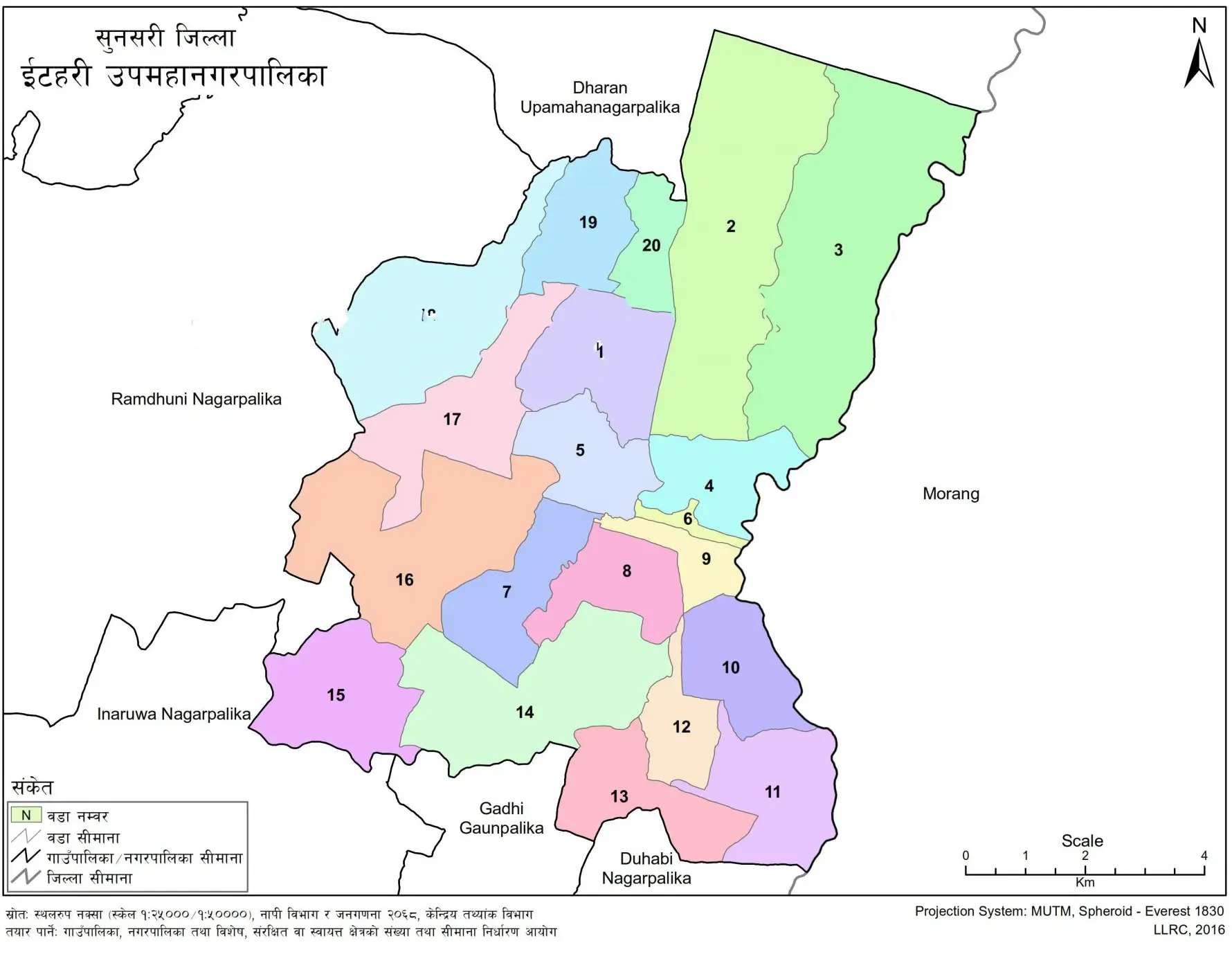
The Sub-Metropolitan City covers 93.78 square kilometres and is divided into 20 wards.
These wards serve as the primary local administrative units for delivering public services.
Ward offices handle everyday administrative needs, personal event registration, various official recommendations, and ward-level development activities.
The Sub-Metropolitan City publishes information about its wards on its official website.
Residents can access relevant details through the Itahari Sub-Metropolitan City Ward Profile.
According to the National Population and Housing Census 2021, Itahari Sub-Metropolitan City had a total population of 197,241.
The population included:
Male Population: 93,290
Female Population: 103,951
Total Population: 197,241
Total Households: 50,350
Average Household Size: 3.92 persons
Population Density: 2,103 persons per square kilometre
The National Statistics Office also reported the following literacy rates:
Overall Literacy Rate: 85.30%
Male Literacy Rate: 91.18%
Female Literacy Rate: 80.11%
These figures appear in Table 1.7 of the Nepal Statistical Year Book 2023, published by the National Statistics Office.
Census statistics provide a basis for assessing local needs related to education, healthcare, drinking water, sanitation, housing, and other public infrastructure.
The figures represent the 2021 census and should not be interpreted as an updated count of the municipality's present population.
The powers, responsibilities, and administrative structure of Itahari Sub-Metropolitan City are governed by the Constitution of Nepal, the Local Government Operation Act, 2074 BS, and other applicable laws.
The Constitution of Nepal establishes the legal foundation for local governments.
Its major provisions relating to local governance include:
Part 17: Provisions concerning the Local Executive.
Part 18: Provisions concerning the Local Legislature.
Part 19: Provisions concerning Local Financial Procedures.
Schedule 8: Powers assigned exclusively to local governments.
Schedule 9: Powers shared by federal, provincial, and local governments.
These constitutional provisions cover areas such as local administration, municipal police, local taxation, cooperatives, basic and secondary education, basic healthcare, sanitation, local roads, and development planning.
Under Article 226 of the Constitution, the Municipal Assembly can make laws on matters within its constitutional authority. Such laws must not conflict with applicable federal or provincial laws.
The Local Government Operation Act, 2074 BS (2017 AD), provides detailed rules for the functions, duties, powers, procedures, and service delivery responsibilities of rural municipalities and municipalities.
For the purposes of this Act, the term municipality also includes Sub-Metropolitan Cities and Metropolitan Cities.
The Act covers several areas of local governance, including:
Preparation and implementation of local development plans.
Annual budget preparation and approval procedures.
Duties and responsibilities of ward committees.
Administrative management and public service delivery.
Local taxation and revenue administration.
Functions and legal powers of the Judicial Committee.
The Act helps define how local governments exercise their responsibilities within Nepal's federal governance system.
Itahari Sub-Metropolitan City can issue local acts, rules, procedures, directives, and standards within its legally defined jurisdiction.
These legal instruments guide administrative decisions, service delivery, revenue collection, and other municipal functions.
The Sub-Metropolitan City has published local legislation, including its Economic Act for the fiscal year 2083 BS, on its official website.
Residents and other interested individuals can access these documents through the Acts, Laws, and Directives section.
Itahari Sub-Metropolitan City operates through elected representatives and administrative employees who have different responsibilities under Nepalese law.
The main components of its governance structure are the Municipal Assembly, Municipal Executive, Judicial Committee, ward committees, and administrative offices.
The Municipal Assembly is the local legislative body of Itahari Sub-Metropolitan City.
Under Article 223 of the Constitution of Nepal, the Municipal Assembly comprises:
The Mayor.
The Deputy Mayor.
Ward Chairpersons.
Four elected members from each ward.
Other relevant Municipal Executive members elected in accordance with the Constitution.
The Municipal Assembly is responsible for making local laws, approving annual policies and programmes, approving the municipal budget, and performing other legislative functions provided by law.
Its decisions must remain within the powers assigned to local governments by the Constitution and applicable legislation.
The Municipal Executive is the main executive body responsible for municipal administration and the implementation of approved decisions.
The Mayor chairs the Municipal Executive.
Its members include the Deputy Mayor, Ward Chairpersons, and other members elected in accordance with constitutional provisions.
The Municipal Executive is responsible for implementing policies, plans, and budgets approved by the Municipal Assembly.
It also oversees local administration and the execution of municipal decisions within the applicable legal framework.
Article 217 of the Constitution of Nepal provides for a three-member Judicial Committee in each municipality.
The Deputy Mayor serves as the coordinator of the committee.
The other two members are elected by the Municipal Assembly from among its members.
Section 47 of the Local Government Operation Act, 2074 BS, defines the committee's jurisdiction.
The committee has two main types of legal responsibilities:
Dispute Adjudication: Deciding specified disputes that fall under Section 47(1) of the Act.
Mediation: Helping resolve disputes covered by Section 47(2) through mediation.
The Judicial Committee does not have authority over every type of legal dispute or court case.
Its powers are limited to matters specifically assigned to it by applicable law.
Each ward has a Ward Committee consisting of one Ward Chairperson and four Ward Members, as provided by the Constitution.
Ward committees help identify local needs, prepare ward-level development plans, coordinate development activities, and deliver administrative services to residents.
They provide a direct administrative connection between local communities and the Sub-Metropolitan City.
The Chief Administrative Officer leads the day-to-day administrative operations of Itahari Sub-Metropolitan City.
Under applicable law, the Chief Administrative Officer is responsible for administrative management, implementation of decisions, staff coordination, financial administration, and public service delivery.
The Sub-Metropolitan City also operates divisions and sections for different functions according to its approved organisational structure.
These offices carry out technical, administrative, and service-related responsibilities within their assigned areas.
The legal responsibilities of Itahari Sub-Metropolitan City cover public administration, education, healthcare, social security, taxation, infrastructure, and local development.
However, having legal responsibility for a particular service does not automatically mean that every related service or programme is available at all times.
Residents should verify service availability, required documents, procedures, and applicable charges through updated information from the relevant municipal office.
Personal event registration is an important public service delivered through local governments.
The main registration services include:
Birth registration.
Death registration.
Marriage registration.
Divorce registration.
Migration registration.
Residents can contact their respective ward offices for these services.
Ward offices also handle various administrative recommendations and certifications under applicable laws and procedures.
These include citizenship recommendations, relationship certifications, and other official recommendations.
A citizenship recommendation and the issuance of a citizenship certificate are separate administrative functions.
Receiving a recommendation from a ward office does not mean that a citizenship certificate has been issued.
The Constitution of Nepal includes basic and secondary education within the jurisdiction of local governments.
Itahari Sub-Metropolitan City's responsibilities in this sector relate to:
Local education planning.
Legally assigned school management functions.
Monitoring and educational coordination.
Local education development.
School-related administrative and regulatory responsibilities.
Matters such as school approval, regulation, teacher management, and local curriculum arrangements are governed by applicable federal, provincial, and local education laws.
University constituent campuses and affiliated colleges operating within Itahari remain subject to the academic programme and recognition requirements of their respective universities and regulatory authorities.
Municipal education responsibilities should not be confused with the separate legal authority of universities and higher education regulators.
Basic healthcare and sanitation are among the constitutional responsibilities of local governments.
Itahari Sub-Metropolitan City has responsibilities relating to the management of local health institutions and public health activities.
These responsibilities include:
Management of local health facilities.
Public health promotion.
Coordination related to vaccination programmes.
Health awareness activities.
Sanitation-related services and activities.
The availability of medical treatment, healthcare workers, operating hours, or specific programmes at a particular health institution must be confirmed through updated information from that institution or the Sub-Metropolitan City.
Local governments perform administrative functions associated with social security programmes.
These functions include beneficiary record management, registration, renewal, and payment coordination.
Eligibility requirements, allowance amounts, payment arrangements, and necessary documents are determined by the relevant laws and procedures.
Itahari Sub-Metropolitan City has also published ward-level information concerning certain social security payments on its official website.
Residents should consult updated official information to understand the procedures and requirements applicable to their circumstances.
Itahari Sub-Metropolitan City administers local taxes and revenues in accordance with applicable legislation.
Its revenue-related responsibilities include:
Property tax.
House rent tax.
Business tax.
Other applicable local taxes and service charges.
The local government also has responsibilities relating to business registration, renewal, and associated administrative recommendations.
Tax rates, exemptions, penalties, and fees are determined by the applicable Economic Act for each fiscal year and other relevant legal provisions.
Residents and businesses should not assume that tax rates published in previous fiscal years remain applicable.
The latest municipal legislation and revenue office information should be consulted before making payments or completing tax-related procedures.
Local infrastructure development is another responsibility of Itahari Sub-Metropolitan City.
Its responsibilities include local roads, drainage systems, public structures, building-related regulation, and other municipal infrastructure activities.
Building construction must comply with the applicable National Building Code, local building standards, and relevant legal procedures.
Itahari Sub-Metropolitan City has also listed an Electronic Building Permit System on its official website.
Before beginning construction or applying for building plan approval, applicants should consult the relevant technical section to confirm current standards, procedures, and approval requirements.
Annual policies, programmes, and budgets are important documents that explain a local government's development priorities and planned use of public resources.
Itahari Sub-Metropolitan City has published its policies, programmes, budget, and budget statement for fiscal year 2083/84 BS on its official website.
These documents provide information about planned municipal activities and financial allocations.
However, a budget allocation does not establish that the allocated amount has been spent or that a development project has been completed.
To understand the actual implementation status of a programme or project, readers should examine:
The approved municipal budget.
Relevant progress reports.
Expenditure statements.
Other official implementation records.
Published budget documents are available in the municipality's Budget and Programmes section.
Residents seeking services from Itahari Sub-Metropolitan City or its ward offices should understand that the requirements can differ depending on the service.
Required documents, fees, responsible departments, and processing times may vary.
The municipality has published a Citizen Charter on its website.
However, some available versions of the Citizen Charter date from earlier years. Residents should not assume that the procedures or fees mentioned in those documents remain unchanged.
Before visiting a municipal office, it is advisable to confirm current service requirements through the relevant office.
The Itahari Sub-Metropolitan City Citizen Charter and official notices from the concerned departments can help residents obtain service-related information.
The following contact details are published on the official website of Itahari Sub-Metropolitan City.
Office Name: Itahari Sub-Metropolitan City Office
Address: Itahari-6, Sunsari, Nepal
Phone Numbers: 025-580046, 025-584659
Call Centre: 025-597001
Toll-Free Number: 16602558888
Email: itahari.municipality@gmail.com
Official Website: https://itaharimun.gov.np/
These are the institutional contact details published on the Sub-Metropolitan City's website.
For the contact information of a particular department or ward office, residents should consult the latest details published by the relevant office.
Itahari Sub-Metropolitan City is a local government in Sunsari District of Koshi Province, Nepal, comprising 20 wards.
Under the Constitution of Nepal and the Local Government Operation Act, 2074 BS, it carries out responsibilities related to local governance, development planning, public administration, education, healthcare, social security, revenue management, and infrastructure.
According to the National Population and Housing Census 2021, Itahari had a population of 197,241 and 50,350 households. These statistics provide a basis for understanding the municipality's demographic profile.
Residents, businesses, and other service users should rely on the municipality's updated official records to confirm service availability, applicable fees, administrative procedures, and the implementation status of development programmes.
Itahari Sub-Metropolitan City is located in Sunsari District of Koshi Province, Nepal.
Itahari Sub-Metropolitan City has 20 wards. Each ward has a ward office responsible for local administration and public service delivery.
According to local-level statistics published by the National Statistics Office, Itahari Sub-Metropolitan City covers an area of 93.78 square kilometres.
According to the National Population and Housing Census 2021, Itahari Sub-Metropolitan City had a total population of 197,241. This figure represents the 2021 census population.
According to its official institutional profile, Itahari was declared a Sub-Metropolitan City following a decision of the Government of Nepal dated Mangsir 16, 2071 BS.
Residents can contact their respective ward offices for personal event registration, including birth and migration registration.
Required documents, processing periods, and other procedures are governed by applicable laws and updated official instructions.
Under Article 217 of the Constitution of Nepal, a Judicial Committee operates under the coordination of the Deputy Mayor.
The committee handles dispute adjudication and mediation within the jurisdiction assigned by the Local Government Operation Act, 2074 BS.
Information about applicable taxes and service charges can be obtained from the municipality's current Economic Act, the relevant revenue department, and official service notices.