Janakpurdham Sub-Metropolitan City (Upa Mahanagarpalika) is a local government in Dhanusha District, Madhesh Province, Nepal. Under the Constitution of Nepal and the Local Government Operation Act, 2074 BS (2017), it is responsible for local administration, public services, development planning, school education management, basic healthcare, sanitation, and local revenue administration.
The sub-metropolitan city's official website uses the name "Janakpurdham Sub-Metropolitan City." However, the Ministry of Federal Affairs and General Administration lists it as "Janakpur Sub-Metropolitan City" in its local government contact records. Both names refer to the same local government in Dhanusha District.
According to the National Population and Housing Census 2021 (2078 BS), Janakpurdham Sub-Metropolitan City had a population of 194,556. It covers an area of 91.97 square kilometres and is administratively divided into 25 wards.
Officially Used Name: Janakpurdham Sub-Metropolitan City (जनकपुरधाम उप-महानगरपालिका)
English Name: Janakpurdham Sub-Metropolitan City
Local Government Type: Sub-Metropolitan City
Province: Madhesh Province
District: Dhanusha
Total Wards: 25
Total Area: 91.97 square kilometres
Total Population: 194,556
Male Population: 99,764
Female Population: 94,792
Total Households: 40,409
Average Household Size: 4.81 persons
Population Reference Year: National Census 2021 (2078 BS)
Main Administrative Body: Office of the Municipal Executive
Public Contact Number: 041-520520
Official Email: info@janakpurmun.gov.np
Official Website: https://janakpurmun.gov.np/ne
The population and household figures are based on Table 1.10 of the National Statistics Office's Statistical Pocket Book Nepal 2022. The area, number of wards, and contact information are based on the relevant government records.
Janakpurdham Sub-Metropolitan City is located in Dhanusha District of Madhesh Province. According to the geographical description published on its official website, most of its territory consists of relatively flat land.
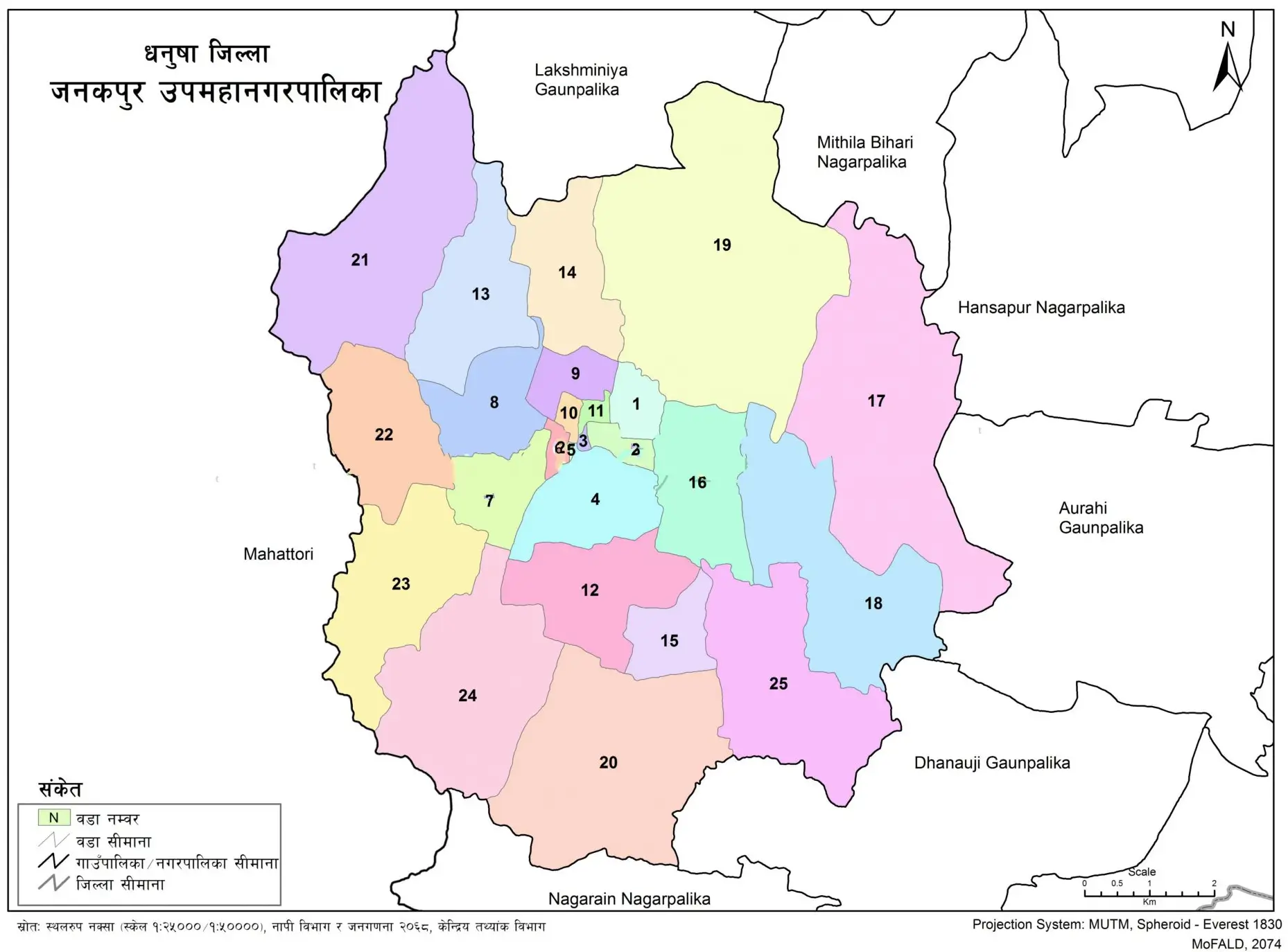
The municipal area is divided into 25 wards. These wards serve as the basic administrative units for local governance, public service delivery, and the implementation of ward-level development plans.
According to the 2021 National Census conducted by the National Statistics Office, Janakpurdham Sub-Metropolitan City had a total population of 194,556, comprising 99,764 males and 94,792 females.
The same census recorded 40,409 households, with an average household size of 4.81 persons.
These figures relate to the 2021 census. They should not be presented as updated population estimates for the current year.
The governance of Janakpurdham Sub-Metropolitan City is guided by the Constitution of Nepal and the Local Government Operation Act, 2074 BS (2017).
Part 17 of the Constitution establishes provisions relating to the local executive, Part 18 addresses the local legislature, and Part 19 covers local financial procedures.
Schedule 8 of the Constitution specifies the exclusive powers of local governments, while Schedule 9 identifies powers shared among the federal, provincial, and local levels of government.
The constitutional responsibilities of local governments include local taxation and service charges, basic and secondary education, basic healthcare and sanitation, local roads, local market management, and environmental protection.
These powers must be exercised in accordance with the Constitution, applicable federal and provincial laws, and relevant local legislation.
The Local Government Operation Act, 2074 BS (2017), provides the legal framework for the Municipal Assembly, Municipal Executive, ward committees, Judicial Committee, local planning, administration, and public service delivery.
The governance of Janakpurdham Sub-Metropolitan City involves elected representatives and administrative personnel with distinct responsibilities. The Municipal Assembly, Municipal Executive, Judicial Committee, and ward committees are the main institutions of local governance.
The Municipal Assembly is the local legislative body of the sub-metropolitan city.
Under Article 223 of the Constitution of Nepal, the Municipal Assembly consists of the Mayor, Deputy Mayor, Ward Chairpersons, four elected members from each ward, and members of the Municipal Executive elected from Dalit or minority communities in accordance with constitutional provisions.
The Municipal Assembly is responsible for enacting local laws within its jurisdiction, approving annual policies, programmes, and budgets, and making decisions concerning local governance.
The Municipal Executive is the executive body of the sub-metropolitan city. It is headed by the Mayor.
Its membership includes the Mayor, Deputy Mayor, Ward Chairpersons, and other members elected in accordance with the Constitution.
The Municipal Executive is responsible for implementing policies, programmes, and budgets approved by the Municipal Assembly. It also oversees local administration and manages public service delivery.
Article 217 of the Constitution of Nepal provides for a three-member Judicial Committee in each municipality, coordinated by the Deputy Mayor. The other two members are elected by the Municipal Assembly from among its members.
Section 47 of the Local Government Operation Act, 2074 BS (2017), defines the jurisdiction of the Judicial Committee.
The committee may adjudicate certain local disputes specified by law. For some categories of disputes, its authority is limited to facilitating resolution through mediation.
Not all disputes fall within the jurisdiction of the Judicial Committee. The appropriate authority depends on the nature of the dispute and the applicable legal provisions.
Janakpurdham Sub-Metropolitan City has ward committees and ward offices across its 25 wards.
Each ward committee consists of an elected Ward Chairperson and four ward members. The laws governing local elections also provide for the representation of women and Dalit women.
Ward offices are responsible for legally prescribed administrative recommendations, vital event registration, ward-level development activities, and the delivery of local public services.
The administrative structure of the sub-metropolitan city is headed by the Chief Administrative Officer.
The Chief Administrative Officer and other employees carry out responsibilities related to daily administration, financial management, record maintenance, and implementation of Municipal Executive decisions in accordance with applicable laws and the approved organisational structure.
Local administrative functions and citizen services are delivered through various sectoral divisions and ward offices.
The legal responsibilities of Janakpurdham Sub-Metropolitan City include a range of administrative, social, and development-related services required by residents.
The office responsible for providing a particular service, the necessary documents, applicable fees, and procedures are determined by existing laws and updated notices issued by the relevant authorities.
Vital event registration covers births, deaths, marriages, divorces, and migration.
These events are registered through the designated local registrar in accordance with the law. Residents can contact their respective ward offices for information about registration requirements and procedures.
Ward offices also provide recommendations for citizenship certificates, certify family relationships, issue land and property-related recommendations, and perform other administrative functions authorised by law.
However, citizenship certificates are issued by the designated government authorities under the applicable legal framework. A recommendation from a ward office should not be confused with the issuance of a citizenship certificate.
The Constitution of Nepal includes basic and secondary education within the jurisdiction of local governments.
Accordingly, Janakpurdham Sub-Metropolitan City has responsibilities for school education management, monitoring, local educational planning, and regulation, subject to applicable education laws.
Its educational responsibilities also include functions related to early childhood development, coordination of school management, educational data, and local education planning.
However, not all powers relating to school operations, teacher management, curricula, examinations, and academic recognition rest exclusively with the sub-metropolitan city. These matters are governed by the relevant federal, provincial, and local laws.
The presence of a university or campus within the municipal area does not automatically establish that the institution is under the direct administrative control of the sub-metropolitan city.
Basic healthcare and sanitation fall within the constitutional responsibilities of local governments.
These responsibilities include local healthcare management, public health promotion, sanitation, waste management, and environmental health.
Programmes involving immunisation, maternal and child health, and disease prevention may be implemented through the coordination or participation of the local government.
However, the current availability of services, health professionals, treatments, or medicines at a particular healthcare facility should be confirmed directly with that institution.
Local governments are responsible for functions such as maintaining beneficiary records, registration, and renewal under the prevailing social security laws and procedures.
Eligibility requirements, application procedures, supporting documents, and payment arrangements for social security allowances may change.
Beneficiaries should therefore consult their respective ward offices or the latest official notices issued by the sub-metropolitan city for information relevant to their circumstances.
Janakpurdham Sub-Metropolitan City is responsible for determining and collecting local taxes, fees, and charges within the authority provided by law.
Local revenue sources may include property tax, house rent tax, business tax, and other fees and charges permitted under applicable legislation.
Business registration, renewal, administrative permissions, and related recommendations are governed by the relevant legal provisions.
As local tax rates, exemptions, penalties, and service charges may change, residents and businesses should refer to the applicable Economic Act for the current fiscal year and relevant official notices.
Urban infrastructure development and the protection of local public property fall within the responsibilities of the sub-metropolitan city.
The local government has a role in planning and implementing activities related to local roads, public spaces, community infrastructure, local markets, sanitation, and environmental protection.
Building construction and building plan approval must comply with applicable building codes, local standards, and relevant laws.
Cultural and religious landmarks associated with Janakpurdham, including Janaki Temple, Ganga Sagar, and Dhanush Sagar, are mentioned in the introductory materials published on the sub-metropolitan city's official website.
The local government's role in conserving and managing these heritage sites may vary depending on their ownership, applicable heritage protection laws, and the jurisdiction of the responsible government or other legally authorised bodies.
The location of a heritage site within municipal boundaries does not necessarily mean that the sub-metropolitan city directly owns or operates it.
Janakpurdham Sub-Metropolitan City is responsible for preparing and implementing annual policies, programmes, development plans, and budgets in accordance with the legal framework governing local administration.
The budget approved by the Municipal Assembly presents the estimated revenue and expenditure allocations for the relevant fiscal year.
Proposed funding, approved allocations, actual expenditure, and the completion status of development projects are separate matters.
To assess actual financial progress, it is necessary to examine the expenditure statements, progress reports, and audit records for the relevant fiscal year.
The sub-metropolitan city's official website provides a section for budget and programme-related publications.
Such documents provide information about the policies, programmes, and budgets for their respective fiscal years. However, the inclusion of a project in a budget document does not establish that the project has been completed.
The official website of Janakpurdham Sub-Metropolitan City contains sections covering local notices, budgets and programmes, legal documents, citizen services, decisions, and public procurement information.
Residents should not assume that information contained in an older notice, citizen charter, or fee schedule remains unchanged.
Before seeking a service, residents should obtain updated information from the relevant office about the required documents, applicable fees, procedures, and service availability.
Institution: Janakpurdham Sub-Metropolitan City, Office of the Municipal Executive
District: Dhanusha
Province: Madhesh Province
Phone: 041-520520
Email: info@janakpurmun.gov.np
Website: https://janakpurmun.gov.np/ne
Janakpurdham Sub-Metropolitan City is a local government in Dhanusha District of Madhesh Province, comprising 25 wards. It covers an area of 91.97 square kilometres and had a population of 194,556 according to the 2021 National Census.
Under the Constitution of Nepal and the Local Government Operation Act, 2074 BS (2017), the sub-metropolitan city is responsible for local administration, public services, school education management, basic healthcare, urban infrastructure, sanitation, and local revenue administration.
Its governance structure includes the Municipal Assembly, Municipal Executive, Judicial Committee, ward committees, and administrative offices, each with distinct responsibilities.
Institutional and demographic information should be interpreted using the relevant official records and reference years. For information that may change, such as service requirements, fees, and procedures, residents should consult applicable laws and the latest official notices issued by the sub-metropolitan city.
Janakpurdham Sub-Metropolitan City is located in Dhanusha District, Madhesh Province, Nepal.
Janakpurdham Sub-Metropolitan City has 25 wards, as stated in its official records.
According to the National Census 2021 (2078 BS), Janakpurdham Sub-Metropolitan City had a population of 194,556, including 99,764 males and 94,792 females.
According to the sub-metropolitan city's official records, its total area is 91.97 square kilometres.
No. The Ministry of Federal Affairs and General Administration uses the name "Janakpur Sub-Metropolitan City" in its local government contact records, while the official municipal website uses "Janakpurdham Sub-Metropolitan City." Both names refer to the same local government in Dhanusha District.
Residents can contact their respective ward offices for information about birth registration, other vital event registration services, and ward-level recommendations required for citizenship certificates.
The applicable procedures and supporting documents are determined by law.
Under Article 217 of the Constitution of Nepal, the Deputy Mayor serves as the coordinator of the municipality's Judicial Committee.
Residents can obtain updated information about local taxes and service charges by consulting the applicable Economic Act for the current fiscal year, official municipal notices, or the relevant revenue division of the sub-metropolitan city.