



Floods Cause Severe Damage to Community Schools in Nuwakot, Classes Halted
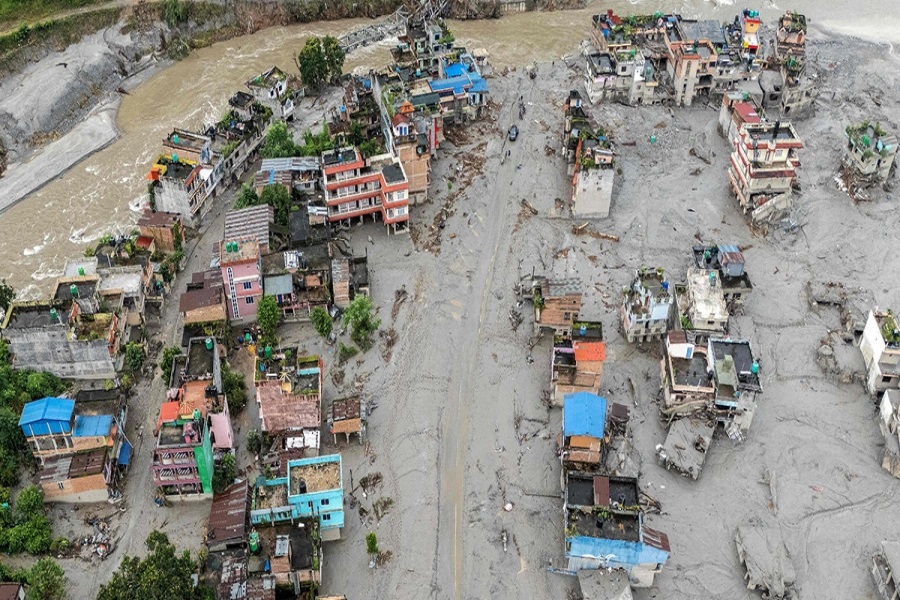
A devastating flood that occurred on 10 Bhadra caused severe damage to various community schools in Nuwakot. With physical infrastructure destroyed, access disrupted, and some students, teachers, and parents out of contact, schools in the affected areas are facing difficulties resuming classes immediately.
Damage to School Infrastructure
According to Rajendra Dawadi, principal of Tribhuvan Trishuli Secondary School in Bidur Municipality–1, the flood completely swept away the school. Before the disaster, the school had 14 permanent buildings spread across 86 ropani of land. After the flood swept away the structures, he said it is now difficult even to identify the school premises.
The students remained safe because they had been moved to a secure location after receiving advance warning. However, one teacher and one office assistant from the school remain out of contact. Preparations are underway to resume classes after arranging a temporary location in Bidur Municipality–9.
Similarly, Ganesh Prasad Lamichhane, principal of Chandeshwari Secondary School in Tupche, Bidur–7, said the flood destroyed the school’s residential facility for visually impaired students, which had been built on around three ropani of land at an investment of Rs. 10 million.
According to Principal Dawadi, the Trishuli River is now flowing behind the school building, while students coming from Betrawati, Bhainse, and Kispang are now far from the school’s access.
The flood also swept away the building of Ramchandra Basic School in Betrawati, Bidur–10. Similarly, Ranabhuwaneshwari Secondary School in Devighat, as well as Simaltar Secondary School and Mahadev Secondary School in Taruka, have also been affected by the flood.
Impact on Students and Parents
According to Manju Chitrakar, principal of Shahid Jagat Prakash Jung Shah Sanskrit Secondary School in Devighat, Bidur–5, the flood swept away 250 homes belonging to students from flood-affected areas who study at the school.
Some children have lost their parents, while others have parents who remain missing, leaving them without homes. After the flood swept away four permanent bridges and one suspension bridge, the routes used by students to reach school have been cut off.
Principal Chitrakar suggested that attention should be given to avoiding the establishment of schools near rivers and streams and to constructing earthquake-resistant buildings in order to protect community schools from disasters.
Stakeholders have said attention should also be given to assuming guardianship of students who have lost their parents, arranging educational materials, fees, and residential facilities, and providing psychosocial counseling.
Principal Dawadi said psychosocial counseling is necessary before classes resume because students are frightened and parents are worried. He said that since disasters cannot be prevented, attention should be given to early-warning systems, sirens, prevention, and mitigation.
Educationist Suggests Rehabilitation and Psychosocial Counseling
Educationist Prof. Dr. Vidyanath Koirala said the problems faced by students who have lost their parents due to the flood could be addressed if Aravind Rao Ashram, SOS Hermann Gmeiner School, or private schools arrange education with residential facilities for them.
According to him, flood-affected students require counseling in three stages: general counseling, peer counseling, and individual counseling.
Educationist Koirala said lessons learned from the flood could also be used in classroom teaching and learning activities.
“Topics such as Archimedes’ principle, what a glacier is, and what a flood is can be discussed in the classroom,” he said.
He suggested relocating schools to safer places, as rebuilding school buildings at the same locations could expose them to flooding again.
Stating that rehabilitation is necessary alongside the pain, he noted that the flood had taught that life is uncertain and that grieving alone achieves nothing.



Comments 0
No comments yet. Be the first to start the conversation.