



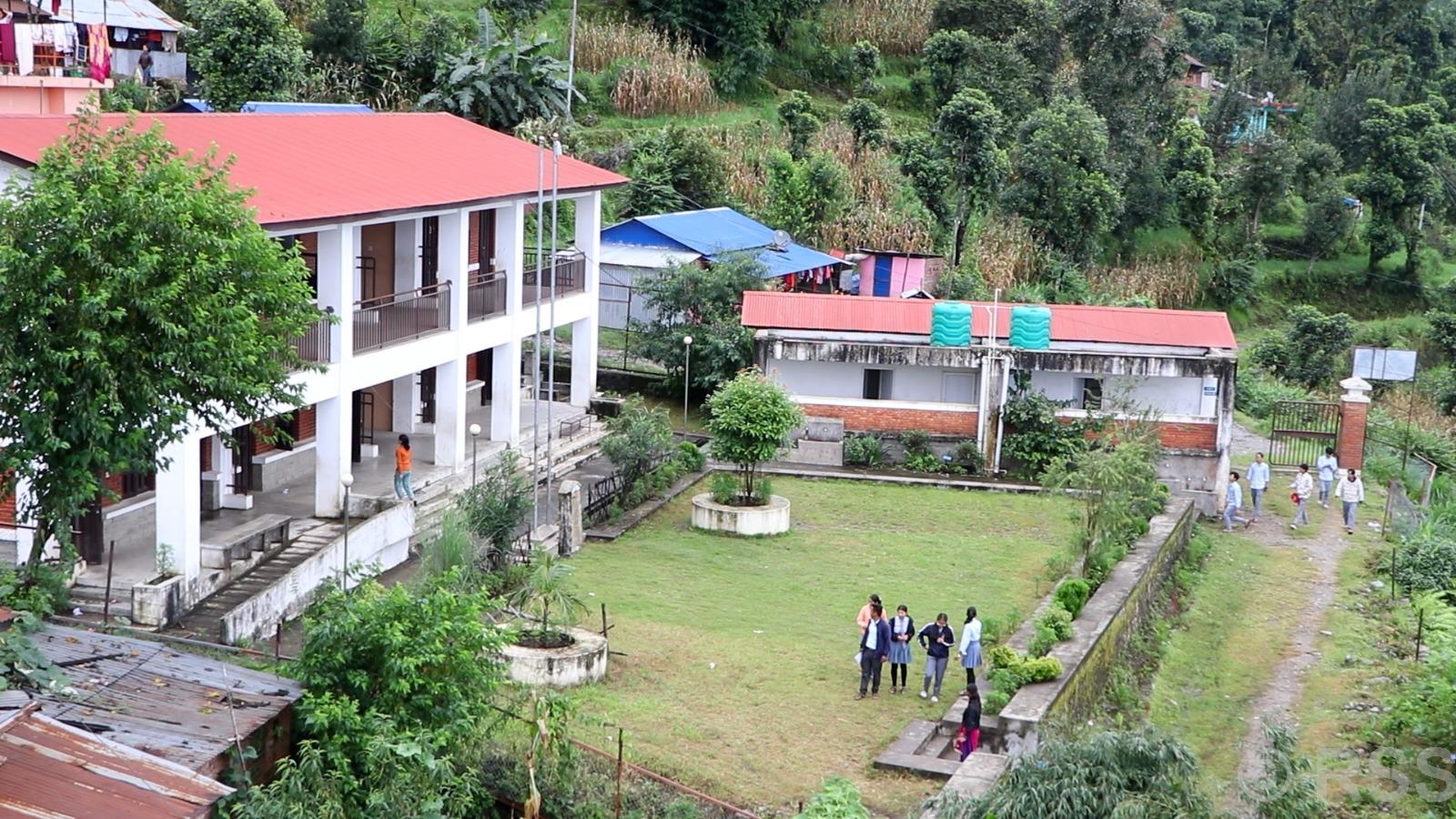
Kispang Emerging as a Technical Education Hub
Naturally beautiful Kispang Rural Municipality of Nuwakot is also moving ahead as an educational destination. Over the past three years, after the rural municipality began operating a technical institute at an affordable fee with affiliation from the Council for Technical Education and Vocational Training (CTEVT), students from Sankhuwasabha in the east to Kanchanpur in the west have reached Kispang to study technical education.
Among rural municipalities across the country, Kispang Rural Municipality is the first to operate a health-sector multi-technical institute on its own. It has been charging only Rs. 195,000 to complete the courses in General Medicine and Diploma in Pharmacy.
The institute, established in 2080 BS at Kahule, Kispang Rural Municipality–3, admitted only students for Diploma in Pharmacy in its first batch because affiliation was received late. In the second batch, all quotas for General Medicine and Diploma in Pharmacy were fully filled, and in the third batch as well, admission was completed with all quotas for General Medicine and Diploma in Pharmacy filled.
In terms of students studying from all seven provinces and 31 districts, this institute has possibly become the first of its kind in the country. With 30 percent of the students from the home district, Nuwakot, and the remaining students from other districts, Kispang has now become a village of educational tourism. Most students from outside districts live and study in the institute’s hostel. Some have rented rooms around the institute.
Students studying Health Assistant (HA) at the technical institute—Sangita Magar from Sankhuwasabha, Dhansori Budhathoki from Salyan, Priyanka Yadav from Mahottari, Arpit Kumar Das from Sarlahi, and Aakriti Chaudhary from Rautahat—come from different districts, but they are happy to now be learners of the same institute.
Similarly, Kopila Bishwakarma and Pramila Dani from Bajura, and Vijaya Gurung from Surkhet, who is studying Diploma in Pharmacy, say that studying with friends from many districts has also given them cultural learning.
Nabin Bayak from Achham, who is studying Diploma in Pharmacy, and Pawan Baral from Surkhet, a second-year HA student, said they had a different experience as they made new friends while studying technical education. Interestingly, father Dilli Dhakal and daughter Salina Dhakal are both pharmacy students at the same institute.
Dhakal, a resident of Dhikure, Likhu Rural Municipality–2, Nuwakot, plans to open a pharmacy in her own village after completing her studies. “It is a good thing for us that this type of education is available even in rural areas,” Dilli Dhakal said.
Shailesh Giri, who came to Kispang from Ghodaghodi Municipality–2 of Kailali to pursue technical education, says he came here because he could study at an affordable cost despite the long geographical distance. Along with Giri, 17 students from the institute have been assigned to Lomas Pharmaceuticals at Gatthaghar, Bhaktapur, for practical training. Among them, some, including Giri, are currently doing practical work at Trishuli Hospital in Bidur, Nuwakot.
Anjali Giri, a student from Suryagadhi–5 of Nuwakot, says the institute has well-managed and safe accommodation for female students. Ruban Tamang from Bhalche, Kispang–1, says that, overall, the institute’s teaching is good. Both are preparing to open medical shops after completing their studies.
According to institute chief Binod Neupane, the institute reflects the overall image of the country. In the first year, there are 40 students each in General Medicine and Diploma in Pharmacy, including three students studying on scholarships. Province-wise, students from six provinces are studying General Medicine, while students from all seven provinces are studying Diploma in Pharmacy.
Across different subjects and years, students from Bara, Rautahat, Parsa, Sarlahi, Bajhang, Bajura, Dhading, Dolakha, Humla, Kalikot, Nuwakot, Rasuwa, Rolpa, Sankhuwasabha, Baitadi, Bardiya, Kanchanpur, Okhaldhunga, Sindhuli, and Tanahun are studying at the institute.
In the second year, province-wise, 27 students are from Bagmati, one from Gandaki, 17 from Karnali, 26 from Madhesh, and four from Sudurpashchim. In the third year, there are 17 students from various provinces and districts. “Along with hostel facilities, students have been given a village-like experience by using organic vegetables produced at the institute itself.”
Institute chief Neupane said, “From time to time, we invite guest instructors to conduct classes. We have also been organizing programs such as sports week, quiz contests, elocution, Saraswati Puja, picnics, Women’s Day, and Holi celebrations. These activities have created enthusiasm among the students.”
Rural Municipality Chairperson and Chair of the Institute Management Committee Birbal Tamang says they consider the arrival of students from 31 districts as an opportunity for those students to receive the water of Kispang as a blessing.
He said the institute would be a milestone for expanding the rural municipality’s income and developing entrepreneurship for the nation. Tamang expressed confidence that they have taken it as a service and that it will also become a foundation for tourism development.
Rural Municipality Vice-Chairperson Arjun Prasad Neupane says there is no doubt that the institute has a bright future, as regular admissions are taking place with full quotas and feedback from students has so far been positive.
According to Chief Administrative Officer Kedar Prasad Khatiwada of the rural municipality, construction work worth Rs. 10 million was carried out for building construction at the institute through the Ministry of Urban Development in fiscal year 2081/82. For fiscal year 2082/83, the same ministry has allocated Rs. 30 million, and construction of the building is now underway on the institute’s own land.
He said the rural municipality would gradually increase the budget, develop infrastructure including laboratories, and make the institute a model institution. Teaching and learning are being carried out by skilled and experienced instructors. There are seven full-time teachers, including Dr. Ashish Dahal, who studied on a full scholarship at Tribhuvan University Teaching Hospital, five staff members, and 13 part-time personnel.
The institute’s library has sufficient books, along with modern and well-equipped computers, necessary laboratory equipment, and chemical materials.


Comments 0
No comments yet. Be the first to start the conversation.