



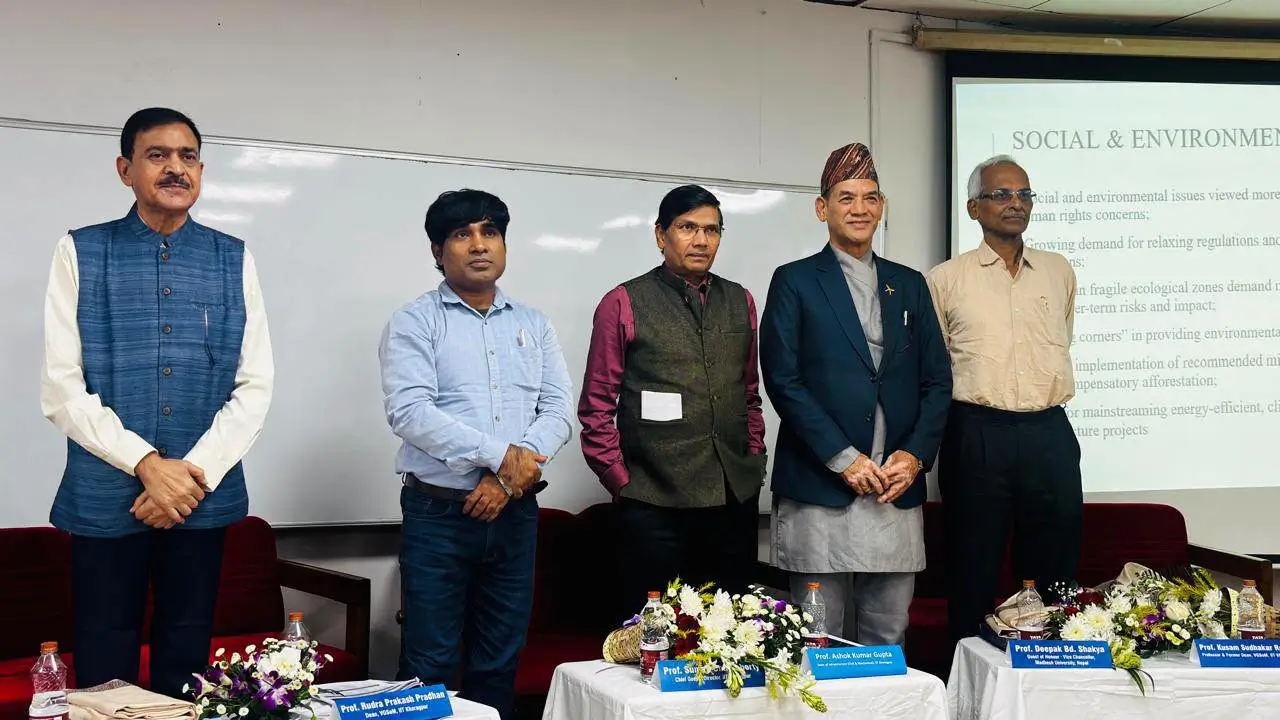
Prof. Dr. Deepak Shakya, Vice-Chancellor of Madhesh University, Nepal, participated in the International Conference on Frontiers of Infrastructure Finance (ICFIF 2026), organized by the Vinod Gupta School of Management (VGSoM) at the Indian Institute of Technology (IIT) Kharagpur, India.
The three-day international conference, held from November 20 to 22, 2026, brought together professors, academics, policymakers, financial experts, and industry representatives from different countries. The conference focused on emerging approaches to ensuring the availability of and access to financial resources for infrastructure development, as well as sustainable infrastructure financing and management.
During the conference, Prof. Dr. Shakya presented his experiences, research findings, and perspectives on the topic "Bhotekoshi Flash Flood: A Multidimensional Critical Crisis." His presentation particularly addressed disaster management, infrastructure risks and vulnerabilities, the impacts of climate change, and the need for sustainable and resilient development.
He also shared his views on infrastructure financing, climate-resilient infrastructure development, and new financing models for developing countries such as Nepal. In particular, he highlighted the specific challenges of infrastructure development in Nepal's Himalayan regions and presented Nepal's experiences in the financial management and sustainability of hydropower projects in the Rasuwa Corridor.
Prof. Dr. Shakya stated that infrastructure development should not be limited to the construction of physical structures and financial investment. He explained that it should also incorporate the capacity to withstand disasters and climate-related risks, environmental balance, sustainability, and community safety.
According to him, the discussions, exchange of experiences, and sharing of knowledge at the conference are relevant to Nepal as a whole. He highlighted the close relationship between securing sustainable financial resources for infrastructure development, reducing climate-related risks, and promoting inclusive development.



Comments 0
No comments yet. Be the first to start the conversation.