



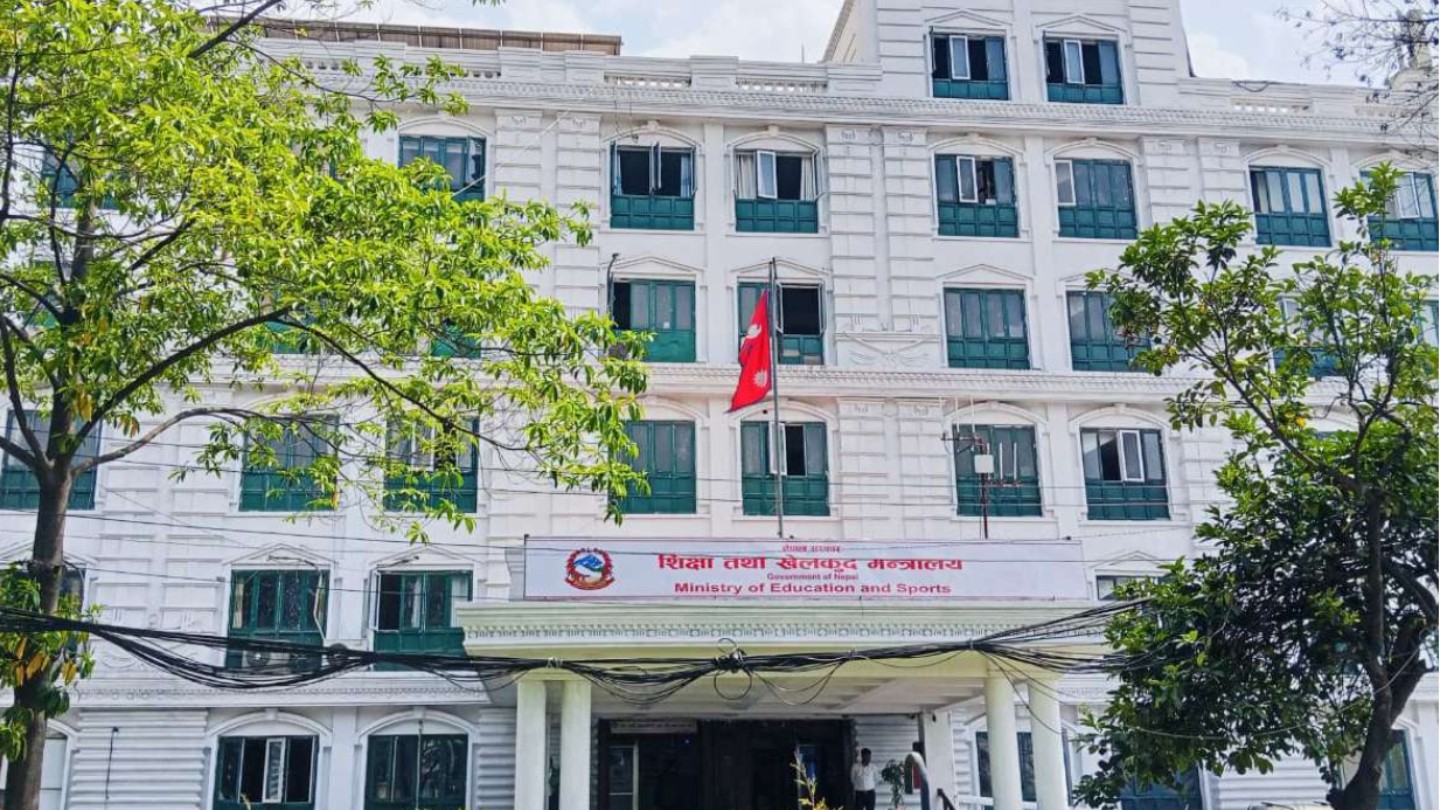
National School Curriculum Framework Being Revised as Nationwide Feedback Collection Intensifies
The Government of Nepal is collecting suggestions and feedback from across the country to revise the “National Curriculum Framework for School Education, 2076.”
The process, initiated with the aim of making the curriculum contemporary, practical, life-oriented, and student-friendly, is not limited to a formal collection of suggestions but is also moving forward as an effort to understand the actual situation of school-level education.
Feedback Collection Process and Task Force
Following a decision of the 98th meeting of the National Curriculum and Assessment Council, a National Curriculum Framework Revision Task Force was formed last Baisakh under the coordination of Prof. Dr. Balchandra Luitel. The task force, which has 12 thematic groups, has been advancing the ongoing work as an institutional process rather than an ad hoc political program.
Seven teams of the task force, formed under the Curriculum Development Center, are visiting 28 districts across all seven provinces and holding direct discussions with teachers, students, headteachers, parents, education experts, policymakers, and representatives of local governments. Feedback will be collected through field visits until Bhadra 30. After that, preparations have been made to receive additional suggestions through all 77 Education Development and Coordination Units and the Center’s website.
Education Minister’s Engagement and Initiative for an Engineering Campus in Madhesh Province
As part of the campaign, Minister for Education and Sports Sasmit Pokharel has been visiting various districts and holding direct discussions with stakeholders. He has been visiting districts including Dhanusha, Mahottari, Siraha, and Saptari in Madhesh Province to understand existing problems and collect suggestions.
According to the Education Minister’s Chief Advisor Jha, the challenges facing school education are not the same everywhere in Nepal. Schools in the Himalayan region and Madhesh face different problems, while students in urban and remote areas have different levels of access to technology. He said direct dialogue in Madhesh is particularly important because issues including the quality of school education, student access, school dropout, infrastructure, teacher management, and access to technical education require special attention in the province.
Meanwhile, Minister Pokharel has initiated efforts to establish a new campus of the Institute of Engineering under Tribhuvan University in Madhesh Province. Minister Pokharel said preparations are underway to form a study committee to identify a suitable location and begin classes within the next three years, reducing the need for students from Madhesh to travel elsewhere to study engineering. The initiative is expected to expand geographical access to higher education while contributing to the development of technical human resources and innovation.
Challenges of AI and Technology
Task Force Coordinator Prof. Dr. Luitel said curriculum revision is not limited to deciding which subjects should be added to or removed from textbooks. He said answers must also be sought on teaching methods, ways to engage students in active learning, problems faced by teachers, and how school education can be connected with technology and employment.
The rapid development of artificial intelligence (AI) has raised questions about the traditional structure of education. Students need to develop skills not only to obtain information but also to identify, analyze, and use it creatively, while using technology responsibly. Prof. Dr. Luitel pointed out that issues such as curriculum load, the examination system, integration of technical education, use of AI, and reducing the quality gap between rural and urban schools need to be discussed directly at the classroom level.
Gap Between Policy and Implementation
One of the major long-standing challenges in Nepal has been the distance between the center of education policymaking, Singha Durbar, and the areas responsible for implementation, including local governments and schools. Coordinator Luitel emphasized that a curriculum prepared in a meeting in Kathmandu may take on a different meaning when it reaches a school in Siraha. He stressed that the national curriculum should maintain its national character while allowing flexibility to address local needs.
Although field-based feedback collection is a positive beginning, its real test will be how much of the collected feedback is incorporated into the final curriculum. Prof. Dr. Luitel said education reform should be demonstrated through results rather than speeches. He made it clear that the government and the education ministry would be assessed on factors such as students’ interest in learning, ease of teaching, parents’ perceptions, and the extent to which students can use the skills they learn in employment.
It has been concluded that, rather than turning an incident at a program in Siraha into a matter of political accusation and counter-accusation, attention needs to return to the broader question of whether education policy will be developed by listening to schools and students or once again be prepared within Singha Durbar.
It has also been pointed out that turning this process, which has begun in the right direction, into concrete results will require not only government commitment but also constructive participation from teachers, students, parents, local governments, and political parties.


Comments 0
No comments yet. Be the first to start the conversation.