Council Urges Schools Not to Remove Employees Who Have Reached 60 Years of Age
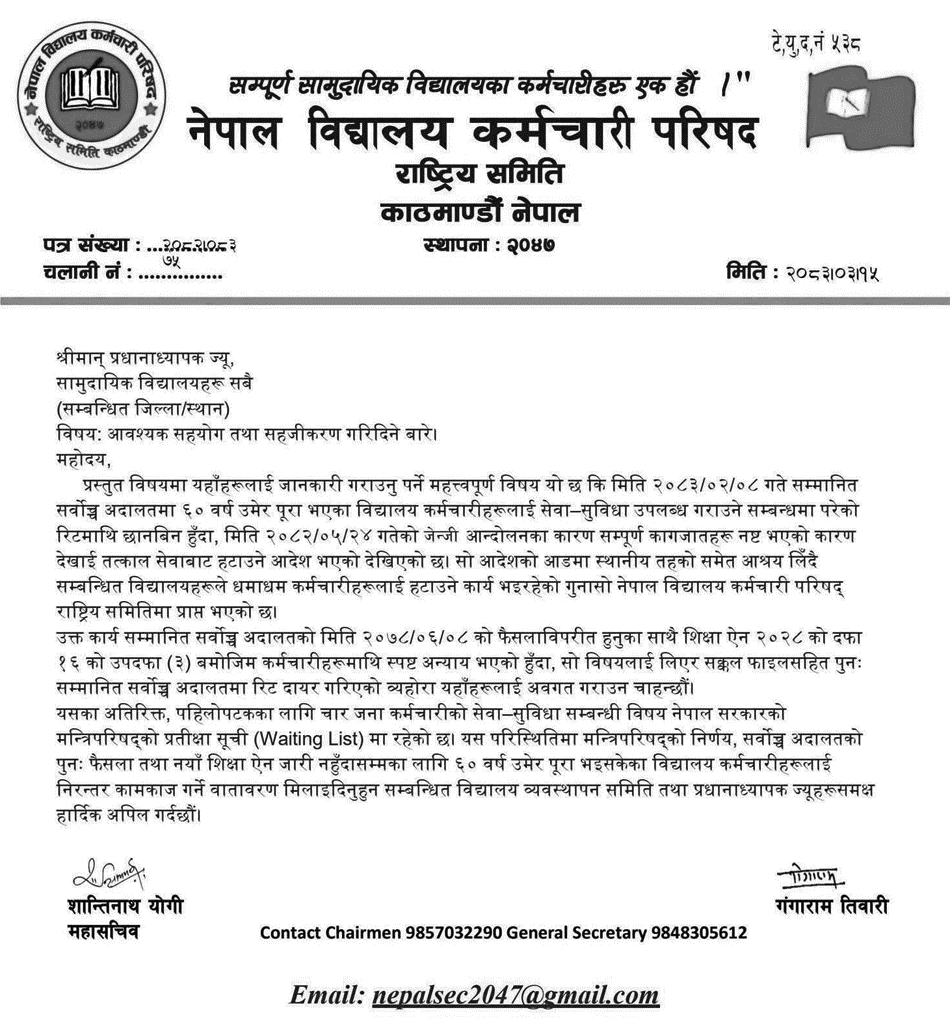
The Nepal School Employees Council, National Committee, has urged all community schools not to remove school employees who have completed 60 years of age from service. The Council issued a letter to the principals of all community schools on Asar 15, 2083 BS, appealing for necessary support and facilitation.
The Council has requested school management committees and principals to create an environment for employees who have already completed 60 years of age to continue working until the decision of the Council of Ministers, the fresh verdict of the Supreme Court, and the issuance of the new Education Act.
Court Order and Trend of Removing Employees
According to the Council’s letter, during the hearing of a writ filed in the Supreme Court on Jestha 8, 2083 BS, regarding the provision of service benefits to school employees who had completed 60 years of age, it appeared that an order was issued for immediate removal from service, citing the destruction of all documents due to the “Gen Z Movement” of Bhadra 24, 2082 BS.
The Council stated that it has received complaints at the National Committee that concerned schools have been removing employees rapidly by relying on the same order and also taking shelter under local levels.
Writ Filed Again in the Supreme Court
The Council has concluded that the act of removing employees is contrary to the Supreme Court verdict dated Ashoj 8, 2078 BS (2078/06/08), and that it is a clear injustice to the employees as per Section 16, Sub-section (3) of the Education Act 2028.
The Council has also informed that a writ has again been filed in the Supreme Court with the original file regarding the same issue.
Issue of Four Employees on the Cabinet Waiting List
The letter, signed by Council Chairperson Gangaram Tiwari and General Secretary Shantinath Yogi, states that, for the first time, the issue related to the service benefits of four employees is on the Waiting List of the Council of Ministers of the Government of Nepal.
Taking this situation into consideration, the Council has made a heartfelt appeal to create an environment for employees to continue working until the Cabinet decision, the court verdict, and the new Act are issued.