



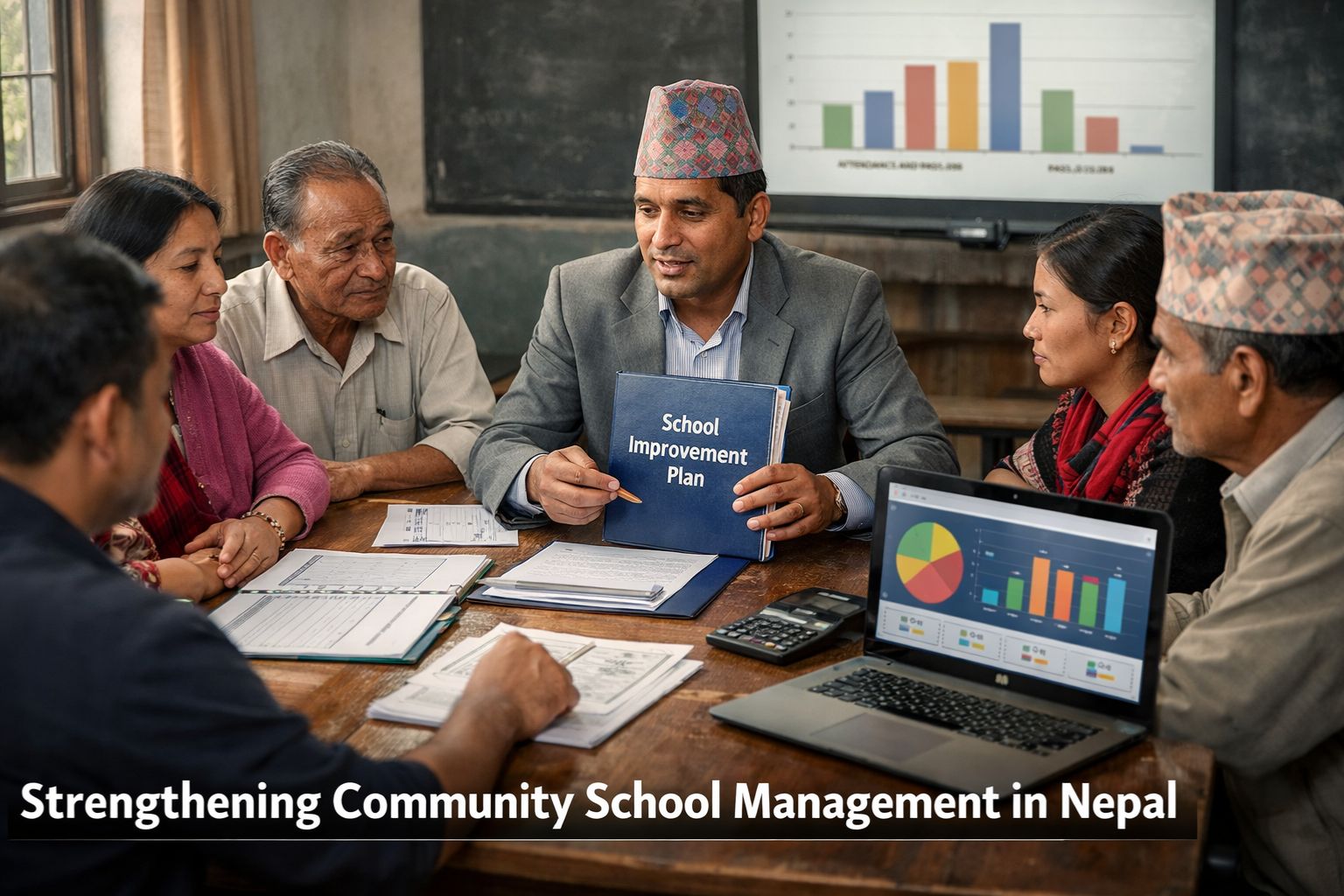
Community School Management in Nepal
In Nepal’s educational history, community (government) schools are not only places for teaching. They are also foundations for social transformation.
An analysis of recent “Flash Reports” from the Center for Education and Human Resource Development (CEHRD) indicates that the community sector accounts for roughly 75–80% of Nepal’s school education infrastructure and human resources.
The state allocates around 10.9% of the national budget to education each year.
Even with such a large investment and system, why is public trust moving toward private schools?
Why are even daily-wage earning parents compelled to cut essential household expenses to send their children to private (“boarding”) schools?
The strongest single answer is managerial inefficiency.
The problem is not teacher qualifications, and it is not the curriculum. The problem is the mechanism that should create a sense of ownership, but instead pushes people to dismiss schools as “the government’s responsibility.”
This article examines the effectiveness of community school management, the political and social tensions within it, and practical models for improvement.
Table of Content
- Community School Management in Nepal
- Historical and Legal Background: Transfer of Authority
- Major Problems Seen in Management Effectiveness
- Practical Solutions and Roadmap for Effective Management
- Responsibility of Young Readers and the Community
- Conclusion
- Editorial Note
- Additional Information and Reference Materials

Historical and Legal Background: Transfer of Authority
Community school management cannot be discussed without the Education Act, 2028 (especially the Seventh Amendment made in 2058). From this point, the Government of Nepal adopted a policy of transferring responsibility for school operation to the “community.”
The core principle was decentralization and ownership.
School Management Committee (SMC): The Act recognized the SMC as the school’s highest executive body. Authority for teacher appointment, financial mobilization, and physical infrastructure development was assigned to a representative institution of parents.
Constitution of Nepal 2072: The Constitution assigns school education responsibilities, including secondary education (up to Grade 12), to local levels (rural municipalities/municipalities).
However, regardless of how well policies are written, outcomes depend on intent and implementation. In schools said to be transferred to the community, did genuine community participation occur, or did local “elites” dominate? This is the central question.
Major Problems Seen in Management Effectiveness
Diagnosis of Problems
Longitudinal study and case studies show five major chronic (long-term) problems in Nepal’s community school management.
Political Interference and Party-ization
In many schools, the process of forming the School Management Committee (SMC) resembles a mini-election. Instead of people with a clear education-improvement agenda, local party cadres often compete to become chairpersons or members.
Fact: SMC positions are often used to influence teacher transfers, building-construction contracts, and local influence.
Impact: When chairpersons come through political placement, headteachers can be pushed to prioritize political accountability over student outcomes.
The Dominance of “Dummy” Parents
Legally, SMC members should be those whose children study in the same school. But in many schools, there is a practice of installing nominal guardians (registered on paper but not the child’s actual guardian) and capturing the committee.
If a person’s own child’s future is not connected to that school, the incentive to carry the burden of improvement weakens. This conflict of interest is a core reason quality declines.
Leadership Capacity of the Headteacher
In Nepal, many headteachers are appointed based on seniority rather than leadership skill. A good teacher is not automatically a good manager.
In schools where headteachers are trapped in administrative tasks, cannot guide teachers effectively, and fear local politics, educational disorder spreads.
A lack of vision is also seen in the preparation and implementation of the School Improvement Plan (SIP).
Financial Opacity and Misuse of Resources
Saying “community schools have no budget” is only half true. The government sends large sums for salaries and benefits (PC/PF), midday meals, scholarships, textbooks, and building construction.
The problem lies in managing existing resources.
Science laboratories turning into storage rooms.
Computers breaking down and remaining unused.
Compromises in the quality of midday meals.
These are management failures—weaknesses in governance.
Accountability Gap in Teaching
In private schools, weak teaching can lead to job loss, so teachers face stronger pressure to perform. In community schools, after becoming permanent, a psychology can dominate: teaching effort becomes optional.
Only a strong management committee can make teachers accountable to the classroom. Where the committee is weak, teachers can exploit political protection.
Practical Solutions and Roadmap for Effective Management
Problems must lead to workable solutions. The following blueprint is presented as a practical approach rather than an abstract ideal.
These suggestions are based on models drawn from successful example schools in Nepal (such as Kalika Secondary School in Butwal, Bishwo Niketan in Kathmandu, Janapriya in Pokhara, and others).
Performance Contract Between Headteacher and Management
The forward path is a performance contract.
Headteachers should sign an agreement with the local government, and teachers should sign an agreement with the headteacher, with clear targets.
Without provisions to remove headteachers who do not deliver results and incentives for those who perform well, sustained improvement remains difficult.
“Real” Parent Participation in SMC Formation
Only parents whose children attend school regularly should be brought into the management committee.
For this, a leadership test and a letter of commitment should be implemented.
The need is for parents who carry the school’s responsibility, not a party flag.
Regular and Meaningful Social Audit
Current social audits often become ritualistic. They should be transformed into genuine public hearings.
Where was the budget spent?
Compared to last year, how many students passed this year?
How many days was each teacher absent?
A school that publicly presents these figures to parents—such as through a projector—can sharply reduce corruption and negligence.
Moving Beyond the “English Medium” Illusion: Focus on Learning
Many parents and school managers believe that translating everything into English automatically improves quality. This is a harmful misunderstanding.
Quality is not language. Quality is content knowledge and pedagogy.
Management should strengthen English as a subject, but it should not promote rote learning that harms creativity in other subjects.
Providing teachers with practical materials and training in modern teaching methods is more effective than putting up an “English medium” board.
Use of Technology and Data: Data-Driven Management
Management can no longer operate on assumptions.
Schools should correctly use IEMIS (Integrated Educational Management Information System).
Which student stopped coming to school?
Which group of students has weak learning?
Management should analyze these data and arrange remedial classes.
Role of Local Government: Regulation or Support?
Local levels should act as supporters and guardians rather than as “police.”
They should depoliticize the education section and deploy a team of experts.
During monitoring, they should enter classrooms, interact with students, and build that practice—rather than returning after only checking attendance registers.
Responsibility of Young Readers and the Community
Community schools are not anyone’s private property. They are public assets funded by the taxes we pay.
As an aware citizen, visit the school in your rural municipality/municipality and ask questions:
-
Ask: What is the school’s five-year strategic plan (SIP)?
-
Observe: Are there books in the library, or only spider webs? Are toilets clean or not?
-
Act: If you have a useful skill, volunteer one day a week. Form an alumni association and support the school.
Conclusion
To reform community schools in Nepal, the need is not only a larger budget. The need is strong willpower.
Effective management is not only about constructing buildings; it is about building the culture inside those buildings.
The day the management committee, headteacher, and parents sit at the same table and speak not from “mine,” not even from “ours,” but from students’ interests—community schools can become centers the nation can genuinely take pride in.
There has been enough frustration and blame. There is no alternative but to apply a scientific management system with responsibility and accountability.
Editorial Note
This article is fully based on research facts, existing laws, and practical experience. It contains no commercial bias or misleading information.
Additional Information and Reference Materials
-
Education Act, 2028 (with amendments)
-
School Sector Development Plan (SSDP) and School Education Sector Plan (SESP) documents
-
Annual reports of the Ministry of Education and CEHRD
-
Annual report of the Office of the Auditor General (education governance section)







Comments 0
No comments yet. Be the first to start the conversation.