



Nepal’s Education System: Reality, Challenges, and Reform Roadmap
Education is not only rote memorization of textbooks and certificates. It is the art of living, a problem-solving skill, and a core pillar of nation-building. Yet a serious question remains: did we reform the education system, or did we only change signboards?
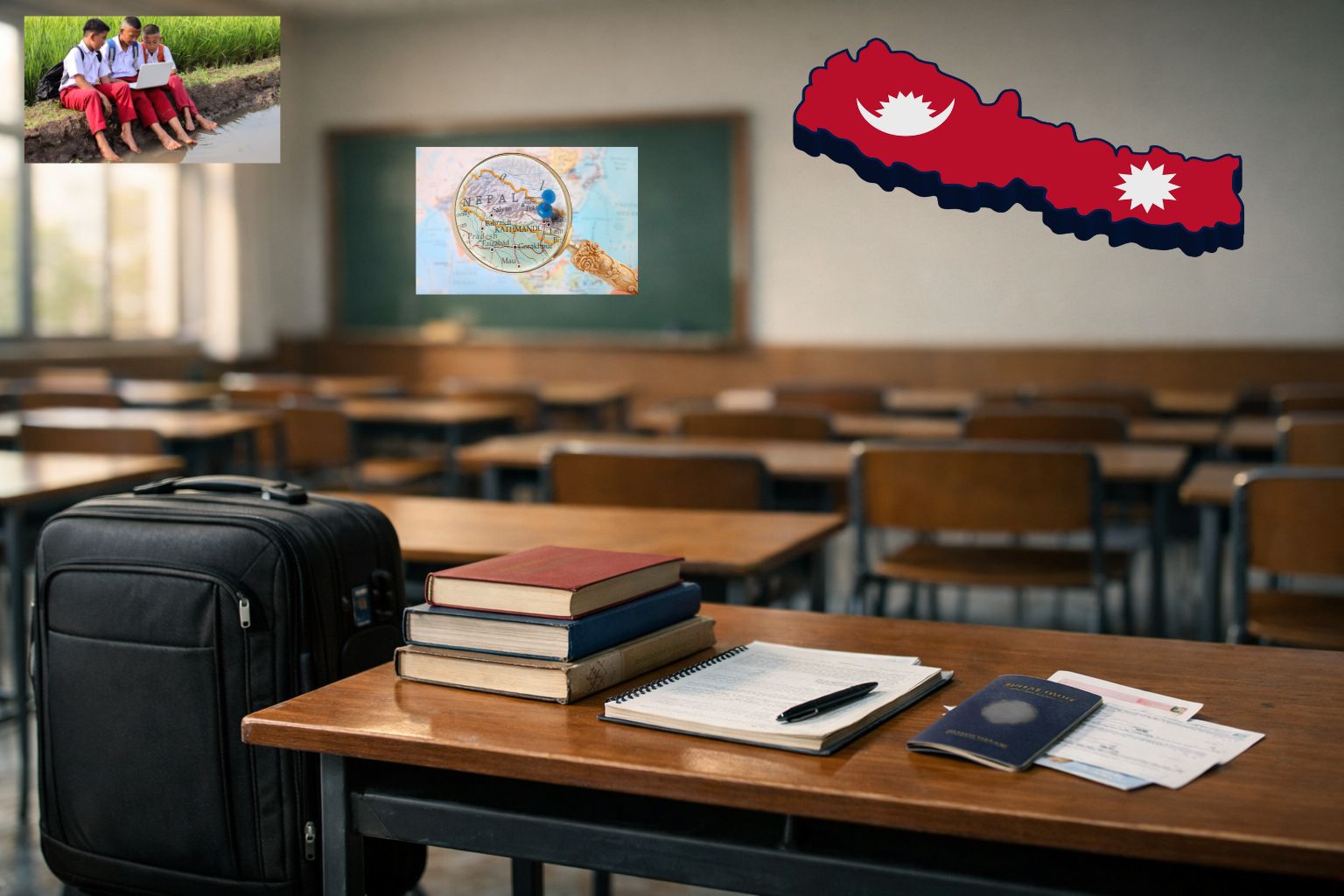
The long queues of young people in the departure lounge of Tribhuvan International Airport, alongside empty classrooms in Nepal’s universities, raise hard questions for policy-makers. The problem is not with students. The problem is with the delivery system.
In this article, we examine the wide gap between student psychology, market demand, and state policy, using facts and grounded observations.
Table of Content
- Nepal’s Education System: Reality, Challenges, and Reform Roadmap
- School education: structural change, slow mindset change
- Technical education
- Higher education: disorder and a crisis of trust
- A close look at root causes
- Practical solutions and a reform roadmap
- Conclusion

School education: structural change, slow mindset change
Nepal’s Constitution and the National Education Policy 2076 introduced major changes to the structure of school education. However, the implementation phase remains uncertain and uneven.
Below is an analysis of the present condition of Nepal’s basic and secondary school levels, the contradictions visible in practice, and areas of policy ambiguity, assessed through 20 years of experience and research.
Basic level (Grades 1–8)
The Government of Nepal has legally defined the basic level from early childhood development (ECD/PPC) through Grade 8 and handed full responsibility to local governments (municipalities). On paper, this is a strong example of decentralization.
However, my field study and research suggest the situation at ground level is serious and demands urgent attention.
1. Neglect of ECD and the start of brain drain
Ninety percent of human brain development occurs within the first five years. Yet the most neglected group in the system is early childhood development facilitators.
They are expected to support children’s holistic and cognitive development, but the state does not provide even the minimum remuneration set by the Labour Act. Many ECD centers, lacking basic resources, have become rooms where children are simply kept, like day care. When the foundation is weak, a strong structure becomes difficult.
2. Obsession with English and learning poverty
One of the most damaging trends observed over two decades is community schools copying boarding schools and adopting English medium without adequate preparation.
This has produced learners who struggle in both directions: they do not gain strong conceptual understanding, and they also do not develop functional English.
Fact: Grade 5 students are made to memorize Social Studies in English. They often fail to understand their culture and also fail to grasp the meaning of the English sentences. Teachers struggle to teach in English, and students do not understand. As a result, students may read their grade-level textbooks but cannot comprehend them.
NASA (NASA Report) reports have identified linguistic complexity and rote learning as major factors behind declining performance in Nepali and Mathematics.
3. Challenges in implementing the integrated curriculum
The government introduced an integrated curriculum in Grades 1–3, which aligns with international standards. However, teachers were not trained to implement it as intended.
Many teachers still follow the old approach by separating subject periods, even though the curriculum requires fusion of subjects.
Secondary level (Grades 9–12
Although the Constitution assigns responsibility for secondary education (Grades 9–12) to provincial and local levels, the mindset continues to revolve around the SLC era of 2040 BS and the certificate level of Tribhuvan University.
1. The false prestige of SEE
Under the current structure, the Grade 10 exam (SEE) is now a normal class-upgrade exam, like moving from Grade 9 to Grade 10. Yet the market, media, and many parents treat it as a life-or-death matter.
Students focus on memorizing up to Grade 10 to secure an A+. After reaching Grade 11, many become vulnerable to dropout. One reason is that exams up to Grade 10 largely test memory, while Grade 11 demands analysis.
This creates a difficult transition: a student with 4 GPA in SEE may face pressure to memorize Physics in Grade 11 without understanding.
2. Stream obsession and ignorance of the single-track reality
The National Curriculum Framework 2076 has already abolished the stream system in Grades 11 and 12. There is now no Science and no Management. There are only compulsory and optional subjects.
Yet many schools and colleges still market admissions using stream labels, which misleads students and parents. Students lose flexibility to combine subjects they genuinely want (for example, Physics with Music, or Economics with Computer). This undermines the right to choose.
3. Grade 12 as the real iron gate and the fear of NG (Non-Graded)
Recent Grade 12 results show around 50% of students becoming non-graded (NG). This is not a normal statistic. It signals deeper systemic failure.
The root problem is that students were taught for years, but not supported to learn. In the name of passing, liberal promotion continued, and then standards became suddenly strict at Grade 12. Without a strong foundation, attempting to add the final floor to a 12-storey structure leads to collapse.
4. Social stigma
The belief that a son should become an engineer and a daughter should become a nurse or banker was common 20 years ago, and it remains common in 2026.
Today’s world also needs data scientists, AI specialists, sociologists, and digital artists. However, secondary education has not established a strong school-level career counseling mechanism to identify student aptitude. As a result, many students choose subjects under peer pressure and later regret it.
Technical education
There is significant policy ambiguity between programs under the Council for Technical Education and Vocational Training (CTEVT) and the technical stream operated in Grades 9–12 under the Ministry of Education.
Research findings indicate that Nepal has produced thousands of overseers and junior technicians, but has not developed the industrial linkage needed to absorb them. As a result, many hold diploma certificates but still face the compulsion to work abroad in Gulf countries as unskilled labor.
Higher education: disorder and a crisis of trust
This section is the most sensitive. According to the University Grants Commission (UGC), student attraction in Nepal is declining.
In my experience, there are three main reasons.
1. Instability of the academic calendar
A student’s biggest enemy is wasted time. Tribhuvan University (TU), which carries around 80% of the burden, had reached a point where a four-year course taking six years became a new normal.
Although there are signs of improvement, credibility still needs to be regained. When students study for six months and wait eighteen months for results, many are pushed toward going abroad.
2. Teaching without research
Universities should be knowledge production centers. Instead, they have been reduced to examination centers.
At postgraduate level, many theses being driven by a cut-and-paste culture is a serious concern. Without research that addresses real market and social problems, degrees risk becoming paper credentials rather than meaningful preparation.
3. Curriculum and market mismatch
The world has moved into AI, data science, and blockchain, while Nepal continues teaching outdated syllabi. The market looks for digital marketers, but universities often focus on memorizing traditional marketing theories.
Until this gap is addressed, the system will continue producing unemployed graduates.
A close look at root causes
It is no longer credible to blame only budget shortages or political instability. Based on two decades of research and many policy dialogues, the problem is not only resources. The deeper problem lies in culture and system design.
Key problem areas include the following.
Accountability ignored: secure positions, abandoned outcomes
One major weakness in community education and universities is the job-holder mentality. After passing the Teacher Service Commission or the TU Service Commission, a sense of impunity develops: now no one can take the job away.
Ground reality shows a contrast: in private schools, declining results can threaten a teacher’s job, but in community schools or campuses, even widespread failure does not stop salaries. Performance appraisal is often treated as a file-based promotion tool rather than linked to student learning.
Without an automatic system where poor performance leads to action and good performance leads to reward, training and buildings alone cannot raise quality. When School Management Committees (SMC) become political recruitment centers, meaningful accountability further weakens.
The three-hour evaluation trap and the illusion of marks
The evaluation system often ignores ten years of diligence, discipline, and creativity and treats the final three-hour exam as supreme.
This creates a scientific flaw: it rewards memorizer students rather than learned students. Continuous Assessment System (CAS), claimed to be implemented at school level, often becomes a formality of distributing marks.
Schools frequently award full practical/internal marks (such as 25 out of 25) to almost everyone, yet in external exams those same students become non-graded (NG). This wide variation between internal and external assessment raises serious questions about the credibility of the examination system.
This method pushes students away from textbooks and toward guidebooks and “guest papers.”
Digital divide: the construction of two Nepals
Nepal promotes the idea of a smart future, but the digital divide in education risks producing two classes of citizens.
In urban schools and colleges, students grow with high-speed internet, AI tools, and access to international journals. In many community schools in Karnali or Sudurpashchim, textbooks may not arrive on time, and computer labs remain out of reach.
By 2026, the internet is not a luxury. It is a basic right, like a pen and notebook. Policies that ignore this inequality will benefit mainly the urban middle class and leave real Nepal behind. Unequal access to technology pushes poor students closer to rejection in a competitive market.
In short, Nepal built a system but did not build the ecosystem required to run it. Reform is needed not only in buildings, but in the culture of teaching and management.
Practical solutions and a reform roadmap
Identifying problems is not enough. As a responsible writer, I present solutions for policy-makers, institutions, and students and parents.
For policy makers
Credit transfer
Legal and practical systems should make it easier for a student who studied one year in a Nepali university to complete the remaining study abroad or at another university within Nepal.
Classification of universities
Not every university should teach everything. Universities should be categorized as research universities, teaching universities, and vocational universities.
Unified entrance examination and calendar
Just as the Medical Education Commission (MEC) applied a calendar model for MBBS, that model should be applied strictly to humanities and management faculties as well.
For colleges and teachers
Industry-academia linkage
Learning remains incomplete if business and industry voices never enter classrooms through guest lectures. Internships should not be limited to the final year; they should become part of every semester.
Change in pedagogy
Teachers must shift from being only lecturers to becoming facilitators. Rote learning should be prohibited, and learning should be made mandatory through case studies and project work.
For students and parents
This is the most important advice in this article for you.
Choose skills, not names
Do not judge by the size of a college building. Ask how many students got jobs and whether labs exist.
Do not fear a gap year
Passing Grade 12 does not require immediate college admission. Use six months to understand the market, take a short-term course, and then choose a suitable subject.
Certificate plus skill
While pursuing a degree, also learn additional skills such as IT, language, or leadership development (soft skills). In today’s world, hard skills open doors, and soft skills help you rise.
Conclusion
Hopelessness may sell in the market, but society is built by hope. Despite visible problems in Nepal’s education sector, possibilities are not dead. Nepal is in a transition phase.
Some institutions, such as Kathmandu University (KU), have presented models of quality assurance. Some community schools have also shown strong improvements, including examples such as Kalika in Butwal and some model schools in Kathmandu.
The central need is integrity: integrity in policy, integrity in teaching and learning, and integrity in evaluation.
Nepal Related Topics Education Nepal